

Writers are taught many rules by the greats. But should we believe them?

Avoid adverbs
Stephen King famously said “the road to hell is paved with adverbs” and urged writers to eliminate them. Three years ago, I wrote in defence of these much maligned parts of speech.
Now we have some objective analysis of the truth or otherwise of the dictum. Ben Blatt analysed the more than 300 novels that reached number one on the New York Times bestseller list since 2000 and the 100 most recent winners of literary awards. He compared these “professional” authors with a sample of 9,000 “amateurs” who had written novel-length fan fiction. The professionals used around 114 adverbs per 10,000 words, compared to 154 by the amateurs. So there is a correlation between fewer adverbs and literary success. As you can see from the graphic, I used 44 adverbs per 10,000 words in my current novel.
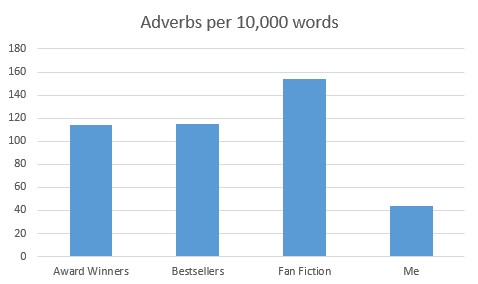
However, Stephen King seems to be wrong about eschewing adverbs, if you take him literally. He used an average of 105 across 51 books.

Never open with the weather
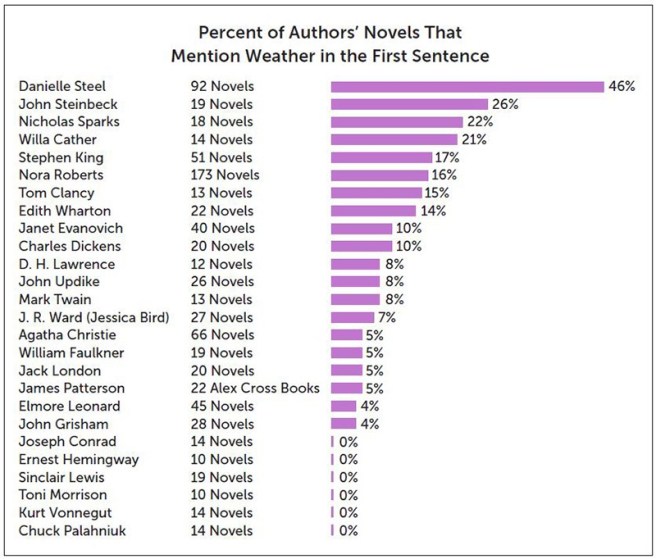
Another great writing dictum Blatt explores is Elmore Leonard’s “never open a book with the weather”. The graphic below shows that Leonard did this 4% of the time across 45 novels.
Keep it short and simple
Bestsellers today, according to Jodie Archer and Matthew Jockers’s The Bestseller Code, use shorter sentences and simpler words. And it seems true that sentence length and complexity has gone down.
Sentences in Jane Austen’s 1811 Sense and Sensibility averaged 23.2 words and in Charles Dickens’s 1859 A Tale of Two Cities 17.7 words. They both require a reading age of 14-15 years.
By contrast, J.K. Rowling’s 1998 Harry Potter and the Philosopher’s Stone, with a reading age of 12-13 years, came in at 11.8 words. Stephanie Myers’s 2005 Twilight was a lightweight 9.6 words per sentence and demanded a reading age of 10-11 years.
While the complexity of language has gone down, the size of novels has gone up. In the era of mass publishing between 1850 and 1950 shorter novels arrived but they grew in size again after the advent of long-haul travel and the airport blockbuster.





 Neil MacDonald Author