It has become a truism of Western writing advice: that stories are built on conflict, a character overcoming obstacles to solve a story-problem. The three (or five) act structure illustrates this classic form. Act 1 sets up a problem, Act 2 is the conflict over the problem (often, but not necessarily, violent), and Act 3 resolves the problem. It is a tale of winners and losers.
There is no doubt that conflict is the author’s magic go-to sauce. Sprinkled over a stewing plot, it adds body and savour. But the fact that it’s commonly used does not make it universal. Nor is the absence of conflict necessarily a plotting flaw.
The classic bildungsroman may or may not contain struggle, but it’s driven by the process of maturation, not conflict. In Viriginia Woolf’s To the Lighthouse, there is little that could be labelled conflict. Indeed there is little that could be labelled events, since most of the book is taken up by the internal thoughts of the various characters. Or, consider Albert Camus’ The Stranger. The essence of the protagonist, Mersault, is that he feels nothing, not when his mother dies, nor when he shoots the Arab, nor when he is tried for the crime and sentenced to death. You might want to argue that Mersault’s conflict is with society and its expectations, but this would be shoehorning in the notion of conflict, since his role in the conflict is essentially passive.
Other cultures
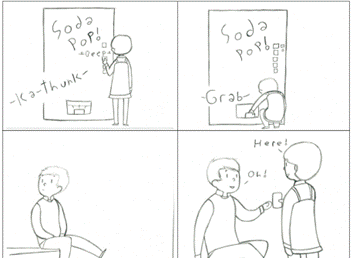
Many other cultures tell stories that do not follow the Western three act format. Conflict is not a necessary feature of all storytelling, merely a characteristic of much modern Western fiction. Consider, for example, the four-act structure known as Kishōtenketsu, found in Japanese, Chinese and Korean literature. By contrast in a Kishōtenketsu story, Act 1 sets up a situation, Act 2 develops the situation. Nothing much changes until Act 3, which throws in a twist, while the final Act resolves the tension between the starting situation and the twist.
From: https://stilleatingoranges.tumblr.com/post/25153960313/the-significance-of-plot-without-conflict
There are other non-conflict story structures. The Nicaraguan Robleto, for example, shares with many oral storytelling traditions a characteristic repetition. The tale opens with a short and poignant statement, which is the repeated element and then introduces the protagonist. This is followed by a climax. Next comes a Journy or Journies in which other characters or situations are related. At the end of each journey, the key statement is repeated. The structure is one of a spiral of Introduction, Climax and Journey, ending finally in a Close in which all issues are resolved. .
You can find an example of a Robleto in The Farmer Who Became a Doctor https://www.youtube.com/watch?v=FuKgH3p7Hx0
“Many people here believe I am a doctor who became a farmer. But that’s not so. I am a farmer who became a doctor. The origin of this is that my father and my grandfather lived just right over there. Right over where that house is. My father was born there. They are people from here. Originals. They were country folk. My father didn’t know how to read or write. It was hard for him to even write his name. All his life, he worked the land. But he didn’t want me to become a farmer. He never taught me anything about farming. Nothing, absolutely nothing. Because he wanted me to be a doctor.
“I am a farmer who became a doctor. I started my clinic here. Things went well, more or less. My father never said ‘This calf is yours’ because he never wanted me to be a farmer. He always wanted me to be a doctor. So I opened my clinic, and it went well, thank God. Because everything I now have is thanks to my clinic. Then, someone was selling this little farm, and they said ‘Let’s go see it.’ And I said, ‘Why do you want to see it? Why do we want a farm? It’s abandoned. There’s nothing there.’ But, with much insistence, I bought it. There was a lady—I was her doctor and I had visited her in her house during my duties. And one day she said to her son, Santiago, ‘Look, Santiago, give a calf for the doctor. Look for a good one.’ And so, they gave me a calf, a Holstein. And that was my first cow.
“My first cow was given to me by a patient. Then that calf grew and I got more cows. I cleaned up and arranged the abandoned farm. I always dedicate myself to my clinic, but the truth is, my passion is the farm and my animals. It’s quite a story. I’m someone who was born here in the countryside, but my father didn’t want me to be a farmer. He wanted me to be a doctor, and , thanks to God, I became a doctor, but now I have returned to my roots and I also dedicate myself to my farm. I am a farmer who became a doctor.”
There are other examples of structures without conflict. Often cited in lists of such structures, for example, is the Rashomon story, after the famous film of the same name (itself inspired by Akutagawa’s short story, In a Grove). In such stories the same events are recounted repeatedly through multiple points of view, with no necessary guide to which, if any, version is true.
Are there any universals?
If a story need not involve conflict, what, if anything, are the universal essentials of a story? Many would say change and/or tension. To a degree, arguing that a story requires change is a truism. If nothing changes, we remain at the first frame of the film. But we need to be careful here. The dominant Western model of narrative stipulates that the fundamental change should be in the protagonist and possibly in other characters too. This need not be so. It is quite possible to have story-telling traditions in which the change is in the situation rather than in the character. Though various Asian traditions are often cited in this respect, there are venerable Western genres, entirely plot-driven, in which the protagonist undergoes no change. Prime among these is the detective story: Holmes remains Holmes, but he solves the case. It’s also worth looking back at our own past in the West. Until roughly the time of the troubadours, who invented the Western love story, the internal lives of characters was of no interest to storytellers or audiences—only their actions mattered. It is also possible to have stories with no change in either the protagonist or the situation but rather in the reader. I’ll come to this again below.
So, what of tension? Again, by definition, there must be some sort of tension. The reader must want to know “what happens next?” But this tension need not be created by a problem or a threat to be surmounted. Here, once more, we come back to the importance of the reader. Stories are not just (or even primarily) about how well the character is drawn, nor about how adroitly the character solves the story problem. A story is, above all things, a device for taking a reader on an emotional and/or intellectual journey. It takes a reader to bring a story to life. We can give the name “plot” to the things that happen, and “story” to the way this plot is recounted. There is a third concept: “narrative”. Narrative here means how the story is received by the reader or listener or viewer. How does this relate to the question of tension? Suppose, for example, we have a tale in which neither the character nor the situation changes. Rather, over successive moments, the reader gets an increasingly full picture of what is happening and why it is happening, as if a camera were panning out. Such revelation can be intensely satisfying to a reader. Though much Western writing advice will focus on the binary choice of plot-driven vs character-driven stories, there is a third alternative: understanding-driven stories, in which the reader gets to explore a situation or a world. I might, perhaps, offer Alice in Wonderland as an example of such a story.
Beyond this, it’s instructive to ask how variable can other elements be that we uncritically take to be universal elements of story-telling.
- Does there need to be an individual protagonist with whom we identify? Or can a tale be about a collectivity? There is clearly an issue here about societies based on individualism and those based on collectivity. Traditional southeast Asian stories often have no protagonist in a Western sense. But there are Western stories too that use a first-person- plural narrator. Joseph Conrad’s The Nigger of the Narcissus, in part, used this voice. Jeffrey Eugenides’ The Virgin Suicides is narrated by a group of boys.
- Do we need to get straight to the point (the old saw about starting in media res) starting in the middle of the action? Or can a story also build up context, lay out its organizing themes, before getting to the action? Again, cultural predilections are in play here. Where the past is relatively unimportant and the drive towards the future is what matters, we are in a recognizably United States mindset. Travel further south to Latin America and context and history may be everything. Think, perhaps, of Gabriel Garcia Marquez’ One Hundred Years of Solitude.
- Is there always a linear structure of cause and effect, leading logically from the beginning to the ending? Not necessarily. Story-telling can just as easily, for example, start at the end and work back to the beginning. Arundhati Roy’s The God of Small Things may offer an example here. In addition, there are story forms in which there is no real beginning or end. In Frame stories such as The 1001 Nights, the beginning is simply a frame to hold a diverse collection of unrelated stories. Chaucer’s Canterbury Tales is another example of a frame.
- Is a story necessarily a “conversation” between one writer and one reader? Clearly not. Oral storytelling presumes a collective audience, and such audiences often participate in the story-telling through comment, call-and-response, dance, and re-enactment. Such stories are often non-linear, meandering or looping back. Native American stories such as the Trickster myth cycle follow this rubric as do a number of African traditions. One common, though not essential, feature of such traditions is that they often explore the reasons for things being as they are and conclude by underscoring a “moral”.









 Neil MacDonald Author