93. Stories for change – restoration or transformation?

George Monbiot’s book, Out of the Wreckage, is the second this year to explore the idea that what the planet needs is a new story. Like Alex Evans in The Myth Gap, Monbiot suggests that people are mobilised to action by stories, not by facts and evidence.

WWF
Image © WWF https://www.youtube.com/watch?v=ASwq1XITrOI

This is clearly an idea whose time has come, and one which resonates with a “post-truth” world. I won’t rehearse again my concerns with the anti-rationality of the idea, which I covered in a review of Evans’ book.  And, in fairness, Monbiot advocates a new story based on science. I do agree with both authors that we need new stories to confront the challenges of our times.

Stories, as I said in my review of The Myth Gap “are among the oldest human devices for encoding and sharing knowledge. They have the huge advantage over collections of facts that they tell us what goes with what, what is important and what is unimportant, who to praise and who to blame.”

Monbiot goes further than Evans in suggesting the structure of this new story.

“Disorder afflicts the land, caused by powerful and nefarious forces working against the interests of humanity. The hero – who might be one person or a group of people – revolts against this disorder, fights the nefarious forces, overcomes them despite great odds and restores order.”

He calls this the Restoration Story and says “stories that follow this pattern can be so powerful that they sweep all before them, even our fundamental values.”  He suggests that this is an archetype, which is common to both social democratic and neoliberal narratives, and he may indeed be right in saying this.
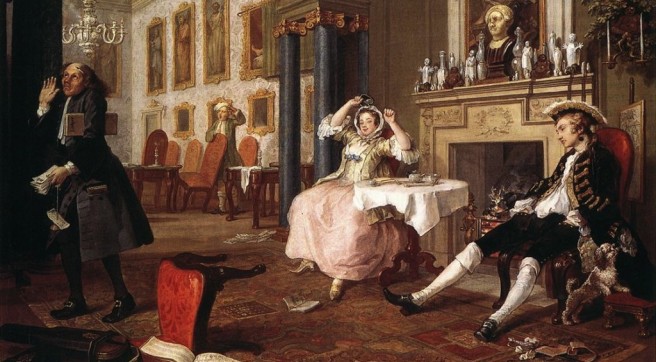
Restoration
Restoration – The Tête-à-Tête, from Marriage à-la-mode, William Hogarth

However, the interesting thing about the idea is how timid it is, with its narrative of “restoring order”. And it isn’t the only archetypal story we tell about the future. I know this because I did some research a few years ago, analysing 64 futures scenarios (“Futures and Culture”, Futures 44 (2012) 277–291). All these stories fitted into four broad classes – Progress, Catastrophe, Reversion and Transformation.

  • Progress is, as the name suggests, one where existing trends lead towards the expected goals. This story was dominant during the brash optimism of the nineteenth century.
  • Catastrophe is also simple – the outcomes prevent us realising our expected goals. In the darker years of the twentieth century, dystopian visions became more common.
  • Reversion, which is essentially Monbiot’s Restoration, is a little more complicated, and involves a return to previous conditions in order to maintain viability. These stories often have a sentimental view of a simpler earlier time.
  • Finally, the Transformation story involves, as the name suggests, a fundamental change in the “rules of the game“, leading to a new and unexpected end-state.

I would suggest that to get out of the wreckage we need Transformation stories not Reversion stories. Monbiot would probably agree, but perhaps he might want to rethink his narrative archetypes.


Friday Fictioneers – Breathing

jhc-2
Photo Prompt © J Hardy Carroll

She lay beside him, sleeping. The respirator of her chest rattled as it rose and fell, the breath rasping alien through sunken tubes. In terror, he believed he heard a mechanical hum and then a click at the end of every in-breath.

Beyond the fevered bedroom, the church clock struck thirteen.


Friday fictioneers is a weekly challenge set by Rochelle Wisoff Fields to write a 100-word story in response to a photo prompt. You can find other stories here.

Fancy sharpening your skill with writing exercises? The Scrivener’s Forge offers a new exercise every month to hone one aspect of your craft. Take a look at this month’s exercise on point of view.


Rupture – Scrivener’s Forge 11

This is my response to the exercise in The Scrivener’s Forge on point of view, examining an incident from the point of view of two different characters.

aff0965126067bb47887ab4295318e10
Gilbert Garcin “La Rupture” Tightrope Walkers

Ayesha came to him.

“Zami, I’m pregnant.”

He said the usual silly things men say – What? How? Why? Are you sure?

‘It will be all right, won’t it?’ she asked. ‘You must marry me.’

‘Your brothers will never allow it,” he temporised.

“My brothers and father will kill me if I have a baby and I am unmarried.”

The moment of betrayal is always agonising. You recite for yourself all the reasons that make it right.  There’s duty. There’s the uncomfortable truth that you already have a wife and two vaguely C of E kids.  And those are good justifications. But you can only betray what you first love.

He walked away. He looked back once, and shed a tear.

…………………………………………………………………..

Ayesha tracked him down.

“Zami, I’m pregnant.”

She searched his eyes as he stammered and asked all the stupid, obvious, irrelevant questions. She wanted to see love there, concern, and maybe even joy. She saw fear.

‘It will be all right, won’t it?’ she asked. ‘You must marry me.’

‘Your brothers will never allow it,’

How could he not understand? “My brothers and father will kill me if I have a baby and I am unmarried.”

The sound of her voice came to her through the numb bone of her skull flat, factual, unemotional. But her body shook.

She saw it in his eyes before he said anything. She saw his need for her, perhaps even caring. But his love was insufficient. Or maybe his duty was misplaced. Either way, she understood this was going to be her problem, not theirs. Men were animals, just like Mama said. Her arm lashed out, intending to slap him.

He flinched but didn’t draw away. She stopped her hand, an inch from his face, caressed his cheek and then spat in his face.

Friday Fictioneers – Common as muck

chicagomg
Photo Prompt © Marie Gail Stratford

Whaddaya mean I can’t be here? Whodyathink you are? Oh, you’re the doorman? Well, whoopiedoo, I’m a street-sweeper! You ain’t no better than me. Whodyathink keeps the pavement clean for the lovely ladies ‘n’ genelmen?

What? Of course I’m dirty, you eejit. Muck does that to a bloke. I’m good enough to keep your customers from stepping in poop, but not good enough to be one? Get you!

Silly hat but nice coat, by the way. We’ll see how pretty the jacket looks when you have to clean up your own crap because I ain’t gonna ever again.


Friday fictioneers is a weekly challenge set by Rochelle Wisoff Fields to write a 100-word story in response to a photo prompt. You can find other stories here.

Fancy sharpening your skill with writing exercises? The Scrivener’s Forge offers a new exercise every month to hone one aspect of your craft. Take a look at this month’s exercise on point of view.

Friday Fictioneers – Attack

saltaire-sarah-ann-hall
Photo Prompt © Sarah Ann Hall

They were drawn up like an army on the heights, standing tall in silent challenge. Mist swaddled them and a pale moon shone through their ranks.

My opponent’s bishop rushed me, and the daring caused the watchers to gasp.

A shake of my head to clear it, and a hand run over tired eyes. These were only vases, a collection on my sideboard. Just ornaments.

The bishop’s mitre scythed over my head and I saw moonlight glint on keen steel.

Confronting mortal threat makes philosophical speculations about reality fade. I hefted the broadsword that formed in my hands.


Friday fictioneers is a weekly challenge set by Rochelle Wisoff Fields to write a 100-word story in response to a photo prompt. You can find other stories here.

Fancy sharpening your skill with writing exercises? The Scrivener’s Forge offers a new exercise every month to hone one aspect of your craft. Take a look at this month’s exercise on point of view.


The Scrivener’s Forge 11 – Point of view again

schmiedefeuer
Medoc

This follows on from last month’s exercise on point of view.

Exercise

Write a short scene with two characters in which your main character encounters a strange or difficult situation involving another character. Use what you know about your main character’s desires and fears to show how they respond to the other character. Now repeat the exercise, this time using the other character as your main character. Notice how this change of point-of-view alters the story.

Friday Fictioneers – Ordinary Folk

rogers-sunset
Photo Prompt © Roger Bultot

“When you know how it’s done, it takes away the magic,” Petran says.

The vaulted roof soars almost all the way to heaven. Petran painted yellow stars on the high blue ceiling. And I, of course, chamfered the columns, tapering them at the top. This trompe l’oeil makes the viewer see the chamber as taller than it really is. Long flights of stairs force the petitioner to look up towards the majesty of the dais and throne. Together, we artisans manufactured awe.

Truly, it don’t destroy the magic. Ordinary folk made this with brains and hands. That’s awe too.


Friday fictioneers is a weekly challenge set by Rochelle Wisoff Fields to write a 100-word story in response to a photo prompt. You can find other stories here.

Fancy sharpening your skill with writing exercises? The Scrivener’s Forge offers a new exercise every month to hone one aspect of your craft. Take a look at this month’s exercise on point of view.

Friday Fictioneers – The Cottage


tree-sandra-crook
Photo Prompt © Sandra Crook

Tom has halted beside the woodcutter’s cottage, a stand of burly oaks patrolling the fence line. He can’t make his feet go on.

You picture dread and think of a sudden shape in the underbrush, a howl in the night. If only it were so simple. How little separates us from what we fear!

To count as brave you must first be afraid of death. Tom’s fear runs much deeper. He can see the weave that connects the worlds. The fools tried to make us go away, but what use is that when we’re always a part of him?


Friday fictioneers is a weekly challenge set by Rochelle Wisoff Fields to write a 100-word story in response to a photo prompt. You can find other stories here.

Fancy sharpening your skill with writing exercises? The Scrivener’s Forge offers a new exercise every month to hone one aspect of your craft. Take a look at this month’s exercise on point of view.

Friday Fictioneers – Locked-in

myna-bird
Photo Prompt © Douglas M McIlroy

Nothing. Whiteness. And the hum of a motor. I can see and hear, but when I try to move, nothing. Not restrained, just no muscles. Not even to call out. Without larynx and tongue, the shout remains trapped within me. Am I dead?

Shadows move across the ceiling. People in the room.

Helen’s voice. “How is he doctor?”

“A vegetative state. He may come out of it, he may not.”

The scream inside me has nowhere to go. It may live in me for ever.


Friday fictioneers is a weekly challenge set by Rochelle Wisoff Fields to write a 100-word story in response to a photo prompt. You can find other stories here

Fancy sharpening your skill with writing exercises? The Scrivener’s Forge offers a new exercise every month to hone one aspect of your craft. Take a look at this month’s exercise on point of view


92. How to succeed as a novelist – more facts

In a previous post I summarised Jim Hines’ fascinating survey of the success factors for 246 authors. Now I’ve come across another survey of 150 authors by Graeme Shimmin.

Shimmin
Photo © Graeme Shimmin

The conclusions of the two studies are remarkably similar, despite Hines being from the US and Shimmin from the UK.

Success factor Jim Hines (US)

246 authors

Graeme Shimmin (UK)

150 authors

Average time writing before publication 11.5 years No data
Previous publications track record Only half (52.8%) had published short stories prior to first novel publication Only 28% had published short stories but 86% had some form of prior publication including:

  • 10% self-published novels
  • 11% internet publication
  • 21% journalism
  • 9% non-fiction books

However, paradoxically, 54% said they had no “platform” or that a platform was not a factor in their success

Creative writing qualifications Just under half (48%) had a  relevant degree A third (34%) had a relevant degree.

But 86% had done some sort of writing course mostly non-academic courses or retreats

Networking and contacts  61% had attended a writer’s convention and 59% were members of a writing group.

Three quarters had no contacts before publication.

Less than a quarter of agented authors had been recommended by a friend, and only 5% knew the agent beforehand in a personal capacity.

A quarter (26%) used contacts (of which over half came from working in publishing or a literary agency and a fifth from knowing a published author).


Most had some contact with the literary world


Route to publication Over half (55%) went through an agent. For those achieving breakthrough in the 21st century, agents were involved in two thirds (67%) of the successes


No data on competitions or other routes

No specific data on agents

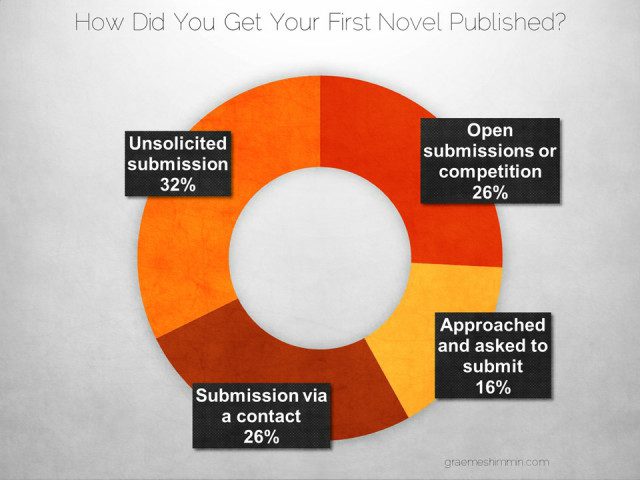
A third (32%)  succeeded with unsolicited submissions (key success factors were the quality of the writing, the commercial nature of the text and the quality of the pitch)

A quarter (26%) went through open submissions or competitions

A quarter (26%) used contacts (see above)

16% were approached by an agent or publisher and asked to submit

Conclusions

  1. Time spent learning your craft is essential. Expect to struggle for years. Joining writing groups, non-academic courses and writers’ retreats may help. Creative writing or English degrees are not necessary.
  2. A track record in publishing short stories is helpful but not necessary, though some form of publication track record may help to create profile and credibility.
  3. Having an agent is increasingly important according to Hines. Shimmin’s survey has no data on agents.
  4. Unsolicited submissions can succeed in a significant minority of cases, especially where the writing has commercial prospects. Entering open submissions and competitions can help, as can working your contacts.
  5. Building up your networks and experience of the writing world may help, though don’t over-emphasise the importance of developing your “platform”

The main difference between the two surveys is Shimmin’s emphasis on networking and contacts, which Hines concludes is not so important. However, this seems to be a question of interpretation, rather than numbers. Their data is similar, indicating that around a quarter of successful submissions went through contacts.