It’s an old question. The basic idea is there are only a certain number of stories we can tell and everything is a retelling. The most common answer to the question, deriving from Arthur Quiller Couch and Christopher Booker, is seven basic stories. Aristotle argued there were only two – comedy and tragedy. George Polti found thirty-six. Joseph Campbell, with his idea of the Monomyth, famously plumped for one – the “Hero’s Quest” so beloved of Hollywood. Research I did into the narrower theme of stories about the future, suggested there were eight.
I was struck again by this question this week doing Friday Fictioneers. This is a community of over 100 writers who every week write a 100-word story in response to a photo prompt. The curious thing, reading the entries by other writers, was how many of them had written variations of the same story. Before I tell you what that the Ur-Tale is, here’s the photo prompt.
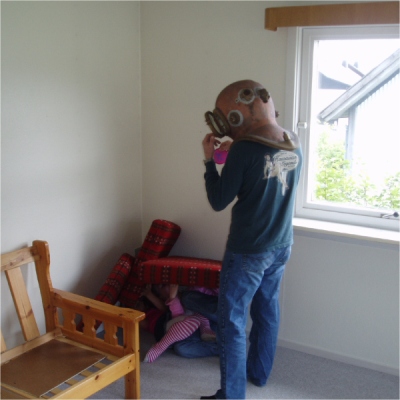
More than a quarter of all the 75 writers (at the time of writing this post) interpreted the prompt to create stories around a theme I call Scary Daddy. Basically, Daddy (or some other adult) puts on a diving helmet and mock-scares the kids. About a quarter of the tales have variants and twists. This one, by The Reclining Gentleman, is one of the more subtle, where the Scary Daddy motif is used as a device to explore loss.
Monster by The Reclining Gentleman
It’s always the same dream.
I am hiding behind the cushion sanctuary I have built in the conservatory; curled into a squealing nine-year-old ball, legs coiled inside my skirt. Dad, on leave from the sub, is searching for me, chasing me. He’s wearing that old diving helmet, the one that terrified me, and he’s a roaring sea monster. He finds me and as he lifts the helmet, I wake. Relief engulfs me.
For a moment.
Then I recall the day the commander came to the door. Mum, her voice strained and shaking, sending me upstairs.
And then, always, I remember.
Two explored the theme of abuse.
What could explain the recurrence of the Scary Daddy story? Perhaps a clue is in the fact that four of the nineteen stories on this theme have the word “monster” in the title. The image obviously suggested play and, of course, a frisson of fear is a good way to add edge to a story. Eight (non-Scary Daddy) writers also adopted monster-related horror and sci-fi themes. A creature without a face is always scary, even when the fear is playful and reassuring. One of the stories is titled “Mask”. Helmets and masks strip us of our individuality, though masks may also unite us through rituals with a world of spirits and imagination. Perhaps that’s where the archetype lies, drawn on by so many of this week’s Friday Fictioneers. One of the Scary Daddy writers commented that this is what fathers do.
There were, of course, other recurrent themes. Eight, including me, saw the prompt as an invitation to enter the world of children’s play and imagination. (A ninth used it to explore adult fantasy play, but that’s another thing entirely). Eight, as I already mentioned, wrote sci-fi or horror stories. Nine used the diving helmet in thrillers, some quite grizzly. Seven wrote family tales. Five used the helmet as a device for character studies. This one by JWD is a great example.
The Voices by jwdwrites
It was after the fall the voices began. Not just English, so many languages it was hard to understand anything. “It’s like this plate in my head is a damned antenna and I’m picking up long-wave!” Ray joked.
Before long, Ray had stopped joking, stopped playing with his kids and stopped talking to his wife. There was just so much damned noise!
Then he found the diving helmet. When he wore it, there was silence in his head.
He wore it everywhere.
Then they came for him.
They took the away the helmet, and locked him up…
…with the voices
Of the remaining stories, three were humour, three dealt with death (also a recurring theme in Friday Fictioneers over the weeks), two dealt with hiding, and the remaining five were unique in their themes.
So, I don’t know how many stories there are. But probably fewer than we think. Whether this is really because we can’t tell other stories, or whether it’s an effect of our culture only presenting certain themes, I leave you to judge.







 Neil MacDonald Author