51. The unsuspected power of stories, Part 3

In 2011, I wrote a book, still unpublished, about how stories work called The Scheherazade Code. This series of posts draws on that book. The last post discussed the way stories shape our sense of the world. This post describes why we are so susceptible to stories.

Stories are powerful because our brains are narrative engines. We are ‘hard-wired’ to make and respond to stories. According to neuroscientist Michael Gazzaniga, the left hemisphere of the brain houses what he calls ‘the Interpreter’. The Interpreter’s job is to make sense of all the impressions and stimuli we constantly receive, as well as of our actions, even where they are prompted by unconscious stimuli. The Interpreter weaves this together into a coherent narrative about why things are happening as they are. Our brain hungers for pattern and meaning. When there are gaps and facts that don’t fit, the Interpreter keeps the story seamless, even where necessary inventing memories of things that never happened.

Many brain areas are required for story-making. Studies of brain injury that affect people’s ability to construct or understand narrative have identified three distinct areas in addition to the brain’s language areas. Like the Interpreter, the language areas are in the left hemisphere. Narrative seems to involve the limbic system, particularly the amygdala and the hippocampus, (involved in emotion and memory). It also involves parts of the frontal lobes (involved in assigning meaning to events) and prefrontal lobes (involved in regulating impulses). People with damage to these different areas experience different impacts on narrative.

With modern scanning technology, it is possible to watch a brain listening to a story. Different brain regions light up when a new character enters the tale, when an action is performed, when a cause is described and so on. We use many of the same parts of the brain when we listen to a story as we would if we were performing the action ourselves. The brain areas that would be involved if we kick a ball are active when someone kicks a ball in the story.

We understand a tale by mentally simulating events of the story world. This is true whether we are reading a book or watching a movie. The narrative machinery, which must have evolved before we invented written language let alone motion pictures, seems to underlie any kind of story-telling. Whatever way it is presented to us, in an important sense we become the protagonists in the tale. Moreover, when we hear a story, our patterns of brain activity become aligned with and mirror those of other listeners and of the speaker. The simulation of the events of a narrative that we run in our brains is not simply a passive inner movie. We construct it actively and predict what we think is coming next.

The narrative machinery of our brain may be linked to our ability to recall memories. Most of us have little or no memory of events before we were around age two or three. This may be linked to the age at which children are able to organise their memories into a narrative. Research shows that the age of first memory seems to be related to how complex the conversations are between mother and infant. Interestingly, while the average age of earliest memory is around 3.5 years in Europeans, it is 2.7 years for Maoris, and 4.8 years in East Asians. Might this be to do with the observed fact that Maoris have a rich story-telling tradition? And also that East Asians discuss feelings about the past with their children less frequently than Europeans?

Why and when did humans evolve this capacity for making and telling stories? The most obvious reason is that it evolved along with language to allow people to share skills and information and to forge social bonds.
My own speculation is that the narrative brain was built on the machinery that predators use to hunt. A predator has to be able to recognise its prey and to navigate rapidly the space that separates it from the prey to make the kill. To do this, predators make mental maps of their environment. A predator can kill faster and more efficiently if it doesn’t have to process information about everything it sees. Instead, its brain creates a model of what it is looking for, and only when its eye sees something that matches the search image model are the hunting routines activated. Other things in the environment are ignored.

This emphasis on important things, and ignoring of unimportant things, is exactly what stories do. Exactly the same thing happens with expert observers. Trafton Drew, a psychologist at Harvard medical school, asked radiologists to inspect chest scans for signs of lung nodules, a possible sign of cancer. Unbeknownst to them, he had superimposed on some of the scans an image of a gorilla. Astonishingly, he found that 80% of these highly trained observers missed the gorilla. Radiologists’ search image is geared to cancer growths, not gorillas.

gorilla scan
The gorilla is in the upper right.

The brain region seems to be involved in both navigation and in narrative. This structure is the hippocampus. It is involved in making long-term memory and storing our mental maps. When the hippocampus is damaged, we have difficulty remembering where we’ve been or how to get where we’re going. London taxi drivers are required to master “The Knowledge”, a detailed grasp of the road layout of London, before they are licenced to drive the famous black cabs. And fascinatingly, they have a part of their hippocampus enlarged compared to the rest of us, perhaps as a result of all that studying of maps. The hippocampus and amygdala are involved in our ability to create and relate to stories. It is a fascinating speculation then that our story-making ability evolved from, and still shares features with, the much older machinery for making mental maps.
50. First Crime

I have just sent off my entry to the First Drafts Competition run by Myriad publishers. Five thousand words of mayhem. The 2016 competition, open to writers who never published a novel or collection of short stories, has a Crime theme. The prize is a week-long writing retreat in the luxurious surroundings of West Dean College near Chichester, as well as detailed editorial feedback from the judges and six months’ mentoring from a Myriad author.

My aim last year was to make 2015 the year I got some short stories published. I achieved that. Now my aim is that 2016 should be the year I find an agent or a publisher. Winning the competition would be a big step towards that. By the way, I didn’t get short listed for the Costa Short Story competition.

If you want to enter, the competition closes 31st March.

49. Engines of war

This week’s chapter of my serialised book  A Prize of Sovereigns  has the story reaching a turning point in the war between two rival medieval princes. And that turning point is technological. Technology has always played a major role in war.

The Hollow Crown
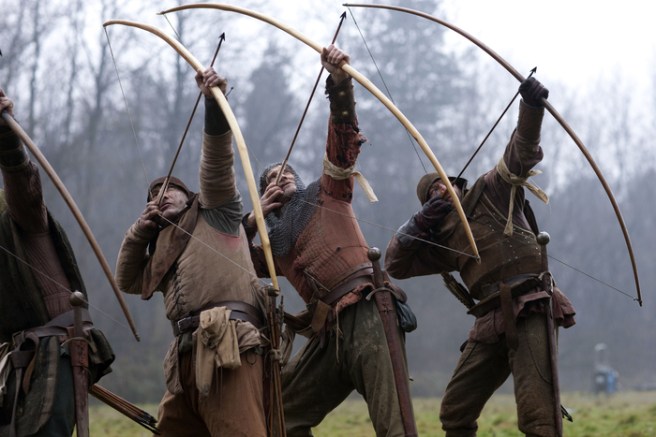
Programme Name: The Hollow Crown – TX: n/a – Episode: Henry V (No. Henry V) – Embargoed for publication until: n/a – Picture Shows: Archers – (C) Neal Street Productions – Photographer: Nick Briggs

When medieval England perfected the longbow, it transformed the nature of war. Armed with one of these long-range armour-piercing weapons, an archer could kill an armoured knight. The invention not only changed forever the military balance of forces between England and its adversary, France, it changed the code of war. A commoner could now kill a nobleman, a deep shock to the psyche of French chivalry. Until then, the most fearsome weapon of war had been mounted shock combat, the province of the aristocratic knights on their heavy horse.

Incidentally, mounted shock combat depended on another technological change: the invention of the stirrup. Until the stirrup, which braces the rider, any attempt to charge the enemy at speed with lances resulted in the mounted warrior falling off backwards at the moment of collision. Before stirrups, horses were only a means of delivering the warrior fast to the battlefield.

One of the rival princes in A Prize of Sovereigns, Aurthur, reasons that his army is at a disadvantage because it does not have longbows of comparable range and power to his enemy, King Byrom of Ceweth. He decides that he must again change the balance of forces, and warfare itself, with a weapon of even greater capacity. This passage shows the reaction of his chancellor, Gustaff:

“A new weapon? What is it?”

“Bombards.”

“Bombards, Majesty? The cannon makes a loud bang and frightens the horses, to be sure. But it is an unreliable thing, as likely to explode and kill our own men as the enemy. And it has not the accuracy of a bow.”

“And a bow once had not the range it does today, until Ceweth’s archers perfected it. I have engaged an artificer from the east who assures me he has a way of smelting iron of greater purity, and of more precisely casting and boring cannon. His demonstrations show me that we can make a cannon less prone to destroy itself; and one that will hurl a ball further and more predictably. All I need is time for him to perfect the cannon, and build enough of them. Cannonade will be to war in the future what massed longbows were to Byrom’s father. We will be able to destroy the Ceweth army before they can engage us.”

The role of technology in military and political change is a subtext of A Prize of Sovereigns. The chapter also illustrates another subtext – how power works. To succeed as a ruler, the scholarly Authur has had to learn to become as cunning and ruthless as his rival, Byrom. He shares with Gustaff his intention to betray Marta, the Joan of Arc figure in the story. Gustaff is astounded at the way the young prince has become a king. Aurthur responds:

“It may be as you say, Gods willing. But, just between us, I mourn the boy who has gone. He was gentle, and loved the creations of art and philosophy. He was innocent of the wiles of strategy, and the vicious compromises of statecraft.”

Kingship exacts a terrible price on Aurthur. Perhaps that is a choice faced by everyone who wields power – to gain it at the cost of their humanity.

48. The unsuspected power of stories, Part 2

In 2011, I wrote a book, still unpublished, about how stories work called The Scheherazade Code. This series of posts draws on that book. The last post discussed the way stories shape our sense of self. This second post deals with how stories construct our sense of the world.

Scheherazade told 1001 stories to keep herself alive. The king was entranced and fell in love with her. Spin doctors, marketers and hoaxers use this same story code. If we crack the code then we can’t be hoodwinked: even by ourselves.

The history of moral panics about children illustrates the pervasiveness of narrative.

‘Thus entertained and equipped, the wide army of the children of the poor are sent on their way to take part in the great battle of life, with false views, false impressions, and foul aims.’

Penny Dreadul

So said the Edinburgh Review a century and a half ago, railing against the moral influence of the Victorian ‘penny dreadfuls’. These were serialised and often gruesome pamphlets, featuring retellings of crimes, arrests and punishments, along with romances of lawlessness, and Gothic horror tales. A hundred years later, in the United States, the book reviewer of the Chicago Daily News in 1940 raised the same standard against children’s comics, writing:

‘Their crude blacks and reds spoils a child’s natural sense of colour; their hypodermic injection of sex and murder make the child impatient with better, though quieter, stories. Unless we want a coming generation even more ferocious than the present one, parents and teachers throughout America must band together to break the “comic” magazine.’

Modern readers will recall almost identical moral panics about the impact of satanic videos. Later came the contemporary scares about the corrupting effect of the Internet and social media on our children. The medium and the technology changes, from penny dreadfuls to the Internet, but the story persists through the centuries. We fear the way youth culture corrupts our children, and we fear the changeling children who succumb. This persistent moral panic is an example of a social narrative. The story lives a life of its own in our culture, morphing a little to fit the age, but essentially unchanged. Understanding how and why we make these stories has implications for everything from how we live our lives to how we run our world.

The rules for making stories are like a code. I call it the Scheherazade Code, after the famous narrator of the 1001 Arabian Nights stories. Decoded, it gives us critical distance and more control over the impact narratives have on us. There are many devices for structuring the meaning of a story. Among the most common devices are the ‘Alien’, the ‘Nudge’, the ‘Scales’, and the ‘Frame’.

The demon children story, which I referred to at the beginning, illustrates a standard device: the ‘Alien’. In an ‘Alien’ story, the subject is rendered ‘other’, different from us, and makes no call on our sympathies. Wartime propaganda often uses the device to demonise the enemy. But it also recurs in stories about any groups we fear. The British media, for example, uses the ‘Alien’ to describe not only ‘feral children’ but also immigrants. A Daily Mail article in March 2009 about illegal immigrants to the UK talked of a ‘relentless rise’ and a ‘massive surge’. No longer people, these immigrants are now an inundation.

The ‘Nudge’ is a device beloved by the advertising industry in its narratives of hope and fear. The ‘Nudge’ works by loading a story with an embedded cargo of other stories. This cargo surreptitiously nudges our emotional response to the facts of the main story. The metaphor of inundation in the Daily Mail article about illegal immigrants functions as a ‘Nudge’. Car advertisers combine the technical facts about the vehicle, with a nudge towards the sexual prowess, the power, the freedom, and the lifestyle the car embodies. Antibacterial soaps and handwashes are marketed by nudging mothers’ fear of the dangers surrounding their children. ‘You may not see germs. But they are everywhere’ is how an advert for Dettol begins. Advertisers don’t just tell us that soap cleans, but that it protects us from hidden perils.

The ‘Nudge’ and the ‘Alien’ are obvious ways in which the meaning of facts can be put in a different light, changing the way they are read. The ‘Scales’ operates rather differently. This device appears to offer the reader fairness and balance. It is often used in news reporting to ensure coverage of both sides of a debate. Ostensibly nothing could be more balanced than that, and indeed it often functions that way. However, the device can also be deployed mischievously. A false scale may be used, to tip the reader’s impression towards one view. The easiest way of doing this is to pit a strong account against an opponent who only mildly disagrees. Or a controversy can be manufactured where one doesn’t really exist. This is particularly misleading in reporting on scientific issues. The false Scales device is often found in portrayal of the climate change debate. Among climate scientists there is now consensus that human activity is causing global warming. But when news reports give equal weight to the climate scientists and to the deniers, the reader is led to believe that the issue is still unresolved.

Perhaps the most subtle of the devices is the ‘Frame’. Stories, just like pictures, depend for their meaning on how they are framed. The photographer can change the way we read a picture by what is included in the composition and how it is cropped. A storyteller may do the same. So, it’s important how much of context we are given. This goes to the heart of how narrative works. It has been said that ‘facts are all things that objectively exist; truth is the connection between them’. By changing the framing of a story we radically alter the connections between facts and thus the sense of what that truth is.

framing

Street Photography Composition Lesson #6: Framing

The public debate about the English riots of August 2011 provides a fascinating example. The mass media at the time described ‘an orgy of violence’ by ‘gangs of teenagers’. But the facts were perplexing and led to varying narratives afterwards. The liberal press, predictably, focussed on underlying problems of poverty and marginalisation. But if they were riots, what was the political grievance? Of those arrested, 45% of charges were for burglary and only 26% for violent disorder, not what would be expected in a riot. If they were simply criminality, ‘shopping with a crowbar’, as the conservative media suggested, why was there so little involvement of criminal gangs?

Press coverage of the disturbances, both liberal and conservative, largely focussed on the characteristics of the social underclass. This way of framing the story cast it easily into a variant of the ‘Alien’. The perpetrators were not people like us. But there were a few notable exceptions to this framing, which located the problem in a much wider context. Peter Oborne, writing in the Daily Telegraph on 11 August 2011, argued that ‘the moral decay of our society is as bad at the top as the bottom’. He drew into his frame the public outrage at bankers’ bonuses, Members of Parliament fiddling their expenses, and the misdemeanours of footballers and other celebrities. The acquisitive consumerism that fuelled the looting of trainers and wide screen televisions, according to Oborne was connected to the looting of the public purse by bankers and MPs. In his framing of the story, the subject becomes society at large, and the example set by those at the top.

Since we naturally turn everything we know into stories, we can’t escape their influence by an appeal to the ‘true facts’. But we can use the rules of story making, the Scheherazade Code, to remain critical and sceptical and to search out different, and perhaps better, stories.

47. The unsuspected power of stories, Part 1

In 2011, I wrote a book, still unpublished, about how stories work, called The Scheherazade Code. This series of posts draws on that book. This first post deals with how stories shape our sense of self.

Scheherazade

Stories are the machines through which we make sense of our world. Almost everything we think we know is a story. Even our sense of our own identity. Narrative is probably the oldest form in which humans have stored and transmitted wisdom. Our brains are ‘hard-wired’ to make and respond to stories – we are Homo Narrans, the story-making ape.
Stories are powerful because they help us organise things. They tell us what goes with what, what things mean, why they happen and how to assign praise and blame. Narratives are devices for organising events in a coherent way; they describe cause and effect; they lay out a timeline with beginning middle and end; they carry a judgement about the meaning of those events and how we should see them. Stories may illuminate and inspire, or they may deceive.

A story is more than a set of facts. The facts are arranged in a particular way. And there is more than one way to do this. This is important for how we tell and respond to stories. Stories highlight what is important in a situation and fade-out the unimportant.

Consider this statement.

‘The chief died. A month later, his wife died. The harvest was poor.’

This is a sequence of events, a diary list of a year, not a story. Now consider this.

‘The chief died. A month later, his wife died of grief.”

This second set of statements is more story-like, because it offers a reason for the sequence. It makes sense of them. And it invites our empathy: the wife died because of her grief at the chief’s death. Narrative is how we order and give meaning to unordered information. Note that it omits the fact about the harvest since it is not relevant to the story. This is an important feature of stories. They draw our attention to what is important in a situation and fade-out the unimportant. Of course, with a few more statements we could tell a different story, connecting different facts.

The chief died. The tribe fell into disarray, feuding over who was to succeed him. They neglected the fields, and the harvest was poor.’

In this case, the death of the chief’s wife is not included. The story has now become one about politics rather than about a personal relationship.
The same facts can be narrated in very different ways. This feature of stories makes them powerful and compelling ways of understanding the world, but it also opens them to manipulation. We can be fooled by stories. We can even fool ourselves.

The ‘I’ that each of us senses ourselves to be is also a constant narrative creation: a story which weaves together what is happening, why it happened, who is to blame and who should be praised. The philosopher Paul Ricouer argued that we make sense of own identities in much the same way as we make sense of characters in stories. We understand characters by way of the plot that ties together what happens to them, the aims and projects they adopt, and what they actually do. Similarly I make sense of my own identity by telling myself a story about my life. We are constantly bombarded by an inchoate mix of sensations, stimuli, motivations and thoughts. From these we weave a coherent story with ourselves as protagonist. Much of our motivation may be subconscious, things of which we’re not even aware. We fill in the gaps of the things below the level of consciousness with rationalizations that keep the narrative seamless.

This has important implications for our everyday lives. Narratives have to be simple. Their purpose is to select facts and throw what is important into sharp relief. By implication, what is unimportant to a story lies in shadow or is omitted altogether. In pursuit of a coherent story about our own lives and who we are, we may miss out quite a lot. We may trick other people. We may even trick ourselves. The collision of fictional and autobiographical stories is where the risk of trickery arises. We buy into other narratives. Advertisers are extremely good at selling us products through selling us self-images and aspirations.

Of course, our own life stories are not like the stories of fiction. Fictional stories have beginning middle and end, whereas ours are ongoing. We don’t know how ours are going to end. In fictional stories we understand why things are happening and what their consequences are. We don’t always know this about our own life stories. Stuff just happens. But as we pick out the elements of our own stories from the rushing torrent of life, currents begin to nudge them, pick them up and sweep them into a more stable flow. There is a reassurance once we can relate our own stories to those of literature, or those of people we admire. We develop a sense that we know why things are happening, and where things are heading. Fiction helps us structure autobiography. The world is full of Elizabeth Bennets reassessing their opinions of their Mr Darcy.

46. Don’t worry about finding your voice


His_Master's_Voice

Here’s the bottom line – don’t worry about finding your voice, you never lost it. They tell aspiring writers you have to find your voice. Ignore the fear. Just write like yourself, not copying other writers, and you’ll be writing in your voice. No two people write alike, just like no two people speak alike.
The dread command “find your own voice” is as mystifying as it is unsettling. But your “voice” really doesn’t mean any more than the style in which you write, your typical choice of words, and the (usually recurring) issues you care about. Some writers have voices which are light and fast, others are descriptive and meandering, some are dark and brooding. All you need to do to see a writer’s voice is to look at how they write. For instance, this opening of a book:

Marley was dead, to begin with. There is no doubt whatever about that. The register of his burial was signed by the clergyman, the clerk, the undertaker, and the chief mourner. Scrooge Signed it. And Scrooge’s name was good upon ‘Change, for anything he chose to put his hand to. Old Marley was as dead as a doornail.

Mind! I don’t mean to say that I know, of my own knowledge, what there is particularly dead about a doornail. I might have been inclined, myself, to regard a coffin nail as the deadest piece of ironmongery in the trade. But the wisdom of our ancestors is in the simile; and my unhallowed hands shall not disturb it, or the Country’s done for. You will therefore permit me to repeat, emphatically, that Marley was as dead as a doornail.

The voice is rambling, and wordy, inviting the reader into a conversation. It couldn’t be anyone but Dickens. Of course, part of the reason for his wordiness is that his books first appeared as serials, and he was paid by the word!

In contrast, consider this, an opening from a completely different book:

It was a bright cold day in April, and the clocks were striking thirteen. Winston Smith, his chin nuzzled into his breast in an effort to escape the vile wind, slipped quickly through the glass doors of Victory Mansions, though not quickly enough to prevent a swirl of gritty dust from entering along with him.

Here the voice is spare and lean. This is the voice of that champion of plain English, George Orwell. But note how the clock striking thirteen immediately tells us we’re not in Kansas anymore.

Voice is more than just style, and the style may vary depending on the kind of story. You probably wouldn’t use the same style for a crime novel and a romance novel. A distinctive voice is also created by the recurring moods and themes in a writer’s work. Both Dickens and Orwell were concerned, in their very different ways, with social justice. You may have to write for quite some time before you can spot the recurring themes and characters your subconscious dishes up. A distinctive mood is very characteristic of writers such as Gabriel García Márquez, whose magic realism style mingles different planes of reality.

Many years later as he faced the firing squad, Colonel Aureliano Buendía was to remember that distant afternoon when his father took him to discover ice. At that time Macondo was a village of twenty adobe houses, built on the bank of a river of clear water that ran along a bed of polished stones, which were white and enormous, like prehistoric eggs. The world was so recent that many things lacked names, and in order to indicate them it was necessary to point. Every year during the month of March a family of ragged gypsies would set up their tents near the village, and with a great uproar of pipes and kettledrums they would display new inventions.

So the secret of finding your voice is just to tell the story in your own way, and make sure not to be boring. It’s nothing more than that.

45. In which our hero attends a Literary Event

Une_soirée_chez_Paul_Verlaine

On Saturday, I attended the launch of the anthology of short stories, published by a literary magazine. The event happened in a pub in London. My connection with the magazine is pretty tenuous. My short story Zhuang Zhu’s Dream appears in their current issue. I engaged in a to-and-fro with the editor, revising the story before it was accepted. Other than that, I knew nobody there.

I’m not by nature a gregarious person, and pushing myself forward like this is my idea of hell. But, sticking my courage to the screwing point, I decided it was the Sort-of-Thing-I-Should-Do. It was a good opportunity to meet the team, and to talk perhaps to other contributors. When you’re a published author, you attend Literary Events. It goes with the territory.

I wondered whether I could get round my terror by going as a character. I could play the author, I thought, and perhaps I should polish my Literary Conversation before I attended. Maybe I should prepare some clever remarks about the Arc-of-the-Story in modern African fiction. I had, after all, just finished an eight-week course on creative writing run by the University of Iowa. So I was well up on the terminology for the Craft Skills of Character, Description, Setting, Dialogue, and so on. But the reality is I’m the kind of person who at parties avoids the People-Who-Know-Everyone, and seeks out the other Person-Lurking-in-a-Corner-Who-also-Knows-No-one.

I asked a friend in my writing group, who is also an actress, how I should go about playing an author. “Play yourself,” she advised.

Things never work out as you expect. What I expected was some booze, some standing around, and a quick speech for the launch. What I got was an organised floorshow. Fifty folding chairs squeezed into the sweaty basement of a Bloomsbury pub, facing a postage-stamp sized stage. So there was neither need, nor possibility, of talking to anyone. The bar wasn’t serving. I squeezed, late, into the only vacant chair.

Well, I say it was an organised show. The contracted musicians hadn’t made it. At the last moment, two others agreed to step in with voice and keyboard. The singer had a cold, the music kept blowing off the stand when the door opened, and the amp had a dull throb. Apparently, someone dropped it earlier in the evening. So, in the end, they unplugged the amp. Then Katie Lumsden read a story from the anthology. Next came a one-act play for two characters. More cancellations – the contracted male actor had backed out at the last minute, because he’d been offered a paying job. Which seemed fair enough to me. But it did mean that the stand-in didn’t know his lines. The playwright also hadn’t turned up, which was perhaps a mercy for him. Last up before the interval was Aliya Whitely, talking about her career as a novelist.

At the interval, I saw my moment. I approached the editor. I extended my hand. “Hello,” I said, “I’m Neil.”

There was no flash of recognition. “Neil MacDonald,” I added.

“Ah,” he replied.

I caught the next train home.

44. Revising with spine and ribs

Michael Crichton says “books aren’t written, they’re rewritten. Including your own. It’s one of the hardest things to accept, especially after the seventh rewrite hasn’t quite done it.”

Revision
As promised last week, I’m devoting this post to the feared and hated topic of revision and a great approach to revision that I learnt from the University of Iowa course that has now finished. The take-home messages were:

  • Writing is only the beginning; where the real work and the real fun of it comes is in the rewriting
  • Let time pass between edits – part of writing is not writing
  • Build the rewrite in “layers” – focussing on one thing at a time for each edit
  • Enjoy the problem-solving – failure leads to mastery – the more problems you solve, the better you get at it

I got really excited about a method for structuring the revision process, which I’m going to call the spine and ribs method. It was proposed by one of the teaching assistants, Christa Fraser. But this is my own adaptation of it, for whose faults no blame attaches to Christa. The method involves two passes, and each is structured as a set of questions. I’ll lay out the questions here. Then I’ll illustrate its use with the revision I made of a story about a shoe shine guy who has an encounter with a mysterious customer.
Pass One

  1. What is the “soul” of the piece?
    What are you trying to convey and what concerns were working there of which you were not fully conscious?
  2. Who are the main characters and what is the setting here?
  3. What are the primary obsessions, preoccupations, desires, fears, obligations, etc. of our characters?

Once you’ve answered these questions, in what ways are these things driving or pulling the narrative forward? These are the long lines or spine of the story

4. What are some of the short lines of narrative tension that are already there?

Now that you have identified the spine of the narrative, are some of the existing short lines of narrative tension now incongruous with the re-aligned story? Are there new short lines, or ribs, that are opening up and wanting to align themselves along the spine of the story?

You revise the piece using these questions. After the story has been realigned so that you feel that you can see the true shape of the story as it wants to and ought to be, you return for Pass Two.

Pass Two
1. Record and adjust the timeline
The story’s timeline may extend earlier than the earliest point of present moment action and later than the last moment of present action. Can you explore references to the backstory, or hopes and plans that extend beyond the action?

2. Adjust the arc of understanding.
Are you explaining too much? Too little?

3. Polish the mirrors in the mirrored hall of infinity: moments that endlessly reflect
What are the motifs? Where do they repeat? Which parts should mirror each other? Which parts should be prefigured? This is where you play with structure.

4. Polish the burrs off
Read the piece aloud and listen to the rhythm. You’ll hear the false notes, unnatural syntax, incorrect words or phrases, repetitive elements, and anything else that will disrupt your reader’s experience of the narrative at a sound and language level.

5. Share the work with friends whose feedback you trust

6. Repeat all these steps until you think the story is ready

7. Put the story away for months.

8. Repeat all of the above until you think the story or longer work of fiction is ready for submission or publication.
The spine and ribs revision method applied

I used this method for the last assignment of the course, which was to revise a story we had already written. I revised a story about Horacio, a shoe-shine guy. Horacio has a simple moral worldview that good people are recognisable by the care they lavish on their shoes. He has an encounter with an enigmatic drifter, who he sees initially as a devil and then as an angel. An apparent miracle occurs which forces Horacio to question his morality.

I was really pleased and surprised by the result. In pass one, I came to recognise that in addition to Horacio’s worldview there was another idea lurking: an exploration of the way we try to fit events to our worldview. I considered whether I needed to give Horacio more of a backstory, to explain his morality. I also considered whether I needed to give a clearer explanation of the drifter, and whether he really was a messianic figure, or whether he was manipulating Horacio. The main conclusion was that I needed to give the story more room to breathe – to draw out the conflict between Horacio and the drifter. I also moved the devil/angel definition of the drifter from the narrator’s voice to Horacio’s voice.

In pass two, I had a lot of fun. At this point I layered in a lot more complexity that had been lurking in the story as subtext without me being aware of it. In particular, I saw that the events which challenge our worldview with good outcomes need not themselves be good.
I gave Horacio a backstory, tracing his morality to his flinty mother who scoured him of religious doubt. I considered, and rejected, extending to story to what happened after Horacio’s revelation.

The work on structure and motif in the second pass was really the glory of the thing for me, perhaps because playing with structure is the bit of revision I enjoy most. I recognised motifs not only of devils and angels, and good shoes/good men, but also of burnishing/scouring and aridity that I hadn’t been conscious of. I saw how I could connect them more clearly. I saw that I could prefigure the climax (hopefully, without it being obvious). I gave Horacio a more explicit revelation that good shoes did not necessarily imply a good person. I altered the ending so that it echoed the beginning. Interestingly, this changed the story but not the subtext. In the original version, Horacio leaves his shoe-shine stand and follows the drifter. In the revised version, he refuses. But this didn’t matter because it still underscored Horacio’s revelation.

I shared the rewrite with two other writers on the course before submitting it. One wanted a tighter structure and deletions, and the other a greater opening up. I tried two different approaches to structure and I now had two different versions of the piece! One was narratively more straightforward but eliminated some of the backstory. The other was more convoluted but denser. My head opted for the first version, my heart for the second. In the end, I went for the first version when I realised that my heart was attached to a piece of descriptive writing that didn’t really move the story forward.

I’m really pleased with the result. One reader said “you have deepened and expanded this into a lovely parable”, and another described it as a “richly intelligent read, full of a kind of tenderness”. Now I just need to leave it to infuse and mature in a deep recess of my hard drive before I return to it.

43. Things I learned from the University of Iowa creative writing course.

The seven-week course is almost over now. I’ve been taking it since the beginning of October. I learned the term MOOC – massive open online course. I have no idea how many students there were – hundreds certainly. We’ve had video lectures from 15 writers about their craft, read nine pieces of writing, engaged in discussions moderated by six teaching staff, and done seven writing exercises.

Of course you don’t get in a massive free course what you get if you pay – namely critique and mentoring from a successful writer. But nonetheless, I’ve enjoyed it. There have been times when I’ve been cross and frustrated, most particularly by the apparent emphasis on the literary to the exclusion of other genres, and on the rubric of “trusting the writing”. This seems to privilege the subconscious over the conscious, the observational over the analytic, character over plot, and the inspirational over the perspirational. Ironic perhaps in the US which is the home to so many writing toolkits and methods.

It’s hard to say yet whether the course has made me a better writer. My wife says she can’t see any difference in my writing. But that would need time to ferment and bed-in. It’s certainly made me more fluent in what I can say about writing, and therefore probably a better critic.

I thought I’d share with you what have been the most important insights (for me) of the course.

Character

  • Characters should be interesting, not necessarily likeable
  • Characters change over time

Dialogue

  • Dialogue should appear lifelike but isn’t – the reader suspends disbelief
  • Don’t overdo dialect – a little goes a long way
  • Vary the size of speeches
  • Dialogue is about showing what can’t be told. Dialogue enables the writer to convey information, emotional information, psychological information, of which neither the characters nor the narrator are yet fully aware

Voice

  • Voice is an ambiguous term. It can mean authorial voice (i.e. style), narratorial voice, and character voice. Don’t worry about “finding your voice” – it’s natural, it’s just your own style.
  • Different characters will see the same setting in different ways
  • Voice is about mentality. Characters can be the embodiment of ideas, to keep the reader engaged with the idea
  • If voice is a mentality, rather than just diction, then building a character is building a world

Story, plot and structure

  • A storyline should achieve the quality of being surprising yet inevitable
  • Some writers are “planners” and other are “pantsers”. Neither is superior, they’re just how different brains work. Both merge at rewrite stage.
  • A story is the events that happen. A plot is the sequence of causality that makes these events happen (“plot” is the name for the events seen in the light of their endings) Structure is the decisions we make about how to deploy the plot to tell the story in its most compelling form. The storytelling may be better than the story
  • In literary fiction, which may be character-driven rather than plot-driven, narratorial or character voice is a major determinant of structure. In other genres, the author’s decisions about voice are relatively independent of decisions about structure
  • As well as point of view (POV), consider point of telling (POT), and point of entry (POE). POT is the point in time from which the events are being narrated. POE is the moment at which you enter the beginning of the story or some specific part of the narrative. There may also be a consideration of Point of Exit – when you decide to leave the story.

Setting, description and world-building

  • Description can show how the two worlds – physical world and emotional world of the story – interact. It should show us a singularity – a world we’ve never seen before and will never see again. Not necessarily a bizarre world, but one which overlays the physical wold with an emotional world. The external world becomes an extension of character
  • Vivid description is a portrait of a mind thinking its way through the world.
  • When you’re describing a landscape, you’re trying to describe it comprehensively and precisely but not necessarily exhaustively
  • Images can function in a work as powerful hinges, ways to transition between places and times and they can be powerful tools for transitioning within fiction. They give us access to the associative nature of memory, allowing us to suspend the linear movement of plot and plunge into the past.
  • Worlds, whether they are imaginary or real, not only have things in them, but relationships between those things which are governed by rules that often differ from those in the everyday world. So as well as observing, world-building involves analysis.

Some of these insights came from the lectures, some from dialogue with staff and other students. The final class of the course deals with the dreaded topic of revision. Since I’m still in the middle of that, I’ll leave sharing what I’ve learned from that until the next post.

42. What makes a good ending?

Happy_Ending

There’s any amount of advice out there to writers about how to write good beginnings. Beginnings are important, because if you don’t capture your reader’s attention in the first few pages, even the first few sentences, they obviously won’t read on. But there’s much less advice on writing endings, and they’re important too. If your reader isn’t satisfied by your ending, they probably won’t read anything else by you.

I stumbled on this question while doing the coursework for a fiction writers’ class that I’m taking with the University of Iowa. It had never consciously occurred to me before. Of course I already knew about plotting rubrics like Freytag’s triangle. I knew stories needed to have beginnings, middles and ends. But I guess what made me think about this anew was a discussion in the course about point of entry. Point of entry means the decision you make in a chain of events about where to start telling the story. It needn’t be the beginning of the chain, it can be the middle, or even the end. The choice of point of entry, like that of point of view, radically changes the way the story is told.

I began to wonder if there were similar choices about what you might call point of exit. And, of course, there are. The ending is the most important part of the story. Everything that happens has been leading up to the ending. Unlike real life, it’s the ending that determines everything that happens. It may take several attempts to find the right point of exit. Sometimes you stop too early, other times you stop too late. Or sometimes it’s even the wrong ending, which can involve you in going back and restructuring much of the story. John Irving, author of The Cider House Rules, famously writes his last line first.

I’ve mentioned before a story I wrote which had a beginning and a middle but no end. It deals with a character who begins to have memories that are not his. This is Zhuang Zhu’s Dream, which has just been published by Gold Dust. The lack of an ending was intentional. I mean, what would you do if you had memories that weren’t yours? You’d just get on with your life, there would be nothing else you could do. I sent it to Gold Dust, and the editor understandably rejected it. He wanted to know why the character was having these memories.

So, I wrote an ending. The protagonist goes to his doctor and is referred to a specialist. The specialist tells him that he’s probably confusing imagination and reality, not least because he lacks a particular structure in his brain which helps to keep the two apart. But then he is enrolled in a brain study in which he meets another subject who may, or may not, be the person whose memory he is sharing. I still left it open-ended. The reader could choose which explanation they preferred – the rational one that he was confusing imagination and reality, or the spookier one that he really was sharing memories with this other subject. The editor asked for a rewrite again. He still wanted to know what happened. So I added a clincher, and it got published.

The basic rule of endings is probably best expressed by Anthony Vicino who argues you have to keep your promises to the reader. He says:

“To write a good ending, you have to go back to the beginning and figure out what promises you actually made to the reader. If you’re writing a murder mystery, you’ve promised to reveal the bad guy. If you’re writing a light-hearted romance, you’re promising the main characters will get together, or at least have a happy ever after ending. If you’re writing a Narnia’esque portal story, you’re promising to return the reader to the regular world when it’s all done.”

But endings are about providing a satisfying close, not necessarily about resolution. You don’t have to tie up all the loose ends. Indeed, you shouldn’t or the reader will reject it as too neat, too engineered. A good ending should surprise, but also, in retrospect, seem inevitable. But it should also leave the reader with questions about what might be in store next for the characters they’ve come to know so well.

So there are probably five ways you can end a story well:

  1. Closure. The main dilemmas have reached a satisfying conclusion. This is the expected ending with many genre works. You can ask, has all the adversity and hazard you’ve heaped on your protagonist played out fully? This doesn’t have to mean that the protagonist has overcome the challenges – they may have failed. But ask: Is the conflict concluded? Has your protagonist come to terms with whatever flaws you’ve etched into their ever-suffering soul? If you’re writing a series, you won’t want to resolve or close all the dilemmas. Or you may resolve one mystery, only to tee-up another one.
  2. The plot twist. This works a bit like a joke. You trick your reader into thinking they understand the logic that drives the story, and then at the last moment flip it into another logic. This kind of ending is more appropriate to short stories than to novels.
  3. Mirroring the opening. This might be simply a return to square one, indicating that everything the protagonist has tried to do has failed. Generally it’s more satisfying if the mirroring takes the opening to a new level. You have to drop in hints during the beginning and the middle that lead up to this ending. This creates a sense of balance and completeness and is particularly appropriate for stories with a philosophical focus
  4. The open-ending. This is intended to leave your reader with questions, persuading them to think about possible answers. This is what I failed to do in the example I gave of my own story about the man with memories that were not his. It was an every-day ending, but readers don’t read in order to see a representation of the every-day. They read to escape or transcend the every-day. It’s hard to do this kind of ending well. Though the characters’ fates may not be extraordinary, they must continue to live their lives with new-found insight from what they have been through. This ending generally works best with character-driven tales.
  5. The revisit. After the ending, generally at the moment of climax, you revisit the characters in a final scene, often written as an epilogue. This is remote from the setting and timeframe of the main story, and may happen days, years or even generations after the main action. It gives your characters the opportunity to look back at what they have learned and what has happened since.

Whatever you do, the ending has emotionally involve the reader, and leave him or her feeling satisfied that you’ve reached some kind of conclusion or that lessons have been learned.