2. Learning to Write

You learn to write by writing. Over the last five years I’ve written four novels and several short stories. I’ll tell you about the short stories in another post. That comes later. It was the novels that formed my main apprenticeship in writing.

The first novel was a dark psychological thriller- very dark, and unfortunately, very short. It’s only just over 50,000 words. I now know that a good length for a debut novel is between 70,000 and 90,000 words. The second novel was a better length, but not very commercial. It was much too literary. I had great fun writing it, but it’s very much a journey of the mind. Probably not enough happens in it to please a general reader.

Which raises an interesting question. Who do we write for? If we’re not writing for ourselves, at least in the first instance, there’s not likely to be much passion or imagination in it. But, at some point in the writing process, if we’re not writing for the readers, the book is never likely to see the light of day.

Quite when you make the transition from writing for yourself to writing for other people is a matter of personal taste and temperament. Certainly, the first draft should really be for yourself. This is where you explore the story, let your characters take you by the hand and show you their world. It’s magical, at least for me. But it doesn’t produce a readable work. Maybe in the second, maybe in the third draft you have to switch to writing with a cooler and more dispassionate judgement, bearing in mind how it will work for a reader. You may need to develop a lot more backstory at this point. You may need to explain things more slowly. You may discover that what you thought was a very cool idea doesn’t really work. You may discover that you’ve put in too much of the research you did. You may find that there’s not enough tension and interest in the first chapters. It’s not unusual to discover that your story really starts only in the third chapter. It’s an old adage of screen writing that you should “go in late and come out early”. In other words, start where the main action or plot development, starts.

There’s a really useful checklist on the website Flogging the Quill (www.floggingthequill.com/) about the elements a good first page should have.

  • It begins connecting the reader with the protagonist
  • Something is happening. On a first page, this does NOT include a character musing about whatever.
  • What happens is dramatized in an immediate scene with action and description plus, if it works, dialogue.
  • What happens moves the story forward.
  • What happens has consequences for the protagonist.
  • The protagonist desires something.
  • The protagonist does something.
  • There’s enough of a setting to orient the reader as to where things are happening.
  • It happens in the NOW of the story.
  • Backstory? What backstory? We’re in the NOW of the story.
  • Set-up? What set-up? We’re in the NOW of the story.
  • What happens raises a story question—what happens next? or why did that happen?

Like all checklists, use it with caution, but I find it useful.

Edit, edit, edit. Be ruthless. Be prepared to junk your first chapters. Be prepared, as they say, “to kill your darlings”. You will need to take out all the clumsy passages, all the self-indulgent interludes, everything, however precious to you, that doesn’t move the story forward. After the first draft, your book belongs to your readers, not to you. If you don’t like editing, force yourself. If you can’t force yourself to edit, have a long think about whether you want to write for others or simply for your own pleasure.

So that brings me to my third novel, A Prize of Sovereigns. It’s a historical fantasy of around 79,000 words – the right word length for a debut novel. It has intrigue war and revolt. It has princes, peasants, statesmen and storytellers. This is the one I decided to push. This, I felt sure, was my first commercially viable book.

prizesovereigns_squclean_01

I edited it, cut it, reworked it, moved chapters around, and added new characters and scenes. I read it to my writing group and made many of the changes they suggested. I researched topics like medieval armour and the Hundred Years War, read the entire transcript of the trial of Joan of Arc, and took an archery course to understand how bows are fired. I paid a literary consultancy, Cornerstones, to take a look at the initial chapters and the synopsis, and worked in many of the very helpful changes they suggested. I read other writers in the same genre, from George RR Martin to Ken Follett, and noted how they did things. It has been through eight or nine drafts in the two years I’ve been nursing it.

In later posts I’ll tell you about how I have gone about pushing A Prize of Sovereigns. The main point for now is that, unless you have an exceptional talent, your first attempts at writing may not produce something that’s good enough to take to market. It makes sense doesn’t it? A carpenter has to serve an apprenticeship, learning his or her craft. Why would it be any different for an author?

1. Join a group

Joining a group is one of my top tips. It can be scary, opening your work to the comment of strangers. I seem to remember I was in awe of the members when I joined and introduced myself rather diffidently saying that I’d like to try my hand at fiction. Over time, I got to know them. There are about a dozen people in the group, some poets, some short-story writers, some novelists, and some dramatists. Some of them are published, some have won prizes, others not. They write for very different reasons. Some write because they want to be writers, some for their own pleasure or to externalise things they’re thinking about. We are a dozen fairly ordinary human beings. The good thing about the group is that we offer criticisms of each other’s work. If you don’t have a group near you, and you don’t feel like starting one, you can always join an on-line writing community. I later also joined one of these, Webook (http://www.webook.com).

We meet once a week, and, as well as setting writing exercises, we can read a story, or a poem, or a chapter of a book, and hear how they come across to other writers. I have learned a huge amount in the group. I have learned the standard conventions for punctuating fiction (I didn’t know the comma went inside the inverted commas when writing speech for example). I have learned about showing rather than telling. I have learned about maintaining consistency of point of view. I learned how others tackled the same problems I was facing. I learned how to take and give constructive criticism.

Giving and receiving criticism, in writing as in life, is a skill that has to be acquired and practised. Writing is a very personal thing. We often feel as protective of our words as we do of our children. Criticism can wound. We can too easily fend it off by thinking “Well, that’s just your opinion” or “You don’t really understand what I was trying to do”. It’s good practice, even if you don’t agree at first, to make yourself listen. Try to understand what it is that might make a reader feel thus about your work. Would other readers also be likely to feel the same thing? Take time afterwards to think about the comment, after the sting has worn off, and ask yourself “Could they have been right, after all?” Of course, you won’t change everything just to please the critics. You do have to have confidence in your own work, just not over-weaning confidence.

Learning to give criticism can be equally hard. Again, there are some good practice guidelines. Start with something you did like about a piece before going on to what you didn’t like, for example. Being specific is important. If you don’t like something, figure out what it was that made you not like it, and if possible think of suggestions for how it could be fixed. Which brings me to another point, all criticism should be constructive. You’re trying to help someone else, not tear them down.

Sometimes, in our group, people have felt that the criticisms were negative and we’ve had to spend time exploring what way of commenting works best for us, and recognising that the rules may be different for different people. I know that for me, with an academic training, truth is often foremost in my mind, and I have to make myself think before I speak about how others may hear what I want to say.

It’s important to know how to give criticism, because if you give, you’ll get. Most communities of any kind work on this principle of reciprocity. If you offer to help another writer by reading through all 39 chapters of their book, they will do the same for you. My friend Toni (http://toniallenauthor.com) in the group has patiently read through three manuscripts for me and I’ve done the same for her.

How you think about being critical is a personal matter. It’s as varied as how you think about writing at all. Personally, I tend to think of writing as having three main elements: the story, the characters, and the writing. Good story-telling requires a polished performance in each of these areas. Often a good plot line may be marred by unbelievable characters, or a great character by a choice of words that doesn’t reflect their personality. Webook, the online writing community I belong to, has a template for criticism divided into categories “General”, “Plot”, “Character Development”, “Structure” and “Tone/Voice”. Just do whatever works for you, and try to apply the same critical thought to your own work.

criticism

I know that joining a group was a critical step in my apprenticeship to fiction writing. It may work for you too.

Wayfaring

I’m a writer. I say that with a little battered pride. Perhaps my experience will help you.

.One way or another, I have always written. I had my first short story rejected when I was around 14. Subsequently, like every adolescent, I wrote adolescent poetry. However, I didn’t become a professional author. I pursued a varied career in biological research, followed by journalism (the last profession of the gentleman), publishing, and then international aid. Since then, I have published six non-fiction books about aid. At the back of my mind was the idea that I would one day devote myself to writing fiction, full time. I’ve been moving towards that goal for the last five years.

I know I’m starting this blog a bit late. Many of the events of the past five years are already memories of memories. I can’t be sure how accurate some of them are. The main thing, though, is that I haven’t yet made it, if I ever do. So, I hope this account may be of help to other budding authors.

Reading accounts by well-known authors doesn’t really help that much. Sure, there are some tips there. The most important are probably “Forget inspiration, habit is more dependable” as Octavia Butler says, and “believe in yourself” as everyone says. This is true, even important. You can only become a writer by writing, and the professional writer has to keep writing whether or not the Muse is paying a call. And, of course, you have to believe in yourself, otherwise how will you convince any agent or publisher to do so? But what if you’re actually no good? What if your cherished vampire story is the thousandth to cross the agent’s desk that month?

Yes, you need to believe in yourself, but you also need to suppress your ego enough to listen dispassionately to the criticism of others. Sounds easy, doesn’t it? But, in fact, it’s an extraordinarily difficult balancing act.

There’s nothing in the accounts of authors who’ve made it, that tell you how to do this. Why did they make it, when I haven’t? Is it just that they’re better than me? Or more persistent? Or just luckier? By writing this blog as I try to follow in their footsteps, my hope is that it may offer some comfort and some insight to others on the same journey.

You can accompany me, watch me trip, develop and reject strategies, and perhaps watch me succeed.

So let me begin, unsatisfactorily with a recap of the past five years. Don’t believe everything in this tale. I may have made some of it up. It’s what story-tellers do.

I did a little writing on my own, and showed it to family. Showing your writing to your family isn’t the best way of getting criticism.

Writers Block

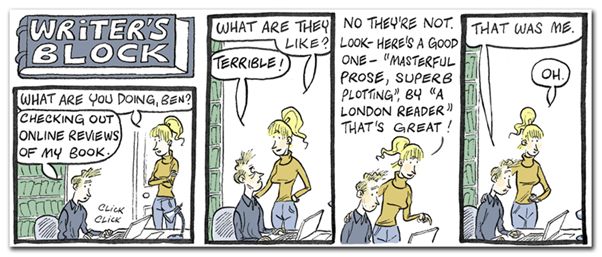
Of course, they think you’re wonderful. Unless you’re Kazuo Ishiguro, I suppose. His wife apparently told him the first draft of his The Buried Giant was no good, and he had to rewrite it from scratch. For me, anyhow, the key step was probably getting out of my study and joining a local writers’ group.