185. Spines: Would you trust a robot to craft your book?

Would you trust an AI to edit and produce your book?

Spines is, in the spirit of the tech bros, a disrupter. It describes its mission on its website as “Harnessing the power of cutting-edge AI, Spines revolutionises every facet of the publishing journey, including proofreading, formatting, cover design, distribution, and marketing across all major channels and platforms.” They aim to cut, from months to weeks, the process of producing a book.

What exactly do they offer? They deny that are a vanity publisher or self-publishing service, but, of course, that is exactly what they are. What is different is the automation. The Israeli start-up plans to produce 8,000 books this year.

Predictably, the community of authors and publishers have been scathing in their criticism. “These aren’t people who care about books or reading or anything remotely related,” said author Suyi Davies Okungbowa. “These are opportunists and extractive capitalists.”

So what does the customer get? Oddly, for a publisher, they don’t list their books on their website. To find their books I had to go here. I examined a sample of 18 of these books

What do they charge?

        Authors are charged between $1,824 and $5,496 for a print on demand service. By comparison, an established self-publisher, Troubador, charges £600 (about $730) to produce an e-book and £2,295 (around $2,800) for 200 printed copies. So Spines are not offering significant cost savings for cutting out human labour.

        How well are their books selling?

        To estimate the sales of these 18 books, I converted the Amazon Book Sales Rank into numbers of books using TCK’s calculator. On average, the sample sold 1.29 books a month. Six of them sold none at all and the largest sales were 4 a month.

        The books are also not attracting a lot of marketing attention. On average, these books received 4.29 review.

        How good is the production quality?

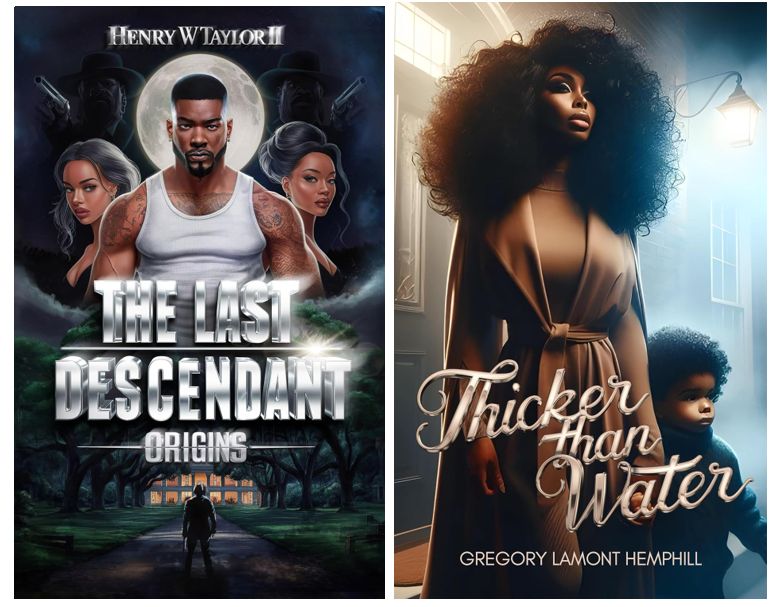
        To assess this, I looked at the cover designs for the two fiction books in my sample. Design is, of course, an art, not a science. Personally, I found the covers stereotyped and banal, but I am not the target readership. Since I am assessing AI publishing, I gave two AIs a crack at the cover analysis. Both were assessed as high quality by Joel books. The Last Descendant got a rating of B from ebookfairs, while Thicker than Water got a C.
        How well are the books edited?

        This is the acid quality test of the hyped AI tools. A careful editor and proof-reader will ensure that the text is free of errors and that the words flow, as well as paying attention to structure and consistency. I examined only The Last Descendant, and only the first paragraph and the cover blurb. The cover blurb has one spelling mistake. The first paragraph contained six grammar mistakes, ranging from unnecessary commas, overuse of two words and one confused word. Judge for yourself:

        “The vibrant atmosphere of the office holiday party at 12 Greenway Plaza in Houston, TX, enveloped Jason as he moved through the crowd. Laughter, music, and the aroma of LES BBQ, filled the air, creating a festive ambiance. Surrounded by employees, Jason basked in the joy of the season, drink in hand, and the sounds of celebration surrounded him. Jason Martinez was a man who knew how to make an impression. His brown skin and muscular frame contrasted with his crisp white shirt and black pants, giving him an air of confidence and authority. His face was framed by a neat and lined-up barbarian-style beard, which added a touch of ruggedness to his handsome features. His eyes sparkled with intelligence and ambition, and his smile was charming and persuasive. On his right hand, he wore a Bochic Burma ring, a stunning piece of jewelry that featured a single ruby encrusted in diamonds. The ring was a symbol of his success and power, as well as his taste and style. Jason was a man who had everything he wanted, and was not afraid to show it.”

        The spelling and grammar mistakes aside, this opening paragraph has several problems. Sentence variety is low with little variation in length and structure. There is no character complexity—Jason is simply handsome, rich, and powerful. There is, as yet, no tension or plot to engage the reader, simply a character description, making for a slow-paced read. The description is all told by the narrator, rather than shown in Jason’s actions or thoughts.

        Conclusion

        Going with Spines is not cheap, offers no marketing support, and the editing is noticeable by its absence.
        175. Do readers still crave long books?

        Novels used to be long, really long. Samuel Richardson’s 1748 Clarissa weighs in at 467,870 words (for comparison, standard advice to authors today is that a novel should be between 70,000 and 110,000 words).  Then between the second half of the nineteenth century and the first half of the twentieth, literature went on a diet. John Buchan’s 1915 Thirty Nine Steps is 29,725 words. Everything changed again in the second half of the twentieth century, with word-count ballooning. You can see my analysis of these trends in this blog post.

        In that post I attributed the changes to:

        • The growth of a mass market for books in the nineteenth century resulting in a working class appetite for shorter books than those which had been enjoyed previously by the leisured classes.
        • The advent of cheap air travel and long haul holidays in the second half of the twentieth century leading to the parallel creation of the “airport blockbuster”.

        The trend for larger books continued into the present century, A study found that average book length increased by over 25% (or 80 pages) between 1999 and 2014: from 320 to 400 pages.

        The modern obesity of literature appears paradoxical, given the standard claim that readers’ attention spans are diminishing (thought the evidence for this is dubious). You might expect book lengths to decrease again, and people in the industry keep claiming that this is happening, but I haven’t seen convincing evidence. In my 2018 blog post I decided this was an urban myth, though there was clear evidence of such a trend for non-fiction.  But five years on, I decided to take another look at fiction.

        Yes, novels are getting shorter

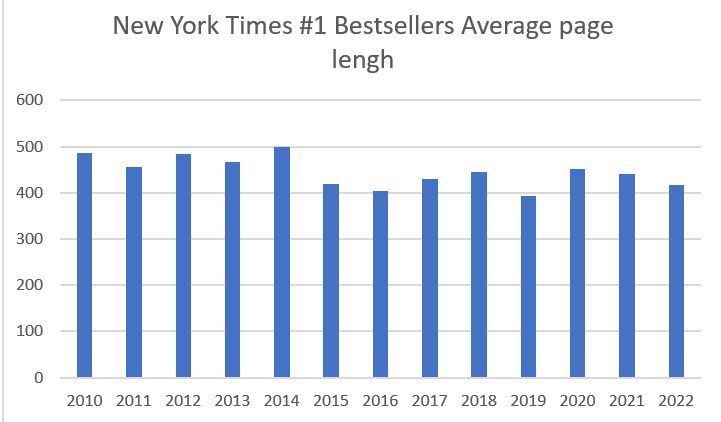
        I looked at the New York Times fiction #1 bestseller lists between 2010 and 2022. And finally, there is evidence that novels are getting shorter. The point at which the change happened seems to be  around 2015.

        Average page length has dropped 53.2 pages (or about 11%)  comparing the 2010-2014 years with 2015-2022. This change has a probability of 0.0095 of occurring by chance (unpaired t-test)  and is, thus, highly significant statistically. For one of the list’s most prolific authors, James Patterson, the drop in novel size is even more pronounced. His novels shrank by almost 80 pages from an average size of 455 pages in the first period to 376 in the second.

        A similar study by Wordsrated looked at the top three positions in the New York Times bestseller list between 2011 and 2021 and found a similar trend. However, this analysis pooled fiction and non-fiction titles.

        Why are novels getting shorter again?

        Precisely why this change has happened is unclear. Perhaps it is the fabled shrinking attention span kicking in, though I have never been very convinced that this is even a thing. My own favourite hypothesis is that it’s due to the growing market for e-readers and e-books during the second decade of this century. The graph below shows the sales of e-books in the US. From a slow start, they begin to take off from around 2010, making a change mid-decade quite a plausible consequence.

        A picture containing text, diagram, line, plot

Description automatically generated
        https://digitalpublishing101.com/digital-publishing-101/digital-publishing-basics/a-very-short-history/

        Why might the rise of e-books begin to erode novel size? For the simple reason that the weight of an 80,000 word book in your e-reader is exactly the same as that of a book twice that length. The reader is no longer so able to readily do a cost-per-page comparison between two possible purchases. This allows publishers to more readily accept works for e-publishing that violate the standard length guidelines.

        Persuasive though I find this argument, there is no evidence for it. And I should point out that the rise of e-books was advanced as a possible reason for exactly the opposite phenomenon: the increase in book lengths in the first decade of this century. The argument was that, by virtue of not being able to weigh the length, fat books were not intimidating.

        152. Special Offer

        My literary thriller, The Tears of Boabdil, will be on special offer on Amazon at 0.99 for a week from Friday 26 March to Thursday 1 April.

        A solitary undercover cop, torn between duty and desire, risks his sanity. Everything he believes he knows, including himself, is a story

        Grab your copy at this great price while you can!

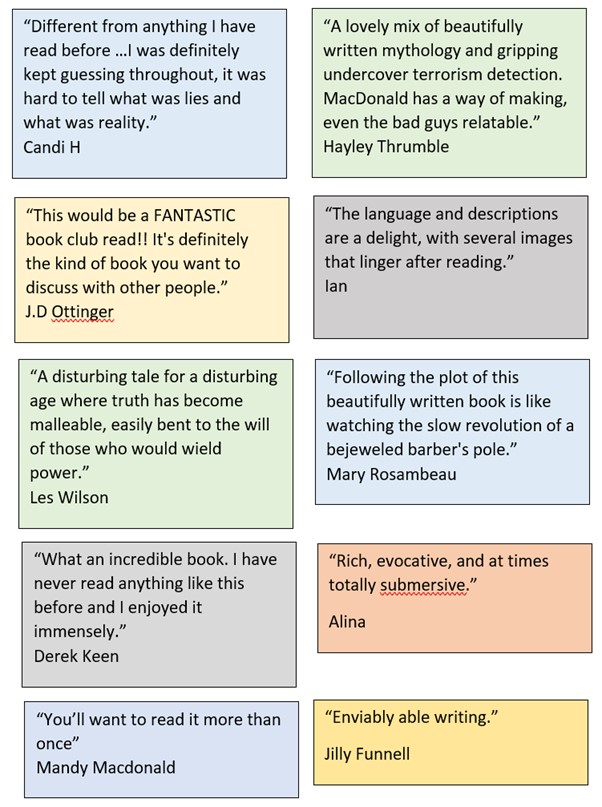
        Here’s what some reviewers have said on Goodreads

        They variously characterized the book as Thriller, Psychological Crime, and Fantasy Romance.

        Take a look and decide what you think it is.

        Buy The Tears of Boabdil.

        Amazon UK

        Amazon US

        146 How to get your book noticed and bought

        You send your book out into the world. But unless readers know it’s there, they can’t find and buy it. Without promotion, the work dies. I’m not a natural at promotion. In fact, I don’t even like it. But my experience is that there are things you can do. Some of them depend on seizing opportunities. Others just rely on doggedly working through the system.

        Opportunities

        I was lucky that there was a news event linked to the theme of the book—the opening of hearings in the UK’s official enquiry into undercover policing. I timed the production of the book to coincide with this date and was able to get some press coverage.

        The other opportunity has not yet come to fruition. But I’m part of the way there. I entered the novel for various literary prizes. And it has been longlisted for the McKitterick Prize. Judges won’t begin shortlisting until 2021.

        Press launch and reviews

        Tears was published on 24 September. Review strategy and pre-launch promotion concentrated on the paperback, paving the way for sales boosted by the press launch in November.  I secured 20 reviews across various platforms. NetGalley, from which I was hoping for great things, was disappointing—only two reviews. And I only managed to place two pieces on book-blogging sites.

        The press launch produced a significant boost. Forty two copies had been sold by launch date on 6 November. Five days later, an additional 54 copies sold.

        The launch made a small splash, which died away quite quickly. It wasn’t enough to generate sustained sales. The good news is that you don’t need to despair—you’re not in the hands of fate. There are things you can do that will make a difference and raise your book’s profile.

        Advertising

        Principal among the things that can make a difference is advertising. Amazon advertising, targeting the US market, began in early December. It worked, adding another 10% to sales.

        By 22 December, Tears was number 666 in the Kindle rankings for terrorism thrillers, and 1,062 for magic realism. Overall, its ranking climbed from number 1,683,775 to 99,986 (of over 14 million books) on Amazon.

        But it’s a little like succeeding in coaxing a spark into a handful of kindling. I need to find ways to get a warming blaze going and keep it alight.

        I don’t yet know what these ways are. It may simply be a matter of more advertising. But I’m hoping book discovery sites will make a difference.

        144. Press launch of “spycop” novel

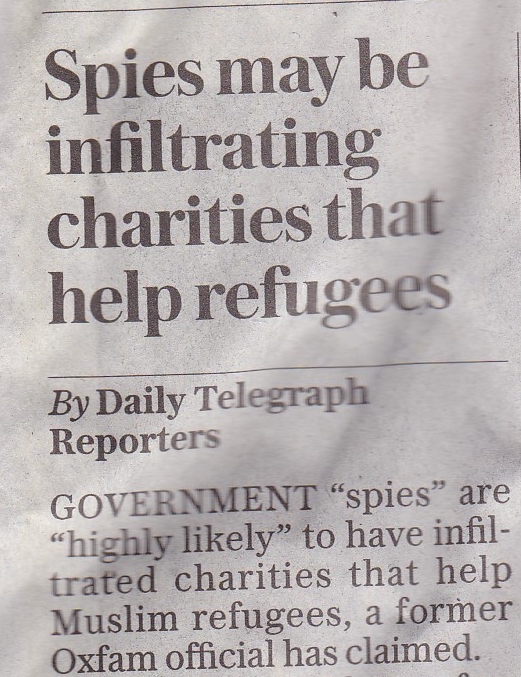
         The press launch for The Tears of Boabdil, coinciding with the opening of hearings in the Under Cover Policing Inquiry, has gone better than I could ever have expected. My publicists, Palamedes, excelled themselves in getting national news coverage in the Telegraph and the Express.

        They also arranged a radio interview on BBC Scotland’s Lunchtime Live  which has 850,000 listeners.

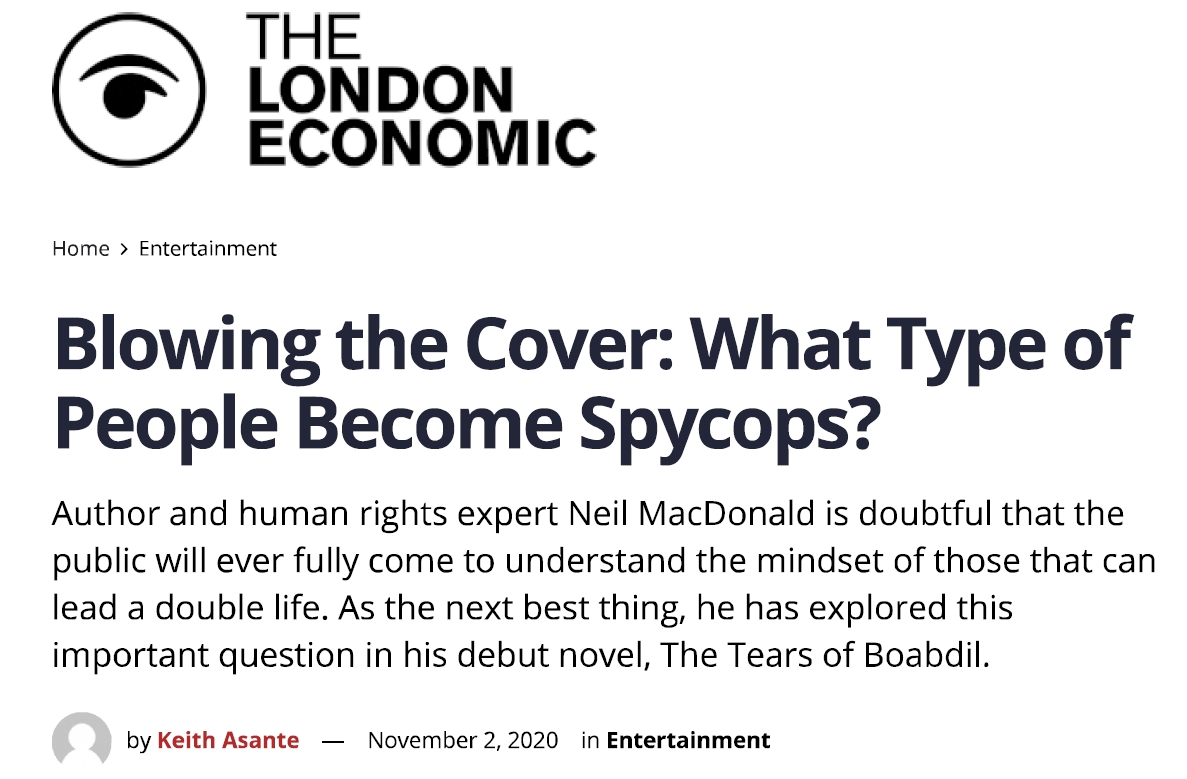
        I wrote opinion pieces in Readers Digest which has 280,000 unique visitors per month, and London Economic which has 3 million unique visitors per month.

        London Economic also picked up the press released and ran with a news article on 2 November.

        Have a look or a listen and let me know what you think

        143. What’s gone wrong with the Amazon “buy” button?

        My book, The Tears of Boabdil, was published on 28 September, 2020. A few days later, its Buy button for the paperback disappeared on Amazon and was replaced by an Out-of-Stock notice. A week later, it was available through re-sellers but not direct from Amazon.

        Even more bizarre, fluctuations in the Amazon sales rank for the book indicate that orders were still being placed.

        But friends who had placed orders received e-mails from Amazon offering to refund the money. Estimated delivery dates for orders placed at the end of September range from November to the beginning of December. The good news is that some people, who pre-ordered in September, have now been told the order is being fulfilled.

        I asked my publisher what was going on. They replied

        “We have seen reduced ordering from Amazon since they have re-launched their catalogue of ’non-essential’ items after prioritising stock orders for household and medical essentials at the peak of the pandemic. As such, their goods in service has been put under pressure and they appear to be struggling to keep up with the demand for orders. We can expect to see continued reduced stock ordering from Amazon for the short term – which has affected the order times being reflected on Amazon’s website. All other UK book distributors and wholesalers – who supply bookshops – are also functioning as usual, if slowly, and we are running uninterrupted supply for all orders we receive.”

        In April this year, Amazon was quoted in the Guardian newspaper denying this claim. Yet Amazon’s own seller central pages said “We continue to prioritize household staples, medical supplies, and other high-demand products coming into our fulfillment centers”. An article in The Bookseller in March indicated the same stock-management issue.

        A more conspiracy-theory-oriented explanation, having nothing to do with Covid, was offered by Writers Weekly. This article, dated March 16, 2017, alleges that the company has been pressuring print-on-demand publishers to use Amazon’s own print service by removing the Buy button from non-compliant titles. This doesn’t apply to my book which is not P-o-D, but the article notes in passing that “Amazon’s latest shenanigans have been affecting a variety of print on demand (and other) books for quite awhile now.”

        I checked the situation of twelve other sample paperbacks. They comprised a mix of large publishers, small houses and self-published books. Four (one third of the total) were listed as out of stock or only available through resellers. Three more showed low stock. The unavailable books included Robert and published by Sphere. Two of the four unavailable titles were self-published books, one was from a small press, and one was published by Sphere—Robert Galbraith’s (pen name of JK Rowling) Troubled Blood, released in September 2020  So, there seems to be no correlation between the absence of the buy button and independent publishing, nor with lesser-known authors.

        I’m persuaded that it is, indeed. a problem of stock management.

        If you have books in print or have tried to buy a book recently, have you seen this problem?

        142. On the launch pad

        My literary thriller, The Tears of Boabdil, is in the final weeks before publication, and my focus now is on publicity. With bookshop distribution successfully underway, thanks to my publisher, I’m concentrating on reviews, as described in a previous post.

        Here’s a flavour of the reviews so far, by which I’m delighted.

        “Neil MacDonald has skilfully fitted a complex plot and a diverse ensemble of characters, likeable and otherwise, into a space from which they almost, but don’t quite, burst out. The Tears of Boabdil is an ambitious, assured, and gripping debut novel.”

        Mandy Macdonald (no relation)

        “Having been given its time to breathe as recommended in the book, a story needs a satisfying and convincing conclusion. Neil MacDonald has achieved this, not by magic, but by enviably able writing.”

        Jilly Funnell

        In other wonderful news, one of my stories was longlisted for the BBC Short Story Award.

        The book is out on 28 September and has its press launch on 2 November. You can get it here

        141. Building a review strategy

        You’ve written, printed, and published your book. Then what? If nobody knows it’s there, you’ll get zero sales.  This is where publicity comes in.  In this post, I’ll talk about getting your book reviewed. The good news is you can ignore most of the options out there.

        Book sales come from advertising, word of mouth, searches, and reviews. I began to think about getting my novel reviewed about six months before the release date

        In the old days, you’d send your book out to the reviews editor of newspapers and magazines. My publicity company will try to place such reviews. While these are important, getting your book accepted is very hard. But the internet has transformed book reviews. Readers can leave reviews on the internet, And now there are BOOK BLOGGERS. Many of them have huge followings and can be very influential in driving sales.

        This is how I created a list of almost 800 potential reviewers.

        If you start searching online for how and where to secure reviews, you get inundated by information, much of it bad. And if you join discussion groups on the subject, as I did on Goodreads, you’ll find your in-box filling up with offers to give you reviews in return for money.

        Never pay for a review

        Reviews have two different purposes

        You want your reviews to do two different things:

        • Spread the word to lots of potential readers. For this, you want to target reviewers with a big following
        • Increase the ranking of your book on sites like Amazon and BookBub (I’ll cover BookBub in a later post on advertising). For this, the readers only need to review and like your book.

        Start early

        I started six months before publication. Here’s what I did. My navigation through the blooming buzzing confusion may help you. These are the key principles of my approach:

        • Identify the key sites
        • Locate bloggers who’re likely to be influential and sympathetic to your book
        • Create lists of reviewers to contact

        Three key sites

        There are a host of sites, blogs and apps. To make it manageable, I developed focus. The key general sites I aimed to understand are Netgalley, Goodreads, and Amazon.

        Netgalley
        One respected and key source of book bloggers is Netgalley. It acts as a portal for putting your advance review copy before reviewers. This site hosts over 380,000 reviewers, librarians and booksellers, 45,000 of them in the UK. Members produce 60,000 reviews a month.  It describes itself as helping “readers of influence discover and recommend new books to their audiences.” One top reviewer I checked had just under 4,000 followers.
        The majority of NetGalley readers are interested in Teens and YA, General Fiction, Mystery and Thrillers, and Sci-Fi and Fantasy, and there is least interest in Middle Grade, Humour, Horror, Sports, and Literary Fiction The site is free for reviewers, but they charge authors and publishers to list there (around $399-599). But, luckily, I already had access through my publisher’s promotion program.
        Data on Netgalley from John Hunt Publishing

        The key sites on which you really want reviews to appear are Goodreads and Amazon. Most of the influential bloggers post reviews on those sites.

        Goodreads
        This is a book listing and review site, perhaps the most important on which to secure reviews. Is now owned by Amazon, but operates independently of the parent company. It is the largest and best-known book review site. In 2018 it had 80 million users and listed 2.3 billion books and boasted 80 million reviews.
        Data on Goodreads from Expanded ramblings
        Amazon
        In the US in 2018, the internet giant controlled almost 50% of physical book sales and 83% of e-book sales.  Reviews, as well as adverts, on Amazon are therefore supremely important to boost these sales. Think of it not just as a sales platform, but as a search engine for books.
        Date on Amazon from The Bookseller

        Locate bloggers

        Apart from the reviewers on NetGalley, I needed to find some key bloggers and reviewers, particularly those who post on Goodreads and Amazon. There are millions, as any internet search will prove. But they don’t all read in my genre, and they’re not all in my country (where I would expect the majority of my sales to be concentrated). Some bloggers will only accept traditionally published books.

        So, I began to narrow down my search. On Goodreads and Amazon, I identified the relevant top reviewers in the UK. You can do this by looking at the number of reviews and what they review. There is no direct way of putting your book in front of these people. But, on Goodreads, there are forums so you can hang out where they do, and follow and friend them. The list of relevant Amazon top reviewers turned out to be surprisingly small—only three of the top 100 matched my criteria and one of these was also on Goodreads.

        You can identify top reviewers on Goodreads through listing them https://www.goodreads.com/user/best_reviewers. Similarly, the Amazon rankings are on https://www.amazon.co.uk/review/top-reviewers. Many of the key reviewers, unsurprisingly, are also top Netgalley members.

        Beyond the key sites, there are many book bloggers out there. You may already know some of them. If you don’t, or to add to your contacts here are a couple of useful listings of book bloggers that I used.

        Many bloggers will be completely uninterested in your genre and style. So expect to pass over most of them. I noted down perhaps 6% of entries, even though I’d searched by my genre.

        Every now and again, one of the bloggers will also list other book bloggers they follow. If you like their approach, you’ll probably like a fair number of those they follow. I found one such blogger who listed 13 others. Of these, almost a quarter were suitable for me.

        You can get a useful sense of how influential a blogger is by looking at the number of their followers. Where they don’t publish this number, you can still get a sense of traffic on their site by looking at their Alexa rank. You just type the site’s URL into the box and click.

        Build lists

        My initial list comprised almost 800 potential reviewers

        It included the obvious people:

        • Suitable friends and friends of friends (12)
        • Authors I know (including members of my physical and online writing groups) (70)
        • Followers of my blog (665). Of course, not all of these are potential reviewers.

        Then I began to create lists of the less obvious ones

        • Book bloggers I’d had contact with before, particularly for the blog tour for a collection of stories in which I’d appeared. (9)
        • Appropriate book bloggers I didn’t know (24)
        • Goodreads top reviewers (13)
        • Amazon top reviewers (3)

        Timing

        Choosing the right time is crucial. I wanted as many reviews as possible to coincide with the launch of my book in November. So the right time to approach potential reviewers was around six weeks before, in September.

        Activating the lists

        Any marketer will tell you, the key thing is relationship. Those people I already had a relationship with were simple—I just asked them for a favour. The unknown people needed some more thought. With some, I tried to build a relationship beforehand by commenting on their reviews. With others I researched in detail the genres they preferred, looking in particular for books they’d enjoyed that I had too.

        The principles of contacting a reviewer are really common sense but I’ll reiterate them here:

        • Research. Make sure you understand the kind of books they’re interested in, and that yours fits. Check that they are open to receiving review copies (many close periodically with long backlogs). Read their review policy and you follow it.
        • Personalise. Never do a mass mailing. Tailor each contact to the particular reviewer. Address them by their real name, not the name of their site. Identify something you have in common, particularly something in their blog you can comment favourably on.
        • Be polite. They don’t have to read your book. You’re asking them for a favour.
        • Proof read. Check your e-mail carefully for spelling or grammar mistakes. An illiterate message does little to sell an author’s competence.

        The final list

        Not all of the potential reviewers are equally suitable. I pared my list down to the top 50. In a couple of weeks, I’ll press “go”.

        140 Cover reveal: the evolution of a design

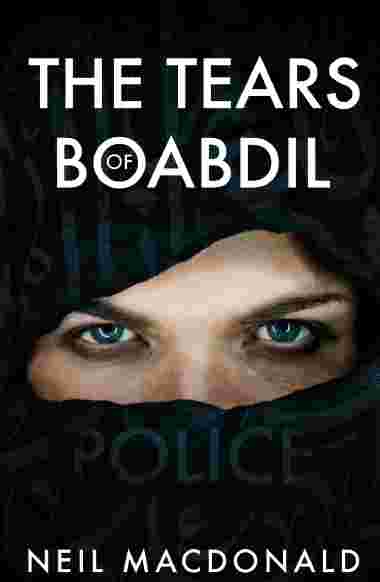
        My final cover for The Tears of Boabdil is back from the designer. I love the directness and mystery of the eyes and the subtlety of the blue Islamic lettering against the black background.

        Tears final cover

        My brief to the designer was that it had to say “police”, “deception” and “Muslim”.

        This was my first mock-up and the designer’s execution.

        Tears drafts

        I didn’t feel this fitted the brief, and combining two faces proved to be technically complex. So, we went through another round of design with a different concept to produce the final cover. You can see my thinking on the intermediate steps in this post.

        The paperback is now available for pre-order in the UK at https://www.amazon.co.uk/Tears-Boabdil-Neil-MacDonald/dp/180046018X/. The e-book will follow soon

        139. What would you pay? Pricing a book

        Oscar Wilde said that a cynic is someone who knows the price of everything and the value of nothing.

        Oscar Wilde

        Setting a price is an art, not a science. But it’s not all guesswork. As a trip round any shop will confirm, pricing at one penny under a round number is a common ploy to lure the consumer. So my price was going to end in 99 pence.

        Price

        Set a level too low, and readers will perceive it as having no value, set it too high and nobody will buy. Amazon (the premium book retail site) offers 70% return to the author on prices between £2.99 and £9.99, providing a range within which the sweet spot should lie.

        The average cost of a fiction title in 2018 was £3.23, but the important thing is to pick a level in relate to comparable titles, which takes a little research. Looking at some comparable authors, I located a price point at around £7.99 to £8.99.

        You also need to set a price that will cover your production costs. The print on demand cost for a single copy of my book is around £5, but costs come down as the number increases. A print run of 500 copies brought my unit cost down to under £2.

        Finally, you need to factor-in discounts for wholesalers and retailers. Assuming 45% discount on a paperback and 30% on e-books, I calculated that a price of £7.99 for the paperback and £3.99 for the e-book would give me a return of £1.20 and £2.79 per copy respectively.

        pricing strategy