
86. Rejection is your friend

26782696-stamp-denied-with-red-text-over-white-background

Rejection can be hurtful. But all writers have to learn to accept it. It seems like someone is telling you that your writing is no good. But there’s a huge amount of subjectivity in the decision-making process, which a writer doesn’t normally glimpse.

I just had a story rejected by Every Day Fiction with enough feedback to illuminate the process of decision-making. There are several reasons why a story might get turned down:

  • The writing is no good
  • The writing is good, but the story doesn’t work
  • The writing is good and the story works, but it’s not what the editors are looking for

The first two reasons are objective, the third is subjective. But, of course, the first and second reasons also involve judgements by people and can also be subjective. You rarely discover what has led to a rejection.

In this case, the magazine sent me the reports by the four readers. They had to score the submission between 1 and 5, and their scores varied between 1 and 4: a 4, a 3, a 2 and 1. If scoring were purely objective, this would not be possible.

The reader who scored me 1 said “This is an interesting beginning to a story but not a complete short tale as yet”. So that was a rejection reason two.

The reader who scored me 4 said “I love it when a story takes me by surprise, as yours did. Usually I find the ‘it was a dream’ motif a pretty hard sell. But here, the dream (or initiation) was an integral part of the narrative. Also, you capture quite a story in very few words. Nice. Your prose is gorgeous, too. I was taken in by its imagery and sound quality”. So that was an acceptance.

The remaining two readers also offered variants of rejection reason two. “The ending was a let-down” said one, who also commented “very strong writing”. They offered me the opportunity to rewrite and resubmit. Confident that the writing was good, I looked again at the structure.

I know enough about reactions to my endings to understand I have a problem here. I like open-endings. Readers, by and large, don’t.  I’m working on beefing up the ending now.

Rejection, as Sylvia Plath once wrote, shows that you’re trying. Make rejection your friend. It can help you try better. And editors who tell you the reasons for the rejection are priceless.

78. The Big Push

It was the summer of the big push. The plan for this year was to get across no-man’s-land and find myself an agent. In June, my writing career was poised on the brink of breakthrough.

horses-mud-560x363
The Great War Project

As I reported in this blog the literary consultancy, Cornerstones, asked to see as revised version of my novel The Golden Illusion. They act as scouts for agents. I was thrilled!  The book is a mystery story with a twist. The sleuth is a conjurer who believes he hunts an ancient illusion. Instead, he reveals a conspiracy concealing an atrocity that spans the centuries.

Writing is a cruel game though. At the end of August, Cornerstones decided not to represent the book. Though they were very complimentary about it, it was still a rejection. They said:

“The concept is high – a magician as your protagonist is gripping – he’s intriguing and mysterious and powerful. His voice is accessible and engaging and the ancient magic has an allure. In a way, this is submittable right now and you may well get agent interest.”

Despite that, they felt it needed more work – more than they were willing to risk. So here I am, still in no-man’s-land, all barbed wire and mud and shell craters filled with water. Another big push repulsed. I’ve been through this before when a publisher showed interest and then rejected the book, and also with an agent.

All you can do is pick yourself up again.  And again. And keep heading across the field to the far trenches. But I get better at handling defeat. I have flanking manoeuvres now. Though none of my novels has yet survived going over the top into hostile terrain, I know I can get short stories published. I fired off five stories to magazines. I have another two on the launch pad. With that many, there’s a good chance of some being accepted and cheering myself up. In fact, one story, Bomaru’s Quest Part IV, has already been accepted and published today by Literally Stories. You can read it here.


76. Why it’s worth writing short stories

Do you suffer anxiety about whether your writing is any good? If you don’t, you’re probably not doing it right. You get lots of advice and encouragement when you start writing. Most of it is well-meaning. Much of it is wrong – at least for you. There’s one thing I wished I’d known when I started. Of course, like most well-meaning advice, it may not be valid for you. But my advice is write and publish short stories, even if your main interest is novels.

Short story Stephen King

Why? Many reasons, but these were the main ones for me:

  • Polish your craft.
  • Boost your confidence
  • Measure your ability.
  • Build a track record.

Polish your craft

Short stories are short. You can write them faster than a novel and revise them more easily. It’s a simpler apprenticeship to serve.

Boost your confidence

Publishing and selling a novel is hard. It takes lots of work, and lots of luck. Mostly, you get negative feedback from agents and publishers (if you’re going the conventional route) or reviewers and sales (if you’re self-publishing). It can dent even the toughest hide and the most humble spirit. Self-doubt eats away at your confidence. It doesn’t have to be like that. It’s easier to publish short stories than novels – there are many more outlets, both print and on-line magazines. The website Duotrope lists 5,821 markets. There will almost certainly be one that will publish you. Nothing beats the boost of seeing yourself in print. If you’re just starting out, these magazines accept over half of the work submitted to them.

Measure your ability

Pick your market. Different outlets for stories have different acceptance rates.  I didn’t know about acceptance rates when I started out. Until 2015 I was unwittingly submitting stories to prestige magazines that accept less than 1% of everything submitted to them. No wonder I wasn’t getting published. No wonder I was dejected and felt talentless. In 2015 it all began to change when I got hold of data on acceptance rates. Duotrope  publishes these figures. Armed with them, I can target where I sent my stories.

place in market

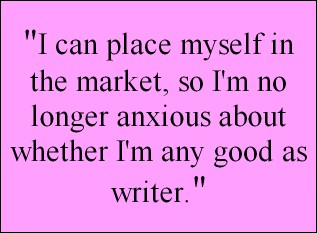
Last year, I had stories accepted by Alfie Dog and The Opening Line. Not so hard to do since both accepted around half the material sent to them. I got bolder. Gold Dust, with an acceptance rate of 12.5%, accepted a story, Zhuang Zhu’s Dream, about a man who has memories he believes are not his own. Then this year Structo accepted Interstices, a slipstream kind of story, to be published in issue 16. At the time of submission, Structo accepted only 3.85% of the material submitted, and currently the number is (an impossible) 0%. Now I can place myself in the market, so I’m no longer anxious about whether I’m any good as writer.

Build a track record

The publications give me a track record. Now, when I submit book manuscripts to agents and publishers, I can claim some credits attesting to my ability. The outlets with 50% acceptance rates don’t help this, but the two below 20% do.

75. The Sunday Times Prize – tempting the muse with breadcrumbs

It’s worth £30,000 to the winner. At £5 a word for a 6,000 word story, the Sunday Times EFG Award is the richest prize in short story writing. Hilary Mantel was only a runner-up in a previous year’s competition. So you might say it’s hubris for a tyro writer to enter such a competition. And you might be right. But I’m doing it anyhow.

Partly, I’m doing it because I can. Last year, I would not have been eligible. Entrants must already have been published by an established house or magazine. This time last year I hadn’t reached that mark.

Partly, I’m doing it because there’s a story I’m struggling to tell, and the competition gives me a spur to doing it. Assuming (reasonably) that I don’t win, at least I will have written the story.

The idea responds to my plea for new stories about post-Brexit Britain. My first attempt at writing read so much like a rant that one of my writing friends didn’t even realise it was supposed to be a story.   So I tore the thing apart and started again. This time, I created a version with which I’m happier.

Land Girl is a tale of Margaret and Malina. Margaret is a British pensioner with traditional working class values, but also a strong streak of prejudice against the immigrants who she feels threaten her way of life. Malina is a Roma immigrant and Margaret’s carer, threatened by racist abuse. Margaret loves music and dance. Malina’s singing is beautiful. Finally, this brings them together. Allie, a community activist, is the catalyst for challenging Margaret’s attitude to immigration. The political rant is now buried in one small section and narrative is now foregrounded.

Alright as far as it goes – a tale of a decent person overcoming prejudice and recognising the humanity of a foreigner. But it’s not a winner. Friends’ comments have helped to improved and polished it (thanks Derek and Paula).  I’ve checked that there is a narrative spine that drives the story forward, and short ribs of added tension that add depth – a technique I described in an earlier post. I’ve looked for opportunities to create repeating motifs that reflect each other in the hall of mirrors. None of this is enough.

Cordoba

What else can I add?  I wonder.  I know I need another narrative axis at right angles to the first. A hall of mirrors may not only reflect, but also distort and change perspectives. I’m still searching for what that right angled theme may be.  My intuition is that it may be to do with music.  Or with land and maps. Nothing is gelling yet. You can’t always tempt the muse down with breadcrumbs.

73. Progress

I’ve been lax in reporting on where my winding path as an author has led. So here’s a brief update on my story … whatever its ending turns out to be.

snakes and ladders.jpg

Apart from writing, of course (how easy it is to forget that central focus!) my preoccupation has been deciding which of my existing novels to pitch.  I covered this in a previous post, describing how I’d outsourced the problem by sending both books to a literary consultancy for critical reports. The reports are back.

The consultant made some detailed comments, not least about my tendency to over-punctuate and slips in point of view. But the main conclusion is:

“The first thing that is clear to me, from this MS and also your potential submission chapters of The Golden Illusion, is that you are well capable of writing a commercially successful novel. That said, I am not entirely sure that A Prize of Sovereigns is that novel … Of your two manuscripts, and with the caveat that I have only seen a few short chapters and a synopsis, The Golden Illusion is your more intriguing and original story.”

A disappointment, because I still believe A Prize of Sovereigns to be the better book. But I was thrilled that he liked The Golden Illusion. Even better, the Director of the literary consultancy, Cornerstones, has asked the see the revised chapters of Illusion. Cornerstones, a leading consultancy, act as scouts for agents. I sent it off to her today.

The decision to spend my money on the reports, rather than on attending the Winchester Writers’ Festival this year, may have paid off.

Updating other stories – I was not short-listed for the Costa Short Story Award. But the story I submitted has been accepted for the forthcoming issue of Structo. This literary magazine is one I’ve been trying to get into for about a year. Since they have an acceptance rate of only around 3%, this is an achievement of which I’m proud.  I did not win the crime writing competition I entered.

Onwards!

31. What price artistic integrity?

This week I’ve had my first brush with the writer’s moral dilemma. Namely, to stand on principle and refuse to change our work, or to accommodate editor’s requirements in the interests of publication.

Those of you who have been following this journey know that my strategy as a writer is to accumulate artistic credentials by publishing stories in literary magazines. As I explore the caves and grottoes of the literary labyrinth, slaying dragons and accumulating treasure, the plan is that these magic credentials will deflect the cold thrust of rejection from literary agents and publishers.

I resubmitted a story to an editor who had enjoyed it but felt that though it had a beginning and a middle, it lacked an end. Fair comment. I wrote an ending. He got back the next day to say the ending still did not provide the resolution he wanted.

Now comes the dilemma. I had crafted the ending, with some thought, to leave the reader unsure about which of two supplied explanations was the truth, and had stopped the tale just short of clear indication of what came next. That’s me. I like ambiguity. The world is full of things we don’t fully understand, and I have no problem with that. But I understand why it might be a problem for others. So, should I take the ending one step further on to resolve the ambiguity, making it, in my opinion at least, a weaker story? Or should I stand on my artistic dignity and dicker?

It took me only five minutes to decide. Artistic dignity is for those who already have a reputation. I changed the story. After all, I still have the earlier version. Did I sell my soul, or am I one step closer to being able to afford integrity?

28. To publish or not to publish?

Who knew there were so many tactical decisions in a writer’s life? As earlier posts attest, I keep having to make decisions. The gentle escapism into the creative craft is only the first step on a long journey. My dilemma may strike a chord with you. The decision I have to make now is whether to continue the serialised publication of A Prize of Sovereigns. Sixteen chapters have already appeared, and I’m committed to publication of the first 24. Do I agree to the next 12 (which would mean around three quarters of the book has been published online)?

prizesovereigns_squclean_01I made up a list of pros and cons. I consulted friends. The pros are:

  • Since I’ve decided to switch to pitching my mystery novel The Golden Illusion, it will continue to provide exposure for A Prize of Sovereigns and a readership for my work.
  • Some publishers like to see demonstration that a book has enjoyed online success
  • Along with the serialisation, the book gets an edit

The cons are:

  • The readership this site attracts is not large. The first 12 chapters attracted 555 unique page views, and about 20 regular readers
  • Some publishers will not touch a book which has already appeared online
  • The edit is a micro copy-edit, not a strategic macro-edit.

Decisions, decisions!

22. The dilemma of evidence

I’m considering radically changing my approach to getting published. I’m trying to decide whether I should stop pitching my historical novel. A Prize of Sovereigns, and start pitching my mystery novel, The Golden Illusion.

I’m a scientist by training. I like to make decisions based on evidence. Understanding the signals about your work is hard because it’s not clear what’s evidence.

I just got a really interesting response from an agent to whom I had pitched A Prize of Sovereigns. It was unusual, in that it was feedback, not just a template no. This is part of what he said.

You have a lively style, but – you knew there’d be a “but” – the situation you describe, and the language you employ, is in my opinion too familiar to commend your book to editors who are, like agents, even more boringly cautious than usual about new writers in this extraordinarily harsh publishing climate.

[It} needs – in my view, and you will know that all publishing judgements are wholly subjective – a distinctive narrative voice and original twist if it is to commend itself to today’s jaded and impatient readers

As he says, all publishing judgements are subjective. But, this is the twelfth agent who has turned down A Prize of Sovereigns. The problem for an ex-scientist is deciding whether twelve rejections, all subjective, is evidence. It’s not a statistically significant sample. J.K. Rowling had 12 rejections for her Harry Potter series.

Nevertheless, I think there may be a message there. I’m getting clear feedback that I can write. But I may be putting my effort into pitching the wrong book. Don’t get me wrong, I’m very proud of A Prize of Sovereigns. I believe in the book. It’s a story of two realms in peril, of rulers playing for high stakes, of conflict within dysfunctional families, of ordinary folk trying to build their lives amidst war and chaos. But it’s not just an adventure tale of intrigue, war, and revolt. Buried in the story are some chunky issues. Is goodness a function of a person’s character, or the outcome of their actions? Can absolute rulers bend events to their will? Are there prices too great to pay for personal independence? What does war do to people’s humanity? How did propaganda work in medieval Europe? What does a Prince do when confronted by a teenager who claims to have religious visions of her mission to save the country from invasion? How did technology influence conflict and the exercise of power?

The thing is, there’s no simple way of communicating this to an agent or publisher. The elevator pitch is the one sentence description of your book you’d give to a publisher if you shared a ride with them in a lift. Prize of Sovereigns’ elevator pitch is.

‘Two rival medieval princes attempt to bind events to their wills, with unintended consequences.’

It doesn’t exactly convey much more than knights in armour. Compare it with the elevator pitch for The Golden Illusion.

A mystery story with a difference, in which the detective is a hapless conjurer searching for the secret of an ancient illusion, and the crime spans the centuries.

This makes crystal clear the main twist of the story. It may not be such a complex book, but it’s easier to convey what it’s about. My heart is telling me to keep pitching A Prize of Sovereigns, but my head is telling me to switch horses. I still have three pitches out to agents, so I don’t have to decide quite yet.

20. Costa Short Story Award

It’s Costa Short Story Award time. The competition opened at the beginning of July and closes at the beginning of August. First prize is £3,500 and a massive boost to reputation. I’ve been dithering about which story to enter. If you’ve read previous posts you’ll know that my strategy for achieving fame and fortune is to rack up some literary credits, with which to impress agents and publishers. Perhaps the thoughts I’ve had about the Costa will help others whose strategies are similar.

Forget the question, why enter the competition. I can’t tell you. Yes, I know the chances of winning are smaller than those of dying in a meteor smash (which are 1 in 250,000 if you care to know). Call it the triumph of hope over experience.

Deciding to enter was easy. Deciding which story to send, that was a whole other problem. I looked at the shortlisted stories for 2014 and for 2013. I also looked at the profiles of the judges, though that’s less importance, since you have to get through the panel of readers to the shortlist before the judges ever set eyes on the story. For what it’s worth, the judges are three novelists (two of whom write women’s fiction, and one rather more experimental stuff), an academic who specialises in publishing, and a literary agent.

The profile of shortlisted entries wasn’t hugely comforting. Five of the six 2014 shortlist were women, and so were five of the six 2013 and 2012 shortlists. Two of the 2012 shortlist also made it in 2013. The judging is blind, so this has nothing to do with reputation. The stories all had three things in common – they were about the inner life of the main characters, the writing was elaborate and literary, and they dealt with the oddity of everyday life. I’m not a woman, and this really isn’t the way I write.

For about a month, I was sure the story to enter was one about a man who has memories that are not his. This is one of the stories that almost got published, and that I have been invited by the magazine editor to rewrite and resubmit. I read it to my writers’ group this week, and they made helpful suggestions for improvement. But one of the comments stuck in my mind. One group member said ‘Don’t put it into Costa. It’s a proper story. It’s got a beginning, a middle, and an end.’

I went back and looked again at the shortlisted stories, and sure enough they’re more dreamlike, with less identifiable structures. So I added ‘anti-narrative’ to my list of characteristics. Then I assessed what I think are my four best-fit stories against all four criteria. My intended story scored highly on the psychological dimensions but more poorly on others.

So, I’ve changed my mind. According to the competition rules, I had better not say anything about the story in case this reveals the identity of the author during the judging process. But I can say it’s much more anti-narrative, literary in style, and playful. I’m hoping that the playfulness will scrape it through the reading panels by virtue of intrigue, on the same basis that a tutor at University once said of an essay I’d written ‘I can’t tell whether this is very clever or very stupid.’

As I gave the story a final polish, just for fun I ran it and the winning 2014 entry through the copy editing tool I described in the last post, Pro Writing Aid. The comparison didn’t really tell me much, but was amusing. My story scored better for over-used words, for clichés and redundancies, and for ‘sticky sentences’ (sentences with low impact words). The winning entry scored better for avoiding adverbs, passive verbs, and slow-paced sentences. These comparisons say nothing about the quality of the story, but do maybe say something about the writing.

I still haven’t submitted the story, but I’m getting there.

14. Rejection

The publisher who liked the first chapters of A Prize of Sovereigns and asked to see the whole book has turned it down. It’s another rejection, but at least it made it to the second stage. My thoughts are focussed now on the Winchester Writers’ Festival this weekend, where I have meetings with an agent and a publisher.