
8. How do you know what agents and publishers want? Some key websites.

Let’s say you’re writing a vampire novel (please don’t, it’s been done to death). How do you find out whether this is what the market is looking for? Are you spending hours writing a dark mystery novel when what everyone wants right now is spy thrillers? One editor, for example, fourteen hours ago was looking for “original fantasy! No elves, no orcs, no dwarfs, no euro-centric worlds. Give me something new!” and “non-military space opera! Well-developed characters, intriguing plot, original world building”. A day ago, another was looking for “a romantic comedy featuring hockey players! Bonus points for an enemies to lovers conflict”.

How do I know this? The Internet of course. All this information, and loads more, is on a website called MS WishList (http://www.mswishlist.com/). It is one of several such sites. Another is Agent and Editor Wishlist (http://agentandeditorwishlist.tumblr.com/). And then there’s the twitter frenzy of #mswl. Agents and publishers post their interests on these sites. There’s even an online pitching party four times a year on twitter at #pitmad (short for pitch madness) where you can pitch your completed manuscript directly. The next one is on Thursday 4 June from 8 a.m. to 8 p.m. Eastern Standard Time (1:00 p.m. to 1:00 a.m. UK time).

Of course, the agents and publishers who use these sites are generally the smaller ones. But some of the larger companies also periodically indicate what they’re looking for. Agents at Curtis Brown, one of the largest literary agencies, recently published a list of books they loved and what they would like to see more of (http://www.curtisbrowncreative.co.uk/blog/the-last-book-i-loved-recommendations-from-the-curtis-brown-agents/)

And then there’s the industry trade magazine, the Bookseller (http://www.thebookseller.com/) if you want to keep up with what’s hot and what’s not. You’ll find a lot of articles there about how the publishing world has been transformed by the e-publishing and self-publishing technological revolutions, and arguments about whether power in the industry has been transferred from publishers to readers, or to authors.

When I discovered all these websites, in addition to those of agents, publishers and magazines I had researched as being of interest to me, my heart sank. Were there really enough hours in the day to keep up with them all, and leave the odd minute here or there to do some writing? Of course, if you’re diligent you will keep up with them all. However, if you’re indolent like me, you’ll want something more digested. I confess the only thing I read regularly is the weekly (free) newsletter from Authors Publish, which I mentioned in a previous post. They highlight different publishers and magazines you can approach. That’s how I found the publishers to whom I submitted A Prize of Sovereigns. They have a really useful overview of publishers you can approach directly (http://www.authorspublish.com/the-top-20-publishers-for-new-authors/).

You do have to somehow keep tabs on what the market wants. Going to talks at Literary Festivals can be the sluggard’s way of doing this. The Winchester Writers’ Festival is coming up in a month’s time, and I’ll be there. I have one-to-one meetings lined up with an agent and a publisher. I’ll let you know how I get on.
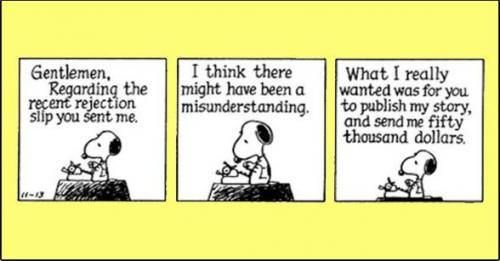
5. Rejection hurts – the dark night of the soul, the light at the end of the tunnel and other clichés

J.K Rowling, with sales of 450 million copies of her Harry Potter series, received 12 rejections before she got the deal with Bloomsbury. The judgements of agents and publishers aren’t infallible. They’re just informed opinions about what is likely to sell. They can be wrong.

You tell yourself this when the rejections start coming in. The first one or two I was able to deal with as disappointing. As it got beyond five or six, I began to wonder “Can they all be wrong?” Maybe, I thought, my book isn’t as good as I believe it is. Maybe it’s the wrong book. Maybe I need to wait until I’m a better writer, and I’ve learned more.

By the end of 2014, I really felt that the book just wasn’t good enough. I stopped submitting to agents. Friends in my writing group tried to console me, but they were friends after all. I stopped listening to them. I said that until someone in the business told me I had a good book, I wasn’t going to believe. I weighed up my options. Option one, I could abandon A Prize of Sovereigns, and start work on the new book that was taking shape in my subconscious. Option 2, I could go back to a literary consultancy for some work on the book. Option 3, I could just tough it out, and continue to try to place the book, pretending that I believed in it.

I think most writers go through such times. People like to tell us it’s character-building. Really it’s just shitty.

In the end, what I did wasn’t completely any of the options I’d worked out. I did start work on my new book, but I didn’t completely abandon A Prize of Sovereigns.

At the same time as submitting it to agents, I had also been entering it for novel competitions. I didn’t win any prizes either. More rejections. But it was a small step from the competitions to try offering it to publishers who accepted un-agented submissions. So I was mixing option 1 and option 3. And then I realised there was also an option 4. If I started submitting my short stories to literary magazines I would increase my chances of success, which might make me feel better about my writing ability, and I might also built up some literary credentials with which to impress agents more.

I had submitted a few stories to magazines in the past, rather desultorily. I had 100% rejection rate there too. But I had never approached short stories as strategically as I had novels. I didn’t really know anything about what made for success.

Here’s another top tip coming, if you’re interested in placing short stories. There’s an amazing website called Duotrope (www.duotrope.com). For a relatively modest subscription it puts all sorts of strategic information at your fingertips. It’s a listing. You can look up what sort of stories different magazines are interested in, and what genres they publish. Now of course you can get that information from the magazines themselves. What you can’t get from them is their acceptance rates and their response times. When I looked up the magazines I had submitted to in the past, I almost slapped myself on the side of the head. Every single one of them had an acceptance rate of less than 1%. Unless I was better than 99% of other writers, of course they weren’t going to publish me.

At the beginning of 2015, I began to make a list, and started more rationally targeted submissions. I selected a group of magazines with acceptance rates ranging from the virtually unattainable below 1% all the way out to under 50%. I decided that submitting to anything that accepted more than half of what was sent to them wasn’t going to help me get those much needed literary credentials.

The new strategy paid off quite quickly. I had a story accepted in February by Alfie Dog, an online site with a 47.5% acceptance rate that sells stories in much the same way that iTunes sells music (alfiedog.com/fiction/stories/neil-macdonald/). It wasn’t a high prestige publication, but it was an acceptance. It did wonders for my self-confidence. And then the following week, an online publisher, Big World Network, offered to serialise A Prize of Sovereigns. Publication began on a weekly basis in May (bigworldnetwork.com/site/series/aprizeofsovereigns/).

At last, I could begin to believe in my novel again. Someone had seen merit in it. I didn’t abandon the short story strategy but began to send stories to magazines with tougher acceptance rates. I also began to tailor stories for particular magazines. Up until the present, all I’ve had is rejections, but some of the rejections have been very cheering. A magazine with an acceptance rate below 30% liked the writing so much they asked me to submit other work, as did one with an acceptance rate below 20% and one with an acceptance rate below 3%. I haven’t broken through yet into the literary firmament, but finally I have some reason to believe it can be done. Instead of blank rejections, some editors have taken the trouble to give me critiques and explanations of what made them decide against publication this time. You never get that from an agent.

That pretty much brings you up to date with where I’ve got to. Except for one last thing. A well respected publisher to whom I sent the first 30 pages of A Prize of Sovereigns liked it and asked in April to see the whole manuscript. They’re still looking at it. My fingers are firmly crossed.

This ends the historical section of the blog. I can stop relying on memory. From this point on, you’re along for the ride with me. I may make it, I may not. Whatever happens, I’m sure I’m going to learn new things along the way.

4. After the writing is over – publishing

So, you’ve written the definitive novel of the twenty first century. What do you do then? Sit back and wait for the plaudits to flow in? Well, no. So far nobody knows you’ve written it, apart from your friends and your writing group.

You’ve had to think like an artist when you wrote the first drafts of your novel. You’ve had to think like an editor, when you revised them with a readership in mind. Now you have to make another mind-switch – you have to get your manuscript in front of a publisher, and to do that you have to think like a marketer. Nobody said it was easy being an author!

Who would your book appeal to? What makes it different? You’re competing with an awful lot of other manuscripts. There were almost 305,000 books published in the US in 2013, and 184,000 in the UK in 2011. And in the Internet era, we can all be publishers – in 2012, around 391,000 books were self-published in the US. Sounds good, right? However, these are the tip of the iceberg. Literary agents receive around 1,000 manuscripts a year, and select only a handful of them. Most manuscripts simply aren’t good enough in their judgement, and even among the good ones, they will only choose the ones they think will make them money.
So, in my case, I’d finished the manuscript of A Prize of Sovereigns. I was sure it was as good as I could make it without input from a professional editor. I was upbeat. I was proud and confident. I researched what I had to do to get it published.

You can of course, as I noted, self-publish. The Internet has shaken up the publishing industry. It’s very easy for anyone to publish now, through sites like Amazon Kindle and print on demand companies like Lulu. But it’s not so easy to self-promote and distribute. That’s, at least in theory, where traditional publishers with their distribution networks and marketing departments still have an edge.
I decided I wanted to publish traditionally. Then came the next hurdle. Most of the big publishers will not accept unsolicited submissions from authors. To get to a publisher, you generally need to go through a literary agent. There are exceptions to this. A number of smaller publishers will look at manuscripts from un-agented authors. You can find out who these are by signing yourself up to the free newsletter produced by Authors Publish (www.authorspublish.com). Signing up to this newsletter is another one of my top tips.

Undaunted, I set about finding myself an agent. You can find agents’ details on a number of websites or in the Writers and Artists Yearbook. Look carefully at what they say they’re looking for, and who they already represent. I made up a list of agents who seemed to have an interest in my kind of book, and then worked my way through them. Some I e-mailed, some I saw face to face. Literary festivals are good places to meet agents. The annual Winchester Writers’ Festival is one of my favourites, because it has a reputation as an event where agents and publishers are actively looking for new authors. You get 15 minute sessions with agents, publishers or authors of your choice as part of the entrance fee. By the end of 2014 I had amassed 10 rejections.

One agent told me that A Prize of Sovereigns lacked the historical accuracy to be classed as history, and lacked the magic to be classed as fantasy. Another agent said no, it would appeal to both markets, but she didn’t relate to the characters.
When you submit to an agent you usually need a few sample chapters, a synopsis, and a query letter. Usually the synopsis has to be a page or less, though some agents want something different. Make sure you understand clearly what your agent of choice wants. I became quite adept at writing the synopsis for a complex story with seven point-of-view characters. Clearly, in a page, you can only outline the major elements of the story arc, so you need to make sure you know exactly what they are. Don’t get bogged down in detail. Something that helped me was writing a one paragraph summary of each chapter and then paring this down to the essential elements.

There are some dos and don’ts I’ve discovered about synopses.

  • A synopsis should normally be one page.
  • It is a simple and factual summary of what actually happens in your story. So avoid temptations to write as if you were creating the back cover jacket. Never use promotional language, such as describing your book as “heart wrenching” and never ask teaser questions like “what is the terrible secret Emily is hiding?” Give the answer, not the question.
  • It should be written in the present tense. So, “Emily hides the terrible secret” and not “Emily hid the terrible secret”.
  • The first paragraph should contain a statement of the main point of the book. This is your “elevator pitch”. An elevator pitch is the short 30 second description of your book that you would give if you suddenly found yourself face to face with your most desired agent or publisher in a short ride up in a lift.
  • Subsequent paragraphs should add more detail
  • The query letter is a business letter. Don’t put in lots of detail about how you came to write this book. They don’t care. The letter tells the agent what your book is, who it is for, how long it is. Simply state the title, the word length and the genre.

Don’t under any circumstances say that you don’t write to a genre. That will just make you seem like an amateur who doesn’t know anything about your market. The letter also includes any detail about your life and your writing credentials that may be relevant. For example if your book is set in a restaurant kitchen and you are a chef, this is relevant. If you have been published elsewhere, or have won any writing competitions mention these. Finally, it should give an indication of what it was about this particular agent that made you approach them.

I learned all these things, and put them into practice. I chose my agents with care, but I still got 10 rejections. Rejection hurts. Don’t let anyone tell you different. It eats away at your self-confidence. I’ll tell you about how that affected me in the next post.

Snoopy