The Scrivener’s Forge 1

schmiedefeuer
Metoc

A new writing exercise every month. When you focus on one aspect of writing at a time, you can concentrate on making it the best you can possibly create. That way you can reach a professional level that may be harder with longer works. We’ll explore one aspect of the craft each month.

If you comment on other writers’ efforts, they’ll usually comment on yours. So you get lots of critiques, advice, and encouragement.

Pleaase don’t post your entry in comments here. Create your entry on your own blog, and then click the little blue frog to join the link-up and read other people’s work..

1. Drawing from life

Observing and listening are key tools in a writer’s arsenal. Sit somewhere public and eavesdrop on a conversation.  Listen not only for interesting stories, but also turns of phrase and mannerisms.

Exercise

Turn some of what you hear into a short love story, not longer than 500 words. You may need to do a lot of twisting and reforging of the dialogue to make this work.

83. My secret formula for flash fiction

I’ve been writing Friday Fictioneers, hundred-word stories, for three quarters of a year now. That adds up to 40 stories, each of which has been peer-assessed. I wondered what I could learn from analysing those assessments. Which tales garnered the greatest response and what was distinct about them?

The number of people reading varies each week, depending on season, and whether there’s a public holiday. So totalling the reads doesn’t tell you much.  The average number of reads was just under 91 per story, ranging from 123 for last week’s offering to 40 for my first one.

There is a better way of understanding which stories resonated. I calculated the proportion of likes and comments per read, and then analysing the narrative characteristics.  Eight stood out as garnering above-average likes and comments – After the Asteroid, Lovers, Parting, The Cellist, Leaving, Mud, The Fury, and The Curtain.

A spoonful of medicine helps the sugar go down

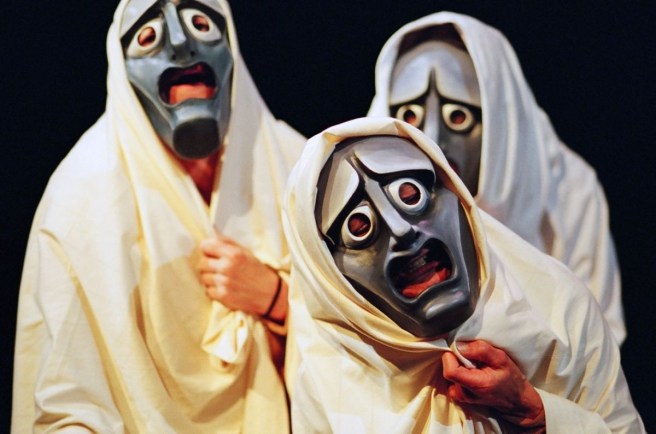
greek_tragedy_mask.jpg

Of these eight “winners”, four were sad – almost half of all the sad stories I’ve written. By contrast, only one of the eight was sweet – 16% of the sweet stories.  So tragedy wins.  “Sadly beautiful” was a comment on After the Asteroid, which deals with dementia and which received the highest ratio of comments and likes to views.

ff-after-the-asteroid

Relationships are essential

lovers

These “winners” also included half my stories about lovers, and a fifth of those about family. No surprise there – relationships are central to a good tale.  Of Parting, one commentator wrote, “’Some moments are so perfect they deserve to be protected from life’s corrosion.’ Oh, what a lovely line! Something to live by.”

Violence

violence

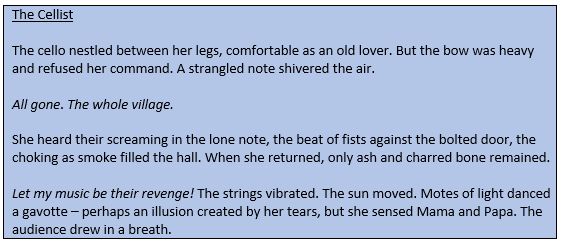
Violence was also a key feature. It occurred in three of the eight “winners” (half my stories that contain violence). The Cellist (see below) features the survivor of an atrocity. One reader said “This is wonderful, sometimes I think that music played from pain is even more beautiful.”

Art or artists

artist

Stories featuring art or artists made up only a tenth of my output, but half of them were among the “winners”. That may reflect the fact that many of the readers are other writers. One reader of the story Abstract, which was not among the “winners”, reflected this, writing “Clever analogy of what we try to do with 100-word stories.”

Story elements that lose

philosophy

Story themes that did not feature strongly or attracted below-average likes and comments included politics and philosophy, science fiction and fantasy, and travel. That surprised me, since these are major genres. Perhaps I just don’t write them that well, though I like to think I do.

Combination works

ffwordcloud

A hundred words is not much. Yet the analysis shows the importance of complexity. Six of my stories included three or more elements. Of these, four were in the group of “winners”. The Cellist combines violence, art, sadness and transcendence. Of the 16 stories with just a single element, only one, The Fury, a horror story, featured among the “winners.”

ff-the-cellist

The secret formula

So if you want to write a successful flash story, combine sadness, violence, relationships and art. But maybe only if you’re me. Your winning formula may be different.


82. A strategic turn

A couple of months ago, I wondered if I should concentrate my publication efforts on short stories. Despite a few near misses, I’m not getting anywhere in finding an agent or publisher for my novels, but I am starting to get recognition in literary magazines.  And I’m doing better than in 2015.

acceptance-rate-2016

Compared with last year, the pattern of success and failure shows that this year I was published in magazines with more demanding acceptance rates than in 2015. Last year, I got into magazines whose acceptance rates varied from 6.67% to 50%. This year, the spread has been from 3.85% to 29.66%.

As you can see, just because you’re a “3.85% man” doesn’t mean you don’t get rejected by magazines with acceptance rates close to 50%. Editors have individual tastes, and you have to learn what those tastes are. The magazine at 3.76% from which I got four rejections is Bartelby Snopes, one of my targets.

Two of the instructors in the University of Iowa writing course that has just finished, thought concentrating on short stories was sensible. Both said they first got approached by agents because of short story publication. They also advised entering competitions.

So this is what I’m going to do for the next year. I will concentrate on prestigious magazines and competitions, and hope to boost my “signal” above the “noise”. And I’m thinking of applying for mentorship programmes.


81. Writing sex

writing-sex

This post is based on an exercise I did for my writers’ group.

Writing sex, like writing fight scenes, is difficult. Both involve altered mental states, and physical arousal. Yet the action repertoire is very limited. If you can’t make it fresh and an integral part of the plot, tell the reader it happened, rather than showing it.

Eight top tips.

The sex should

  • Advance the story. What is different for the characters between the beginning and end of the scene? If the answer is nothing, skip the scene
  • Show character in action. Different characters respond in different ways. Make the scene the physical embodiment of this.
  • Be a dialogue. Sex is a dialogue between two (or more) minds and bodies. It should be as unique as the other dialogues between the characters.
  • Maintain the spirit of the story. For example, if it’s a humorous story, make the sex humorous

The writing

  • Should be fresh and different for each sex scene. What is going on for the characters at time?
  • Less may be more. It doesn’t need to describe everything. Let the readers choreograph the action in their own heads.
  • Avoid too much plumbing, and too much purple prose. Avoid excessive “naming of the parts”.
  • What’s most sexually charged is often not the sex itself. The main sexual organ, the brain, is where the eroticism is. Look at the first Ernest Hemingway quote for an example of this


Examples of different ways to write sex

Humour – Jilly Cooper, Pandora

“You on the pill?” he asked Sophy as, in between kisses, he unbuttoned her shirt.

“Good, I am now going to shag the arse off you.”

Sophy was seriously big…As they carried on, Trafford, frantic to distinguish some of the magnificent heaving flesh, switched on his torch…The ensuing romp so excited Trafford he nearly fell out of the wardrobe, knocking over a canvas. Furiously Jonathan kicked the door shut. But by this time Sophy was too excited to notice. Later, as she ecstatically cradled a snoring Jonathan to her breasts, she wondered if she’d dreamt it, or had a man really slithered out across the floorboards.

Showing character – Ian McEwan, On Chesil Beach

She said, ‘Very well, you may kiss my vibrato.’

He took her left hand and sucked the ends of her fingers in turn, and put his tongue on the violin player’s calluses there. They kissed, and it was in this moment of relative optimism for Florence that she felt his arms tense, and suddenly, in one deft athletic move, he had rolled on top of her, and though his weight was mostly through his elbows and forearms planted on either side of her head, she was pinned down and helpless, and a little breathless beneath his bulk. She felt disappointment that he had not lingered to stroke her pubic area again and set off that strange and spreading thrill. But her immediate preoccupation – an improvement on revulsion or fear – was to keep up appearances, not to let him down or humiliate herself, or seem a poor choice among all the women he had known. She was going to get through this. She would never let him know what a struggle it was, what it cost her, to appear calm. She was without any other desire but to please him and make this night a success, and without any other sensation beyond an awareness of the end of his penis, strangely cool, repeatedly jabbing and bumping into and around her urethra. Her panic and disgust, she thought, were under control, she loved Edward, and all her thoughts were on helping him have what he so dearly wanted and to make him love her all the more. It was in this spirit that she slid her right hand down between his groin and hers. He lifted a little to let her through. She was pleased with herself for remembering that the red manual advised that it was perfectly acceptable for the bride to ‘guide the man in’.

Fresh use of metaphor – Jeanette Winterson, Written on the Body

She arches her body like a cat on a stretch. She nuzzles her cunt into my face like a filly at the gate. She smells of the sea. She smells of rockpools when I was a child. She keeps a starfish in there. I crouch down to taste the salt, to run my fingers around the rim. She opens and shuts like a sea anemone. She’s refilled each day with fresh tides of longing.

Perhaps the best sex scene ever written – Ernest Hemingway, For Whom the Bell Tolls

Then they were together so that the hand on the watch moved, unseen now, they knew that nothing could ever happen to the one that did not happen to the other, that no other thing could happen more than this; this this was all and always; this was what had been and now and whatever was to come. This, that they were not to have, they were having. They were having now and before and always and now and now and now. Oh, now, now, now, the only now, and above all now, and there is no other now but thou now and now is the prophet. Now and forever now. Come now, now, for there is no now but now. Yes, now. Now, please now, only now, not anything else only this now, and where are you and where am I and where is the other one, and not why, not ever why, only this now; and on and always please then always now, always now, for now always one now; one only one, there is no other one but one now, one, going now, rising now, sailing now, leaving now, wheeling now, soaring now, away now, all the way now, all of all the way now; one and one is one softly, is one longingly, is one kindly, is one happily, is one in goodness, is one to cherish, is one now on earth with elbows against the cut and slept on branches of the pine tree with the smell of the pine boughs and the night; to earth conclusively now, and with the morning of the day to come. Then he said, for the other was only in his head and he had said nothing, ‘Oh, Maria, I love thee and I thank thee for this.’

 Where “the earth moved” comes from – Ernest Hemingway, For Whom the Bell Tolls

For him it was a dark passage which led to nowhere, then to nowhere, then again to nowhere, once again to nowhere, always and forever to nowhere, heavy on the elbows in the earth to nowhere, dark, never any end to nowhere, hung on all time always to unknowing nowhere, this time and again for always to nowhere, now not to be borne once again always and to nowhere, now beyond all bearing up, up, up and into nowhere, suddenly, scaldingly, holdingly all nowhere gone and time absolutely still and they were both there, time having stopped and he felt the earth move out and away from under them
 

80. More things I learned from the Iowa Writers’ Programme

This year I did a second course with the Iowa Writers’ Programme. What I learned last year is here.

This year’s course was called “Storied Women” but, curiously, there was little instruction on how to write women characters, something that doesn’t always come easily to men. Since all the exercises involved writing women, I could practice and I’m now much more comfortable with them. I was pleased that peers described my women characters as “authentic”.

Writing the “other”

culture-app
From AZ Magazine

How we write the “other” (how men write women, how whites write people of colour etc.) was one of the most interesting discussions of the course. Can we write a character who is not like us? Of course. Otherwise we’d never write at all. But we need to deploy respect, care and research. And recognise there will be some characters we can never write, owing to our social position and lived experience.

And there are ethical issues too. Cate Dicharry offered a thoughtful discussion of the thorny problem of cultural appropriation. She said “we, the creators must think hard about questions of racism, misogyny, homophobia, stereotypes of all kinds as well as question our history and integration. If you’re going to include a character who is wildly different from yourself, you the writer, then you are taking on a responsibility to think about those things carefully and to be attentive to what you are doing and how you are doing it.”

Characters don’t have to be likeable

Dicharry also made interesting comments on character and gender. She argued that characters don’t have to be likeable, but they do have to be interesting. That was music to my ears as someone who enjoys writing difficult characters. She also noted that readers are often much less tolerant of unlikeable women characters than they are of male characters.

Character, plot and structure

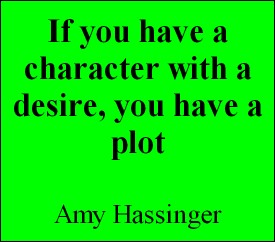
Most of the course dealt with character and plot. The two are closely connected. Amy Hassinger said “If you have a character with a desire, you have a plot”.

character-with-a-desire

Rebecca Makkai said that every character must have something they want or fear, and every character must emerge from a scene changed, even if only in superficial ways (otherwise, what’s the point of the scene]. Margot Livesey talked about plot being when something enters a story and upsets a previous balance.

Plot and structure are not quite the same thing. Plot is what happens in a story, structure is the way you reveal the plot, according to Cate Rambo.

The hierarchy of characters: round and flat characters

Characters are different. There are major characters and secondary characters. Angele Flournoy explained that major characters’ problems needed to be introduced in the first quarter of the book and play out in the rest of the work. Secondary characters’ problems can be resolved in a couple of scenes. Secondary characters can be differentiated in the readers’ mind by simple devices like dialect, distinctive clothing and how they treat the main characters.

E.M. Forster talked about round and flat characters. This is about the role the characters play in the story, not how well-written they are. A round character, in Forster’s definition, is a character who’s capable of convincingly surprising us. A flat character ” is a convenience for an author when he can strike with his full force at once, and flat characters are very useful to him since they never need reintroducing, never run away, have not to be watched for development, and provide their own atmosphere. Little luminous disks of a prearranged size pushed hither and thither like counters across the void, or between the stars. Most satisfactory.” A flat character can be summed up in a single sentence, but a bad sentence isn’t going to become a little luminous disk – it has to be a very nice sentence.

World-building: connecting the physical world and the emotional world

worldbuilding
From Anna Butler

World-building is about connecting a physical world and an emotional world. According to Lesley Jamison, it doesn’t need to be “a world that is completely outlandish and defies every law of physics … You can create that kind of singularity simply by overlaying an emotional reality over that physical reality in a way that’s never been done before in quite that sense.”

That connection between the physical world and the emotional world is also at the heart of structure.  Both Margot Livesey and Bruce Elgin talked about this. Good structure includes an exterior narrative in which events are happening, and an interior narrative in which we’re learning more about the characters and their hopes and fears. The external events reveal the inner landscape, and at the climax or turning point, both come together.

Experimental writing

Call me old-fashioned, but I like a story with a beginning, middle, and end. The last session of the course was on experimental narratives. It covered techniques like fragmentation and stream of consciousness. Priya Dala reminded us that Indian and African story-telling traditions are often non-linear. Suzanne Scanlon talked about how fragmentation of timelines can be useful for capturing memory and loss and the way we link our present moment to the past.

Some tips and tricks

Margot Livesey advised about how to progress when you’re blocked in a story

  • Raise the stakes: what comes next may be exactly what the character doesn’t expect
  • Introduce a new character and point of view
  • Go deeper into your character

Alisa Ganieva talked about the difficulty of political writing in a globalised world where everything is known. She suggested using irony and comic characters, mingling big political issues and small personal things. Gossip and rumour are devices she favours.

Fatima Mirza drew attention to the power of repetition and involving the reader’s memory. “Every page of a story becomes a part of the reader’s memory. If, on page fifty, a novel subtly references an event that occurred on page 30, the reader will not only remember it, but they will also be pleased, knowing that they have paid attention to the story and are now being rewarded. Writers can take advantage of this.”

repetition-architecture-1

Shenaz Patel pointed out that the writer is god of their world. They don’t need to create something that mirrors reality so long as it’s real in the space of the book

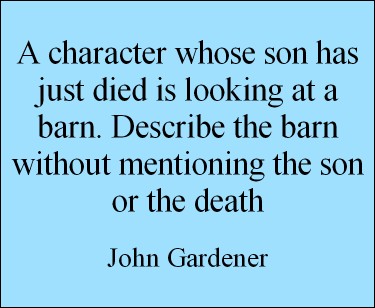
Karen Novak reminded us of a great exercise from John Gardner –

john-gardner-exercise

An exciting writer

One of the real pleasures of doing a course is finding other writers I like, some in the readings and some as course participants. A fantastic new writer I discovered in this course was Lesley Nneka Arimah. Her extraordinary story Who Will Greet You at Home was published in the New Yorker You can read it by clicking the link.

79. Flash in the pan – tips for writing flash fiction

flashfictionstories

I write flash fiction in the Friday Fictioneers group every week. Flash fiction is very short fiction, typically under 750 or 1,000 words. Within it, some people distinguish between “drabbles” (100 words), “dribbles” (50 words) and so on. These distinctions don’t really matter.  The genre is good exercise for a writer in editing skills and wordcraft.

The talented Friday Fictioneer, Claire Fuller (author of Our Endless Numbered Days) produced 12 hints on writing flash fiction . That stimulated me to write a few of my own.

It’s still a story. Beware of writing something that’s just a scene rather than a tale. Flash fiction has to do all the things a story normally does. It must have a plot with a beginning, a middle, and an end. It needs a narrative hook, character development, conflict, resolution, dialogue and all the other elements of a regular story. The general rules of fiction apply in spades. The “show don’t tell” principle is especially important here.

Flash fiction is short, so …..

  • Keep the idea simple.
  • Be clear what the main conflict is and introduce it early, ideally in the first sentence
  • Rule of one. There can only be one central character, one setting, one scene, one plot.
  • Keep the timeline tight (even to within a few minutes) so you develop the idea rather than describing it. This isn’t an extended narrative, it’s about a moment or series of moments.
  • Make the title ring so it does some of the heavy lifting for you

Enter the action at a late point, come out early. This principle of film-making applies also to flash fiction. You don’t have time for backstory.

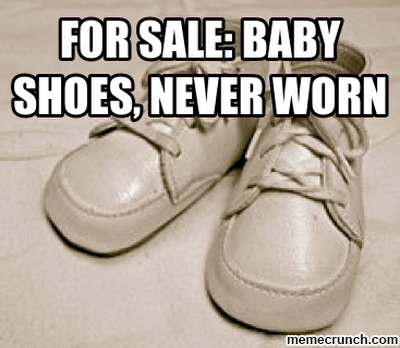
Reduction. This is a top tip from storyville. In cooking, a reduction is when you boil away most of the liquid to leave a thick and intense sauce. Reduce. Don’t start out writing to your word-length.  Let the story take its course, then edit down. Perhaps the most famous example of successful reduction is the six-word story “For sale: baby shoes, never worn”, often attributed to Hemingway.

image


Write like a poet – make every word count. Cut down on adjectives and adverbs and let the nouns and verbs do the work. Take the time to find the right word. Reading novels won’t help you write flash fiction. Reading poetry may.

Work with the reader and make use of the space beyond the page. Skip as much of the backstory as possible.  If you reference history, fairy tales, romance, sci-fi or other tropes you can invite the reader to supply background, context and meaning themselves. What is not said may be as powerful as what is. The baby shoes story is a great example of this.

Write vivid characters. They add density and carry the action. But don’t use too many characters. One or two are usually enough. Remember to develop a character arc so there’s change in the story.

Create an illusion of generosity. You can open up a sense of space if you risk devoting precious words to small details. That way it doesn’t feel cramped like a full story cut down, or worse still, like an outline rather than a story.

The ending is crucial. Think about it very carefully. It’s not a gag, so don’t turn it into a punchline. The ending should leave the reader pondering the story and wondering about the resonances. Often, the finale is a twist. More radically, it need not be the dénouement at all. David Gaffney recommends putting the dénouement in the middle. That way you can devote the ending to considering the ramifications of what has happened.

Break all these rules if you’ve got a really cool idea and you can get away with it.

77. Angry readers

A writer friend told me about a reader who got angry with a character in her draft novel. This character tried to control the actions of his lady love, and, worse, had not been completely frank. That anger made me think.

Enjoyment, intrigue, excitement – yes those are emotions you want your readers to have. But anger? And was their anger with the character or the author? The situation struck a chord with me because I’ve also encountered anger recently from writing colleagues.

Storm Catcher Felicia Simons
The Storm Catcher © Felicia Simion

Anger is a disturbing and scary reaction to provoke. As a writer, it makes you wonder if you’re doing something wrong. Our instinctive response to anger is usually to conciliate or to strike back. Conciliation can lead to messing up a storyline. To strike back is, of course, human but very stupid. Anger generally tells you the reader is reacting to something in themselves.

My friend had made her character a little more flawed, a little more like a real person. That can only be good.  But of course she worried that she was risking alienating her readers. She compromised her intention and wrote a chapter that didn’t work.

This made me consider my own reactions to readers’ anger and what the lessons might be. I’ve braved some anger in my writers’ group towards my novel The Golden Illusion. And also towards the story that I’m working on for the Sunday Times competition.

What do these stories have in common? Unsympathetic characters is the most obvious thing. Ruairi, the main character in The Golden Illusion, is charming but manipulative. Margaret, protagonist of the Sunday Times story has many traditional working-class values but is also racist. Do your readers have to like your characters? No, not necessarily, but they have to find them interesting. It also helps if the characters go on a journey and end up more sympathetic than at the start. Ruairi and Margaret follow such journeys. I guess the anger shows that neither Margaret nor Ruairi are leaving readers cold. You can’t be angry about something if you don’t care.

One friend apologised later for the ferocity of her reaction to Ruairi. She had said she found Ruairi’s seduction of a woman he meets in a bar unbelievable. She confessed she was, in fact, angry that that the woman succumbs.

In Margaret’s case, there’s an added element. The story is overtly political, a response to the UK’s vote to leave the European Union. The British learn early in life not to talk about politics or religion in polite company. But then, I don’t think the conversation between a writer and a reader has much to do with politeness.

Writing political stories is, of course, risky. It divides your readers and can lead some of them to see you as “preaching”. When that happens, they’re probably angry with you rather than your character. It’s an odd fact that portraying a politics is often seen as “telling me what to think” while depicting any other facet of personality rarely provokes such a reaction. I’ve never had a reader tell me that they felt manipulated by a character’s selfishness or courage. In my defence against the charge of “preachiness”, Margaret’s fear and racism isn’t defeated by her friend’s political arguments, but by music.

The up-side of being political is that it’s topical. So, while it may turn off some readers, it may engage others.

And I guess this is the main lesson – you can’t please all the readers all the time, so cast your reading net wide. A writer has no choice but to walk the tightrope of simultaneously believing in their work and being open to criticism. I got very disheartened by colleagues savaging The Golden Illusion and had decided it was a bad book. That was until another writer read it and loved it. In fact she loves it more than I do and restored my confidence in the novel. So it pays to get lots of opinions.

76. Why it’s worth writing short stories

Do you suffer anxiety about whether your writing is any good? If you don’t, you’re probably not doing it right. You get lots of advice and encouragement when you start writing. Most of it is well-meaning. Much of it is wrong – at least for you. There’s one thing I wished I’d known when I started. Of course, like most well-meaning advice, it may not be valid for you. But my advice is write and publish short stories, even if your main interest is novels.

Short story Stephen King

Why? Many reasons, but these were the main ones for me:

  • Polish your craft.
  • Boost your confidence
  • Measure your ability.
  • Build a track record.

Polish your craft

Short stories are short. You can write them faster than a novel and revise them more easily. It’s a simpler apprenticeship to serve.

Boost your confidence

Publishing and selling a novel is hard. It takes lots of work, and lots of luck. Mostly, you get negative feedback from agents and publishers (if you’re going the conventional route) or reviewers and sales (if you’re self-publishing). It can dent even the toughest hide and the most humble spirit. Self-doubt eats away at your confidence. It doesn’t have to be like that. It’s easier to publish short stories than novels – there are many more outlets, both print and on-line magazines. The website Duotrope lists 5,821 markets. There will almost certainly be one that will publish you. Nothing beats the boost of seeing yourself in print. If you’re just starting out, these magazines accept over half of the work submitted to them.

Measure your ability

Pick your market. Different outlets for stories have different acceptance rates.  I didn’t know about acceptance rates when I started out. Until 2015 I was unwittingly submitting stories to prestige magazines that accept less than 1% of everything submitted to them. No wonder I wasn’t getting published. No wonder I was dejected and felt talentless. In 2015 it all began to change when I got hold of data on acceptance rates. Duotrope  publishes these figures. Armed with them, I can target where I sent my stories.

place in market

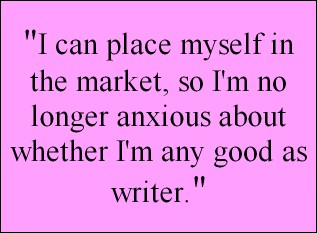
Last year, I had stories accepted by Alfie Dog and The Opening Line. Not so hard to do since both accepted around half the material sent to them. I got bolder. Gold Dust, with an acceptance rate of 12.5%, accepted a story, Zhuang Zhu’s Dream, about a man who has memories he believes are not his own. Then this year Structo accepted Interstices, a slipstream kind of story, to be published in issue 16. At the time of submission, Structo accepted only 3.85% of the material submitted, and currently the number is (an impossible) 0%. Now I can place myself in the market, so I’m no longer anxious about whether I’m any good as writer.

Build a track record

The publications give me a track record. Now, when I submit book manuscripts to agents and publishers, I can claim some credits attesting to my ability. The outlets with 50% acceptance rates don’t help this, but the two below 20% do.

71. World-building

worldbuilding

Sure you can have elves and dragons, time travel and aliens. Myth and alternative technology are part of world-building in fantasy and sci-fi. But the real alternative worlds are inside people’s heads. To take the reader emotionally into a fictional world, the writer must show us how the main characters understand this world. Every world in fiction is a mentality – a way of understanding, a means of making judgements, a catalogue of right and wrong. To build a world, we must build our characters.

Consider, for example, an old jalopy. To one character this might just be a heap of rust, a shameful sign of poverty. To another character, the same car might be a challenge, a promise of something to be restored, a long summer full of happy activity. Different characters invest the same landscape and the same object with a multiplicity of significances.

I’m interested in how people create meaning in their world and negotiate shared meanings with others. And I was stuck at a fulcrum chapter in the book I’m writing, The Tears of Boabdil in how I was to achieve that with my main character. The novel is a braided narrative (thanks, Paula, for reminding me of that term). It combines a gritty police tale of an agent infiltrating a jihadist group, a forbidden love, and the magical power of narrative. In this chapter, the undercover police agent meets his handler. I needed to find a way of showing that the character inhabits a world not quite like our own, and I was struggling to express his rules.

The answer came from an unexpected source – a book I’ve been reading on the meaning of Palaeolithic art by Jean Clottes (What is Palaeolithic Art). Whether Clottes, a world expert on the cave paintings of southwest France, is right or wrong in his interpretation I don’t know, and I don’t really care. His schema was captivating, and perfect for my character.

  • Connectedness and fluidity. Everywhere and everywhen are one. Things and events can metamorphose into each other. Signs are important.
  • We tend to see individuals as members of general categories (cats, women, vehicles). But my main character responds to the particularity of things, so that a sleeping cat is a different thing from a stalking cat. He will later on experience the multiple aspects of his quarry – jihadi, respected teacher, doting father – as different entities
  • The world is permeable to the effects of supernatural forces and these forces can be appealed to for their blessing
  • The identity of a person or thing is the story we tell about it. Images have an affinity with the thing they portray and can change reality.

And there, I had the framework of my world. If we allow ourselves to be open to the permeability of things, the answer is out there. Now it’s a somewhat scary craft challenge to see if I can match up to Tolkien’s description of the goal of world-building as creating immersion or enchantment.

70. Developing an author platform

We aspiring authors are constantly advised to develop an author platform. In fact some publishers make it a requirement. So what is an author platform, and how do you make one?

A platform is a means for you to reach out to a target audience. In part, it’s the main thing about you as a writer – your published work. In part, it’s your profile on social media – whatever form of it appeals to you, blogging, tweeting, Facebook. Goodreads. I blogged about this in my tenth post, and I decided to take a re-look at what had worked for me on this blog.

author platform.png

When I wrote that first post, the blog had been going a month. It had received 90 views from 30 visitors, and had garnered three followers. Now, a year later, I’ve just passed 1,600 reads, with 588 unique visitors. As you can see, it’s a slow process, and, though slow and steady, the progress is not stratospheric. So it’s a good idea to get started and have your platform in place and growing before you’ve published your first book.

From May 2105 to February 2016, the blog chugged on, bumping along the bottom. On average, every month it attracted around 53 views from 23 visitors. Around three new people followed me every month. Then it all changed in March 2016. Average monthly views went up around seven-fold to 383. Each post is now read by 58 people, instead of the previous nine. Visitor numbers rose over four-fold to 119 a month. And follows more than doubled to eight a month. What was the secret? I joined a network, Friday Fictioneers, built around a challenge to write a 100-word story in response to a photo prompt every week.

blogstats

The boost came from two elements: firstly, I was posting stories; and secondly I was connected to a network of around 150 people who write for the challenge every week. So I was buying into an established readership. It’s not magic. Some of the new visitors are reading other blog posts as well as the stories. Views of non-story posts almost doubled from an average of 53 a month to 98. While it does promote my visibility, it certainly doesn’t allow me to post stupid messages like “follow me” or “read my book”.  Though the links are there on my site, only nine new people have clicked through to my publications.

I can’t suggest what will work for you. It will be different for every writer. But the general message is probably

  • However you start your platform, take it slow and give it time
  • Link up with existing networks