Micro-editing points: Writing

The reader
Who is the reader? Who do you want to read the book? Is it intended for adults or children? Will it appeal more to women than to men? Is there too much description and not enough action for your intended reader? Or too little?

Location
How have you used location? Readers today generally don’t want a lot of description, but every scene takes place somewhere. The location may make a difference to how the scene proceeds. A rocking boat may make movement uncertain. A noisy cafe may impede conversation.

Dialogue
Is all the punctuation correct, with quote marks, commas, full stops in the right places? Is there a new paragraph for each new speaker? Is it clear who is speaking? Endless repeats of ‘he said’ and ‘she said’ get tiresome, and you can miss them out for two or three paragraphs if you only have two speakers.

However, don’t make the mistake of using lots of synonyms for ‘said’ to create variety. Variety is essential in descriptive words but they make the reader stop and stumble if you use them for speech tags. Provided there aren’t too many speech tags, the mind skims over ‘he said’ easily.

As an alternative to the ‘he said, she said’ speech tags, you can use beats, small bits of action to label who is speaking. For example, ‘Tom scratched his head. “What should we do about it?”’
Inserting bits of action into long chunks of dialogue is essential. People rarely just sit and talk without interacting with their environment in some way. One of my bad habits is writing pages of dialogue without action that punctuates it.

Wordcraft
This is where micro-editing becomes really micro. You need to go through your text word-by-word. This is what I’m doing at the moment with The Golden Illusion. Obviously you want to check for spelling mistakes. But there’s a host of other things you need to check for too.

  • Favourite words: We all have favourite words or constructions we tend to overuse. Seek them out and destroy them. For example, I tend to writing ‘I’m not going to do that’ when it would be much simpler to say ‘I won’t do that.’
  • Overused words: Some words are routinely overused. All of us tend to overuse words such as can/could, seem, think/believe, feel/feeling/felt, was/were, know/knew, hear/heard, look, see/saw, watch/notice/observe, it, that, just and maybe. Slash them down. You can’t eliminate every one, but make sure you don’t overuse them.
  • Words that aren’t working for their keep: Also on the hit list, words that aren’t doing any work. For example, ‘It seemed to him that she was interested.’ The phrase ‘It seemed to him that’ is just padding. Eliminate words that aren’t pulling their weight.
  • Adjectives and adverbs: Look out for overuse of adjectives and adverbs. It’s often a sign of weak writing. Why say ‘She looked at him angrily’ when you can use a stronger verb and say ‘She glared at him’?
  • Sentence length: Don’t make it hard for your reader. Hunt down sentences that are too long, and break them up. As a rule of thumb, keep sentences below 30 words. Same thing with paragraphs – break them if they’re running to more than 5 sentences.
  • Pronouns: Overuse of pronouns at the beginning of sentence is another common fault. I’m often guilty of in first draft of having up to 40% of my sentences start with pronouns – “I opened the door and stared at her”. “She looked at me”. It makes for boring writing. Varying the sentence structure makes the writing flow – “Once inside the door, I stared at her.” As a general rule, keep those initial pronouns to 30% or less of sentences.
  • There are many other technical elements, such as avoiding the passive voice – it’s weaker to say ‘Tom was invited by Sue’ than to use the active voice ‘Sue invited Tom.’

Going through all these checks is time-consuming, but it’s worth it to improve the readability and power of your writing. I automate detection of problems by using editing software. This saves some time, but it still takes me the best part of a day to copy edit a chapter.

Macro-editing points: Character and Story

Soul
What is the book’s soul? What was the kernel of truth you wanted to communicate when you first had the idea? When you look at comments you’ve got from readers, do they advance or impede this soul? This may help you decide which comments to work on, and which to ignore.

Character

  • Are your main characters the right ones for telling your story? Usually you’ve got this right, but not always.
  • Is the motivation clear? What do your main characters want? Without motivation, the story won’t move forward. Is the behaviour of the main characters and the interaction between them consistent?
  • Are your main characters interesting? They don’t have to be likeable, but there must be something about them that resonates with the reader and makes him or her want to find out what happens to them.
  • Are your main characters’ voices distinct and consistent? Check that you haven’t introduced your own voice by mistake.
  • What role do the minor characters play? Do they have a purpose in the story? What would happen to the story if you cut them out? If the answer is ‘nothing’ then consider removing the characters who serve no purpose. Be ruthless. Kill your darlings.

Story
Does the story structure work?

Beginning and ending

  • Have you written a page-turner opening that makes the reader want to continue?
  • Does the opening set up the problem and does the ending resolve it? If not, do you need to remove or relocate the opening and the ending? One reader pointed out that she though the real beginning of The Golden Illusion comes in Chapter 3, and I have a horrible feeling she may be right.
  • What’s the inciting incident? Does it happen because of something the main character does, or is it external?
  • Is there a climax? Does it come at the appropriate place, just before the ending? Is there a denouement which ties up the loose ends and resolves the plot? I have a recurring tendency to stop too soon and not write a proper denouement.

Middle

  • Is there an arc of rising action, including setbacks?
  • Do scenes end on cliffhangers to keep the reader motivated?
  • Is there a logical connection between each scene and the next in this middle part? Can you say for every scene ‘this happens because ….’?
  • Does each scene move the story forward? If not, you know it, kill your darlings.
  • Do you need to raise the stakes? Have you pushed your main character as far as he or she will go? In the early drafts of The Golden Illusion, I hadn’t given my hero nearly enough of a hard time.

21. Breaking the rules – in defence of adverbs

People talk about rules of good writing. I’ve used the term myself. But really, there are no rules, just tips. See? I broke a rule there – I started a sentence with a conjunction, ‘but’. Did it bother you? It avoided the comma and the run-on sentence if I’d made it a clause. You can break the rules if it makes sense. Following the rules blindly just leads to weak writing. Follow the tips when they make sense.

The so-called rules are there for a good reason – they distil a lot of experience. The show-don’t-tell rule, for example, is a pretty good tip. Writing is a collaboration between the author and the reader. Constant telling, constant narration, distances the reader. Showing involves the reader in deciding for herself what is going on.

If I write ‘Peter was old and sickly’ I’m telling you how to see Peter.
If I write ‘Peter shuffled towards me, supported by a stick. The effort of every step was etched in pain on his furrowed face’ I’ve invited you to picture Peter and draw your own conclusions.

Does that mean a writer must always show rather than tell? No, of course not. If the detail is unimportant to the story, tell it. If Jane walks down the stairs, it’s much better to say this, rather than tiring the reader with a long description of the stairs and the walking. Use the show-don’t-tell tip when there’s a good reason to do so.

Closely related to show-don’t-tell is the adverb rule. All writing manuals tell you to use adverbs sparingly. Stephen King goes further and would have us eliminate all adverbs. He argues that adverbs make for sloppy writing, signs the author is fearful that she isn’t getting her point across clearly.

I, like many amateurs, am guilty of breaking the adverb rule. Of 1,000 words in the story I described in the last post, 18 were adverbs. After editing, I reduced this to 14, but that’s still 14 that Stephen King would say shouldn’t be there. Maybe he’s right. He’s a successful author and I’m not.

Let’s look at this though. Why this particular hatred for one part of speech? In case you forgot your school grammar lessons, adverbs are words that modify verbs, and usually end in –ly (though not all do – ‘up’, for example is also an adverb). We don’t have the same rules about nouns, or verbs, or adjectives. Is this just textism? What’s the reason?

Reason one. It makes sense to eliminate adverbs when they’re making the writing weaker. Sometimes they just cover up failure to find better words. For example ‘he spoke quietly’ is unnecessary – it would be stronger to say ‘he whispered’ or ‘he murmured’. Many times, we can eliminate adverbs by using a stronger verb. In this sense, adverbs can be good pointers at the editing stage to where we need to polish the writing.

Reason two. When the adverb is doing no work at all, purge it. For example, in the phrase ‘he shouted loudly’ the adverb loudly is doing nothing – a shout is loud. Or, to take another example, ‘he said interestingly’. If what he says is interesting, maybe that he’s discovered the secret of time travel, then the reader doesn’t need the adverb, and if it’s dull, maybe that he’s tired, the adverb doesn’t change the dullness. Though, even there, if the character to whom he’s speaking has good reason to be interested, the adverb may still justify its place.

Reason three. Adverbs may distance the reader by telling, rather than showing. They can narrate details the reader should be filling in for themselves. For example ‘she looked suspiciously at the box’ could be better written ‘she examined the box, checking for booby traps.’

There may be other good reasons for eliminated adverbs. I couldn’t think of them while writing this. The point is that if there’s a reason not to use an adverb, don’t use it. By the same token, if there is a reason to use an adverb, then use it. Adverbs are pretty much like adjectives. Adverbs can add description to verbs, bringing a picture to life, in the same way as adjectives can bring nouns to life.

For example, take this phrase from the story I’ve just edited, ‘trees perched crazily like sure goats on precipitous falls.’ I spent some time considering whether to remove or change the ‘crazily.’ It’s doing some pretty important descriptive work, showing the random arrangement of the vegetation. It can’t be turned into the adjective ‘crazy’ since neither the trees nor the goats are crazy. The only thing that’s crazy is the perching. So, I retained the adverb. I think I had good reason to do so.

Technically, I suppose you could argue that the ‘crazy’ and the ‘sure’ contradict each other and one of them should go. I would disagree – crazy paving isn’t less secure as paving for being crazy. You might also argue that the description is overdone, with two adjectives and one adverb in the phrase. Overusing descriptive words in the belief this makes the writing more literary is a classic error of amateurs. You might be right, but there are some good reasons in the context to be highly descriptive.

So, here’s my conclusion. We give adverbs too hard a time. It’s a good tip to think long and hard about why an adverb is there, and what work it’s doing. But, should we eliminate every adverb? No. As with every other part of our writing, we should make it as crisp and effective as we can. I’m all for better verbs, adjectives, gerunds and nouns, as well as better adverbs. The prejudice against adverbs is simply textism.

There is a big however to the defence of adverbs. Agents, editors and publishers often believe in the ‘no adverbs’ tip as an iron-clad rule. If you submit a work full of adverbs, however well-chosen and hard-working, they may just put a red pencil through it and decide you’re an amateur. You pays your money and you takes your choice.

19. Writing and editing tools

There are many tools for writers out there. Goodness! How on earth did Shakespeare and Dickens managed without them?

Plot, structure and character

I’ve already talked about te tools for plot and character that I use for keeping track of the storyline, scenes, and characters. You can buy software that does this, but I make my own in spreadsheets. Obviously, you also need something to write on. Like most people, I use a word processor, but you can also get dedicated author software.

Depending on how you write, such software may help you. I tend to write in a fairly linear way from the beginning to the end. I know that some people write scenes just as they occur to them, starting in the middle of the book. Shuffling and re-ordering scenes can be very frustrating on a word processor. I can’t review any of the dedicated tools that make this easy, because I don’t use them. The most popular, however, seems to be Scrivener, which combines a word processor and a project management tool.

Here, I want to talk about tools that can help with the third essential element – the writing itself. Good writing is about sentences that are easy to read, dialogue that sings, evocative description, and scenes that make the reader want to keep turning the page. The most important thing here is, of course, practice. Write lots, get friends and colleagues to criticize it, and you’ll improve. Reading your work aloud to yourself can also help you spot the bits that don’t work. But there are some tools that can help.

Spelling grammar and words

A good word processor will have inbuilt spell-check and grammar-check, as well as a minimal thesaurus. A thesaurus is invaluable for authors. You read your sentence, like “John stared in fright at the apparition.” You can see the sentence should pack more punch. The problem is “in fright”. The word should be working harder. You consult your Thesaurus and find alternatives – panic, terror, dread, for example. You can buy a Roget’s Thesaurus or use the online version (http://www.thesaurus.com).

If you write, as I do, historical fiction, you have another word problem. There’s nothing worse than a Tudor character saying something like “you’re messing with my mind”. It transports the reader straight back into the twenty-first century and the spell is broken. So how do you check when a particular word first came into use? Enter the Etymological Dictionary (http://www.etymonline.com). I used this a lot in writing A Prize of Sovereigns. The archer, Reuven, for example addresses his comrades in arms as “mate”. But when did this first come into use with this meaning? Is it modern? The dictionary reassured me that it goes back to the mid-fourteenth century.

Stringing the words together

Sounds obvious, but this is where most of the trouble comes in. There are so many mistakes you can inadvertently make. We all have favourite words that we tend to over-use. We can inadvertently repeat the same word too close together. We overuse adverbs. We write sentences that are too long, or that make the reader stumble. We use the passive instead of the active. We allow the pace to drop.

There is editing software that can help you detect and correct these and other problems. There’s quite a neat little fee website at http://www.thedreamside.com/machine.html, which gives you word-counts for frequently used words and which flags up “hot-spots” where the same word is used repeatedly close together. You can find more sophisticated editing help from Pro Writing Aid (https://prowritingaid.com). The free version will give you reports on 17 different aspects of your writing. It will check for things like over-used words and repeated phrases, pacing, clichés, writing style, over-long sentences, and sentences that don’t flow well. The image, for example, shows the check for pacing on two of the chapters from The Wheel Turns, the sequel to Prize of Sovereigns, which I’m working on now.

Pacing

The blue bars show areas of action or dialogue, while the white spaces are areas of background or introspection. Areas of white should be sprinkled through the text, rather than all dumped in one place. I was reasonably happy with the pacing, though there is a warning sign in the first chapter, with a slower area coming very close to the beginning.

I’m fairly impressed with Pro Writing Aid. With 17 reports, the amount of information you get back can seem a little daunting, but, as you work through them, you can decide which suggestions to respond to, and which to ignore. If you’re not employing a real copy editor, software like this can help sharpen up your prose

18. The moral core of your characters

Plot, writing, and character – those for me are the three crucial elements of an author’s craft. In posts 3 I talked a little bit about character and plot, and in post 12 I described some of the tools I’ve used for developing and keeping track of plots. I haven’t said much about tools for developing characters. That’s probably because I haven’t yet encountered many tools I find really useful, beyond the checklist in post 3.

  • Name
  • Age
  • Origins (including family and background)
  • Appearance
  • Characteristics (positive and negative) and flaws
  • Distinctive mannerisms
  • Likes and dislikes
  • Goals
  • Key relationships

As I started work on the sequel to A Prize of Sovereigns, I’ve been wondering whether there aren’t other tools I should think about. There are new characters in this sequel, whose working title is The Wheel Turns, but most of them have already appeared in the first book. I know these characters well. They’ve lived with me for the last two years. So why the anxiety about them?

I guess it’s because some of them are going to change in ways they were never challenged to in the first book, most particularly morally. There is morality in A Prize of Sovereigns. It is, among other things, about goodness. I was interested in looking at goodness not so much as measured by individuals’ characters but rather by the consequences for others of their actions. But this is a fairly easy moral universe. Characters either succeed or fail in their stratagems. In The Wheel Turns, different characters’ senses of what is right will come into play, and will be changed. I realised that I didn’t actually know enough about each of them constructed their moral universes, so I began to think and to do read around how other writers had approached this. I tried a couple of the approaches out for my characters.

You can, for example, build your characters by understanding their attributes or traits. There’s quite a lot of this in the Writers Helping Writers website (http://writershelpingwriters.net/). One approach is used by Angela Ackerman, who writes:

‘What really resonates with readers is when a character shows deep convictions–a passion for something meaningful. Why is this? Because buried deep within each of us is our moral center, a belief system that influences our every thought, action and choice. And, for characters to be authentic, they too must display a highly tuned set of beliefs that guide their motivations.’

She advocates building your characters in four onion layers, starting from the moral centre. You work out what particular moral attributes they have, such as kindness, loyalty or responsibility. You then work to the second layer of achievement attributes, aligned with the moral centre and which help the character succeed. Examples of achievement attributes might be resourcefulness or perceptiveness. The third layer, interactive attributes, defines the way your character relates to others, through traits such as honesty or courtesy. The final layer is the identity attributes, which help your character express who she or he is, such as introversion or idealism.

I tried this with my characters. It didn’t really tell me anything about them that I didn’t already know. More importantly, it also didn’t make intuitive sense to me. It’s not how I understand people. It seemed like a sort of character “kit” in which you collect attributes and glue them together to make a person.

Another approach was more intuitive for me. I had quite a lot of fun with this one. It begins with the pyramid of needs, an idea developed by psychologist Abraham Maslow. He argues that people’s behaviour is driven by a set of five needs. At the bottom of the pyramid are basic needs, such as food, clothing, and shelter. Without these, an individual can’t go on to express and try to realise other needs. With basic needs satisfied, people are driven to achieve safety and security. After safety and security come the needs for love and belonging. The fourth level of needs are those esteem and recognition. And finally, at the top of the pyramid, once all the other needs are satisfied, comes the need for self-actualisation – realising one’s potential and achieving personal fulfilment. I mapped some of my characters onto this pyramid.

What was intriguing about this was that I could map my characters’ personal journeys onto this. So Jyoti for example starts with the need to protect her family, somewhere around the border between safety and love/belonging. Her evolution will move her to becoming a fighter for the rights of women, in the self-actualisation tip of the pyramid. In A Prize of Sovereigns she was the only character who underwent no change. She remained strong and cheerful, a helpmeet to her husband Reuven. He is not especially smart or especially brave. He’s a foot-soldier in the King’s war, who returns broken, and suffering post-traumatic stress. In The Wheel Turns, both of them will ascend the pyramid, though Reuven starts from a different place, grappling with esteem issues. Other characters, however, descend the pyramid, most dramatically the King, Byrom, who plummets from the self-actualising tip, to struggling at the bottom of the pyramid to save his life. I’m still not sure I learned anything new about my characters, but I was intrigued by this way of graphically showing the dynamic of their story arcs.
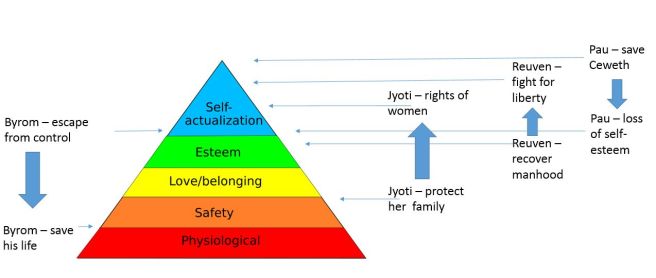
Maslow

The only concrete upshot of all this fun, however, has been that I added one more element to my basic character sheet checklist – moral dilemma. In real life, few of us have a moral code as unshakeable as we like to believe, and in extreme circumstances we may do things that conflict with our codes. Most moral choices aren’t between the good and the bad, but between conflicting goods. So, for example, Jyoti’s character sheet now includes this dilemma:

As she becomes a stronger advocate of women’s rights, is forced to confront her ideals of duty to her husband and family. She becomes ruthless in her pursuit of this goal

The other thing that tickled my fancy was a couple of posts on M Talmage Moorehead’s blog (http://storiform.com) who says, writing about the idea of voice, ‘I think the term ‘voice” applies more to the viewpoint character than to the writer … because it keeps the reader feeling as if all the plot twists are happening to a real person..’ He describes an interesting experiment where he has a secret blog, ostensibly written by his viewpoint character. He uses this to detect where her voice disappears and his own intrudes. I thought that was a really fun idea, if a lot of work. I think he probably lavishes more attention on his characters than I do on mine. One clue to this is another post, in which he says that to make a character’s beliefs credible, you have to know the information on which those beliefs rest. So if your character is a conspiracy theorist, he says, you have to go and read all those conspiracy theories, with attendant dangers to your grip on reality.

Now there he has a really interesting point, which I’m still working through. The main knowledge base for the characters in The Wheel Turns is their religion. So I’ve had to build their religion. There’s a bit of religion in A Prize of Sovereigns, most obviously in the religious girl Marta who hears voices commanding her to lead her country’s fight-back in the war. But all of that was easy compared with the new book which is going to be full of religious schisms and revolutionary ferment. I’ve had to add four new Gods to their pantheon and work out in some detail, what the attributes are of each God, which social group they appeal to and why, and the associated theological and ritual elements of their worship. As social ferment accelerates, Jyoti and Reuven are going to transfer their allegiance from the traditional peasants’ God, Kaldin, to Hekla, Goddess of music, love and magic in Jyoti’s case, and to Gobannos, the artisan God in Reuven’s case. Jyoti is drawn to Hekla because her adherents champion the idea of the equality of women and men. Reuven is drawn to Gobannos because his adherents champion fairness. I’m sure the theological and political disputes this couple are going to have are going to challenge my world-building skills.

I shouldn’t complain though. How many people are privileged to build their own worlds? This is the joy of writing.
17. For whom the bell curve tolls

I was leafing through the summer issue of The Author, the journal of the Society of Authors. It has some interesting statistics in it.

The UK book market is the fourth largest in the world by turnover. But researchers at Queen Mary, University of London, found that the median annual income among writers in 2013 was £4,000. The bottom half the 2,500 writers they surveyed earned less than £10,500 a year, and took home only 7% of all authors’ earnings. The top 1% of writers made more than £450,000 a year, and took home 22.7% of the pot.

Statistical analysis is based on the idea that a variable (like height for example) is arranged uniformly in what’s called a “normal distribution” – a bell-shaped curve with most people in the middle and small tails at each extreme. Success, however, doesn’t follow a bell-curve. The odds are stacked in favour of a lucky few. Ask any actor, or musician, or any author.

wealth

This graph shows the distribution of wealth in the United States in 2013 – a classic non-normal distribution.

The same issue of The Author also has this instructive statistic from a publisher: Of every 10 books sold in bookshops, five fail, three break even, and two make profit. Little wonder then that publishers like to reduce their risk by publishing works by people who’re already famous. However, the statistic does also mean that publishers are dependent on continually finding new authors in the search for that elusive two. And of course, two out of every three books sold in the UK now, are not bought at the till of a bookshop. The online market coalesces even more around winners than does the bookshop market.

So what can an aspiring author do about these grim facts? Above and beyond being talented, writing the best work you possibly can, and editing it diligently.

1. Be independently wealthy
If you’re not already rich, go to step 2.

2. Don’t give up the day job.
It goes without saying that if you’re unlikely to make a living out of writing, you should have another source of income.

3. Make yourself luckier.
If you know some leprechauns or genies, now is a good time to ask their help. If you’re an ordinary mortal like me, there are still some things you can do.

  • They say, it’s not what you know, it’s who you know. If you have a large and loyal fan base, publishers and readers are more likely to pay attention to you. The classic example of this is E L James’ Fifty Shades of Grey. She started off writing fan fiction, which got her the base from which she became an international publishing sensation. You can publish work on story-sharing sites like Wattpad and Smashwords, and wait for the adulation to roll in. Goodreads is another important site where you can connect with your readers. I talked about these sites in post 10.
  • E L James is also a good example of another way you can boost your luck. She tapped into a trend, particularly among women, for raunchier women’s fiction. If you catch a trend at its peak like she did, you may coast to literary stardom. Keeping your eye on new releases in your bookshop and reading trade magazines like The Bookseller can help you keep your finger on the pulse. Dark thrillers are pretty hot right now, for example. As one of the speakers at the Winchester Writers’ Conference said, a fortnight ago, readers want to be traumatised by their books. The other big trend at the moment, believe it or not, is colouring books for adults.
  • I’m not suggesting that you should write the book the market wants. Of course not. We should all write the books we want to write. But, if it makes sense to give your work a tweak towards what’s trending, it may help.
  • Work hard at getting your friends and readers to review and promote your book (assuming you already have a published book). Most of the 184,000 books published in the UK each year appear without any promotion and vanish without trace. Don’t let yours be one of them.

A word of caution. I’m just passing on advice I’ve received and that I’m following. In post 10, I told you how slowly this is going for me. Since that post, my number of Goodreads friends has increased to 7, and on Wattpad, I’ve had 76 reads and have attracted one new follower to add to the four I already had. To be fair, I haven’t posted anything new on Wattpad for months, so this isn’t too surprising. I just posted a new story there, so I’ll let you know how that works out.

The moral is, remember the odds are stacked against you, work at it, and don’t expect instant miracles.
actor, or musician, or any author.

15. Winchester – a worship of writers

Who knew that the collective noun for a group of writers was a worship? I just looked it up. I might have hoped the noun to be “an eloquence of writers”, but that is reserved for lawyers, and lions have already bagged “a pride”.

So there we were on Saturday, a worship of writers at the Winchester Writers’ Festival. Under an overcast sky, the campus of Winchester University was thronged with writers, eager, hopeful, or stoic, each according to their own experience and temperament. Interestingly, there was a preponderance of women, including one striking blonde Amazon with rippling biceps. I’ll come back to an interesting gender issue later on. Old friends met up with cries of “who are you with now”, making me acutely aware I hadn’t yet been signed by anybody. Perhaps my two one-to-one meetings with an agent and a publisher would rectify that.

We streamed from building to building and from room to room, assessing each other with cautious insouciance, wary of encountering a “shrivel of critics”. Three of us from my writing group had a chance encounter, before the event even started, with one of the “shrivel”. She was a volunteer with the event, who, uninvited, joined our table in the coffee room and demanded to hear our elevator pitches and quizzed us about whether we were truly writing from our own experience. She showed no interest at all in what we’d actually written, in her desire to impress us with her own wisdom. “It’s just my opinion”, she wailed as we extricated ourselves. ‘”I’m just an amateur.” Indeed. Her ruthless and undeviating advocacy of the rules of writing spoke eloquently to this point.

Undaunted, my first stop was a dash to the noticeboard in the main conference centre, to see if either of my two entries to the short story competition had been short-listed. They hadn’t, though in act of nominative determinism, I was ticked to note that one D S Writer had made it through.

During the day I went to four workshops. I’ll just give you one take-away point from each of them. An agent said that she took on only two or three new clients a year. A publisher said that, though they won’t admit it, agents and publishers are looking for a reason to instantly bin the submissions they receive, because they can’t possibly read all of them. A novelist said that to find your own “voice”, you have to unlearn the rules of written English you learned at school (I don’t agree with this one). A maker of historical docudramas said that you can get away with imposing a story structure on the known facts, by exploring the drama of well-chosen characters.

I also had one-to-one meetings with an agent and publisher. The good news for me was that they both liked my writing. The publisher really liked it. And that was validating. From my slough of despond about A Prize of Sovereigns at the beginning of the year, I really believe in my book again. But neither of them offered to sign me, though both made really useful suggestions about other agents I should approach. The really interesting thing, though, was the gender issue I referred to at the beginning.

The agent was a man, the second male agent I’ve talked to about the book. And both of them said the same thing. They said it was neither history, because it’s not a true historical record, nor fantasy because there are no fantasy elements. I pitch the book as historical fantasy, because, though It draws on a lot of historical research, I’ve made what George R R Martin calls a “historical mash-up”. I’ve shortened time scales, and, in some cases, put events into a different order or into different places. Many of the major characters are real as well, though I’ve picked and mixed elements of different historical figures to create my characters. History for me, is a rich toolbox of fascinating events, great stories and strong characters. But I do this in the service of fiction, and use what I find in the box to drive the story. Because of this, I’ve set the book in a fictional location, though readers of history quickly recognize it as England and France during the Hundred Years War. I’m not so much interested in writing about the Hundred Years War as I am in exploring why rulers make the decisions they do, and what effect those decisions have on those they rule. So both guys have said this choice is a commercial problem and have urged me to make it straighter history or straighter fantasy.

The publisher was a woman, and had no such problem. For her, it would sell across both the historical fiction and the fantasy genres. Three female agents and a female literary consultant have also been of the same opinion.

Now, you can’t draw any meaningful conclusions about gender differences from a sample of two men and five women, but it’s intriguing nonetheless. My wife says it’s because men can’t multi-task.

Take a look at the book by clicking the link to it on this page (the first seven chapters are published now) and tell me what you think?

9. Lying to your readers

Should you ever lie to your reader? Yes, of course. All the time. That’s what a plot twist is – you lead your readers’ expectations down one path, and then flip them. The mechanism is somewhat similar to a joke, which also leads the hearer down one path only to flip it. The physiological response to a joke is the explosive outbreath we call laughter.

sex

Especially with short stories laughter is often our response to a good plot twist.

There are some standard devices for doing this. The most obvious is the Red Herring, and the closely-related McGuffin. Detective stories are full of red-herrings, clues that seem to lead to the solution but are in fact illusory or mistaken. The term “McGuffin” I think originated with Alfred Hitchcock. A McGuffin is a plot device, some object, person or goal that the protagonist pursues. The McGuffin is often illusory or recedes into the background in the course of the story.

The book I’m currently working on, The Golden Illusion, has the protagonist, a stage illusionist, chasing the secret of a 4,000-year-old illusion performed by the Egyptian magician, Djedi, for the Pharaoh Kufu. It is a McGuffin. I’m still struggling with making the real ending, as spectacular as Djedi’s decapitation and re-animation trick.

Other common devices where you lie to your readers are the False Protagonist and the Unreliable Narrator.

The False Protagonist works by leading the reader to believe that a character is the protagonist of the story. This character then vanishes, often by being killed. This has huge shock value. George R R Martin used it to great effect in Game of Thrones by killing Ned Stark at the end of the first book of the series.

The Unreliable Narrator isn’t so much about lying to your readers as leading them to doubt the version of events given by your narrator. You might do this from the outset, by having your narrator character make a statement that is plainly false or delusional. Or you might leave this reveal until later in the story. If you leave it until the end, it becomes a plot twist. William Riggan, in his book Pícaros, Madmen, Naīfs, and Clowns: The Unreliable First-person Narrator, suggests there are five types of Unreliable Narrators:

  • The Picaro, or braggart
  • The Madman, who may be experiencing psychological defence mechanisms, or deeper insanity
  • The Clown, who does not take narration seriously, and plays with convention, truth, and the reader’s expectations
  • The Naif, a narrator whose point of view is limited through immaturity or ignorance
  • The Liar, a narrator who deliberately misrepresents himself, often to cover up misdeeds

I’ve never yet had the courage to use the Unreliable Narrator device. But I should. I’m fascinated by the way different people read the same situation so differently. Perhaps it’s my academic training that leads me to be so unadventurous with the truth. I did write a short story in which the protagonist is autistic, but that’s as far as I’ve dared go so far.

3. Plotting out a story

Different people seem to write in different ways. Some people develop quite a detailed plan before they start writing, others have only general ideas and let the story develop as they write. I’m still learning the way that works best for me, trying out different approaches.

Whatever I do, it always starts with a core idea, something that I’m interested in exploring. The book that I’m telling you about, A Prize of Sovereigns, started with a musing about what we meant by goodness. We associate goodness with a quality of a person. I wondered then whether a bad person could do good actions, and also whether a good person could do bad actions. The book grew from there.

I didn’t set out to write a historical fantasy. In fact, the initial sketch was set in the real present world. But I soon realised that the dilemmas would be much more dramatic if the central characters were absolute rulers, whose personal decisions affected millions of people. The decision to set it historically emerged quite early on. I wrote it in the same way I wrote the second novel, but quite differently from my first novel or the one I’m currently writing. For A Prize of Sovereigns I wrote what I call a “cartoon”, a 10,000 word extended short story. I mean a cartoon in the same way that artists do simplified sketches of their final work, not in the Disney sense of the word. In the shortened version, it’s easier to sketch out the overall arc of the story.

“Arc of the story” is one of those technical terms I learned. It’s really just a fancy way of saying what change happens. There are lots of ways of thinking about arcs, but the simplest is often the best – a story has to have a beginning, a middle, and an end.

In the beginning we meet the main characters (or most of them anyhow) and we see the situation they are in.

Something precipitates change, taking us into the middle of the story. In the middle, the main character encounters challenges, there is conflict, and there may be mystery or a quest. The story builds towards a climax, with dramatic reversals for the main character on the way.

In the ending, the conflicts are resolved, and any mysteries explained.

Freytag

Sounds simple doesn’t it? But I recently had a short story rejected by a literary magazine for having a beginning and a middle but no end.

Anyhow, I sketched the arc of the story with my 10,000 word “cartoon” and then I elaborated it into the novel. A colleague in my writing group asked me, when I described this method of writing, whether it wasn’t boring since I knew what the ending was. Well, actually it isn’t. The cartoon really only had five main characters – two rival princes, a scheming chancellor, a peasant archer and his sweetheart. I added three more major characters as I wrote – an itinerant story-teller who rises to become a medieval spin-doctor, an abused queen who plots her revenge on her husband, and a religious girl who hears voices, telling her to save her country from invasion. The plot lines became more numerous and the weave thicker. The characters, with more interactions open to them, began to do things I hadn’t expected, and take me to places I hadn’t planned. So, no it wasn’t boring at all. It was a joy. As soldiers are fond of saying, “no plan survives the first engagement”.

Different authors seem to be very different in how they relate to their characters, but a successful character will always become partially autonomous of you. That’s the problem, or the pleasure, of being a Creator, without being omnipotent or omniscient. Sometimes they whisper their stories in your ear, sometimes you have to release them and leave them to show you what the story is.

As the tapestry of your story starts to become more complex, you’ll probably need some tools like I do. I usually develop at least a timeline to keep track of the sequence of events including backstory that isn’t fully developed in the book, and character sheets to record what I learn about my characters, so I don’t inadvertently contradict myself about their age, or appearance, or whims and habits. You can buy author software that does this and more for you, but you can do it just as easily with pencil and paper, or on a spreadsheet.

At a minimum you probably want to make sure you know and record the following things about your main characters:

  • Name
  • Age
  • Origins (including family and background)
  • Appearance
  • Characteristics (positive and negative) and flaws
  • Distinctive mannerisms
  • Likes and dislikes
  • Goals
  • Key relationships

You won’t necessarily use all of these things in the writing, but you should know them, if you want to know who they are and how they might react in the situations that develop.

2. Learning to Write

You learn to write by writing. Over the last five years I’ve written four novels and several short stories. I’ll tell you about the short stories in another post. That comes later. It was the novels that formed my main apprenticeship in writing.

The first novel was a dark psychological thriller- very dark, and unfortunately, very short. It’s only just over 50,000 words. I now know that a good length for a debut novel is between 70,000 and 90,000 words. The second novel was a better length, but not very commercial. It was much too literary. I had great fun writing it, but it’s very much a journey of the mind. Probably not enough happens in it to please a general reader.

Which raises an interesting question. Who do we write for? If we’re not writing for ourselves, at least in the first instance, there’s not likely to be much passion or imagination in it. But, at some point in the writing process, if we’re not writing for the readers, the book is never likely to see the light of day.

Quite when you make the transition from writing for yourself to writing for other people is a matter of personal taste and temperament. Certainly, the first draft should really be for yourself. This is where you explore the story, let your characters take you by the hand and show you their world. It’s magical, at least for me. But it doesn’t produce a readable work. Maybe in the second, maybe in the third draft you have to switch to writing with a cooler and more dispassionate judgement, bearing in mind how it will work for a reader. You may need to develop a lot more backstory at this point. You may need to explain things more slowly. You may discover that what you thought was a very cool idea doesn’t really work. You may discover that you’ve put in too much of the research you did. You may find that there’s not enough tension and interest in the first chapters. It’s not unusual to discover that your story really starts only in the third chapter. It’s an old adage of screen writing that you should “go in late and come out early”. In other words, start where the main action or plot development, starts.

There’s a really useful checklist on the website Flogging the Quill (www.floggingthequill.com/) about the elements a good first page should have.

  • It begins connecting the reader with the protagonist
  • Something is happening. On a first page, this does NOT include a character musing about whatever.
  • What happens is dramatized in an immediate scene with action and description plus, if it works, dialogue.
  • What happens moves the story forward.
  • What happens has consequences for the protagonist.
  • The protagonist desires something.
  • The protagonist does something.
  • There’s enough of a setting to orient the reader as to where things are happening.
  • It happens in the NOW of the story.
  • Backstory? What backstory? We’re in the NOW of the story.
  • Set-up? What set-up? We’re in the NOW of the story.
  • What happens raises a story question—what happens next? or why did that happen?

Like all checklists, use it with caution, but I find it useful.

Edit, edit, edit. Be ruthless. Be prepared to junk your first chapters. Be prepared, as they say, “to kill your darlings”. You will need to take out all the clumsy passages, all the self-indulgent interludes, everything, however precious to you, that doesn’t move the story forward. After the first draft, your book belongs to your readers, not to you. If you don’t like editing, force yourself. If you can’t force yourself to edit, have a long think about whether you want to write for others or simply for your own pleasure.

So that brings me to my third novel, A Prize of Sovereigns. It’s a historical fantasy of around 79,000 words – the right word length for a debut novel. It has intrigue war and revolt. It has princes, peasants, statesmen and storytellers. This is the one I decided to push. This, I felt sure, was my first commercially viable book.

prizesovereigns_squclean_01

I edited it, cut it, reworked it, moved chapters around, and added new characters and scenes. I read it to my writing group and made many of the changes they suggested. I researched topics like medieval armour and the Hundred Years War, read the entire transcript of the trial of Joan of Arc, and took an archery course to understand how bows are fired. I paid a literary consultancy, Cornerstones, to take a look at the initial chapters and the synopsis, and worked in many of the very helpful changes they suggested. I read other writers in the same genre, from George RR Martin to Ken Follett, and noted how they did things. It has been through eight or nine drafts in the two years I’ve been nursing it.

In later posts I’ll tell you about how I have gone about pushing A Prize of Sovereigns. The main point for now is that, unless you have an exceptional talent, your first attempts at writing may not produce something that’s good enough to take to market. It makes sense doesn’t it? A carpenter has to serve an apprenticeship, learning his or her craft. Why would it be any different for an author?