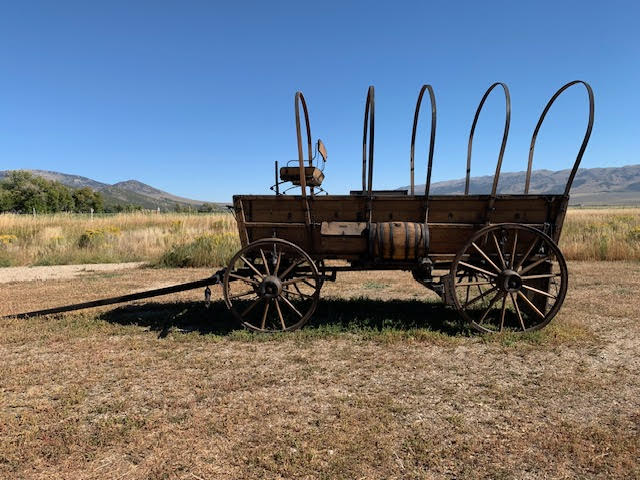
Some lives in traps and some lives free in wagons. Yeah, you pity me, poor and rough as I be. What you don’t know, my suited-and-booted friend, is I pity you—you’ll be paying-off that debt-trap house until you’re old and joyless. Whenever I tire of the setting, I just hitches up me wagon and moves on.
You calls us tinkers or gyppos, though we’re an ancient people with our own language. We calls you salary men. What really scares you is our freedom: I plays me fiddle at a couple of weddings and earns me the dosh to do as I please all week.
.
Friday fictioneers is a weekly challenge set by Rochelle Wisoff Fields to write a 100-word story in response to a photo prompt. You can find other stories here
The brush in my hand is sure as it makes a thin blue vertical ribbon on the right of the canvas. A river. A dip of the brush into zinc white, for a hint of water trapped in the ice, creates a larger swathe of frozen badland beside the river. Beside that, a brick-red frontage holding back chaos. And a horizontal blanket of cerulean wraps the whole.
What am I saying? That the universe resolves to a spectrum of neat bands? Will they understand? Does it matter? Yes, I’d like just one person to hear my scream.
.
Friday fictioneers is a weekly challenge set by Rochelle Wisoff Fields to write a 100-word story in response to a photo prompt. You can find other stories here
There was this crowd of people, all staring off into the distance. So, I watched too, of course.
“What are you looking at?” I asked the guy in front. “I see nothing.”
“Hope,” he said, turning. He had a weird far-away look in his eye.
The Second Coming? I wondered. Lights in the heavens? An ice-cream van?
A flock of sparrows stitched patterns in the sky.
And, you know, it was a kind of miracle.
.
Friday fictioneers is a weekly challenge set by Rochelle Wisoff Fields to write a 100-word story in response to a photo prompt. You can find other stories here
Magda Szabo was an award-winning Hungarian author. Among her best known works is the stunning The Door. I have just finished reading an earlier work, Iza’s Ballad, and found the turning-point chapter so compelling I re-read it four times to understand how she achieved the effect.
In this chapter, Iza learns that her mother has died while on a visit to their home village. Iza rushes to find her partner, Domokos, who drives her to the village. There, they encounter Iza’s, ex-husband Antal, who now lives in her childhood home. Iza is confronted by a grief she did not expect, and all the characters change in this chapter. How, I wondered, did Szabo craft the wild grief and the dissociation the chapter so powerfully conveys. Much of the rendering of grief and loss is achieved by changes in the writing style, rapid shifts of point of view, and dreamlike interleaving of things.
Close analysis showed the chapter is divided into fourteen movements.
Iza is enjoying the prospect of a day alone, with her mother and lover gone. The writing is indulgent and languorous.
A long-distance phone call. Iza is angry that she can’t be left alone. Antal speaks two sentences (which we are not given at that time) and puts the phone down.
Iza struggles to comprehend and experiences animal pain. The writing here is staccato hammer beats. There is a list-like effect, with many sentences starting with “She”.
Because she is alone, every past wound opens. Having neither mother nor father “felt new and raw, like drawing her fingers along both edges of a knife”. There is an explosion of emotion, followed by chemical calm as Iza takes a tranquillizer and plans what to do.
She goes in search of Domokos. The effect is dissociative. She can’t remember where he went, because she wasn’t sufficiently interested to listen properly, but knows she will be able to recall it if she tries.
She arrives at the hall where Domokos is speaking. Iza’s presence is like a rot or contamination, destroying things. She observes Domokos behaving in a way he doesn’t with her. Her arrival destroys his calm. People are annoyed, as if they witness something shameful.
It feels good to be with Domokos who takes charge. She compares being with Domokos and with Antal. Iza wonders how Domokos knows she can’t go back to flat alone: because he is a writer? Or because he loves her? This is the first moment of reappraisal of relationships.
They drive to the village. This movement is in Domokos’ point of view. It is distanced and interrogative. He notes the rarity of the autumn landscape; wonders who Iza is; wonders how the old woman died; wonders if marrying Iza would be good idea. What could have happened? He listens to Iza speak of her old life in a way she hasn’t before. He does not like that Iza is afraid to meet Antal. What will Antal be like? He realises how much he doesn’t know about her.
They arrive at the village. There is a rapid alternation of point of view that creates an effect like anxious darting eyes.. In Iza’s POV: Where has my mother gone? Where has my father gone? In Domokos’ POV: This doesn’t look like Iza’s description. In Iza’s POV: How much has changed in the village and how much remained the same. In Domokos’ POV: Watches Iza pulling at the bellpull like a child.
They go to Antal’s house, because the neighbour is not there. In Domokos’ POV: wonders if he will hate Antal, but likes him. Antal explains about accommodation options but Iza is not taking it in. Domokos, for the first time, takes in the scene not as a writer storing memories, but as a person. In Iza’s POV: she wonders who the “we” is in Antal’s account who searched for the old woman. The effect of this movement is that of a distanced observer.
They discuss sleeping arrangements. There is one place with Antal, one at the clinic. The gap continues to widen between Domokos and Iza, Domokos realises Iza does not want him to stay with Antal, and that he doesn’t care if Iza sleeps in same house as her ex-husband.
Antal walks Domokos to the clinic. As they leave, Iza notes Domokos speaking with Antal in a way he doesn’t with her. Again, she feels his alienness.
Iza is alone in the house. This is an extended passage filled with nostalgia. She reprimands herself for her cowardice in not wanting to leave the two men together. Thinks that old woman would not have died if she hadn’t stayed with Antal. Objects come alive around her—”she could almost hear them breathing”. Unable to bear to sit down, she wanders from room to room. Finds the old woman’s belongings but cannot touch them. She feels everything is as it was in her childhood and the old woman has only popped out for a minute and will return.
Antal returns and she takes his room. Iza says she can’t sleep where her mother’s things are. Antal agrees she can have his room. She needs to be consoled and feels if he embraces her the sadness will go. But he takes her pulse. It angers her that he is touching her as a doctor not a man. He offers a sleeping pill which she rejects. Door no longer creaks as it did in her father’s time. Past and present coexist. Antal leaves. Iza is quite alone.
Something was wrong. The lamplight in the nook was warm and yellow as freshly churned butter. The grandfather clock allotted time with a reassuring heartbeat. But the world felt awry, dirty.
Then I saw it–the desk covered by packing boxes. Someone had moved into my life.
Angrily, I swept the boxes to the floor. “Whoever you are, get out.”
A voice I did not recognize, full of tenderness and sadness, said, “You don’t know me, do you?”
I spotted no-one and ran through the possibilities: Selective amnesia? Dementia? Trans-dimensional portal?
.
Friday fictioneers is a weekly challenge set by Rochelle Wisoff Fields to write a 100-word story in response to a photo prompt. You can find other stories here
The sky was not particularly blue, nor the grass particularly green. But the barns shone vibrant red, like the houses back home—Dad’s one concession to being foreign. In all other respects, he said, “Now we’re here, and must fit in.”
I saw the guilt wracking him for the mistake of emigrating, for abandoning the hunt of the cod to push a plough. And I understood his pleasure when I took to reading the Edda.
“It’s good you know who you are,” he said. “The ancestors may have slaughtered folk, but it was always personal, and we composed an ode over their corpses. Here, everything’s about money.”
.
Friday fictioneers is a weekly challenge set by Rochelle Wisoff Fields to write a 100-word story in response to a photo prompt. You can find other stories here
If you knew what this is, would that make a difference? Let’s say it’s a water scoop for a sauna. Why, then, is it cold enough here to freeze the remaining water? Let’s say glue, instead. Why use such a pretty bucket?
Nothing can be understood without its context, can it, my dear? You are the loveliest woman I ever saw, with a nature as sweet as new-mown summer grass. Why would I kill you? Well, I wouldn’t, of course. And that’s the whole point, really.
Only one more spoonful, my dear, and you can sleep.
.
Friday fictioneers is a weekly challenge set by Rochelle Wisoff Fields to write a 100-word story in response to a photo prompt. You can find other stories here
It was all just a little too perfect. Give them their due—no effort had been spared in attention to detail. Gnarly cobbles underfoot, the yeasty smell wafting from the bakery, the jolly notes of the accordion player, and the swirling gaiety of the people hand-in-hand. Perfect.
“We’re not in Kansas anymore, Toto,” I called, and all motion stopped.
A voice in my ear, almost contrite, from someone I couldn’t see. “What gave it away?”
“Reality is dirtier.”
Of course, he’d do better next time, but I was on my guard now. He’d never learn the secret.
.
Friday fictioneers is a weekly challenge set by Rochelle Wisoff Fields to write a 100-word story in response to a photo prompt. You can find other stories here
See this here? “Favour”, not “favor”. This guy’s in the UK. How do I know it’s a guy? Lots of clues, but the way he describes women’s the clincher.
Holmes, you say? You ain’t seen nothing yet. Well-educated—”prestidigitation”, for example. Not an arts degree. From the language precision and the numeracy, I’d say science. Maybe an accountant, and in the north east of England–he says “pet” like a Geordie. And, of course, he’s cheating on his wife. You can learn so much from people’s social media.
He likes to walk in these woods. Go, bring him in.
.
Friday fictioneers is a weekly challenge set by Rochelle Wisoff Fields to write a 100-word story in response to a photo prompt. You can find other stories here
Every now and again, you get a glimpse into how the illusion is achieved. When the light falls just so, when the air holds a tinny reverberation, you can spot the apparition and hear the clanking of great gears. For a while, for a lifetime, for an epoch, the set captivates us. But then we see the flats vibrate and the backdrop flutter. In a moment, it will all be different, the prince will kiss the sleeping beauty, and the world will wake into a new story,
.
Friday fictioneers is a weekly challenge set by Rochelle Wisoff Fields to write a 100-word story in response to a photo prompt. You can find other stories here




 Neil MacDonald Author