

Book discovery sites offer authors and publishers the opportunity to promote their books to mailing lists comprising thousands of avid readers. Readers subscribe for free, while authors and publishers pay to be included in a listing.
The largest of these sites, by far, is BookBub. But, is it the best?

BookBub is a book recommendation site with between one and four million subscribers, depending on the genre. They claim to distribute to 3.82 million fans of crime fiction, for example, and 2.1 million readers of romance. In my genre of literary fiction, they claim 2.61 million subscribers.
Promoting your e-book through the site would seem to be a no-brainer. But it doesn’t come cheap. To promote to their e-mail list for literary fiction costs $768 if you reduce your price below $1.00 So, to recoup the cost at $0.99 a copy, you have to sell 776 copies.
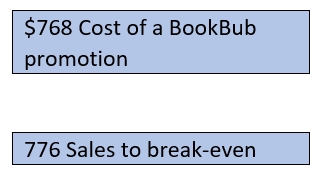
Don’t decide on which book discovery site to use based on its price alone. If BookBub gains you 1,000 sales at a cost of $776, the cost per sale is 78 cents. If another site sells 100 books at a cost of $90, the cost per sale is 90 cents.
BookBub will not accept every book submitted for this service. They handpick their promotions, and accept only around 10%. Here are some of the factors they use to make a decision
- Competitive price, discounted on all retailers
- Number of reader reviews and rating
- Professionally designed cover optimized for the genre
- Optimised product description page
Is it worth it?
I tracked the performance of 102 lit fic titles promoted through BookBub between the beginning of September 2020 and the beginning of December, following each for 11 days.
| A note on method I used ratings on Amazon.com, converting ratings into books sold using the Kindlepreneur calculator. This will be an underestimate of sales since it doesn’t cover all outlets and all countries but it will catch the majority. Amazon accounts for 72% of all e-book sales worldwide and Amazon US alone for 54%. Also, the Kindlepreneur calculator doesn’t register sales when they drop below one a day. Since I examined only literary fiction, it is possible that other genres may perform differently. You can find the results of an analysis for non-fiction titles at Scribe Media. |
BookBub claim that, on average, their promotions result in an additional 2,560 sales in the genre. The titles I tracked achieved less than half this on Amazon, at 1,090. But that’s still comfortably above the 776 needed for break-even. The effect is short-lived. After the boost on the first day, sales dropped sharply to an average of 10% of the initial boost by day five.
But, like anything, success is not evenly distributed. Twenty nine per cent of the titles experienced no impact on sales at all. For the remaining 71%, sales rose, on average, almost two-hundred-fold compared with the level before the promotion. So that’s pretty good, but for individual titles it varied from 12,910 additional sales (which was for Tracy Chevalier’s A Single Thread) to just 1.

Around half (54%) of these titles achieved more than the break-even sales figure of 776. On average, they racked up 2,761 sales. The other half sold an average of 364.
In summary, the odds of covering the costs of a BookBub promotion are 54% of 71%. In other words, 38%.
What kinds of books do better?
Analysing the performers (those that achieved sales) and non-performers (those without sales), some differences stand out
- Performers have a higher rate of reviews. On average, they each had 522 reviews, compared with 400 for non-performers
- Non-performers tend to be more recent publications. The average publication date of non-performers was 2008, compared with 1994 for performers
- Non-performers have a higher percentage of foreign and translated titles, accounting for almost a quarter of the total, compared with 13% for performers. This difference is even more pronounced when the performers are divided into those that recoup the costs of the promotion with those that don’t. Only 6% of those that covered their costs were foreign or translated, compared with 15% of those that didn’t cover their costs.
These differences were not repeated in other book discovery sites. A comparable analysis of BookGorilla showed that titles that achieved no sales had more reviews than the performers. And the group with no sales were, on average, published earlier. None of the BookGorilla titles were by foreign authors or in translation, so this comparison cannot be made. However the role of reviews did show up again in the distinction between the titles that covered their costs and the group with sales that did not cover their costs—those in profit had three times as many reviews as those who did not recoup their costs.
Are other sites better value for money?
BookBub is by far the largest book recommendation site, but there are many others. Many are too small to be of great value, but some of the intermediate-sized sites offer the prospect of significant impact on sales at costs lower than BookBub. I compared three of these sites, BookGorilla, Bargain Booksy, and Fussy Librarian. I also looked at one free site, Book Angel. In all cases, I compared the effects on titles classified as literature.
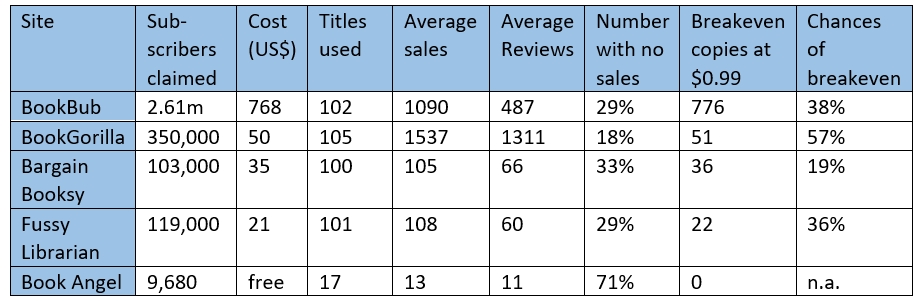
BookGorilla looks like a contender for BookBub’s crown. It is possible that some sales are due to “stacking”. This occurs when a title is advertised simultaneously on multiple sites. To check that sales on BookGorilla were not really reflections of promotion on the much larger BookBub, all titles that appeared simultaneously on both sites were stripped out of the BookGorilla figures. There were 10 such titles. Removing them reduced the average sales on BookGorilla to 1,498, reduced the number with no sales to 15% and increased the chances of break-even to 60%. BookGorilla’s performance was therefore not caused by overlap with BookBub.
The BookGorilla results were so surprising that I ran them again after the Christmas period on a smaller sample of 28 titles. The numbers were comparable for break-even (54%) and for no sales (21%), though sales were lower at 435. A repeat of the BookBub analysis for 30 titles showed no evidence of a post-Christmas slump, averaging 1,353 sales. The proportion who showed no sales was consistent at 30%, though only 30% broke even, a smaller proportion than previously.
The numbers seem clear. BookGorilla offers an equivalent sales boost to BookBub, a dramatically lower price, and a better chance of achieving break-even on the cost. BargainBooksy and Fussy Librarian did not perform nearly as well. The free site (Book Angel) achieved almost no growth in sales.

Two notes of caution about the comparison.
- The sales on BookGorilla may have been artificially high because the first numbers were tabulated in the run-up to Christmas, while the data for BookBub was collected a couple of months earlier. Sales did fall in the second sample of BookGorilla titles after Christmas. There was little evidence of a seasonal boost though for BargainBooksy or Fussy Librarian.
- The sales on BookGorilla, though apparently higher than BookBub, are boosted, in part, because many of the titles were already achieving high sales before the promotion, perhaps due to stacking. As a result, while BookBub saw an elevation of sales by an average 179-fold over the baseline, BookGorilla yielded a more modest average boost of 17-fold.
“Stacking” book discovery sites
Up to this point, I’ve talked about book discovery sites as alternatives. But this isn’t necessarily the best way to use them. You can stack several promotions together. Don’t think of them as being simply additive. 1+1 can be more than 2. This is because of the way the Amazon algorithm works. To get best value from the promotions, you want to kick-start Amazon into recommending your book to more potential buyers. The algorithm notices a successful “spike” in sales. But, as seen, this tails off very quickly. So, if you can maintain sales over time (say 5-7 days), the algorithm will notice the “consistency” and interpret as organic buying behaviour. This will increase the chances Amazon recommends your book.
So, you want to plan a promotional campaign that creates an upward sales trend over the 7 days. You want to come off the promotion at your peak Amazon ranking. Combine all the firepower you have available. For example, you may start on day 1 with a promotion through social media, your website, newsletter or mailing list. You may want to combine this with advertising on Amazon and other places. Around day 3, bring in the first of the book discovery sites, and introduce the others over the succeeding days, ending with a bang on the penultimate day. If you’re lucky, Amazon will give you a long “tail” of sales after the promotion is over.
It’s also important not to think of an individual promotion as an end in itself. Think strategically. Your short term goal is to sell more books, sure. But, longer term, your success depends on building a sustained relationship with fans and subscribers. It also depends on learning what promotional tools work for you. Think about how an individual promotion can help you towards the goals of building your skills in promotion and reaching out to a wider audience.
Conclusion
Opting for the biggest and most expensive site may not be your best option. BookBub performs dramatically, but not for every title. BookGorilla performs equally well, for less cost and with a higher chance of recouping your costs. Think about “stacking” the sites to achieve greatest effect.








 Neil MacDonald Author