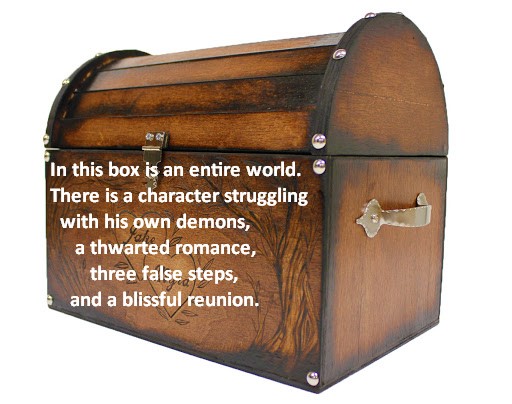
Open the box.
Friday fictioneers is a weekly challenge set by Rochelle Wisoff Fields to write a 100-word story in response to a photo prompt. You can find other stories here

Open the box.
Friday fictioneers is a weekly challenge set by Rochelle Wisoff Fields to write a 100-word story in response to a photo prompt. You can find other stories here
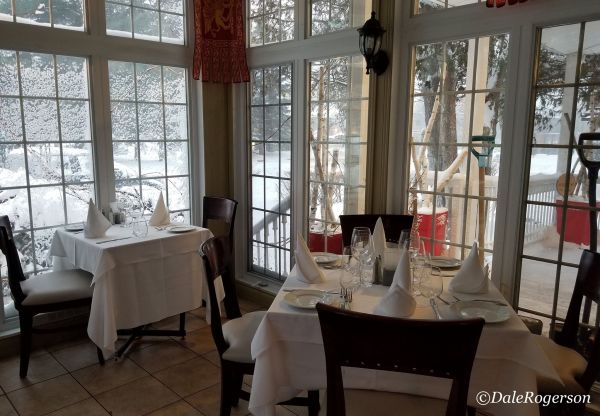
It was a grand idea. One that would tie all the threads together and lead to an unexpected place. I thought, “I must remember this solution when I wake.”
In the morning, it had scuttled away into the wainscoting, and all I was left was a sense of the colour red and a cross-hatched pattern.
Friday fictioneers is a weekly challenge set by Rochelle Wisoff Fields to write a 100-word story in response to a photo prompt. You can find other stories here
 We’re told these days by our leaders that they’re “following the science” in their handling of the coronavirus pandemic. And, of course, we know what they mean. In an age where it became fashionable not to listen to the experts, they’ve never needed experts more. Briefings abound with flattenings of curves and keeping the R value below 1.
But, if I’m uncharitable enough to unpack the catchphrase, an oddity leaps out.
Politicians and scientists have a different understanding of truth. Politicians want clear answers—should we do this, yes or no? Invoking science should be the gold standard of clarity.
Scientists, on the other hand, deal in uncertainties. Hypotheses are contingent on testing, interpretations are contested, epoch-making claims turn out to be mere statistical blips as more data emerges.
There is so little data as yet on this new virus that “the science” is less a provider of clear yeses and nos than it is a habit of thought. That habit of thought is the opposite of what the politicians mean—it is a cultivated scepticism, an openness of mind, a willingness to change your mind when the evidence changes.
In the future we’ll know a lot about this virus. But now we don’t know whether people who have recovered generate immunity or whether they can catch it again. We know that it appears to differentially affect men, the elderly and those with underlying health conditions, but we don’t know why some young patients with no known health conditions have a severe response. We think of it is a respiratory illness, but it doesn’t always respond to ventilation in severe cases and it appears to cause kidney problems in some patients. Other patients seem to be overwhelmed by their own immune responses, a so-called cytokine storm. It may not really be a respiratory condition at all.
We don’t think the virus is mutating in the way the influenza does, but we’re not sure. We don’t even know for sure yet what the death rate is.
Not being sure is “following the science”, but this doesn’t cohere well with policy-making. And we want simple clear answers. This is understandable in a population where scientific literacy is low. We’re only just getting used to weather forecasts that give us probabilities of rainfall rather than simple yes-no predictions. But, perhaps we’ll use this crisis to become more comfortable with uncertainty and more conscious of which things we can be certain about.
Angela Merkel, in a broadcast to the German nation, gave a detailed epidemiological explanation of what different values of R meant for the health system. Covid 19 is thought to have an R of between 2 and 3. This means, without intervention, every infected person goes on to infect between two and three others. If measures like social distancing keep R below 1, the chain of transmission starts to be broken. Merkel explained what a small increase in R meant: if it goes up to 1.1, the German health system would be overrun by October; at 1.2, the crisis would come in July, and at 1.3, by June.
Even where there is a certainty within a discipline, building a response to the pandemic involves different disciplines with different answers. An obvious example is the answer to the question “how long does the lockdown need to last for?” Epidemiology says the best answer is as long as there are high levels of the virus circulating in the population. But behavioural science tells us that people will only tolerate being cooped up for so long before they begin to go walk-about. There were already some signs in the fifth week of the British lockdown that this was starting to happen.
So, from an epidemiological point of view, the lockdown on 23 March came late. But from a behavioural viewpoint, this may have been the optimal time. And, of course, other factors have to be considered too, most particularly the effect on the economy, on people’s livelihoods and consequently on their mental and physical health, covid 19 notwithstanding. We won’t know until the official papers are released, but there are speculations that there was a policy debate in the UK in March as to whether to bear down on the spread of the virus or, alternatively, whether to let infections rip hoping for a quick peak and the creation of “herd immunity”. The world has never encountered anything like this, not even in the Spanish Flu pandemic of 1918-19, because there was no lockdown then. On the contrary, the First World War ground on towards its grisly conclusion despite the virus.
So there really is no simple “science” that can be followed. It’s all a matter of balancing some things that are known and guessing at some things that are not yet known. The decisions are ultimately political, not scientific. The “following the science” mantra may simply serve to shift blame onto the scientists if things go wrong.

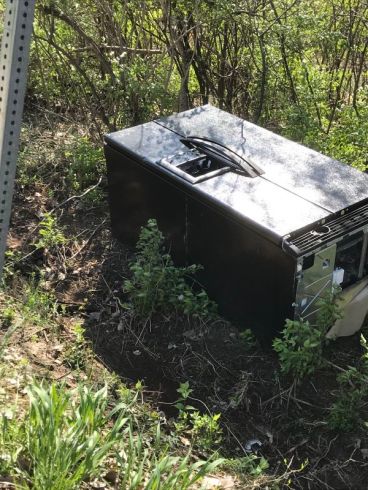
When we plugged the dilithium crystals into the manifold, it happened. The dustbin began to shake and, on the old zinc sheet, a ghostly image formed.
“What is that?” Tony asked, cutting to the heart of the matter.
“Damned if I know,” Truth is important to me.
But Peg was our visionary. “It’s another world,” she said. “We’re seeing into a parallel universe. Look, there’s a building and a tree.”
It looked suspiciously like a baked reflection of our building and a telegraph pole connected by a manifold.
“Not as good as television,” Tony decided and went home.
Friday fictioneers is a weekly challenge set by Rochelle Wisoff Fields to write a 100-word story in response to a photo prompt. You can find other stories here
The urban dictionary defines threading the needle as “While driving, walking, or running you weave in and out of obstacles (other cars, people, etc.) in your path.”

The road to self-publication involves a lot of weaving in and out. In a previous post, I described how I chose my publisher and publicist for my literary thriller, The Tears of Boabdil.
That was only the first of many decisions. Next came:
Each of these decisions will have huge influence on the book’s success. There will certainly be a lot more to research, think about, and decide on. The book is now typset in its first proof stage, and so I’ve been proof-reading.
I can’t pretend to be an expert (I’m learning as I go) but, as a writer, I know the importance of doing my research.
This one was easy, since part of the reason for choosing Matador for the production of the book was that they also have an effective sales and distribution arm which can get books into major retail outlets.
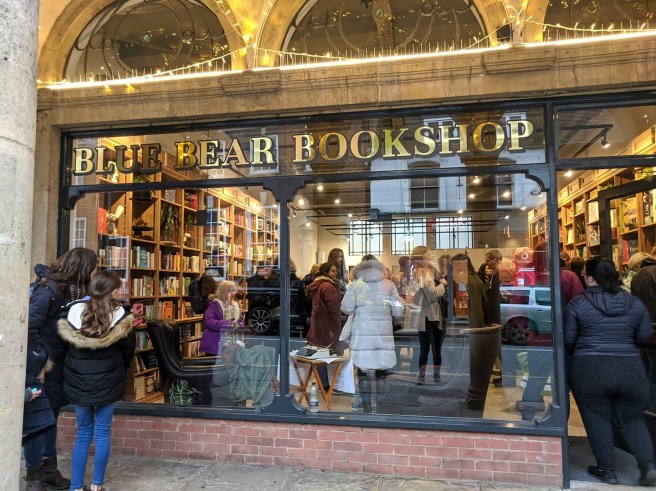
Matador’s distribution service produces an Advance Information sheet to publicise the book for booksellers, arranges all bibliographic data management for wholesalers including Nielsen and Gardners, and distributes to retail physical and online bookshops. This service, which costs £300, requires a print run of at least 100. I also contracted their representatives to hand-sell the book into high street retailers. This service costs £250 and requires a print run of at least 300.
How you categorise your book affects how easy it is for readers to find.
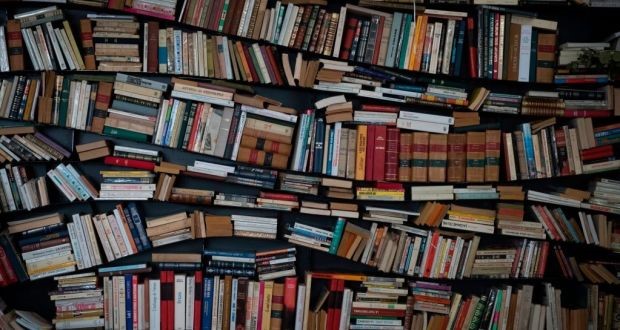
The online seller Amazon dominates the market with over 33 million titles, and understanding the way it classifies books is important to success. Amazon Kindle lists only the top 100 books in each category. That means in a highly competitive category like Romance your book may sink without a trace unless your sales figures are really good. But Amazon Kindle has 10,849 bestseller lists. So, if you expect to be getting sales in the hundreds, it pays to pick a less competitive category. If there are no more than 100 books in your category, you’ll automatically make the bestseller list with a single sale.
Here’s a really useful tabulation of how different categories sold on Amazon Kindle in 2019. It shows Amazon’s overall sales ranking for bestsellers in each category.
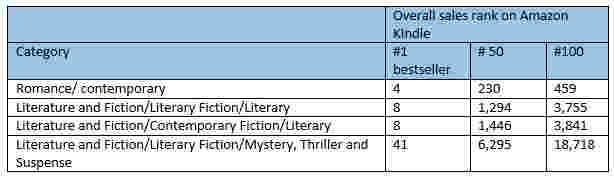
My book is literary with thriller elements. So, if I marketed it as Literary Fiction/Literary, I’d have to be at least number 3,754 on the Kindle rankings to appear on a bestseller list. But if I marketed it as Literature and Fiction/Literary Fiction/Mystery, Thriller and Suspense, I’d only have to reach number 18,717.
To translate these rankings into estimated numbers of books sold, you can use this Kindle Best Seller Calculator or this one.
To achieve a sales rank of 4 (the #1 spot in the most competitive category, Romance/contemporary), the author will be selling around 5,360 e-books a day. To achieve a sales rank of 18,718 (the 100th spot on the bottom row), the author will be selling around 13 e-books a day.
The rankings change over time, so it’s worth checking just before you release your book. In April 2020, the number 100 spot for Literary Fiction/ Mystery Thriller and Suspense had a sales ranking of 4,058.
Most physical booksellers use the more restricted Thema categories. There, my best choices were either Fiction General and Literary, or Modern and Contemporary Fiction, or Thriller/suspense. On my publisher’s advice, I went with Thriller/Suspense, since there was no Literary Thriller category.
So, hopefully, the book will be available through all major retailers. All I need to do is make sure readers know about it and want to buy it.

The city dreams, respiring slowly—the outbreath no longer poison, but blossom-perfume. I sniff the reveries, and they’re heady. My head swims, and lips curl in a smile.
From window to window we call and birds swoop from among the towers carrying our cry like pollen. Buds break on spires and pinnacles. Basements put out roots and taste the earth.
Newness is being born.
Friday fictioneers is a weekly challenge set by Rochelle Wisoff Fields to write a 100-word story in response to a photo prompt. You can find other stories here

The air holds a limpid clarity. A goat, nibbling my hedge, looks in the window at me looking out. Birdsong resounds over empty streets. I skype my neighbours, even those I don’t like. In the highway’s asphalt, a crack widens and a seed takes root. There will be no going back to “normal” after this is over.
Friday fictioneers is a weekly challenge set by Rochelle Wisoff Fields to write a 100-word story in response to a photo prompt. You can find other stories here

All that remained were his last photographs. Surely, they held a message? Some final trace of him to quiet my anguish; a response to everything I should have said.
If only I’d…. But, no. It is what it is. He’d have known I hadn’t meant to leave, that I’d be back.
There it was! A sparrow looking-in through the window. A reprimand? Or forgiveness? Was I the bird, or he?
Friday fictioneers is a weekly challenge set by Rochelle Wisoff Fields to write a 100-word story in response to a photo prompt. You can find other stories here
Lockdown isn’t totally unlike normal life for me. I get up, check e-mails, write, keep in touch with friends. Not so different from before. I think coping with the social distancing depends a lot on a set of factors that writers probably have in spades:
My day, as I said, has structure. Though my writing group has stopped meeting, we continue to circulate drafts to each other as before once a week on Thursdays. Every Wednesday, I write a story for Friday Fictioneers.
Writing, though its product is an intensely social collaboration between author and reader, involves solitary hours communing with the keyboard. So the new isolation is much like the old isolation.

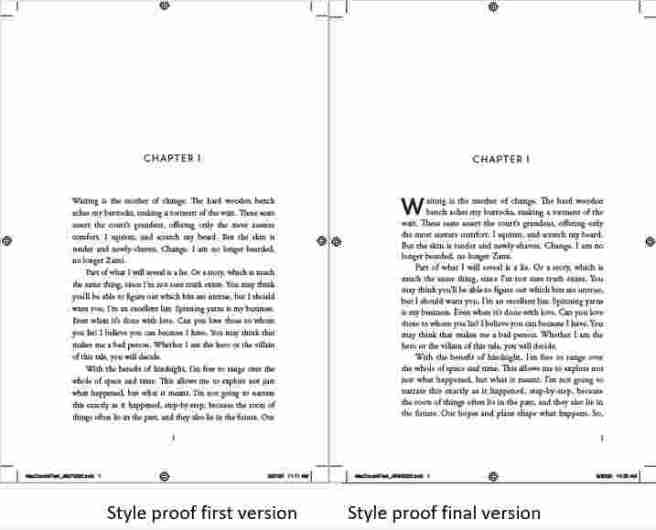
The act of writing is immensely satisfying, creating something that never existed before. For me, each story is an act of discovery, of wrestling meaning from an initial vague intuition. I accomplish tasks every day. And, with my novel The Tears of Boadbil going into production, I get to see my work taking physical shape. Last week I returned to style proofs for page layout. I asked for a change in font size, line spacing, and some other details, including drop caps at the beginning of chapters. I love drop caps. Working on my book production, publicity and marketing gives me a way to engage with a future beyond the pandemic.
I know, of course, that I’m immensely privileged. I can pay my bills, there are no small children to be entertained, and we have a garden to potter around in. For many others, it is much grimmer.
For writers this is a time to be producing. You’d think now is not be the time publishers will want pandemic books. But Penguin says sales of Albert Camus’ The Plague were up 150% in February compared with the previous year and at the end of March, the number two book on Amazon’s charts was The Eyes of Darkness by Dean Koonz, about the fictional epidemic virus Wuhan-400.
The impact of the virus on our lives and our societies will necessarily provoke thoughts about what matters and how we should live our lives. It’s inconceivable coming out the other side of this emergency that the answers to these questions won’t be changed. And who better to reflect on them than writers?

I am aghast. “It’s monstrous,” I say.
He seems faintly amused by my outrage and turns from the keyboard with a shake of his silver head. “It’s necessary,” he says. “The way we stop this disease is to isolate the vulnerable and let the healthy catch it. Most will recover and when they do we’ll have a shield of herd immunity.”
“You can’t know that,” I say. “You’re running a terrible experiment with millions of lives.”
His mane tosses like a lion’s. “The peak will be sharp, but it’ll be short.”
Somewhere, faintly, a phone is ringing.
Friday fictioneers is a weekly challenge set by Rochelle Wisoff Fields to write a 100-word story in response to a photo prompt. You can find other stories here
 Neil MacDonald Author