The sun-swept fjord has been constructed with real flair. Geirfinnur Vidarsson admires the build as only an engineer can. Steeply sloping snow-capped walls and a firth perfectly aligned with the rising fireball, bathing the glaucous waves orange.
He steps with care through the lava field, wary of the razor-edged cinder cones lurking beneath the soft green moss. Geirfinnur is alone in this landscape. He utters a cloud, and it drifts fluffy across the dome of the sky.
Next, he tries to forge a man and a woman, but fails. Head bowed, he turns back towards town.
Friday fictioneers is a weekly challenge set by Rochelle Wisoff Fields to write a 100-word story in response to a photo prompt. You can find other stories here
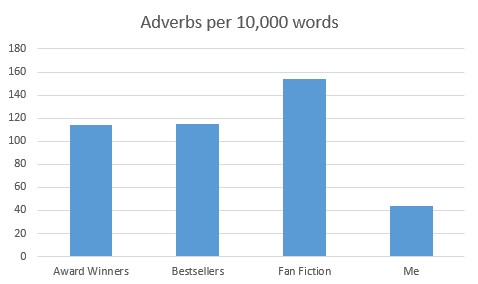
Now we have some objective analysis of the truth or otherwise of the dictum. Ben Blatt analysed the more than 300 novels that reached number one on the New York Times bestseller list since 2000 and the 100 most recent winners of literary awards. He compared these “professional” authors with a sample of 9,000 “amateurs” who had written novel-length fan fiction. The professionals used around 114 adverbs per 10,000 words, compared to 154 by the amateurs. So there is a correlation between fewer adverbs and literary success. As you can see from the graphic, I used 44 adverbs per 10,000 words in my current novel.
However, Stephen King seems to be wrong about eschewing adverbs, if you take him literally. He used an average of 105 across 51 books.
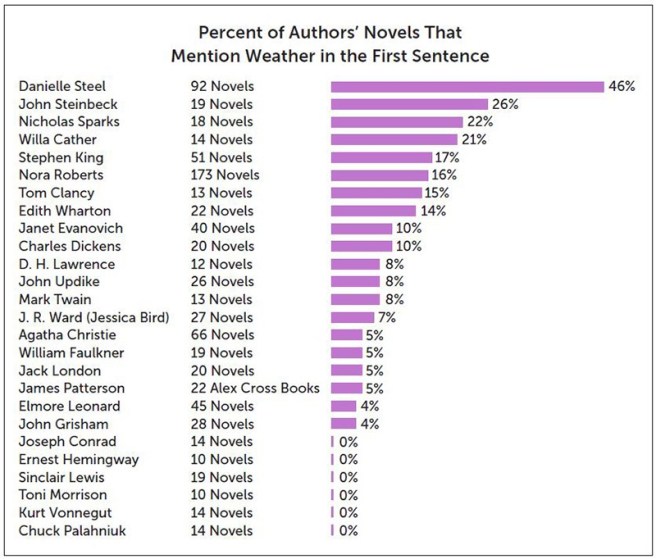
Another great writing dictum Blatt explores is Elmore Leonard’s “never open a book with the weather”. The graphic below shows that Leonard did this 4% of the time across 45 novels.
Bestsellers today, according to Jodie Archer and Matthew Jockers’s The Bestseller Code, use shorter sentences and simpler words. And it seems true that sentence length and complexity has gone down.
Sentences in Jane Austen’s 1811Sense and Sensibility averaged 23.2 words and in Charles Dickens’s 1859 A Tale of Two Cities 17.7 words. They both require a reading age of 14-15 years.
By contrast, J.K. Rowling’s 1998 Harry Potter and the Philosopher’s Stone, with a reading age of 12-13 years, came in at 11.8 words. Stephanie Myers’s 2005 Twilight was a lightweight 9.6 words per sentence and demanded a reading age of 10-11 years.
While the complexity of language has gone down, the size of novels has gone up. In the era of mass publishing between 1850 and 1950 shorter novels arrived but they grew in size again after the advent of long-haul travel and the airport blockbuster.
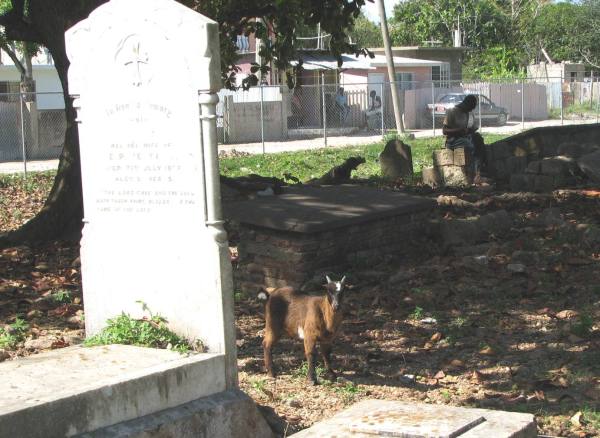
Miss Maisie make a mausoleum. Weren’t that just like she? Even in death, she lord it over Miss Hester.
But Miss Hester, she smile and sweep her patio; keep her place spick and span. She look from her door through the chicken-wire fence at goat and chicken and pickney playing on the grave.
“You don’ mind that your sister still have bigger house?” I aks.
Miss Hester laugh. “She cyan chase them animal out, now. She gone. And I outlive she.”
Friday fictioneers is a weekly challenge set by Rochelle Wisoff Fields to write a 100-word story in response to a photo prompt. You can find other stories here
Ever wanted to know how judges make their choice in literary competitions? Here is the answer.
I can’t promise that this is true of all contests, but the Farnham Short Story Competition uses a format to ensure consistency of assessment between stories and between judges.
Is the submission formatted readably, and without typos, spelling and grammar mistakes? Reject entries that are poorly formatted, inadequately proof-read, and full of spelling and grammar mistakes.
Overall, is it a good story?
Does the story work?
Did it move or enlighten you?
Did you enjoy reading it?
Character and point of view.
Does the author create believable, memorable characters with the uniqueness, complexity, and individuality of real people?
Do the main characters undergo change?
Does the dialogue work?
Is point of view handled consistently?
Plot and structure
Does the opening draw you in, setting up a clear dilemma?
Is there a clear and compelling storyline with an arc of conflict, crisis and resolution?
Is the plot original?
Is there good pacing?
Does the ending satisfyingly resolve the opening dilemma?
Theme
Does the story contain a central or dominating theme?
Does the author make this idea concrete through the characters and their actions?
How well is the message integrated into the story?
Setting and atmosphere
Are historical and geographic details sufficiently and accurately developed to give the story realistic or appropriate atmosphere and setting? Can you visualize the places being described?
Is the setting an integral part of the story
Does the story contain anachronisms or inconsistencies?
Writing quality
Is language skilfully used?
Do specific details appeal to your senses and hold your attention?
Are character and detail “shown” rather than “told”?
Is there a good balance between narrative and dialogue?
Does the author use precise, active verbs and avoid overuse of adjectives and adverbs?
Is rhythm used effectively?
Are metaphors and similes fresh and effective?
Are recurring motifs and/or symbolism used to create additional layers of meaning?
“From where the Benson house used to be, take a left at the duck pond,” I explain to the county surveyors. They unpack theodolites.
Somewhere in these woods, my property stops, and Higgins’ starts. They do things differently in Higgins land. But deer tracks meander through both territories, and, come spring, the blue tits may nest in either. Underbrush obscures the lines of latitude and longitude.
I have no option but to ask Higgins to walk the boundary with me, unfurling black and yellow tape where our internal maps coincide. I gift him a stand of chestnuts. We send the surveyors home.
Friday fictioneers is a weekly challenge set by Rochelle Wisoff Fields to write a 100-word story in response to a photo prompt. You can find other stories here
They found me of course. Writing my journal by the light of the oil lamp. I fancied a wave of warmth tickled my chilled body as the leather and paper blazed-up on the fire. The flag’s crack in the Arctic wind howled despair.
Petrie’s tone was that of a disappointed father. “You know only the official record is permitted. It says so in your contract. No individual tales.”
“You think you can own the past?” I said.
“No.” He laughed. “With my account of muscular purity and heroic suffering, I will own the future.”
Friday fictioneers is a weekly challenge set by Rochelle Wisoff Fields to write a 100-word story in response to a photo prompt. You can find other stories here
Hattie couldn’t remember the point when men stopped noticing her, when construction workers no longer whistled and catcalled. Bur one day, while she was out buying a newspaper, she noticed a sense of ease, a relaxation of the shoulders.
Then she discovered she could deftly extract strangers’ wallets. Nobody saw her.
She tried lifting a diamond tiara from Johnstone’s Jewellers. Nobody saw her.
Governments began to offer contracts of extraordinary delicacy. It was dangerous, of course, but paid lavishly.
One spring afternoon, her grandson walked right through her.
“Well, bugger me,” she said. “I’ve passed on and nobody told me.”
Friday fictioneers is a weekly challenge set by Rochelle Wisoff Fields to write a 100-word story in response to a photo prompt. You can find other stories here
Mirrors glittered in the great hall, images of his opponent marching away in regiments to the ends of the world. Yet Henderson was not overawed by the infinite Vizier, for a similar legion marched at his side.
On the table between the statesmen, pleasant valleys, ripe fields and great cities. And a pen. The Vizier drew a line around a spired settlement. Henderson took a bustling port. Watching counsellors sighed like wind in the forest.
The Vizier said, “Let us sup and be at ease, Excellency. It’s going to be a long day.” He clapped his hands.
Friday fictioneers is a weekly challenge set by Rochelle Wisoff Fields to write a 100-word story in response to a photo prompt. You can find other stories here
Ki warbles. Ki croaks at the edge of a pool, green-shaded by ki’s overhang. Kin everywhere.
The warbling hopping on the earthing seeking seedlings under the shading.
Old menning stroking beardings, separating once and for all “this is the subject, and this the object”.
Now I am he, and all you kin are its.
I gather them, name them. I have dominion. The oak falls to my axe.
Where now are kin?
Friday fictioneers is a weekly challenge set by Rochelle Wisoff Fields to write a 100-word story in response to a photo prompt. You can find other stories here
This piece is an experiment. It uses the suggestion of Robin Kimmerer that the division of pronouns into personal (he/she) and impersonal (it) in English reflects a worldview of dominion rather than stewardship of nature. She
Malkie weren’t bad, not really. Unlucky, you might say. He could have been somebody. At least, I can say he were good to me. Shared his bottle, when he had one, and his blanket on a winter night. I seen the TV pictures of them world war cemeteries for the boys who died afraid in the mud—shade trees and white headstones in neat rows like soldiers on parade,.
Malkie died in the mud here in our trench. But no bugger gave him a pretty grave. I did me best with a rock. Lest we forget.
Friday fictioneers is a weekly challenge set by Rochelle Wisoff Fields to write a 100-word story in response to a photo prompt. You can find other stories here






 Neil MacDonald Author