The Fellowship of the Pen, a writers group, meeting in Farnham Surrey, is organising a short story competition in association with The Farnham Herald and Waterstones, Farnham. The winner will receive an engraved trophy and their story will be published in The Farnham Herald. The competition opens on 7 September and closes on 2 November. Names of those short listed will be published on The Farnham Herald website on 7 December. The winner will be announced at a presentation at Waterstones, Farnham in the middle of December.
The competition rules are as follows:
The Farnham Short Story Competition is open to anyone in the UK aged 16 or over on 7 September 2017. Members and families of the sponsoring organisations (The Fellowship of the Pen, The Farnham Herald and Waterstones Farnham) may not enter.
The competition opens on 7 September and closes on 2 November. Entries received after this date will not be included.
Stories should be no longer than 1,000 words, excluding the title. Any story exceeding this limit will be rejected.
Stories should be original, have not won a prize in another competition and have not appeared in print or on-line (excluding your own blog).
There is no theme or genre.
Entry to the competition is free. All entries should be sent as an e-mail attachment in Word or PDF format to: farnhamshortstorycompetition@outlook.com. The e-mail must include the title of your story and your name and contact details. No identifying information must be included in your story. Please also confirm in the e-mail that you are over 16 years old.
The competition will be judged by the novelist Claire Fuller and writers from The Fellowship of the Pen. All entries will be judged anonymously. The judges’ decision is final.
The Farnham Herald and The Fellowship of the Pen reserve the right to print the short listed stories. All other copyright will be retained by the entrant.
I don’t exist. The track unravels empty across the moor – the physical world contains no first person singular. Though my spirit presses insistently on the arches of my eye socket, like a hawk trying to escape a cage, really the thing’s a ghost.
Fingers flutter and reach for yours. “Give me a hug,” I say.
Even if the outside domain has no room for an “I”, there is a “you”. I know that because I can see you. And through “we”, for a time, I can feel myself in the world.
Friday fictioneers is a weekly challenge set by Rochelle Wisoff Fieldsto write a 100-word story in response to a photo prompt. You can find other stories here.
Fancy sharpening your skill with writing exercises? The Scrivener’s Forge offers a new exercise every month to hone one aspect of your craft. Take a look at this month’s exercise on reveals.
A reveal is a twist in the tail. It can be like the punchline of a joke, suddenly taking the story onto a completely different terrain (the main character wasn’t a person after all, they were a worker bee, for example). Or it may suddenly show the machinery that was driving the story. Or it may make metaphorical and magical connections between events (this is often done by “mirroring” between an event and an earlier one).
Exercise:
Write a short story with a reveal. You may want to work backwards from the ending, as in exercise 8
“There’s earth right under our feet,” he said. “Earth and roots and worms – it can break through any time.”
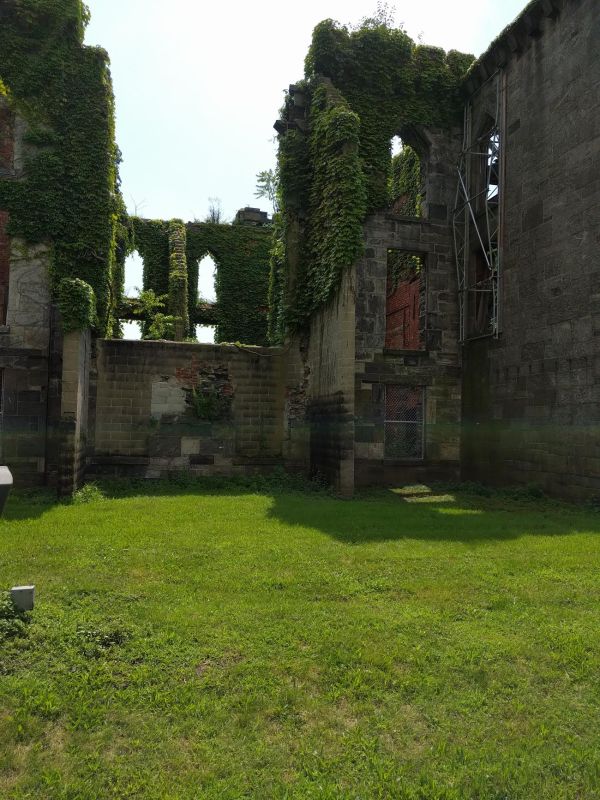
How could I have known the ruined castle would terrorise him so? Imagined tourneys and jousting and round tables was what I expected. Instead, he saw decay, a child’s first glimpse of our impermanent hold on eternity.
“Everything’s okay, sweetie,” I said. “I won’t let anything hurt you.”
He seemed to recover until building began on the plot next-door.
Looking into the foundations’ depth he screamed, “dirt.”
For the next decade he wailed and fought whenever we took him outside.
Friday fictioneers is a weekly challenge set by Rochelle Wisoff Fields to write a 100-word story in response to a photo prompt. You can find other stories here.
Fancy sharpening your skill with writing exercises? The Scrivener’s Forge offers a new exercise every month to hone one aspect of your craft. Take a look at this month’s exercise on plot and endings.
Who can resist a personality test or a fortune teller? Writers are no exception. The online tool I Write Like promises to tell you which famous author your style most resembles. The tool works by Bayesian analysis, much like a spam filter on your e-mail. I tried it and was rewarded with the answer that I wrote like Vladimir Nabakov.
Then I tried it again. And again. Seventeen times with seventeen different stories. I got thirteen answers ranging from the flattering Tolstoy to the surprising Stephanie Meyer. Five times I got James Joyce. So I started to wonder what the tool was really responding to and analysed the five “Joycean” stories in more detail.
The stories didn’t have genre in common. Two were literary, one was humour, one a thriller and the final one a psychological flash story. Did they then have some stylistic similarity? I used the Hemingway app which measures lexical complexity and assigns a readability score. They averaged grade 4.2, but varied widely from grade 7 (more complex) to grade 2 (less complex).
They also had a higher average “lexical density” than is typical for fiction or than the non-“Joycean” stories. Lexical density is a measure of how many words in a text carry information (nouns, adjectives, verbs and adverbs) compared with non-informative grammatical words (such as articles, conjunctions, prepositions). Fiction typically has a lexical density of between 49% and 51%. Only 20% of the five “Joycean” stories fell within this range, but only 25% of the non-“Joycean” stories did either.
To check that the I Write Like website wasn’t just throwing out random names, I fed it the same texts on two different days. It gave the same answers, so it is measuring something. Then I ran the obvious test – I fed the tool text from James Joyce’s Portrait of the Artist as a Young Man. It identified this as being like Agatha Christie! To be fair, it identified Tolstoy’s Anna Karenina as being like Tolstoy.
In the course of this chase, I also looked at another literary analysis tool, the Online Authorship Attribution Tool. This is similar to the tools used by Universities to detect plagiarism in student essays. It compares three features of an unidentified text with known samples: the use of function words, such as “and” and “the” which are independent of content; punctuation; and lexical structure such as sentence length, word length and complexity of vocabulary. This tool failed to identify any of my “Joycean” stories as being like James Joyce. However, it also failed to identify chapter five of Portrait of the Artist as being by Joyce either.
I looked more closely at my five “Joycean” stories. They did have one thing in common – they all contained an extended monologue or internal dialogue. I have no way of knowing for sure whether this was what the tool was detecting. But it made sense, more sense than the idea that I have thirteen different styles. The story that was like Stephanie Meyer (author of the vampire romance Twilight series) was sci-fi and contained a hunt.
The moral of the investigation is: use these toys for fun by all means, but don’t take their readings any more seriously than you would a personality test or a horoscope in a magazine.
Lyra and Will enter the café. Waves lap the sweeping littoral, and colonnades shade abandoned terraces. I sense the heat. This West African seafront belongs to my memory, not the author’s script. But the children who people the scene, fearful and hopeful, are strangers to me.
The book takes root and sprouts in an alien soil. Together the author and I create new and unintended versions. Our stories escape and breed in the wild with other tales. Dark shapes move across the hills.
Friday fictioneers is a weekly challenge set by Rochelle Wisoff Fields to write a 100-word story in response to a photo prompt. You can find other stories here.
Fancy sharpening your skill with writing exercises? The Scrivener’s Forge offers a new exercise every month to hone one aspect of your craft. Take a look at this month’s exercise on plot and endings.
This just couldn’t be right. It offended against everything I’d ever heard.
“You’re kidding, surely?”
“Why?” Ka’arsnak waved a tentacle. I’d learned this signalled irritation. “What’s wrong?”
“The portal opens into a shower?”
The tentacle waved more vigorously. “You wanted maybe a waterfall? Rainbows? Heavenly choirs?”
“Well, it’s not, you know, dignified. Not believable.”
The choking gargle was its way of expressing sarcastic mirth. “An angel with green skin and eight tentacles you can accept, but not a doorway through a bathroom? Get over it, you’re dead. Time to go. Chop-chop.”
Friday fictioneers is a weekly challenge set by Rochelle Wisoff Fields to write a 100-word story in response to a photo prompt. You can find other stories here.
Fancy sharpening your skill with writing exercises? The Scrivener’s Forge offers a new exercise every month to hone one aspect of your craft. Take a look at this month’s exercise on plot and endings
This was my great-grandfather’s head. The intricate spiral patterns are moko, chiselled by skilled artists into living flesh and coloured with soot. Your museums prized them as curios. So men with moko were captured, decapitated, and sold to the whites. The supply of tattooed heads began to dwindle. For a while the market shortfall was eased by killing and posthumously tattooing slaves.
Nowadays, the heads are coming home as toi moko, tattoo art. But it’s really their mana we repatriate. There’s no precise translation of mana in your language. You might call it status, but it also means spiritual force.
Friday fictioneers is a weekly challenge set by Rochelle Wisoff Fieldsto write a 100-word story in response to a photo prompt. You can find other stories here.
Fancy sharpening your skill with writing exercises? The Scrivener’s Forge offers a new exercise every month to hone one aspect of your craft. Take a look at this month’s exercise on plot and endings.
I wove my way through the bright allure of market stalls, and the seductive scents of cafes. She was near now. My com told me she liked chocolate violets, so I stopped at a chocolatier’s to pick up a bag. Any speciality you wanted, the market had it. I wondered about flowers. Lilies, were her favourites, again according to my com. No – flowers would be overdoing it.
The GPS told me she’d left the market, and was walking along the canal bank. I just had to find her. You don’t pass up 86.7% compatibility. And that was just overall: our reading purchases overlapped by a whopping 92%, and leisure activity spending by category was 88%.
I need the chase, and Camden Lock was always good hunting territory for me. I’d already by-passed possibilities in the high 70s and one at 81.2%. But he was male, and I lean more to women. Still, he had been pretty. I hadn’t been immune to the smooth brown skin and smouldering eyes, when I checked him out.
When I turned onto the towpath, I knew I’d been right to pass over smouldering eyes. She was just ahead of me, disappearing into the darkness below a bridge. I saw a mane of blonde hair tumbling in ringlets down her back. I love blondes. There was a seductive sway to her hips, and long legs all the way up to the denim tight arse. To be fair, her legs could be judged a little too thin. I appreciated meat on a woman. But I definitely liked what I’d seen so far, as the towpath took a bend and she disappeared.
I wondered why she was walking the towpath. There were no commercial outlets here. There was something vaguely ungrateful about not consuming. Consuming was how you contributed to society. After most of the jobs were automated, grants from the Administrators replaced salaries. Most of us had become consumers rather than workers. I was quite proud that I qualified for a category B grant, because my tastes included the arts, and most artists and theatres hovered always on the edge of redundancy.
I put on a turn of speed, and caught up with her.
‘Hi there,’ I said, ‘chocolate violets for the lady.’
When she turned, I felt a surge of disappointment. Of course, she hadn’t included her appearance on her profile. Lots of people don’t. But still, from behind she’d looked hot. Her face was foxy, and I don’t mean that in a good way. I mean really, like a fox, thin and drawn into a snout, with a kind of feral alertness about her eyes. Her breasts were pretty good though.
‘Sorry,’ she said. ‘I don’t like chocolate. I’m allergic to it.’
‘But your consumer profile says chocolate violets are your favourites.’
She chuckled and took a step towards me. ‘The profile is a lie. It’s fake.’
‘How? I mean, I didn’t know you could do that. And why, why would you want to fake it?’
‘It’s easy enough. It’s all digital. You can rig a relay to transmit anything you like. I don’t have an implant. As for why, that’s easy too: privacy. I’m a person, not a consumer. You are too, did you but know it.’
None of this was going as I’d intended. I should have just pulled up a chair at smouldering eyes’ table. I wasn’t sure whether it was legal not to have an implanted com. In any case, she felt wrong, disquieting.
‘If I want privacy, I go to a shield,’ I said
‘And pay the admission charge to the shield, registering that as a consumption preference? I want my preferences to remain my business, not marketing data.’
It felt wrong, and dangerous, but it was exciting too. Her canine features were beginning to seem attractive to me; what the French call ‘jolie laid.’ I was beginning to wonder just how unusual and illicit her tastes might be.
‘And what are your preferences?’ I tried to keep the leer off my face, and out of my tone.
‘Subverting the system,’ she replied with the most captivating laugh. ‘Zapping the citizenry. My relay picked up your profile from your com, and when you locked onto me, adjusted what it sent out according to your profile.’
I had to laugh. ‘No wonder it was 86.7% compatibility then.’
‘I could as easily have made it 96.7%, but somehow that wouldn’t be so believable.’
’So who the hell are you really?’
She laughed again. ‘To know that, you’d have to get to know me; in the old fashioned way. Not my data, but me.’
I was confused. ‘But we might not be compatible.’
‘Well that’s the fun,’ she replied. ‘It’s all in the finding out.’
“You’ve seen hunting whales blowing bubble rings to corral herring, right?” Aman drummed her fingers on the angelstone, waiting for the girl to answer. A bleak wind blew in from the north, raising her hair into a crown.
“Uh, yes, sure.”
“Then can’t you see it’s the same with flowers? A woven wreath will corral a spirit. They suck energy from the air, forming a barrier the spirits cannot cross.”
Aman knew the girl was strong and clever enough to one day succeed her. Only the garland around the child’s head held her in check now.
Friday fictioneers is a weekly challenge set by Rochelle Wisoff Fields to write a 100-word story in response to a photo prompt. You can find other stories here.
Fancy sharpening your skill with writing exercises? The Scrivener’s Forge offers a new exercise every month to hone one aspect of your craft. Take a look at this month’s exercise on plot and endings.





 Neil MacDonald Author