189. What is the oldest story? Part 1

What is the oldest story in the world?

Stories are a miraculous technology. They tell us what is important and what unimportant, what goes with what, who to praise and who to blame. And they afford us the experience, denied in real life, of experiencing life from inside somebody else’s head. Imagine if we could excavate the stories told at the equinox within Stonehenge, or the stories told at night in the first city. Or, even, the stories we told in the mother continent of Africa before we fanned out around the world. Imagine imagining as our ancestors did!

The oldest story recorded in writing is probably the Epic of Gilgamesh, inscribed in Sumerian cuneiform around 2,000 BCE.

Writing, of course, is a fairly recent invention in the span of human history. Stories would have been transmitted orally before that innovation.

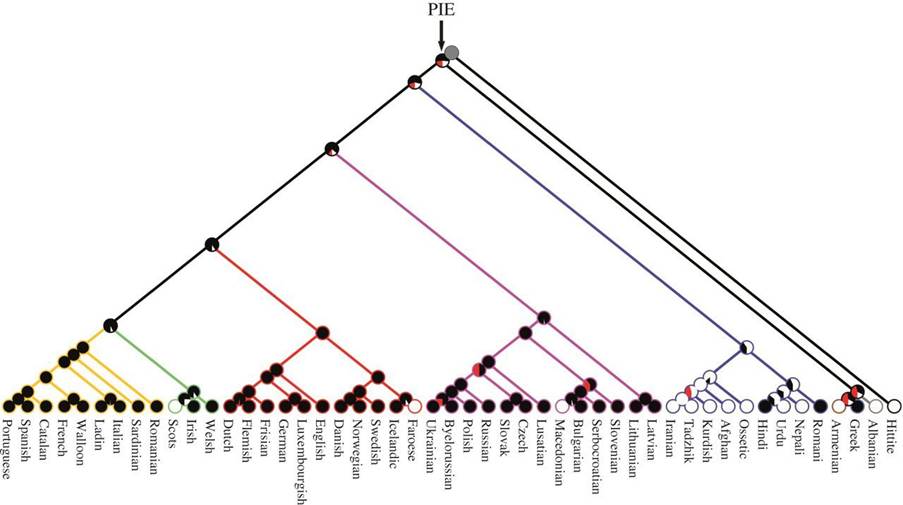
One proposed method for finding even earlier stories is to trace the ancestry of stories today. If two distinct cultures tell the same story, it might reasonably be inferred that the story must have been told by the common ancestors of both cultures. In this way, a tree of descent can be constructed, similar to evolutionary trees in biology.

The next figure shows the tree of descent from the hypothetical Proo-Indo-European language of one common story found across many modern languages of the Indo-European family created by researchers Da Silva and Tehrani[1].

The story in question is “The Smith and the Devil”. 

A smith makes a pact with a malevolent being—in return for his soul, he is granted the ability to weld any materials together. The smith then tricks the devil out of his prize by sticking him to an immobile object, such as a tree or a rock.  Some versions of the tale include three foolish wishes. Some end with the smith being denied entry to heaven or to hell. One version of the story is here https://vocal.media/geeks/the-devil-and-the-smith

If da Silva and Tehrani are right, this may the oldest traceable tale, going back to the Bronze age some 6.000 years ago. Naturally, there will older tales. Our ancestors must have come out of Africa tens of thousands of years ago already painting, dancing and telling stories.

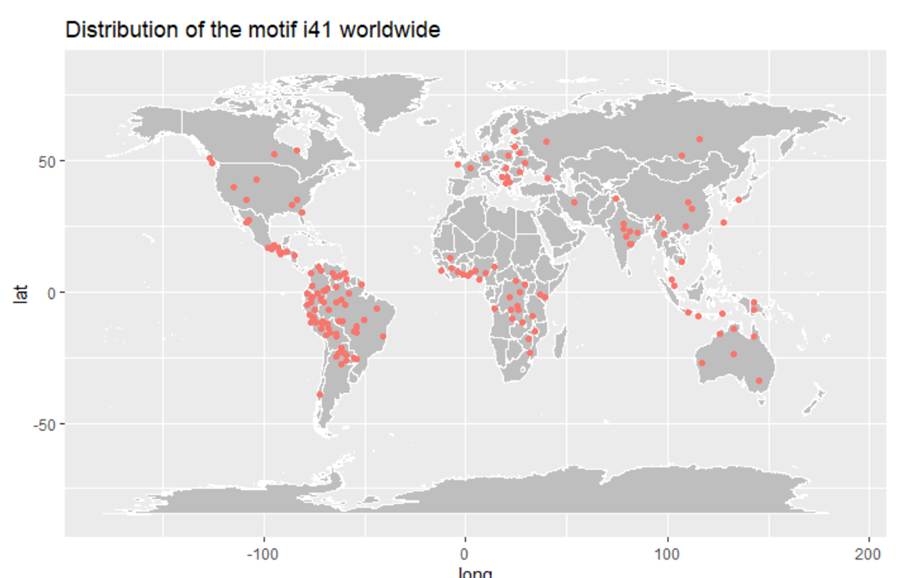
Efforts to reconstruct such tales include the rainbow serpent motif. The map below shows its distribution to be global, as described in a preprint paper that is yet to be peer reviewed.

From:  Hélios Delbrassine, Massimo Mezzavilla, Leonardo Vallini, Yuri Berezkin, Eugenio Bortolini, Jamshid Tehrani, Luca Pagani Worldwide patterns in mythology echo the human expansion out of Africa https://doi.org/10.1101/2025.01.24.634692

The elements of this proto-narrative are described by Julien D’Huy in a 2016 Scientific American article[2] as follows:

“Mythological serpents guard water sources, releasing the liquid only under certain conditions. They can fly and form a rainbow. They are giants and have horns or antlers on their heads. They can produce rain and thunderstorms. Reptiles, immortal like others who shed their skin or bark and thus rejuvenate, are contrasted with mortal men and/or are considered responsible for originating death, perhaps by their bite. In this context, a person in a desperate situation gets to see how a snake or other small animal revives or cures itself or other animals. The person uses the same remedy and succeeds.”

The basic technique is borrowed from evolutionary biology: the idea is that we can track the evolution of myths and folktales with the same techniques that we use to establish evolutionary relationships and evolutionary history.  The method used for the identification involves tracing stories or story motifs (mythemes) across the world.

If two distinct cultures tell a common, or related, story, there are three possible mechanisms that may explain this.

  1. The story moved with the migration of peoples and their descendants.
  2. The story diffused and was exchanged between distinct peoples.
  3. The story is universal because it expresses something about a fundamental human condition.

There is evidence for both the first two possibilities. In some cases, similarity of stories between cultures follows the degree of genetic relatedness. In other cases, geographical proximity better explains the distribution of the story. The third possibility makes a strong prediction that Is not borne out in the data. If a story is universal, it must be universal: in other words, it should appear everywhere in all cultures. Even in such a widely distributed mytheme as the Rainbow Serpent, the map shows significant gaps: in north Africa, north Asia and is rare in north America.

Some researchers are sceptical about the underlying narrative inferences, arguing this is subjective. When we say stories are similar, how similar are they really? Are we forcing the evidence into preconceived boxes? Is the Greek myth of Callisto really the same Cosmic Hunt  story as in the Iroquois tale of the three hunters pursuing a bear?

The Cosmic Hunt (from D’Huy)

A woman breaks a taboo; A man is hunting an ungulate; the hunt takes place in the sky or ends there; a divine person stops the hunter and transforms the animal into a constellation (sometimes,  the one we know as Ursa Major),

Perhaps, yes. In both stories (and in many other variants) a quarry is turned into a constellation. On the other hand, perhaps, no, The strong claim that widely distributed stories (such as the Rainbow Serpent or the Cosmic Hunt) must link back to the time before modern humans emerged from Africa needs strong evidence. It would be seductive to believe we can reconstruct tales told around Palaeolithic fires, but diffusion may be a more plausible explanation than that stories can persist for 100,000 years[3]

A subsequent post will look at archaeological evidence for ancient stories


[1] Sara Graça da Silva and Jamshid J. Tehrani (2016) Comparative phylogenetic analyses uncover the ancient roots of Indo-European folktales, R. Soc. Open Sci.3150645 http://doi.org/10.1098/rsos.150645

[2] https://www.scientificamerican.com/article/scientists-trace-society-rsquo-s-myths-to-primordial-origins/

[3] Andrew Cutler (2023) Contra d’Huy on Snake Myths https://www.vectorsofmind.com/p/contra-dhuy-on-snake-myths; Bortolini et al (2017) Inferring patterns of folktale diffusion using genomic data. PNAS 114 (34) 9140-9145 https://www.pnas.org/doi/10.1073/pnas.1614395114

Friday Fictioneers – Invasion

PHOTO PROMPT © Nancy Richy

Everything has changed. Three months ago, this land was peaceful, sustaining us from our goats, courgettes, and olive grove. My grandfather planted the olive trees, back in the days before the catastrophe.

Two months ago, they came. Just one caravan. What is one caravan, you may say? We have lived here for a thousand years.

Six weeks later, one caravan has become two prefab houses, a barn, and sheep. Then they came at night, tore up our courgettes, killed my dog.

May God curse them. God willing, we will drive them from our land.

.

Friday fictioneers is a weekly challenge set by Rochelle Wisoff Fields to write a 100-word story in response to a photo prompt. You can find other stories here

Friday Fictioneers – The Game

PHOTO PROMPT © Jennifer Pendergast

There are some games it is unwise to play. Especially with those you love. Probably best I don’t name the game we played, all seven of us. Suffice it to say that the rules involve a lot of backstabbing.

Tom and Angie fell out in a big way. We had tears and raised voices. Ruthie preserved an icy calm until all our guests were gone. Then, when the last car departed, she got into her runabout.

“Goodbye,” she said. “I’m going to Mum’s and I may be some time.”

.

Friday fictioneers is a weekly challenge set by Rochelle Wisoff Fields to write a 100-word story in response to a photo prompt. You can find other stories here

Friday Fictioneers – Engines under the floor

PHOTO PROMPT © Dale Rogerson

There are engines under the floor. They thrum in constant labour, heating my house, cooling it, transporting us remorselessly into tomorrow. The floorboards vibrate with a subtlety I’ve stopped noticing.

Below the machines, I saw once, terrifying earth, as if we were just a thin cultivated film on the crust of the planet.

But below the soil, great furnaces burn, stirring molten rock into magnetic force. Beneath the machines are older engines. All the way down.

.

Friday fictioneers is a weekly challenge set by Rochelle Wisoff Fields to write a 100-word story in response to a photo prompt. You can find other stories here

188. App on review: How good is ProWritingAid’s Manuscript Analyser?

Regular readers of this blog will know I’m a big fan of ProWritingAid for spelling and grammar checking. Now it has branched out with a whole AI-powered manuscript critique service, and they offered me a free trial (normal charge £50 or $50).

Manuscript Analysis is broken down into five sections:

  • About My Story: Gives you key information about your story’s genre, narrative elements, and competitive landscape.
  • Narrative Themes: Highlights the key narrative threads throughout your story, and flags themes that are working well along with themes that could use some adjustments.
  • Plot & Structure: Highlights plot points that are working well, as well as those that might need improvement.
  • Characters: Examines important characterization moments and highlights areas where a particular character is working well or could use some closer examination.
  • Setting: Analyzes how your use of setting contributes to the overall narrative structure of your manuscript. This section flags if you need to improve any aspect of your setting, and what you might do to make it stronger.

So, how good is it? The short answer is “not great.” On the plus side, it showed a reasonable grasp of the story and quite accurately identified three comparable titles (two of which were among those I’d already chosen). The “unique narrative structure” was commended, though I’m hard put to it to understand how an alternation between two narrators might be a unique narrative structure,

Less impressive was the actionable feedback. There were 20 suggestions on plot and structure. Of these, only two were moderately helpful, and some were plain wrong.

Lest this seem to be a fit of pique on my part, I’ll give a couple of examples. The AI was troubled by:

“The timing of Ansna’s second pregnancy and miscarriage is unclear. It seems to occur shortly after the previous miscarriage, which feels rushed and lacks emotional weight.”

There is, in fact, only one miscarriage, something a human reader would have understood. Another chapter is said to have little consequence or outcome:

“The initiation ritual, while descriptive, lacks a clear impact on Ansna’s character development or the broader narrative. The lessons learned seem to have little consequence. Show how the ritual’s lessons influence Ansna’s later decisions or interactions.”

In fact, the character recalls such lessons in five subsequent chapters.

On Character, the AI notes three areas of concern, none of which I accepted. For example, a conflict between two characters is said to be “undeveloped”. This is because it’s a conversation, not a conflict. One of the three is illuminating:

“Ansna and Kautia’s relationship is inconsistently portrayed. Ansna expresses deep love for Kautia, but their interactions often lack warmth or genuine connection, and Kautia’s feelings remain ambiguous.”

I spent some time considering this comment before rejecting it. Ansna is conflicted in her feelings for Kautia. Again, I decided a human reader would not have read this as an inconsistent portrayal. Indeed, no human reader has made such a comment.

It’s worth noting that Kindlepreneur ran Alice in Wonderland through the Manuscript Analysis tool. Some of the issues were similar. Alice is said to lack emotional depth:

“Despite the bizarre events, Alice rarely expresses strong emotions. Her reactions are often muted, which makes it hard for the reader to engage with her experience.”

The driving force behind this criticism is, perhaps, the emphasis in modern Western novels on emotional exploration. But Alice is a Victorian upper-class girl, stiff-upper-lipped and confident of the social rules, even as they are buffeted by the absurdity of the Wonderland creatures. She behaves entirely consistently with her background and class. Emoting would be entirely wrong. This failure to grasp the nuances of the setting underlies another critical comment:

“The symbolic meaning of Alice’s experiences is not fully developed. The lack of thematic depth makes the story feel somewhat superficial.”

I would beg to differ. First, this is a book for children, so too much symbolic depth would be inappropriate. Second, and more important, the fundamental symbolism is abundantly clear in the repeated challenges to Alice’s sense of order by the other characters.

This leads me to my conclusion about the app. If the tool makes interpretations that no human would, this is no surprise. The AI does not “understand” a story. It merely follows algorithms that look for patterns of word associations its database says are probable. The net result, in the present stage of development of the technology, is to default to tropes. Though it is an impressive leap to be able to (more or less) follow a narrative arc over tens of thousands of words, my judgement is that the release of this tool is premature.  More work will be needed to give the tool a better grasp of context and psychology.

Friday Fictioneers – An ageless love

PHOTO PROMPT © Sandra Crook

I fell in love. Not so strange, you may say—people fall in love all the time. But my lover and I are separated by all the vastness of space and time.

From an ancient book, he reached out and spoke to me, and I was captivated. These were the words he spoke: “I am only the house of your beloved, not the beloved herself: true love is for the treasure, not for the coffer that contains it.”

Now I stretch out, strain back, all the way to him. Truly, to be in love is a terrible thing.

.

Friday fictioneers is a weekly challenge set by Rochelle Wisoff Fields to write a 100-word story in response to a photo prompt. You can find other stories here

Friday Fictioneers – I’ll see it when I believe it

PHOTO PROMPT © Roger Bultot

There is another world beyond our own. I know, for I’ve seen it—wriggling animacules, tiny armoured beasts, a multitude of hairy legs.

What? You doubt this? Only gaze through my micro-seer and verify the facts for yourself.

Yes, the glasses are curved. What of it? Distortions, you say? Fantasies of bending light? Just look. Why would I endeavour to trick a noble and esteemed patron?

Please, won’t you just look?

 .

Friday fictioneers is a weekly challenge set by Rochelle Wisoff Fields to write a 100-word story in response to a photo prompt. You can find other stories here

Friday Fictioneers – An Archaeology of Garbage

PHOTO PROMPT © Rochelle Wisoff-Fields

You can tell a lot about a man from his library, they say. Well, let me tell you, there’s a damn sight more to learn from a person’s leavings. You can live off those. Once, I found a diamond ring. See what I mean? The garbage tells a story if you know how to read it.  

So, was the ring just lost or tossed out in rage? There were other things which suggested anger—a shredded dress, for one. After that, the contents of the bin changed at this house. Lots of ready meal wrappers. She’d left him!  

 .

Friday fictioneers is a weekly challenge set by Rochelle Wisoff Fields to write a 100-word story in response to a photo prompt. You can find other stories here

187 How did he do that? “Sunset Song”

Sunset Song by Lewis Grassic Gibbon is, in my view, one of the great books of the twentieth century. Re-reading it now, I am struck by how achingly beautiful and how angry it is, and by how cleverly it is constructed.

“She walked weeping then, stricken and frightened because of that knowledge that had come on her, she could never leave it, this life of toiling days and the needs of beasts and the smoke of wood fires and the air that stung your throat so acrid, Autumn and Spring, she was bound and held as though they had prisoned her here. And her fine bit plannings!–they’d been just the dreamings of a child over toys it lacked, toys that would never content it when it heard the smore of a storm or the cry of sheep on the moors or smelt the pringling smell of a new-ploughed park under the drive of a coulter.”

If it has any parallel in it picture of the bustling small life of the folk of Kinraddie, it can only be Dylan Thomas’ Under Milk Wood.

Themes

Above all, the theme is the land. The land which abides when all the folk who till it are dead and gone. Both the prelude and the epilude which bracket the book have the same title, “The Unfurrowed Field”,  representing the unworked land. The book is a lyrical, brawling, angry and tormented paean to the dying age of the Scots peasant. And here too is a theme: of change and changelessness.

The protagonist, Chris Guthrie is herself the land (or perhaps all of Scotland).  In Chapter 1, Ploughing, she is new ploughed for the immense changes that are coming. All the chapter titles represent the cycle of the growing season and the maturation of Chris. Chapter 2 is Drilling (in which her mother commits suicide and her abusive father is stricken with paralysis). Chapter 3, Seed Time, sees Chris’ father die and her inherit the croft. She marries Ewan. In Chapter Four, Harvest, Chris gives birth, Ewan leaves Chris after an unresolved argument to soldier in the First World War, where he is shot as a deserter. Many of the chapters open and close with Chris at the ancient standing stones, a symbol of deep time that brings Chris peace.

There is the theme of ambiguity. Chris is continually loving and hating things, afraid and intrigued. This replicates the author’s ambivalent feelings towards the birthplace he shunned.

And there is also the theme of social justice, a thrumming disdain for those who put on airs or who exploit others.

“Maybe there were some twenty to thirty holdings in all, the crofters dour folk of the old Pict stock, they had no history, common folk, and ill-reared their biggins clustered and chaved amid the long, sloping fields. The leases were one-year, two-year, you worked from the blink of the day you were breeked to the flicker of the night they shrouded you, and the dirt of gentry sat and ate up your rents but you were as good as they were.”

Humour

None of this makes it a dour book. It is full of humanity and the bantering humour of the dying crofter folk.

“John Guthrie himself got a gun, a second-hand thing he picked up in Stonehaven, a muzzleloader it was, and as he went by the Mill on the way to Blawearie Long Rob came out and saw it and cried Ay, man, I didn’t mind you were a veteran of the ’45. And father cried Losh, Rob, were you cheating folk at your Mill even then? for sometimes he could take a bit joke, except with his family.”

The author’s craft

Grassic Gibbon uses several devices to achieve his effect. The main one is, undoubtedly, the use of the Doric Scots dialect of the northeast. In his hands, there is nothing of Walter Scott’s invention of a romantic Scotland. It is the real people of Scotland we hear, small minded, big-hearted, dreaming and dying. The language, of course, has a sad and lyrical music to it. And it also creates the illusion that we are part of a gossipy chat around a fireside, the true stream of consciousness of the narrators. This effect is strengthened by summary sentences that end many sections which begin “So that was how ….”

There are three narrators: an unnamed voice, Chris Guthrie herself, and Greek chorus of the whole gossiping community. And the telling uses a combination of first, second and third person. The use of the second person augments the conversational and confessional nature of the read: Chris is telling us how she feels and acts.

Deep time is another of his devices, creating the sense that this brief flickering and dying of the light of his cast of characters is part of a longer story of constant change. The Prelude sketches a huge antiquity that links Cospetric and his slaying of the gryphon through all the ages of Scotland from William Wallace’s rebellion against English occupation, through the Reformation and French Revolution and finally the clearances and on to the coming of John Guthrie and his family to the croft at Blawearie. And older still are the standing stones by the loch, the place of peace and safety to which Chris repairs in times of turmoil. Many of the chapters open and close at the standing stones.

A lyricism of nature pervades the detail of all the writing, with the call of the birds, the smell of the new-ploughed earth and the feel of the snow and the wind.

Grassic Gibbon frequently makes use of repetition:

“As the gnomons of a giant dial the shadows of the Standing Stones crept into the east, snipe called and called”

The effect of the repeated words is, at once, powerfully poetic and reassuringly conversational.

Character

 The central character is Chris. And an extraordinary character she is, for a male author to have had such insight into the life and dreams and fears of a woman. Chris is strong and determined and fearful and doubting. The book opens with her dreaming of becoming a teacher. But this Chris fades and dies. She thinks of this one as the English Chris. When her mother commits suicide she becomes the second Chris, the Scots Chris of the land who must tend to the house. Released by the death of her sour and abusive father, the third Chris is claimed by that coarse tink Ewan Tavendale:

“He looked over young for the coarse, dour brute folk said he was, like a wild cat, strong and  quick, she half-liked his face and half-hated it”

Ewan loves and marries her and then, gone for a soldier in the First World War, returns and ill uses her before being shot as a deserter. Though there is love, it is a love as clear-sighted and hard-headed as the folk of Kinraddie.

Vivien Heilbron as Chris and James Grant as Ewan in the BBC television series

“She felt neither gladness nor pain, only dazed, as though running in the fields with Ewan she had struck against a great stone, body and legs and arms, and lay stunned and bruised, the running and the fine crying in the sweet air still on about her, Ewan running free and careless still not knowing or heeding the thing she had met. The days of love and holidaying and the foolishness of kisses–they might be for him yet but never the same for her, dreams were fulfilled and their days put by, the hills climbed still to sunset but her heart might climb with them never again and long for to-morrow, the night still her own. No night would she ever be her own again, in her body the seed of that pleasure she had sown with Ewan burgeoning and growing, dark, in the warmth below her heart. And Chris Guthrie crept out from the place below the beech trees where Chris Tavendale lay and went wandering off into the waiting quiet of the afternoon, Chris Tavendale heard her go, and she came back to Blawearie never again.

… Turning to look at him, suddenly Chris knew that she hated him, standing there with the health in his face, clear of eyes–every day they grew clearer here in the parks he loved and thought of noon, morning and night; that, and the tending to beasts and the grooming of horses, herself to warm him at night and set him his meat by day. What are you glowering for? he asked, and she spoke then at last, calmly and thinly, For God’s sake don’t deave me. Must you aye be an old wife and come trailing after me wherever I go?

None of these Chrises are offered by the widow Chris Tavendale to her new husband, the Reverend Robert Colquohoun, who spirits her from Kinraddie and into the next book of the trilogy, Cloud Howe.

Though Colquohoun appears in the book only at the end, it is his voice, giving the dedication to the fallen of the place,  that words Grassic Gibbon’s meaning.

Nothing, it has been said, is true but change, nothing abides, and here in Kinraddie where we watch the building of those little prides and those little fortunes on the ruins of the little farms we must give heed that these also do not abide, that a new spirit shall come to the land with the greater herd and the great machines.

For greed of place and possession and great estate those four had little head, the kindness of friends and the warmth of toil and the peace of rest–they asked no more from God or man, and no less would they endure.

So, lest we shame them, let us believe that the new oppressions and foolish greeds are no more than mists that pass. They died for a world that is past, these men, but they did not die for this that we seem to inherit. Beyond it and us there shines a greater hope and a newer world, undreamt when these four died. But need we doubt which side the battle they would range themselves did they live to-day, need we doubt the answer they cry to us even now, the four of them, from the places of the sunset?”

It is a testament to the greatness of the book that I find myself dreaming in Kinraddie, and its rich vocabulary coming, unsummoned, to my tongue. And the word that comes to mind is “blithe”. It’s a blithe book and no mistake.

Friday Fictioneers – The Town Clock

PHOTO PROMPT © Jen Pendergast

Every hour, on the hour, the door opens and a host troop out—knights, saints, bishops, kings. The thing is a marvel. All around me, folk great and small in the cobbled square, crane up, waiting.

The hands of the clock move slow towards midday. I know it’s midday because both hands point straight up.

The first bong reverberates and the door grinds open. What’s this? A gnarled gnome and a dusky maiden? She bends; he … oh, but I can’t tell you. Disgraceful! I conceal my smile. Those damn prentice boys have been up to their tricks again.

.

Friday fictioneers is a weekly challenge set by Rochelle Wisoff Fields to write a 100-word story in response to a photo prompt. You can find other stories here