36. Conceptualists and Experimentalists – which are you?

headlights

The writer E L Doctorow famously said that writing was “like driving a car at night. You never see further than your headlights, but you can make the whole trip that way”.

This quote featured in two separate presentations this week in a creative writing course I’m doing with the University of Iowa. The presentations talked about “trusting the writing” to reveal the plot to you. One of the presenters, Boris Fishman, acknowledged that there are two types of writers, which he called conceptualists and experimentalists. Conceptualists plan the whole story and then execute it. Experimentalists discover the plot through writing it. But he is an avowed experimentalist and didn’t spend any time exploring the conceptualist approach.

The underlying and unstated assumption was that experimentalists are more artistic, while conceptualists are more mechanical. I’d like to suggest that one is not better than the other, they’re just two different kinds of brains. They’re probably two extremes of a spectrum on which all writers exist. In my local writing group we have members at both extremes. Derek can’t start writing until he’s plotted out the beginning, middle and end. Mary often doesn’t know what her story means even when she’s finished it. My message is that writers should write in the way that makes most sense to them. I want to offer a defence of the conceptualist approach.

Though I have written in both styles, I’m probably more of a “conceptualist”. I usually start with an idea that tickles me. That’s how my brain works. And I usually rough out, at least in broad terms, how the idea will develop before I start to write. For example, my second novel, which was something of “conceptualist”/”experimentalist” hybrid, was triggered by a curiosity about traditional Micronesian sailors, who navigate by means of imaginary islands. By the time I’d finished researching which Micronesian island to set it on, my main character, an eccentric school caretaker, had started whispering his story in my ear. The story was becoming a journey of self-discovery for the caretaker, a confrontation between British and Micronesian cultures. I had more fun writing this book than any other. I trusted the writing and looked forward to my daily journeys to Micronesia to see what my characters would do and discover.

Ultimately though, the book was a failure, and I’ve set it aside to be returned to in some remote future. Can trusting the writing lead to a confused mess? Sure. Does it have to? No. Can having a plan lead to mechanical writing? Sure. Does is have to? No.

A plan isn’t (or shouldn’t be) a template. There’s an old military adage that “no plan survives the first engagement.” Plans aren’t roadmaps of a fixed journey. They’re imaginings of the journey. Things happen, and you meet people on the journey that fundamentally alter what you thought would be your route of travel. A plan doesn’t tell you where you’re going, but it makes you sensitive to when reality starts to diverge from your imagining. Since we can’t adjust reality, we have to adjust our plans. The same, at least for me, is true of writing plans.

My hunch is that “experimentalists” have a plan too, but their conscious brains don’t know what the plan is until they start following it. “Trusting the writing” means letting your subconscious find the path. Being a “conceptualist” means letting your conscious brain find the path.

As an experiment, for this week’s assignment in the course, I’m trying to follow a purely “experimentalist” path. I wrote a sentence “X had run out of time.” Rapidly, X told me his name was Spuggy, an ex-soldier. Pretty soon after that I knew this was about a soldier’s return from war to a world that was no longer the one he had been born into. I still don’t know how it will end, but I can see that my mind is making and following patterns, even when I don’t decide them consciously.

In the end, at revision stages, both approaches merge. The “experimentalist” now knows what the plan is, and the “conceptualist” can work on where the writing has taken them.

35. Conversation with A U Latif

This is the first of an occasional series of conversations with other authors about their work. Last week’s post reviewed A U Latif’s debut novel Songs from the Laughing Tree. This week he talks about the process of creating the book.

Laughing Tree
This is an extraordinary first novel, full of poetry and succulent prose. What’s the story behind writing it? Why did you write this book?

As with all my writing, there is never a set goal or plan; I write to write, for the pleasure of writing and having written. Although it can be a laborious process, it is a labour of love. Songs from the Laughing Tree was definitely that. It took around five years to complete, through sporadic outbursts of inspiration, buckets of sweat, harsh editing, and long, silent bouts of procrastination.

I pin the birth of the novel sometime in 2010 during an exceptionally stagnant stretch of writer’s block. I’d written a good 20 – 30,000 words of a now stillborn manuscript and was forced to see months of hard work go down the drain. As the saying goes, a writer writes. To clear my head, I wrote something completely random—the first thing that popped into my mind—to get the juices flowing. The fruit of that session became the second chapter of my novel. On its completion, I put the scene away somewhere in the netherparts of my computer and stumbled across it a few weeks later. Intrigued by the characters, I wanted to know more about them. So I gave each of them backstories. Later, when the notion of an emperor with thirty wives and three hundred daughters in a palace by a lake in a snow globe came to mind, I knew I had the trappings of a good Arabian Nights style story!

Story is a significant word, and looking back I sometimes feel I’ve let it take a backseat to the prose. It’s not necessarily a bad thing, but I feel my style has evolved since then, and this book marks a clear (if not surprising) snapshot of the writer I was at the time. Songs was heavily influenced by the books I was concomitantly reading, most notably Lolita by Vladimir Nabakov and Midnight’s Children by Salman Rushdie. I fell deeply in love with the Russian’s master prose, his genius for creating intense, colourful scenes with a single well-placed word here and there; and the Indian’s playful, meandering, orotund and sometimes irreverent narratorial voice. I wanted to blend those two styles together with my own voice; and thus came Songs.

Why do you write? And how do you write?

As before, I write for the sheer pleasure of writing. In the same manner as many of my contemporaries and forebears, I blended my English upbringing with my subcontinental heritage. I am of Pakistani descent, although I look more fondly to India, which lends much more romance to my prose..

The initial draft of Songs was written with a purely European frame of reference. It still featured a snow globe encapsulating a city, but the city was a gothic grotesquery that I struggled to connect with. My playful narratorial voice did not feel authentic or, more fundamentally, true in the world I was creating, and it was only when I read Midnight’s Children that I realised I could write from the, shall we say, less solemn Indian perspective. It seems so obvious now, but then I was much more naïve. When I am writing, I put all my favourite books on a shelf above me

The writing process was very tough at times. Some scenes would simply tumble forth onto the page. Whole chapters could go by like this, and they were so perfectly formed that they required very little editing. Other chapters were very difficult and would leave me in no mood to write for months at a time. Without expecting the book to see the light of day, I didn’t set myself to a rigorous schedule, and so I wasn’t too disheartened to let the months pass without setting down a single word. Early feedback by fellow writers on Webook enlightened me on how challenging the prose could be. As such I didn’t anticipate the book would find much luck with modern publishers, considering the books that sell might not be the same as those I wished to write. However, Hannah and the other staff at Webook read the first three chapters and saw promise in it. They offered to publish the book before it was even finished, which was definitely a confidence boost, providing the impetus for me to finally complete it. I was given my first taste of a deadline and a much more concrete motive.

I’ve started work on a new novel now, and have gradually taken to a more strict approach of how much I will (or, rather, must) write per day. I think it is a vital aspect of the art if you wish to do it professionally.

I guess you’d describe this as magic realism. What is it about magic realism that appeals to you?

At the heart of it, there is an indescribable element to such literature that appeals to me. I was just starting to plant my feet in it (“literature, as opposed to “stories” or “books”) and I found the works I loved best just happened to be magical realism. Something about the fantastical being treated as mundane was so charming, much in the same way I find deadpan comedy the funniest. I do love fantasy and science fiction and I’ve never been too fond of pure realism. I read books to escape reality, not to immerse myself in it. Magical realism seems to offer the perfect blend of both. It offers the ordinary lives of ordinary people, but allows magic and wonderment to permeate the world in a sweet, subtle fashion.

For me, reading the book was like taking mind-altering drugs, because of the way story threads interweave with each other until I didn’t know any more which story was which. Was it your intention to create this effect, or was that accidental?

It was not my intention for the book to have this effect, but it is very interesting to hear this is how it came across for you. The blending of the stories was definitely intentional. It was to represent the manner by which the narrator’s own life influenced the fairytale he creates. Eventually the two tales clash together by the end and it was my intent to leave the reader unsure which element exclusively belonged to which narrative strand.

Is it your natural style of writing or did you have to work at it? What techniques did you use?

For me, one of the most potent techniques was the use of metaphor, a complex layering of words, to bridge the gap between one reality and another.

It took time to work at, but once I got it came much easier. I like to think I perfected the prose with the opening chapter, which was written much later in the process. I framed the rest of the chapters against this style. It must be understood that the prose is written as if being spoken by the main character, so I wanted him to have his own unique voice. This concept of layering words, phrases and metaphors, with meandering thoughts thrown in here and there, is very typical of the Indian fashion of storytelling. It follows a more oral tradition, with raconteurs telling tales to an audience, much in the same way people flock to cinemas to watch films. As such, I intended for this book as one to be heard as opposed to simply being read, similar to the works of James Joyce, in which there is a real music to the Irish (or “Oirish”) brogue.

It’s a very “technical” book. Many of the sentences are long, there’s a succulent layering of adjectives, and of course there’s the interweaving of stories. Does it trouble you that it may be difficult to read? Where do you think is the intersection between what the author needs to do for the reader, and what the reader needs to do to meet the author half way?

I’ve never been one to hold my reader’s hand. I find joy in being challenged by literature, in coming back to it, giving it the time it deserves, and unravelling the layers of imagination beneath all those words.

I did get some early feedback from other members of Webook, some of whom said they struggled to get through the density of the prose, which was perhaps a little discouraging. Being an insider to the writing process, I couldn’t perceive the convolution. But I have come to realise that I don’t read Songs as I might read other books with more direct prose. Some readers did give it a second chance, much as you did, and discovered their own way of reading it that made the somewhat languorous pace come alive. For the beauty of the prose, for the depth of the characters, for the poetry and rhythm and musicality of the words. There is more than one way to read the book, I am sure, and I hope people can find their own way to enjoy it.

I do think there is a point where an author can go too far, however. Now that I have developed as a writer, I have come to understand the power of pace and plot. Beautiful prose is an excellent element to capture in a novel, but keeping your reader engaged is just as masterful.

Ultimately, ambiguity makes art timeless. A work of art only persists as long as people still have reason to talk about it and ask questions of it. If everything is laid out before the reader in black and white, it does not lend itself to interpretation or discussion. It does not become personal to the reader. It loses the spark of life that bore it into the world.

What comes next?

I’ve only just started to get back into the swing of writing again. I took some time out following the completion of Songs and began to focus on other creative ventures. Music has been dominating most of my time.

Writing seems to have taken a second fiddle, but I have a new idea for a second novel. It’s going to involve similar elements of magical realism and will again be set in a fantasy version of India, but this will also incorporate elements of steampunk. I have the characters in mind, the setting, the main arc of the story, and I’ve come to develop a regular habit of writing. I’ll be looking to send it to an agency when it’s done and test my work against established publishers. Fingers crossed for that.

What are your three top tips for writing?

Read and write. Those are the top two. You’ll never get anywhere without doing either of those. When you read, you need to read with a writer’s eye. If you like something in a novel you need to learn how the writer did it and apply it to your own writing. That’s not to say copy what they did, but simply use their work as an example. See how they structure sentences, paragraphs, chapters. See how they build characters, story arcs, side plots. See how they incorporate twists and see if you can pick out how they use language to convey mood and tone. When you write, read what you written. Read it aloud. There is no better way of picking up kinks and flaws.

The last tip, I suppose, is to enjoy yourself. You will never be a successful writer if you don’t enjoy it. Those who write for fame or money should choose another career pronto. Being a writer means struggling, working hard, isolating yourself from friends and family, finding truths within yourself that you didn’t know where there and perhaps didn’t want to know were there.

In the end, in the immortal words of Hemingway, there is nothing to being a writer; all you do is sit at a typewriter and bleed.

34. Songs from the Laughing Tree by A U Latif

This week, I’m going to introduce an occasional feature – conversations with other authors. As a lead in to the first conversation, with A U Latif, this is my review of his book Songs from the Laughing Tree.

I guess you could write a thesis about this book, so densely layered and succulently written is it. But don’t worry, I won’t. I will instead say three things about it.

The first is that it took me two or three chapters to decide how I was going to read it. I started reading it as a story, but that didn’t work. It would have been tempting to cast the book aside in the impatience of wanting to get on with the plot. Latif’s imagery and confection of words is rich and more for tasting than reading. The prose doesn’t flow linearly but is wild as an enchanted forest. In the end, the only thing that worked for me was to use it less as a story than as a tool for exploration of my own subconscious with snares wrought by Latif. This book is best read at night, just on the edge of sleep.

The second thing is a reflection on why the book works this way. Our brains are evolved to seek pattern and meaning, and Latif plays with this. The story line is very simple – interwoven tales of three men, a prince, a boatman and a narrator and of the wives and mothers who abandon them and the magical children they father and encounter. But the meaning eludes you as the tales slip from one to the other, linked by a snow globe, which both contains the prince’s fictional world and which appears within it. You become confused as to which tale you are reading, and which event happens to which protagonist. The figures of the stories loop and dive, and create impossible or magical meanings that are whimsically held together by no more than a concatenation of words, an ellipsis of adjectives.

The third thing, a consequence of the first two, is that reading this book is more like taking a mind altering drug than like narration. If you like altered states of consciousness, you’ll love this book.

Next week; an edited conversation with A U Latif

33. If you can’t name it, you can’t see it

We were sitting on a porch in the middle of Mozambique, sharing a bottle of whiskey.

“The trouble with you Anglo-Saxons,” my Portuguese friend, Joao, said, “is that you only know one way of being.”

Portuguese has two verbs to be – ser, to be permanently, and estar, to be temporarily. Joao argued that understanding this difference affects how you are in the world. The ability to name something carries with it the power to recognise it, to feel it, to explore it. Words don’t just communicate meaning, they create meaning.

I was reminded of this conversation this week, when by chance I read three different articles about words. Tiffany Watt Smith writes in New Scientist about the way words may rewire our brains. The BBC website covers the achievements of the Historical Thesaurus of Scots. And I am in the middle of reading Helen Macdonald’s magnificent H is for Hawk, which is filled with the ancient and arcane vocabulary of falconry.

Tiffany Watt Smith, writing in New Scientist, argues that if we don’t have a word for a thing or an emotion, we may not recognise it. She speculates that the Machiguenga people of Peru, who have no word for “worry”, may not feel the emotion. Equally, she says, English speakers lack a word for awumbuk. This word from the Baining people of Papua New Guinea, describes the empty feeling after visitors depart. They believe departing visitors shed a heaviness into the air in order to be able to travel lightly. This heaviness lingers for three days and creates an inertia that prevents the hosts’ ability to tend to their home and crops. The Baining deal with this by filling a bowl with water to absorb the miasma overnight. Early next morning they throw the water into the trees, and normal life resumes.

Watt Smith suggests that language and culture influence what we see and feel by allowing us to link our sensations to a network of other associations, making it easier to seek out experiences which are consistent with this, and to filter out those which aren’t.

An old favourite example of my own is the Portuguese word saudade. This had no precise equivalent in English, and describes the pleasure of feeling sad. So well recognised is this emotion in Portugal that it has spawned a whole culture of music, fado, which you listen to in fado cafes so as to experience saudade. I wrote this description in an attempt to capture the emotion.

The evening air held onto the warmth of the day, but the light had a dying mellowness, full of shadows. It had a softness that contrasted with the harsh angularities of noon. I sipped gently. The wine’s tart greenness contrasted with the dark wood of the tavern, polished by an antique cargo of a hundred thousand nights of convivial transgression. The guitarist took his seat and tuned his strings, while the fadista, her eyes fixed on some spot beyond our prosaic gaze, composed herself. As the plaintive call of the fado rose, shrill and bright, other patrons drifted in from the sun-warmed cobbled lanes of the Bairro Alto, like leaves collected by an autumn breeze.

Strangers, we sat, communing together through the mournful power of the music. The air was suddenly crisper, the wine more piquant, my heart fuller as she sang of the doomed love between a Count and a street girl. I thought of home. When she finished, there was a moment’s pause, and then an outburst of applause. Most of us clapped, but the man at the table next to me coughed, the traditional form of appreciation in the Coimbra school of fado. The Portuguese have a word, saudade. It means the pleasure of feeling sad. I savoured, for the first time, the pleasure of feeling sad.

Music and dance may be the languages in which we communicate concepts and emotions for which we have no words. It’s also worth remembering that the ancient Greeks distinguished between six different kinds of love, where in English we have only the one inadequate word. Precisely distinguishing varieties of things is important when you live on the edge of survival. It turns out from the Historical Thesaurus of Scots that Scots has 421 different words for snow. In a country where weather can be swift and treacherous, being able to communicate precisely about conditions had survival value. Even today, when British trains in winter are halted by “the wrong kind of snow”, this precision may be important.

Some of the 421 words for snow
Pre-snow conditions (Gramshoch)
To begin to snow (frog)
To snow or sleet lightly (scowder, skiff, sneesl)
To snow heavily (onding)
A swirl of snow (feefle)
Snowflake (flicht)
Large snowflake (flukra, skelf)
Slush/ sleet (snaw-bree, slibber, grue)
A sprinkling of snow (skirvin, glaister)
A slight fall of snow (skirlin, flaffin)
A heavy fall of snow (hog-reek, ondingin)
Snow driven by wind/ movement of snow (spindrift, hurl)
Slippery snow (shurl)
A cover of snow (goor, straik)

Words are talismans – they have the power to summon. At the whim of the writer, they may summon demons or angels. Nothing illustrates this more powerfully than Helen Macdonald’s searing memoir, H is for Hawk, in which she describes with stark honesty how she coped with the grief of her father’s death by training the most dangerous of raptors, a Goshawk. Her hawk, Mabel, is “thirty ounces of death in a feathered jacket”. Her use of language is superb, rendering her grief, the “manning” of Mabel, and the minute details of nature with a unique mixture of poetry and science. Her prose offers the rare pleasure of words that make me go to the dictionary. And then there is the arcane language of falconry. There is the equipment of jesses and creances. When Mabel beats her wings and attempts to escape the perch, this is bating. When she enters the state of murderous desire to hunt, she is in yarak. I have already appropriated these words for my own.

Words give us more than one way of being. That is the writer’s craft.

32. Could a machine write my books?

spark

The obvious, though sci-fi, answer is yes. Unless you believe in some immaterial human essence, human brains write books. Human brains are built of linked neurons in massively complex arrays. When we can emulate this complexity, whether the emulation is built of car tyres, tin cans or software routines, the same thing will happen. Conscious minds will emerge with thoughts, feelings and creativity. They will be able to tell stories and write books. Though some scientists think artificial intelligences may need bodies as well to be fully aware.

That doesn’t really help in answering the question now though. Most experts believe we’re at least 35 years away from being able to build artificial intelligences of this complexity. It’s great fodder for sci-fi writers. It exercises those tasked with considering in advance what rights such beings should have, and also how we should protect ourselves against the a Terminator threat.

So right now, when many jobs are about to be handed over to robots, including some quite skilled jobs, is my job as a writer safe? It’s not such a bizarre question as it might sound, at first hearing. Already, millions of share trading decisions are made by software algorithms, rather than City spivs. Machines are much better than humans at highly skilled tasks involving pattern recognition. Radiographers scanning X-rays for signs of cancer will soon be replaced by software which never gets tired and never has a fight with its partner. Even in the creative field, machines are producing music and images. So why not in writing as well? And if so, would it be any better than the “prolefeed” that George Orwell imagines in Nineteen Eighty Four?

There are any number of formulae offered to us aspiring writers to help us write better and more compelling novels. If you fed these formulae into a computer, could it produce a story?

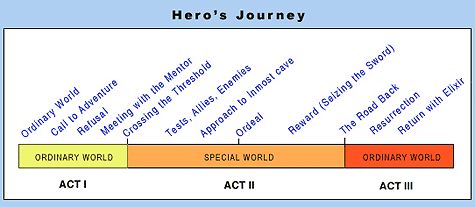
Many of the plot tools are based more or less on Campbell’s “Monomyth”. Campbell believed that all stories ever told are in essence one archetypal story, and outlined the elements of it in his book Hero With a Thousand Faces. George Lukas followed this archetype faithfully in creating the movie Star Wars. The Novel Factory for example outlines six key elements of plot:

  • Goal – your character must have something they either desire or desire to avoid
  • Conflict – someone or something stops the protagonist achieving their goal
  • Disaster – something happens that not only takes the protagonist further than ever from their goal, but preferably adds on extra layers of peril
  • Reaction – following the disaster, the protagonist has an emotional and or physical response
  • Dilemma – the hero should have two choices, neither of them good, so the reader can empathise with the hopelessness of their plight
  • Decision – the protagonist chooses from the options available – which gives them a new goal… rinse and repeat

There are many other similar formulae, such as the Agile method and the Snowflake method. The Agile method offers a course which claims to get a writer to first draft in six months and says dozens of novels have been written using it.

To see what would happen, I developed a formula based on an amalgam of several methods. I used it to create the story board for my current novel The Golden Illusion, which divides the plot into eight stages:

  • Set-up (two stages)
  • Discovery and growth (two stages)
  • Decline and despair (two stages)
  • Climax and dénouement (two stages)

There are also any number of formulae for creating compelling characters. Just go, for example, to the Writers’ Knowledge Base and type into search field something like “compelling characters”.

And then of course there are the algorithms for text and grammar correction such as Pro Writing Aid, which I wrote about in recent posts.

So could a computer programme be written to spew out best-sellers? There are lots of artificial intelligence scientists working on this, but the reassuring answer for all us wordsmiths seems to be “not yet”, as an article by Tom Meltzer shows. Machines don’t yet have any capacity for imagining. They have no means of understanding what a piece of text means. And they have trouble generating the many figurative ways in which people express themselves. Much of what they produce is either bland, or very short.

Metaphor magent

From the Metaphor Magnet

Consider this story, written by the software routine Scheherazade:

John got into his car with his disguise, gun and note in his knapsack and headed towards the Old Second in the next town over, repeating his rehearsed demands silently over and over in his head.

John watched while a little old lady left the bank and walked to her car and then slipped on his gloves, slipped his gun into his coat pocket, grabbed his mask and strode determinedly to the lobby door and pulled it open.

John looked at his reflection in the glass of the door, gave himself a little smirk and covered his face. John took another deep breath as he wondered if this was really a good idea, and entered the bank.

John looked around the bank, making sure his timing was right.

John spotted a young blond teller, Sally, behind the counter.

John stood behind the lady and toddler and politely waited his turn, noticing the nameplate on the counter … “Sally”.

When it was his turn, John, wearing his Obama mask, approached the counter. Sally saw Obama standing in front of her and she felt her whole body tense up as her worst nightmare seemed to be coming true.

Once Sally began to run, John pulled out the gun and directed it at the bank guard.

John wore a stern stare as he pointed the gun at Sally.

Sally screamed hysterically which alerted other people in the bank.

Pretty mechanical, though adding a grammar editor might have made it harder to distinguish from an extremely poor human effort.

But consider these two very short stories:

When the bank robbers that break into calm vaults hide behind livid masks.

And

Ink and soul cooperate with paper

One is by a human, from a blog I follow, In Noir Velvet and one is from a software project called Metaphor Magnet. Not so easy to tell, and I’m not going to let on.

Undoubtedly software will get better in leaps and bounds at generating stories. But there may be a more profound critique of the formulae.

The formula doesn’t work very well if you follow it religiously. I found in my own experiment with a formula in The Golden Illusion, that the plot rapidly spilled over the boundaries of the boxes. Characters began to do things I hadn’t expected or planned. I also found that there were creative problems I had to solve, about plot, sequence, causality and voice for which the formula provided no help. I moved the “call to action” (which was plotted to come to in Chapter 3) right up to beginning of Chapter 1, so there was a “hook” into the action.

Following formulae will produce similar stories. Campbell argued there was only one story – a universal narrative archetype. Critics of Campbell’s Monomyth argue that the similarity in the stories he analysed don’t express an archetype. Rather they reflect the fact that all the stories were created in similar conditions – namely by story tellers to please their rich and powerful aristocratic patrons. Women writers have pointed out similarly that Campbell’s stories were all told by men and don’t include the stories mothers tell their children.

It may not be that hard to invent a story, but it’s considerably harder to write a good story.

31. What price artistic integrity?

This week I’ve had my first brush with the writer’s moral dilemma. Namely, to stand on principle and refuse to change our work, or to accommodate editor’s requirements in the interests of publication.

Those of you who have been following this journey know that my strategy as a writer is to accumulate artistic credentials by publishing stories in literary magazines. As I explore the caves and grottoes of the literary labyrinth, slaying dragons and accumulating treasure, the plan is that these magic credentials will deflect the cold thrust of rejection from literary agents and publishers.

I resubmitted a story to an editor who had enjoyed it but felt that though it had a beginning and a middle, it lacked an end. Fair comment. I wrote an ending. He got back the next day to say the ending still did not provide the resolution he wanted.

Now comes the dilemma. I had crafted the ending, with some thought, to leave the reader unsure about which of two supplied explanations was the truth, and had stopped the tale just short of clear indication of what came next. That’s me. I like ambiguity. The world is full of things we don’t fully understand, and I have no problem with that. But I understand why it might be a problem for others. So, should I take the ending one step further on to resolve the ambiguity, making it, in my opinion at least, a weaker story? Or should I stand on my artistic dignity and dicker?

It took me only five minutes to decide. Artistic dignity is for those who already have a reputation. I changed the story. After all, I still have the earlier version. Did I sell my soul, or am I one step closer to being able to afford integrity?

30. How sticky is glue? Footnote on editing software

Following on from my last post about the perils of slavishly following the dictates of a machine editor, I had this salutary lessons. I was editing a story in which a character quotes Shakespeare’s speech from As You Like It:

“All the world’s a stage, And all the men and women merely players; They have their exits and their entrances, And one man in his time plays many parts, His acts being seven ages.”

My editing software says the Bard of Avon made some schoolboy errors here. The whole thing has a “glue index” of 51.4%. Glue words are the 200 or so most common words in English, which slow the reader down. Worse still, the first sentence has 71.4% of “glue” words – all, the, world. ‘s, a, and, men.

Ha! Much ado about nothing.

29. Machina ex Deus

deus_ex_machina_2

Are machines stupid? Yes, of course. And here’s proof.

I love my editing software. I use Pro Writing Aid to ferret out all those repetitive words, sneaky adverbs, and missing commas. It speeds up my editing and never tires. BUT …….

It’s a machine – the programme has no clue what the words mean. The first line of the chapter from A Golden Illusion that I’m working on at the moment is

“The night was long and adventurous, the morning easy and languorous.”

I was rather pleased with this, and the way it got me out of having to write another sex scene.

Pro Writing Aid wasn’t so impressed, and picked this out as a “sticky sentence”, containing 63.6% of “glue” words. The target figure for such words is below 40%. The software explains glue words as follows:

“Glue words are the 200 or so most common words in English (excluding the personal pronouns). Glue words are generally used to link nouns, verbs, adverbs and adjectives. You can think of the glue words as the empty space in your writing. The more of them there are the more empty space you readers have to pass through to get to the actual meaning.”

Unthinkingly I obeyed since I was in the midst of correcting lots of mistakes. The revised sentence was

“The hours before dawn were prolonged and adventurous, the morning easy and languorous”,

which successfully banished the stickiness by paraphrasing the glue words “night” and “long”. Success! Except that it’s a terrible sentence and doesn’t convey the meaning I wanted. On re-reading, I reverted to my original.

Another thing the software searches for is sentence length. The target for the average number of words per sentence is between 11 and 18, and the maximum length for any sentence is set at below 30 words. Again, this is a reasonable rule, but when followed mechanically, it led to unreadable sentences.

For example, the programme drove me to amalgamate the following sentences into one.

“‘No, not exactly, but it’s a trivial private matter. As I understand it, something to do with a stain on the Parris family reputation.’”

The resulting 24 word sentence was grammatical and within the maximum word limit, but it was harder to read.

Another set of algorithms confirmed the reading difficulty of the sentence. Hemingway App (http://www.hemingwayapp.com/) checks the readability of text, though it will only analyse around 5000 words at a time. The long sentence required a reading age of 14-15 years, while the original corresponded to a reading age of 11.

So, the moral of the tale is don’t allow the god of creativity to become a slave to the machine. I’m a big fan of the machine editor, but make sure your human eye reads everything over afterwards. Correct the text to what you intended to say, even if that breaks a rule or two.

28. To publish or not to publish?

Who knew there were so many tactical decisions in a writer’s life? As earlier posts attest, I keep having to make decisions. The gentle escapism into the creative craft is only the first step on a long journey. My dilemma may strike a chord with you. The decision I have to make now is whether to continue the serialised publication of A Prize of Sovereigns. Sixteen chapters have already appeared, and I’m committed to publication of the first 24. Do I agree to the next 12 (which would mean around three quarters of the book has been published online)?

prizesovereigns_squclean_01I made up a list of pros and cons. I consulted friends. The pros are:

  • Since I’ve decided to switch to pitching my mystery novel The Golden Illusion, it will continue to provide exposure for A Prize of Sovereigns and a readership for my work.
  • Some publishers like to see demonstration that a book has enjoyed online success
  • Along with the serialisation, the book gets an edit

The cons are:

  • The readership this site attracts is not large. The first 12 chapters attracted 555 unique page views, and about 20 regular readers
  • Some publishers will not touch a book which has already appeared online
  • The edit is a micro copy-edit, not a strategic macro-edit.

Decisions, decisions!

27. Editing – am I a craftsman?

Do you love the craft of editing or do you have it? I’ve just had a first class carpenter working on building me new shelving units for my office at the moment. I asked him which bit of the design, manufacture and assembly of the units he enjoyed. He said that his pleasure came from a satisfied customer, but that the bits he most enjoyed were the highly technical intricate work I would never notice, except by their absence if he got them wrong. He’s a craftsman of the old school. That made me wonder whether I’m a literary craftsman.

I’m taking a break from micro-editing. By this I mean copy-editing – going through the text and checking the word use. For me, this is the most tedious part of being a writer. I struggle to find it creative. I have removed 39 instances of the words ‘was’ or ‘were’ and 24 instances of ‘know/knew’ from Chapter 13 of The Golden Illusion. I’m entitled to a rest.

When we write, which part of the process do we enjoy? The big-picture act of writing is a buzz for every author. You have an idea in your mind, and behold it comes to life as your story.

Different authors feel differently about what happens next. After you’ve written your first draft, you then have to revise it, and revise it again. You have to edit, cut, rewrite, hone, and polish. The first draft is one you write only for yourself. Usually, nobody else ever sees it. Subsequent drafts are for the reader. You have to revise with an audience in mind. Some hate the editing process, some love it. Some like bits of it but not others.

I enjoy macro-editing. This is where you’re working on the big picture – does your story work? Are your characters right? The main macro-editing issues are here (https://neilmacdonaldauthor.wordpress.com/2015/08/23/macro-editing-points-character-and-story).

On the other hand, I find micro-editing a pain. This is where you’re working on the nuts and bolts of the writing. This is the heart of wordcraft. The main micro-editing issues are here (https://neilmacdonaldauthor.wordpress.com/2015/08/23/micro-editing-points-writing/)

Both macro-editing and micro-editing are essential if you want your story to sing, and to be the best it can possibly be. To use the analogy of sculpture, it’s not enough to find the form hidden in the rock, you also have to shape it and smooth it and polish it.

I don’t get a buzz from the highly technical stuff, though I can force myself to do the micro-editing because I know it’s essential. I enjoy the texture and savour of finding exactly the right word, just as much as any other member of the wordcraft folk. But done repetitively over the whole 65,000 words of the current draft, it’s just a chore. I guess I’m not a craftsman at heart. Damn! There goes another delusion!