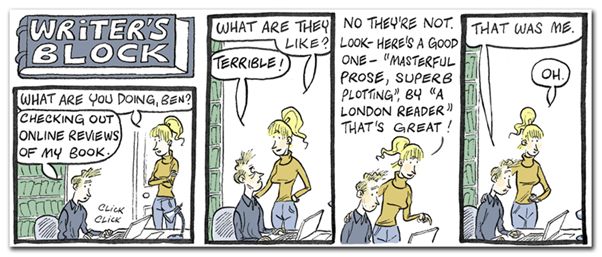
5. Rejection hurts – the dark night of the soul, the light at the end of the tunnel and other clichés

J.K Rowling, with sales of 450 million copies of her Harry Potter series, received 12 rejections before she got the deal with Bloomsbury. The judgements of agents and publishers aren’t infallible. They’re just informed opinions about what is likely to sell. They can be wrong.

You tell yourself this when the rejections start coming in. The first one or two I was able to deal with as disappointing. As it got beyond five or six, I began to wonder “Can they all be wrong?” Maybe, I thought, my book isn’t as good as I believe it is. Maybe it’s the wrong book. Maybe I need to wait until I’m a better writer, and I’ve learned more.

By the end of 2014, I really felt that the book just wasn’t good enough. I stopped submitting to agents. Friends in my writing group tried to console me, but they were friends after all. I stopped listening to them. I said that until someone in the business told me I had a good book, I wasn’t going to believe. I weighed up my options. Option one, I could abandon A Prize of Sovereigns, and start work on the new book that was taking shape in my subconscious. Option 2, I could go back to a literary consultancy for some work on the book. Option 3, I could just tough it out, and continue to try to place the book, pretending that I believed in it.

I think most writers go through such times. People like to tell us it’s character-building. Really it’s just shitty.

In the end, what I did wasn’t completely any of the options I’d worked out. I did start work on my new book, but I didn’t completely abandon A Prize of Sovereigns.

At the same time as submitting it to agents, I had also been entering it for novel competitions. I didn’t win any prizes either. More rejections. But it was a small step from the competitions to try offering it to publishers who accepted un-agented submissions. So I was mixing option 1 and option 3. And then I realised there was also an option 4. If I started submitting my short stories to literary magazines I would increase my chances of success, which might make me feel better about my writing ability, and I might also built up some literary credentials with which to impress agents more.

I had submitted a few stories to magazines in the past, rather desultorily. I had 100% rejection rate there too. But I had never approached short stories as strategically as I had novels. I didn’t really know anything about what made for success.

Here’s another top tip coming, if you’re interested in placing short stories. There’s an amazing website called Duotrope (www.duotrope.com). For a relatively modest subscription it puts all sorts of strategic information at your fingertips. It’s a listing. You can look up what sort of stories different magazines are interested in, and what genres they publish. Now of course you can get that information from the magazines themselves. What you can’t get from them is their acceptance rates and their response times. When I looked up the magazines I had submitted to in the past, I almost slapped myself on the side of the head. Every single one of them had an acceptance rate of less than 1%. Unless I was better than 99% of other writers, of course they weren’t going to publish me.

At the beginning of 2015, I began to make a list, and started more rationally targeted submissions. I selected a group of magazines with acceptance rates ranging from the virtually unattainable below 1% all the way out to under 50%. I decided that submitting to anything that accepted more than half of what was sent to them wasn’t going to help me get those much needed literary credentials.

The new strategy paid off quite quickly. I had a story accepted in February by Alfie Dog, an online site with a 47.5% acceptance rate that sells stories in much the same way that iTunes sells music (alfiedog.com/fiction/stories/neil-macdonald/). It wasn’t a high prestige publication, but it was an acceptance. It did wonders for my self-confidence. And then the following week, an online publisher, Big World Network, offered to serialise A Prize of Sovereigns. Publication began on a weekly basis in May (bigworldnetwork.com/site/series/aprizeofsovereigns/).

At last, I could begin to believe in my novel again. Someone had seen merit in it. I didn’t abandon the short story strategy but began to send stories to magazines with tougher acceptance rates. I also began to tailor stories for particular magazines. Up until the present, all I’ve had is rejections, but some of the rejections have been very cheering. A magazine with an acceptance rate below 30% liked the writing so much they asked me to submit other work, as did one with an acceptance rate below 20% and one with an acceptance rate below 3%. I haven’t broken through yet into the literary firmament, but finally I have some reason to believe it can be done. Instead of blank rejections, some editors have taken the trouble to give me critiques and explanations of what made them decide against publication this time. You never get that from an agent.

That pretty much brings you up to date with where I’ve got to. Except for one last thing. A well respected publisher to whom I sent the first 30 pages of A Prize of Sovereigns liked it and asked in April to see the whole manuscript. They’re still looking at it. My fingers are firmly crossed.

This ends the historical section of the blog. I can stop relying on memory. From this point on, you’re along for the ride with me. I may make it, I may not. Whatever happens, I’m sure I’m going to learn new things along the way.
4. After the writing is over – publishing

So, you’ve written the definitive novel of the twenty first century. What do you do then? Sit back and wait for the plaudits to flow in? Well, no. So far nobody knows you’ve written it, apart from your friends and your writing group.

You’ve had to think like an artist when you wrote the first drafts of your novel. You’ve had to think like an editor, when you revised them with a readership in mind. Now you have to make another mind-switch – you have to get your manuscript in front of a publisher, and to do that you have to think like a marketer. Nobody said it was easy being an author!

Who would your book appeal to? What makes it different? You’re competing with an awful lot of other manuscripts. There were almost 305,000 books published in the US in 2013, and 184,000 in the UK in 2011. And in the Internet era, we can all be publishers – in 2012, around 391,000 books were self-published in the US. Sounds good, right? However, these are the tip of the iceberg. Literary agents receive around 1,000 manuscripts a year, and select only a handful of them. Most manuscripts simply aren’t good enough in their judgement, and even among the good ones, they will only choose the ones they think will make them money.
So, in my case, I’d finished the manuscript of A Prize of Sovereigns. I was sure it was as good as I could make it without input from a professional editor. I was upbeat. I was proud and confident. I researched what I had to do to get it published.

You can of course, as I noted, self-publish. The Internet has shaken up the publishing industry. It’s very easy for anyone to publish now, through sites like Amazon Kindle and print on demand companies like Lulu. But it’s not so easy to self-promote and distribute. That’s, at least in theory, where traditional publishers with their distribution networks and marketing departments still have an edge.
I decided I wanted to publish traditionally. Then came the next hurdle. Most of the big publishers will not accept unsolicited submissions from authors. To get to a publisher, you generally need to go through a literary agent. There are exceptions to this. A number of smaller publishers will look at manuscripts from un-agented authors. You can find out who these are by signing yourself up to the free newsletter produced by Authors Publish (www.authorspublish.com). Signing up to this newsletter is another one of my top tips.

Undaunted, I set about finding myself an agent. You can find agents’ details on a number of websites or in the Writers and Artists Yearbook. Look carefully at what they say they’re looking for, and who they already represent. I made up a list of agents who seemed to have an interest in my kind of book, and then worked my way through them. Some I e-mailed, some I saw face to face. Literary festivals are good places to meet agents. The annual Winchester Writers’ Festival is one of my favourites, because it has a reputation as an event where agents and publishers are actively looking for new authors. You get 15 minute sessions with agents, publishers or authors of your choice as part of the entrance fee. By the end of 2014 I had amassed 10 rejections.

One agent told me that A Prize of Sovereigns lacked the historical accuracy to be classed as history, and lacked the magic to be classed as fantasy. Another agent said no, it would appeal to both markets, but she didn’t relate to the characters.
When you submit to an agent you usually need a few sample chapters, a synopsis, and a query letter. Usually the synopsis has to be a page or less, though some agents want something different. Make sure you understand clearly what your agent of choice wants. I became quite adept at writing the synopsis for a complex story with seven point-of-view characters. Clearly, in a page, you can only outline the major elements of the story arc, so you need to make sure you know exactly what they are. Don’t get bogged down in detail. Something that helped me was writing a one paragraph summary of each chapter and then paring this down to the essential elements.

There are some dos and don’ts I’ve discovered about synopses.

  • A synopsis should normally be one page.
  • It is a simple and factual summary of what actually happens in your story. So avoid temptations to write as if you were creating the back cover jacket. Never use promotional language, such as describing your book as “heart wrenching” and never ask teaser questions like “what is the terrible secret Emily is hiding?” Give the answer, not the question.
  • It should be written in the present tense. So, “Emily hides the terrible secret” and not “Emily hid the terrible secret”.
  • The first paragraph should contain a statement of the main point of the book. This is your “elevator pitch”. An elevator pitch is the short 30 second description of your book that you would give if you suddenly found yourself face to face with your most desired agent or publisher in a short ride up in a lift.
  • Subsequent paragraphs should add more detail
  • The query letter is a business letter. Don’t put in lots of detail about how you came to write this book. They don’t care. The letter tells the agent what your book is, who it is for, how long it is. Simply state the title, the word length and the genre.

Don’t under any circumstances say that you don’t write to a genre. That will just make you seem like an amateur who doesn’t know anything about your market. The letter also includes any detail about your life and your writing credentials that may be relevant. For example if your book is set in a restaurant kitchen and you are a chef, this is relevant. If you have been published elsewhere, or have won any writing competitions mention these. Finally, it should give an indication of what it was about this particular agent that made you approach them.

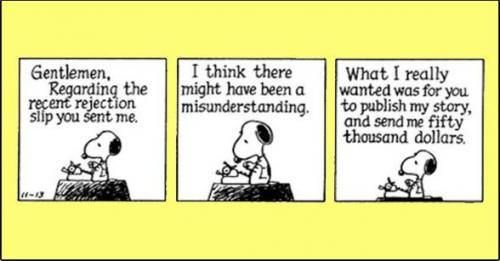
I learned all these things, and put them into practice. I chose my agents with care, but I still got 10 rejections. Rejection hurts. Don’t let anyone tell you different. It eats away at your self-confidence. I’ll tell you about how that affected me in the next post.

Snoopy

3. Plotting out a story

Different people seem to write in different ways. Some people develop quite a detailed plan before they start writing, others have only general ideas and let the story develop as they write. I’m still learning the way that works best for me, trying out different approaches.

Whatever I do, it always starts with a core idea, something that I’m interested in exploring. The book that I’m telling you about, A Prize of Sovereigns, started with a musing about what we meant by goodness. We associate goodness with a quality of a person. I wondered then whether a bad person could do good actions, and also whether a good person could do bad actions. The book grew from there.

I didn’t set out to write a historical fantasy. In fact, the initial sketch was set in the real present world. But I soon realised that the dilemmas would be much more dramatic if the central characters were absolute rulers, whose personal decisions affected millions of people. The decision to set it historically emerged quite early on. I wrote it in the same way I wrote the second novel, but quite differently from my first novel or the one I’m currently writing. For A Prize of Sovereigns I wrote what I call a “cartoon”, a 10,000 word extended short story. I mean a cartoon in the same way that artists do simplified sketches of their final work, not in the Disney sense of the word. In the shortened version, it’s easier to sketch out the overall arc of the story.

“Arc of the story” is one of those technical terms I learned. It’s really just a fancy way of saying what change happens. There are lots of ways of thinking about arcs, but the simplest is often the best – a story has to have a beginning, a middle, and an end.

In the beginning we meet the main characters (or most of them anyhow) and we see the situation they are in.

Something precipitates change, taking us into the middle of the story. In the middle, the main character encounters challenges, there is conflict, and there may be mystery or a quest. The story builds towards a climax, with dramatic reversals for the main character on the way.

In the ending, the conflicts are resolved, and any mysteries explained.

Freytag

Sounds simple doesn’t it? But I recently had a short story rejected by a literary magazine for having a beginning and a middle but no end.

Anyhow, I sketched the arc of the story with my 10,000 word “cartoon” and then I elaborated it into the novel. A colleague in my writing group asked me, when I described this method of writing, whether it wasn’t boring since I knew what the ending was. Well, actually it isn’t. The cartoon really only had five main characters – two rival princes, a scheming chancellor, a peasant archer and his sweetheart. I added three more major characters as I wrote – an itinerant story-teller who rises to become a medieval spin-doctor, an abused queen who plots her revenge on her husband, and a religious girl who hears voices, telling her to save her country from invasion. The plot lines became more numerous and the weave thicker. The characters, with more interactions open to them, began to do things I hadn’t expected, and take me to places I hadn’t planned. So, no it wasn’t boring at all. It was a joy. As soldiers are fond of saying, “no plan survives the first engagement”.

Different authors seem to be very different in how they relate to their characters, but a successful character will always become partially autonomous of you. That’s the problem, or the pleasure, of being a Creator, without being omnipotent or omniscient. Sometimes they whisper their stories in your ear, sometimes you have to release them and leave them to show you what the story is.

As the tapestry of your story starts to become more complex, you’ll probably need some tools like I do. I usually develop at least a timeline to keep track of the sequence of events including backstory that isn’t fully developed in the book, and character sheets to record what I learn about my characters, so I don’t inadvertently contradict myself about their age, or appearance, or whims and habits. You can buy author software that does this and more for you, but you can do it just as easily with pencil and paper, or on a spreadsheet.

At a minimum you probably want to make sure you know and record the following things about your main characters:

  • Name
  • Age
  • Origins (including family and background)
  • Appearance
  • Characteristics (positive and negative) and flaws
  • Distinctive mannerisms
  • Likes and dislikes
  • Goals
  • Key relationships

You won’t necessarily use all of these things in the writing, but you should know them, if you want to know who they are and how they might react in the situations that develop.

2. Learning to Write

You learn to write by writing. Over the last five years I’ve written four novels and several short stories. I’ll tell you about the short stories in another post. That comes later. It was the novels that formed my main apprenticeship in writing.

The first novel was a dark psychological thriller- very dark, and unfortunately, very short. It’s only just over 50,000 words. I now know that a good length for a debut novel is between 70,000 and 90,000 words. The second novel was a better length, but not very commercial. It was much too literary. I had great fun writing it, but it’s very much a journey of the mind. Probably not enough happens in it to please a general reader.

Which raises an interesting question. Who do we write for? If we’re not writing for ourselves, at least in the first instance, there’s not likely to be much passion or imagination in it. But, at some point in the writing process, if we’re not writing for the readers, the book is never likely to see the light of day.

Quite when you make the transition from writing for yourself to writing for other people is a matter of personal taste and temperament. Certainly, the first draft should really be for yourself. This is where you explore the story, let your characters take you by the hand and show you their world. It’s magical, at least for me. But it doesn’t produce a readable work. Maybe in the second, maybe in the third draft you have to switch to writing with a cooler and more dispassionate judgement, bearing in mind how it will work for a reader. You may need to develop a lot more backstory at this point. You may need to explain things more slowly. You may discover that what you thought was a very cool idea doesn’t really work. You may discover that you’ve put in too much of the research you did. You may find that there’s not enough tension and interest in the first chapters. It’s not unusual to discover that your story really starts only in the third chapter. It’s an old adage of screen writing that you should “go in late and come out early”. In other words, start where the main action or plot development, starts.

There’s a really useful checklist on the website Flogging the Quill (www.floggingthequill.com/) about the elements a good first page should have.

  • It begins connecting the reader with the protagonist
  • Something is happening. On a first page, this does NOT include a character musing about whatever.
  • What happens is dramatized in an immediate scene with action and description plus, if it works, dialogue.
  • What happens moves the story forward.
  • What happens has consequences for the protagonist.
  • The protagonist desires something.
  • The protagonist does something.
  • There’s enough of a setting to orient the reader as to where things are happening.
  • It happens in the NOW of the story.
  • Backstory? What backstory? We’re in the NOW of the story.
  • Set-up? What set-up? We’re in the NOW of the story.
  • What happens raises a story question—what happens next? or why did that happen?

Like all checklists, use it with caution, but I find it useful.

Edit, edit, edit. Be ruthless. Be prepared to junk your first chapters. Be prepared, as they say, “to kill your darlings”. You will need to take out all the clumsy passages, all the self-indulgent interludes, everything, however precious to you, that doesn’t move the story forward. After the first draft, your book belongs to your readers, not to you. If you don’t like editing, force yourself. If you can’t force yourself to edit, have a long think about whether you want to write for others or simply for your own pleasure.

So that brings me to my third novel, A Prize of Sovereigns. It’s a historical fantasy of around 79,000 words – the right word length for a debut novel. It has intrigue war and revolt. It has princes, peasants, statesmen and storytellers. This is the one I decided to push. This, I felt sure, was my first commercially viable book.

prizesovereigns_squclean_01

I edited it, cut it, reworked it, moved chapters around, and added new characters and scenes. I read it to my writing group and made many of the changes they suggested. I researched topics like medieval armour and the Hundred Years War, read the entire transcript of the trial of Joan of Arc, and took an archery course to understand how bows are fired. I paid a literary consultancy, Cornerstones, to take a look at the initial chapters and the synopsis, and worked in many of the very helpful changes they suggested. I read other writers in the same genre, from George RR Martin to Ken Follett, and noted how they did things. It has been through eight or nine drafts in the two years I’ve been nursing it.

In later posts I’ll tell you about how I have gone about pushing A Prize of Sovereigns. The main point for now is that, unless you have an exceptional talent, your first attempts at writing may not produce something that’s good enough to take to market. It makes sense doesn’t it? A carpenter has to serve an apprenticeship, learning his or her craft. Why would it be any different for an author?

1. Join a group

Joining a group is one of my top tips. It can be scary, opening your work to the comment of strangers. I seem to remember I was in awe of the members when I joined and introduced myself rather diffidently saying that I’d like to try my hand at fiction. Over time, I got to know them. There are about a dozen people in the group, some poets, some short-story writers, some novelists, and some dramatists. Some of them are published, some have won prizes, others not. They write for very different reasons. Some write because they want to be writers, some for their own pleasure or to externalise things they’re thinking about. We are a dozen fairly ordinary human beings. The good thing about the group is that we offer criticisms of each other’s work. If you don’t have a group near you, and you don’t feel like starting one, you can always join an on-line writing community. I later also joined one of these, Webook (http://www.webook.com).

We meet once a week, and, as well as setting writing exercises, we can read a story, or a poem, or a chapter of a book, and hear how they come across to other writers. I have learned a huge amount in the group. I have learned the standard conventions for punctuating fiction (I didn’t know the comma went inside the inverted commas when writing speech for example). I have learned about showing rather than telling. I have learned about maintaining consistency of point of view. I learned how others tackled the same problems I was facing. I learned how to take and give constructive criticism.

Giving and receiving criticism, in writing as in life, is a skill that has to be acquired and practised. Writing is a very personal thing. We often feel as protective of our words as we do of our children. Criticism can wound. We can too easily fend it off by thinking “Well, that’s just your opinion” or “You don’t really understand what I was trying to do”. It’s good practice, even if you don’t agree at first, to make yourself listen. Try to understand what it is that might make a reader feel thus about your work. Would other readers also be likely to feel the same thing? Take time afterwards to think about the comment, after the sting has worn off, and ask yourself “Could they have been right, after all?” Of course, you won’t change everything just to please the critics. You do have to have confidence in your own work, just not over-weaning confidence.

Learning to give criticism can be equally hard. Again, there are some good practice guidelines. Start with something you did like about a piece before going on to what you didn’t like, for example. Being specific is important. If you don’t like something, figure out what it was that made you not like it, and if possible think of suggestions for how it could be fixed. Which brings me to another point, all criticism should be constructive. You’re trying to help someone else, not tear them down.

Sometimes, in our group, people have felt that the criticisms were negative and we’ve had to spend time exploring what way of commenting works best for us, and recognising that the rules may be different for different people. I know that for me, with an academic training, truth is often foremost in my mind, and I have to make myself think before I speak about how others may hear what I want to say.

It’s important to know how to give criticism, because if you give, you’ll get. Most communities of any kind work on this principle of reciprocity. If you offer to help another writer by reading through all 39 chapters of their book, they will do the same for you. My friend Toni (http://toniallenauthor.com) in the group has patiently read through three manuscripts for me and I’ve done the same for her.

How you think about being critical is a personal matter. It’s as varied as how you think about writing at all. Personally, I tend to think of writing as having three main elements: the story, the characters, and the writing. Good story-telling requires a polished performance in each of these areas. Often a good plot line may be marred by unbelievable characters, or a great character by a choice of words that doesn’t reflect their personality. Webook, the online writing community I belong to, has a template for criticism divided into categories “General”, “Plot”, “Character Development”, “Structure” and “Tone/Voice”. Just do whatever works for you, and try to apply the same critical thought to your own work.

criticism

I know that joining a group was a critical step in my apprenticeship to fiction writing. It may work for you too.

Wayfaring

I’m a writer. I say that with a little battered pride. Perhaps my experience will help you.

.One way or another, I have always written. I had my first short story rejected when I was around 14. Subsequently, like every adolescent, I wrote adolescent poetry. However, I didn’t become a professional author. I pursued a varied career in biological research, followed by journalism (the last profession of the gentleman), publishing, and then international aid. Since then, I have published six non-fiction books about aid. At the back of my mind was the idea that I would one day devote myself to writing fiction, full time. I’ve been moving towards that goal for the last five years.

I know I’m starting this blog a bit late. Many of the events of the past five years are already memories of memories. I can’t be sure how accurate some of them are. The main thing, though, is that I haven’t yet made it, if I ever do. So, I hope this account may be of help to other budding authors.

Reading accounts by well-known authors doesn’t really help that much. Sure, there are some tips there. The most important are probably “Forget inspiration, habit is more dependable” as Octavia Butler says, and “believe in yourself” as everyone says. This is true, even important. You can only become a writer by writing, and the professional writer has to keep writing whether or not the Muse is paying a call. And, of course, you have to believe in yourself, otherwise how will you convince any agent or publisher to do so? But what if you’re actually no good? What if your cherished vampire story is the thousandth to cross the agent’s desk that month?

Yes, you need to believe in yourself, but you also need to suppress your ego enough to listen dispassionately to the criticism of others. Sounds easy, doesn’t it? But, in fact, it’s an extraordinarily difficult balancing act.

There’s nothing in the accounts of authors who’ve made it, that tell you how to do this. Why did they make it, when I haven’t? Is it just that they’re better than me? Or more persistent? Or just luckier? By writing this blog as I try to follow in their footsteps, my hope is that it may offer some comfort and some insight to others on the same journey.

You can accompany me, watch me trip, develop and reject strategies, and perhaps watch me succeed.

So let me begin, unsatisfactorily with a recap of the past five years. Don’t believe everything in this tale. I may have made some of it up. It’s what story-tellers do.

I did a little writing on my own, and showed it to family. Showing your writing to your family isn’t the best way of getting criticism.

Writers Block

Of course, they think you’re wonderful. Unless you’re Kazuo Ishiguro, I suppose. His wife apparently told him the first draft of his The Buried Giant was no good, and he had to rewrite it from scratch. For me, anyhow, the key step was probably getting out of my study and joining a local writers’ group.