A previous post looked at techniques borrowed from biology to reconstruct ancients stories. If biological analogies are suspect, can archaeology perhaps provide clues? The picture below is taken from an 11,000 year-old wall in a communal enclosure at the Neolithic settlement of Sayburç in Türkiye.
Does this represent an 11,000 year-old story? According to the discoverer, yes[1].The frieze occurs on a bench 60-80 cm high and 60 cm wide. The whole thing is 3.7 m long, Two humans, two leopards, and a bull are depicted side by side in a long scene, or a set of two scenes. Among the reasons for suggesting that this is a story is that all the figures, animal and human, are on one horizontal level. Other carvings from this culture, such as the T-pillars at Göbekli Tepe, have a vertical relationship between human and animal, The orientation of the figures from two main sections is like the panels from a comic strip or like bible scenes from a church mural.
The one on the right is the most striking at first glance, with a man standing in the centre and a leopard facing him on either side. Unlike the others, this male figure is rendered in high relief and does not face either of the leopards, but looks straight ahead into space, indicating perhaps that he is not threatened. The figure is depicted in a seated position, holding his phallus with his right hand. He wears a triangular neck adornment similar to those seen on the Yeni Mahalle sculpture (also known as Urfa man) and on some T-pillars from Göbekli Tepe. The leopards on either side of him are depicted in a state of attack, with their forelegs slightly raised, their mouths open and their teeth visible.
The panel on the left is a man with his back to the leopard scene and a bull, head down, opposite him. The man is shown in a slightly crouched position and motion. His arms are raised and bent at the elbow. In his open left hand, six fingers can be counted, while in his right hand, he holds something that has been variously interpreted as a sling, an inverted snake, or a rattle.
The bull facing him is shown in an attacking position, like the leopards, with its front legs slightly raised. Though the body of the bull is depicted side-on, its head and dangerous horns are shown from above. The man may be recoiling from the bull or perhaps preparing to leap onto it. One of the main features of the Sayburç reliefs is that the movement is just as important as the figures which suggests that events are as prominent as figures, whether human or animal.
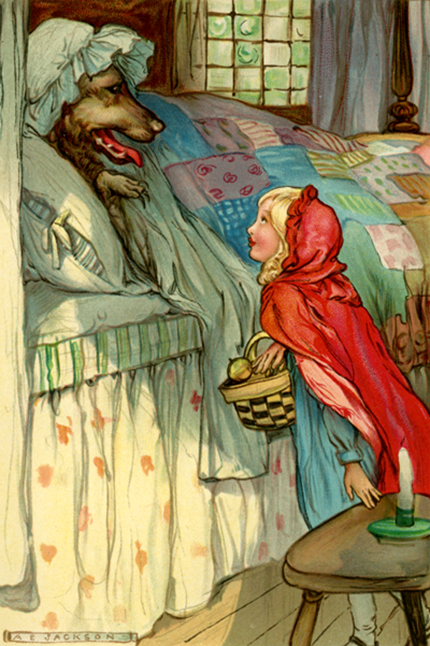
People at the time would undoubtedly have recognised the figures and what was happening, much as we would instantly recognise the story of Little Red Riding Hood from the single image below. Today, we can only speculate.
Phalluses are the only elements that identify the sex of the Sayburç figures, and the emphasis is on the predatory and aggressive features of the animal world, such as teeth and horns, which has also been observed at other sites in the area. The Sayburç reliefs, however, differ in that the figures can be interpreted as forming a narrative, with the two individual scenes appearing to be related to each other as scenes in a story or set of stories. The comparable stature of men and animals in the Sayburç relief may suggest a new dimension recognised in the narratives of pre-Ceramic Neolithic people.
Again, the claim that these scenes form a story can be questioned. What really Is the evidence? That the relationship between the figures are arranged horizontally, rather than vertically? Well, they are inscribed into a horizontal feature, a bench, so a vertical arrangement was not possible. That the figures are shown, dynamically, in motion? The same might be said of the birds from pillar 43 in nearby Göbekli Tepe, one possibly playing with a human head.
Features of the panels
The animals (leopards and a bull) are wild and savage
Both humans are male
The high relief human figure on the right between the leopards is different from the crouching human on the left.
The high relief may signal a different status to the other human
He is not perturbed by, or even interacting with, the leopards. Is he in control of them (a Master of Animals)? Note, however, that he in not resting his hands on the animals as in other depictions of Masters of Animals). In some myths, the Master of Animals controls the game animals, releasing a few to humans as food
He wears a V-shaped neck adornment, a motif also found at Göbekli Tepe, and on Urfa Man and a similar statue at Karahan Tepe. Martin Sweatman (2022)[2] interprets this symbol as representing a lunar month and the V necklace as indicating controller of time, but this interpretation is highly contested.
The Master of Animals figure is not the centre of the story. He is rendered as nothing other than his status. It is the other figure who is in motion and individualised with six fingers and s held object. The object may be a sling (is he therefore hunting?) or perhaps an inverted snake (similar to the Gilgamesh carving above) or a rattle.
If he is the centre of the story, it seems plausible to suggest that he has come into conflict with the Master of Animals or the proper behaviour the Master represents. Perhaps he has failed to engage in the correct rites before the hunt and now is alone, confronted by the bull.
If so, how this story ended might depend on the location in which it is graved. What was this enclosure for? The enclosure has still only been partly excavated. But other sites. such as Göbekli Tepe, have been more fully explored. There is much debate about the function of the large enclosures there: sanctuaries, cultic centres, communal houses?. If these enclosures were spiritual in purpose, the role of the story might have been to underscore what was fitting to do. If they were domestic or recreational, the story might have been more mischievous. In all probability, these societies did not make a distinction between the sacred and the profane.
So, perhaps an interpretation of the story, if there is a story, might be something as follows.
A man desires to hunt for meat, but, being impatient, sets out without consulting the Master of Animals. [This is a serious violation of the natural order. It is the role of the Master of Animals to ascertain where the herds are and to propitiate their spirits before any hunt]. The man is a giant, with six fingers on each hand and six toes on each foot and believes he can do just as he wishes.
The man treks all day, finding only a rabbit. Though he is after bigger game, he is hungry and brings the rabbit down with his sling. He skins the animal and skewers it over the fire to cook. Tired, he finds his eyes closing, and leaves his arse to guard his prize. While he is asleep, foxes come and steal the cooking coney. When the man awakes and finds the bounty gone, he is furious. “I left you to guard the rabbit while I slept,” he says, “and now look what’s happened. I’ll teach you.” He grasps a burning log from the fire and rams it into his bottom. The pain is intense. “What?” he cries, “Must I bear your punishment too?”
The man proceeds gingerly on his way. The Master of Animals sends a deer into his path. “I am yours,” says the deer to the man. Haughtily, he replies, “Though your antlers are magnificent, I am after more dangerous game than you.” So the Master of Animals has a ferocious boar stray into the man’s path. “I am yours, if you have the courage,” says the boar. The man strokes his great chin, “It is true your tusks are sharp and deadly,” the man says, “but I am after bigger game than you, something that can feed my whole clan.”
So, the Master of Animals decides to teach the man a lesson and sends a huge aurochs, taller than two men standing on each other’s shoulders, charging at him. “Ho, man,” says the bull, lowering his horns, “what do you think you are doing, walking the hills armed only with a sling?” The giant bull charges, forcing the man to jump out of its way at the last moment, narrowly avoiding being gored. At the next charge, the man cries out in alarm, “Oh save me, for I will surely die.”
The Master of Animals takes pity, summoning the spirits of the sky to lift hunter and beast up into the heavens, where they still confront each other today.
This story is built on three elements. The first is the analysis above of the carving, which provides the set-up of the tale. The second, to add scatological humour that might have been expected around the night fires, is the theft of the rabbit and the burning stick from the fire. This element has been borrowed from the North American Crow myth cycle. The third element, the intervention of the Master of Animals to save the man by transforming him and the bull into constellations, is, of course, the Cosmic Hunt, described above. This provides a satisfactory ending. It is all entirely speculative.
I have started work on a new novel. set 9,000 years in the past in the ancient city of Çatalhöyük (on the Konya plain of what is now central Turkey).
This is a challenge. How did these people think? What was important to them? Writing had not yet been invented, so there are no texts to tell us what stories they told, what language they spoke, or what they called themselves. All of this has to be pieced together from the material remains of their impressive 2,000 year history. We know equality must have been very important to them. We can say this because, with minor differences, all the houses were pretty much the same.
Artist’s impression of Çatalhöyük
There were no temples, no palaces, and hence, no priestly class or kings. There was no indication of warfare. Their bones show that everyone was pretty well fed, with no nutritional differences between men and women. By this time, they had domesticated plants, goats and sheep. They could have domesticated cattle too, but chose not to because the hunt of the wild giant bulls, the aurochs, and ritual feasting was fundamental to their way of life. We know this because of the feasting remains and because they celebrated the hunt in extraordinary murals.
This article examines a selection of these murals, those found in house F.V.1 which dates from around 6,500 B.C. It was decorated on all four walls with the painting applied to a single layer of plaster. Why have I chosen to analyse these paintings in detail? Because there are clues here to what they believed, and from those and other clues I can try to rebuild a version of what their lives may have been like. I should stress, I am an author, not an archaeologist. It’s my job to make stuff up, but I want what I make up to be wholly consistent with what’s known from the archaeology.
In a journey round all four walls of the house starting from the south, these are the murals. A detailed description of the paintings and their location can be found in a paper by Grant Cox[1].
Painting 1. The Stag. Southwest corner
The painting shows 16 humans with a stag. There are no weapons, so this seems to indicate a scene of playing or baiting (one of the figures tugs on the reluctant animal’s tongue, one on its tail, one its antlers and one its hoof). The scene may be symbolic. Several of the figures are incomplete with missing and disarticulated body parts, including perhaps two missing their heads. The latter may suggest ritual or mythological significance. Alternatively, this may simply be the result of fading or damage to the painting
Several of the humans are rendered in some detail, showing noses, chins, hair and beards. One of the figures, rendered in pink, is unusual in not being a silhouette, the only such figure in all the murals. It is possible he is leaping on the stag’s back (though it is just as plausible to suggest he is behind the animal). Two of the human figures at the bottom of the picture are smaller (children?) and one is a woman (bottom right), Near the woman is what may be a dog.
There are indications of differences between the men. One has pink skin. Some wear leopard skin kilts and others what appears to be of a different animal (goat?)
Pink skin colour
Red skin colour
Total
Men
1
12
13
Women
1
1
Children
2
2
Disarticulated
4
Weapons
0
0
Leopard kilt
1
5
Other kilt
4
No kilt
5
Painting 2. Several animals. Northwest wall.
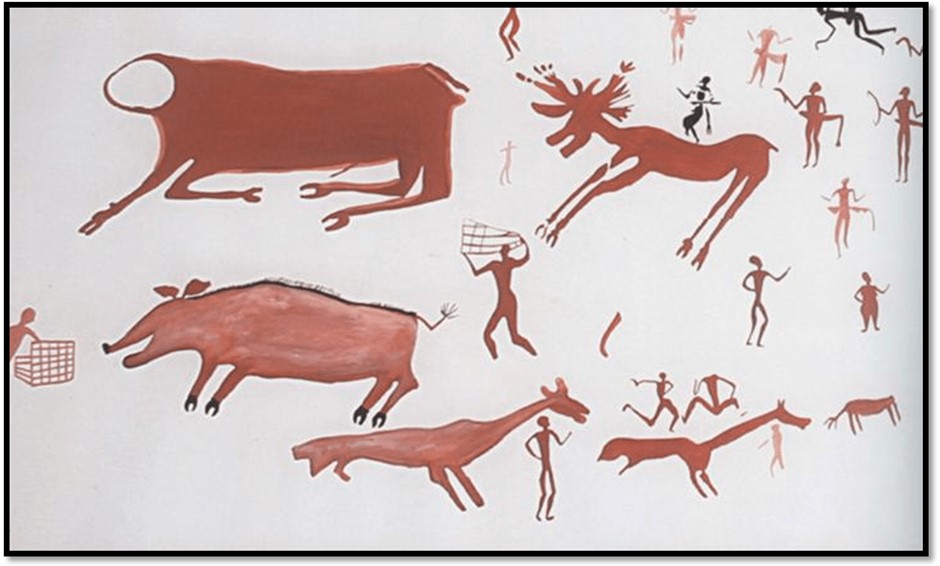
After a separation by a plaster pillar, this painting appears above a long frieze of what appears to be a line of asses. Several animals are shown and 17 humans. This time, six of the people are armed. The top of the painting is dominated by two animals, one of them headless. Melaart interpreted them both as deer, the smaller one to the right being a different species (perhaps a fallow deer). However, the larger headless animal is rendered unusually for a deer and may be a bull or a cow. Again, headlessness may have a symbolic ritual meaning. Two of the humans are also headless, as is a small animal at the bottom right. Two of the humans are trying to net the boar. One of the men may be trying to balance on the back of the fallow deer and two on one of the asses (though it is equally possible they are simply depicted as being behind the animals).
Again, there is one woman on the bottom right and there are differences between the humans, with skin colours of black, red, and pink. None of them is wearing anything that can be clearly identified as a leopard skin kilt.
Pink skin colour
Red skin colour
Black skin colour
TOTAL
Men
5
7
2
14
Women (no kilt)
1
1
Children (no kilt)
2?
2?
Disarticulated
1
1
Weapon (bow)
1
Weapon (boomerang)
2
1
Weapon (other)
Net
1
1
Leopard kilt
Other kilt
2
1
No kilt
Painting 3. The Bull. North wall
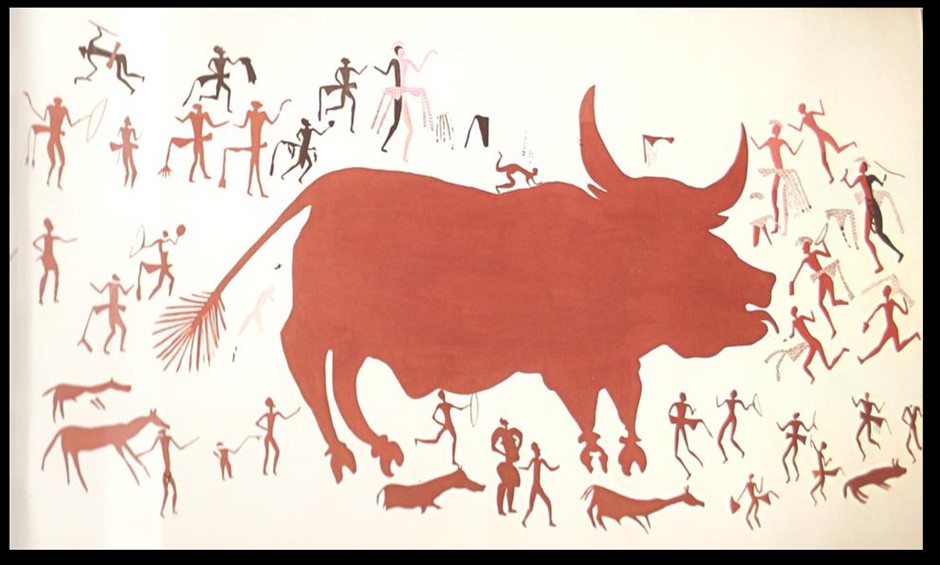
This mural is dominated by the giant bull which dwarfs the people. Several of the people are armed. The skin colour is not easy to distinguish here as between red and pink. Some of the people have a lighter tinge, but not as light as pink and have been interpreted as red. Two of the figures are unique in being half tone (one half red and half black, the other half pink and half black). Both these figures also have leopard skin kilts, weapons and headdresses, indicating they may be high prestige. Again, there is one woman in the picture, apparently pregnant (just below the bull) and one child, seemingly tethered to an adult (just behind the bull).
Red skin colour
Black skin colour
Half tone
TOTAL
Men
23
4
2 (pink & black, red and black)
29
Women (Pregnant)
1
1
Children
1
1
Disarticulated
1
Weapon (bow)
4 (2 kilt, 2 no kilt)
Weapon (boomerang)
2
1
Weapon (other)
4
2
1
Net
Leopard Headdress
2
2
Leopard kilt
14
4
2
Other kilt (red)
10
1
Other kilt (black)
4
No kilt
11
Painting 4. Northeast corner continuing onto the east wall
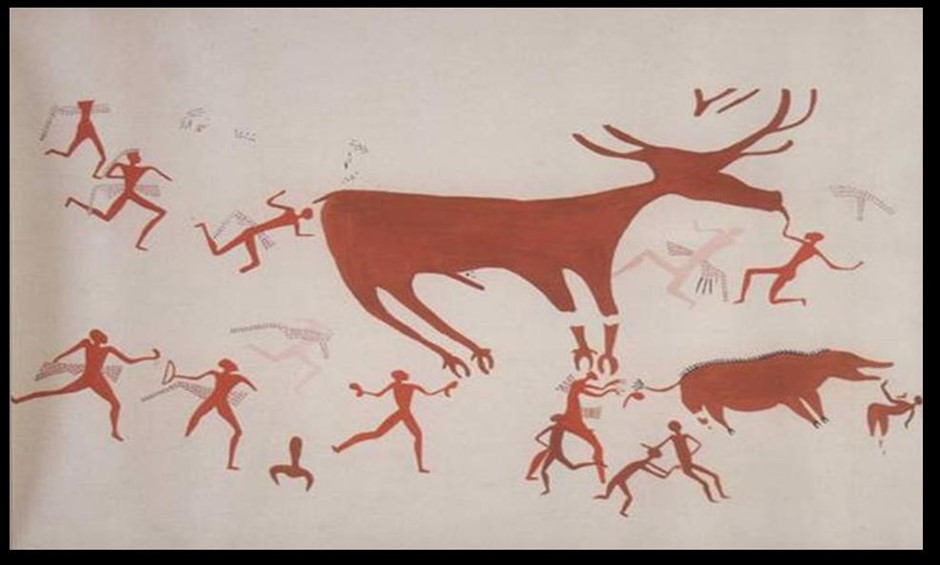
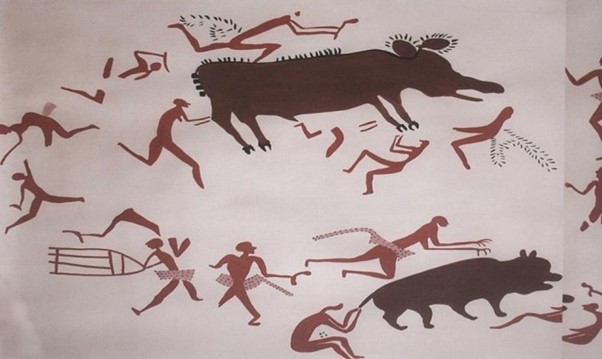
15 men are teasing a stag and a bear, pulling on tongue and tail. The empty leopard skins suggest there might have been more people, lost through the poor condition of this part of the wall. Though three of the men are armed, this does not seem to be a hunting scene. The two figures below the stag’s jaw appear to be in synchrony. Is the pale on a cosmic mirror of the red one? The figure just below the stag’s forefeet and trying to pull the bear’s tail appears to be a human-animal hybrid, with spines on its back and extended claws.
There are no women or obvious children in this scene, though it’s possible the bending figure just below the bear’s rump is a child.
Pink skin colour
Red skin colour
Black skin colour
TOTAL
Men
2
13
15
Women
Children
Disarticulated
2
Weapons (bow)
1
Weapons (boomerang)
2
Leopard kilt
1
4
Other kilt
No kilt
10
Continuation of painting 4 on north side of east wall
The painting continues onto the east wall, showing a boar and bear apparently being baited. Again, weapons are present, as well as a mysterious harp or flail like object. Only one type of person is represented (with red skin). The figures just below the boar’s snout and the one apparently on its back may be wearing feathers.
Of particular interest is the figure leaping at the back of the bear, another seeming human/animal hybrid with extended claws.
Pink skin colour
Red skin colour
Black skin colour
TOTAL
Men
12
12
Women (no kilt)
Children (no kilt)
Disarticulated
2
Weapon (bow)
0
Weapon (boomerang)
2
Weapon (other)
2?
Net
0
Leopard kilt
3
Other kilt
0
No kilt
9
Painting 4 continued (southern part of east wall)
This panel (though it is a continuation of the previous one) is the only one that contains no animals, though the majority (perhaps all if the paint has fade) of the 13 men wear leopard skin kilts as if they were about to face dangerous game. Perhaps this represents the aftermath of a hunt, or a ceremony preceding a hunt. The figures appear to be circled (dancing?) around a magnificently dressed central figure, whose leopard skin seems to be feathered (as is that of the figure on the top left). Again, there may once have been more figures who have faded leaving only their leopard skins at the bottom of the picture. Only one person holds what may be a weapon (a boomerang) and one, on the right of the central figure holds a mysterious object with tines.
Pink skin colour
Red skin colour
Black skin colour
TOTAL
Men
1
12
13
Women (no kilt)
Children (no kilt)
Disarticulated
1
Weapon (bow)
Weapon (boomerang)
1
Weapon (other)
1 (tined)
Net
Leopard kilt
1
9
Other kilt
0
No kilt
3
Painting 5 (South side of east wall)
The image begins after the bench on the east wall and continues to the ladder. Preservation was particularly poor here. A large pink feline creature (possibly a leopard although there are no spots) is surrounded by at least 9 people (more may have been lost to fading), none of whom are armed, though all are wearing leopard skins. The skins this time appear to be feathered. All are men and all are coloured red. The men appear to be holding hands and may be dancing One of the men, with a fine double kilt, is also wearing a leopard skin hat.
Pink skin colour
Red skin colour
Black skin colour
TOTAL
Men
9
9
Women (no kilt)
Children (no kilt)
Disarticulated
? (damage)
Weapon (bow)
0
Weapon (boomerang)
0
Weapon (other)
0
Net
0
Leopard kilt
9
Other kilt
0
No kilt
0
South wall
The murals conclude with an incomplete set of human and animal images on the south wall.
Interpretation
The collection of images are not of hunting alone. Indeed, only the bull mural seems to depict anything that could be considered a hunting scene. But the other scenes may be part of a wider symbolic complex: the prowess-teasing-hunting-feasting complex. The bull mural is the only one in which almost half the participants are carrying weapons (14 weapons among the 31 participants). By contrast, the proportion of weapons in the two stag teasing scenes (painting 1 and painting 4) are zero and 3-in-15 respectively. Teasing (a display of prowess) was probably an important part of the symbolic complex. Even in the bull hunt scene, one of the participants seems to be performing an acrobatic tumble on the bull’s back. Other images too may indicate participants vaulting the animals (paintings 2 and 4, possibly painting 1).
These scenes depict predominantly, if not exclusively, adult male activities. The individual women present in several of the scenes may have been symbolic, particularly because one seems heavily pregnant. It is probable that boys would have been part of the hunt when they came of age.
Though the bull hunt scene shows 31 individual (which is probably the minimum number that would have been required to hunt the wild aurochs) these scenes should probably not be read as a realistic depiction of actual activities and may be highly symbolic in nature. Reasons for believing this include
The probably symbolic nature of the female presence in three of the panels
The scale, with the animals represented larger than life
The presence of hybrid figures who may be symbolic or mythological. The first two are status hybrids, while the second two seem to be animal-human hybrids. The projections from the back of the upright figure in painting 4 may be spines (maybe an iguana or a chameleon?) or feathers (feathers being more likely since it appears predatory: maybe an eagle?). The leaping figure in painting 4 may be a leopard-human hybrid.
The disarticulated bodies (particularly the headless ones) may be indication of a spiritual state. At least some, however, may just easily be the result of damage and fading. Headlessness, however, was an important feature of ritual life. Skulls were retrieved from some corpses and subject to manipulation. On closure of a house, the heads and limb extremities were struck off the splayed figure reliefs.
Headless bodies also occur in the vulture paintings found in level VI
4. There are various differentiators between people in the images
The colour coding of the figures is intriguing. Did red, pink and black indicate different social groupings (perhaps those clustered around a “history house”) or, alternatively, different occupations or, yet again, different ages? Red figures predominate in all the scenes, reflecting perhaps the lineage that lived in this house. It is possible that pink wasn’t a real category but the result of red paint fading. The half-tone figures in the bull mural may represent some status (again, perhaps mythological) that bridged the two groups. The fact that there are no three-tone figures, may add weight to the suggestion that the pink is an artefact of ageing, because more than two house groups would have been required for the hunt. It seems most plausible that the colour coding represents neigbourhoods.
Do the colours represent house groups? The minimum number of hunters to successfully bring down a bull was probably around 30. Assuming an average of two adult males per household, this figure would require cooperation between at least 15 houses. With five or six houses grouped together around a “history house”, the minimum hunting number would have required cooperation of at least three such house groups, and probably more participated. If the colour-coding represented such house groups, at least three colours would be required, but probably more. Yellow was a colour available to the painters but was not used. It seems likely, therefore, that the colour coding did not represent house groups. It could however have represented the neighbourhood level. Houses were clustered into neighbourhoods or quarters of around 30 houses[2]. If a hunt was organized by a neighbourhood, with some members of other neighbourhoods participating, the colour coding would find a ready explanation. The half-tone figures would also be explained as individuals whose lineage or affiliation spanned neighbourhoods.Do the colours represent occupation? The idea that the colour coding represented different occupations (for example herders, carvers, millers) also seems unlikely for two reasons: firstly, in this early and highly egalitarian society, it seems likely that most people performed most activities. Undoubtedly some may have specialized, being recognized as having an expertise in, say, stone working or painting, but they would undertaken other work too. The second argument is that these scenes appear symbolic, reflecting aspects of life that were spiritually important. There are no representations of the mundane activities that would have occupied the majority of people’s work time (farming, gathering, herding, stone-working etc.). Any distinctions between people in these paintings would have reflected spiritual not temporal differences. This argument would not apply, of course, to different roles within the hunt (such as drivers who moved the beasts towards the hunters who killed them, trackers, bearers).Do the colours represent spiritual status? Age would be the most obvious marker of such status. Children would have dependent status and youths (represented in black?) would have a candidate status relative to adult hunters (represented in red?). However, against this interpretation is the fact that apparent children are colour coded with what should be adult status (red). Also against this equation of colour with age grade or other spiritual status is the fact that some of the figures in black are wearing leopard skin kilts (which may have been a badge of status).
Dress is a significant differentiator too: particularly whether or not a person wore a kilt, and, if so, whether it was leopard skin or some other skin. Leopard caps are also worn by some. The fact that leopard kilts predominate in the bull mural (worn by 18 of the 31 people, compared with 6 of the 16 in the stag teasing scene of painting one and with 5 of the 15 people in the teasing scene of painting four, suggests leopard skins had a particular status. When you went out to kill a bull, you needed the leopard’s protection. Interestingly some figures are dressed in kilts that appear to have been other animals (possibly goat), perhaps indicating they had no yet reached leopard rank. Interestingly, all those with the leopard in painting four (which is not a hunting scene but may represent a ritual) are wearing leopard skins. A final noteworthy feature about dress is the feathering worn on the skins by a few individuals in painting four (southeast wall) and painting five.
5. The meaning. The paintings represent much about the spiritual practices involved in the hunt, though interpretation is conjectural. Painting five shows a group of hunters invoking the spirit of the leopard to strengthen and protect them in the hunt. This would perhaps have marked the stage before they set off. The invocation was not simply symbolic. They did not simply dress as leopards in the skins of the animals, but they “became” leopards. Painting four shows the hunt in progress, with one hunter who has transformed into a leopard, leaping on the back of a bear. Other animal spirits too would come to the aid of the hunters. In the course of the hunt, much time was spent demonstrating bravery by teasing the wild animals, including vaulting over the animals, like the daring bull leaping perhaps shown in painting three. At the end of the hunt, there might have been further rituals. We know that feasting was the important ritual terminus, but it seems possible that the panel of painting 4 on the south-east wall may represent a dance of thanks. The seasoned hunters, dressed in leopard skins, are circulating round a magnificently dressed central figure, and one has what may be a musical instrument.
6. Mystery objects
7. What were these paintings for? They should not be thought of as “decoration” or “art” in the modern sense, because they would have been hard to view in the dim interior of buildings lit only from the entry hole in the roof. It is likely that they memorialized important events in the prowess-teasing-hunting-feasting cultural complex. It has been suggested that, in general, the act of making pictures may have been more important than the viewing of them. Wall paintings were normally quickly covered up by annual replastering of the walls, though this particular house had only a single layer of plaster. Given that unusual fact, it is possible that the pictures were used in celebrations and perhaps in initiation rituals within the group who used this house.
8. The aesthetic that flowered in levels VI and V (around 6.500 B.C.) was brief. Such paintings are not encountered again after level II (around 6,100 B.C.). Did aesthetic preferences change, or the culture as whole? Evidence is that the culture itself was changing, with more demands on labour time cutting into the time for collective activities like the bull hunt, together with a growing individualism. Aesthetic activities were now increasingly expressed in the more mobile pottery and seal stamps, perhaps as social bonds loosened. My novel is set at the time of this change.







 Neil MacDonald Author