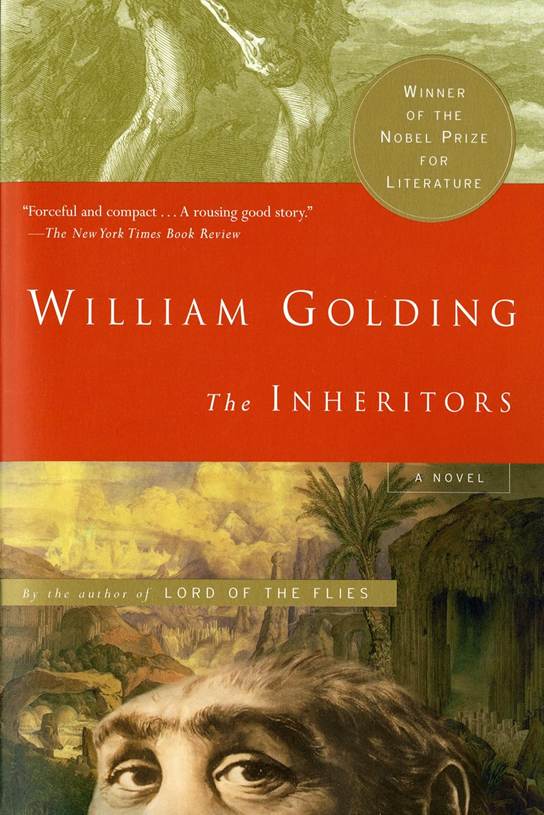
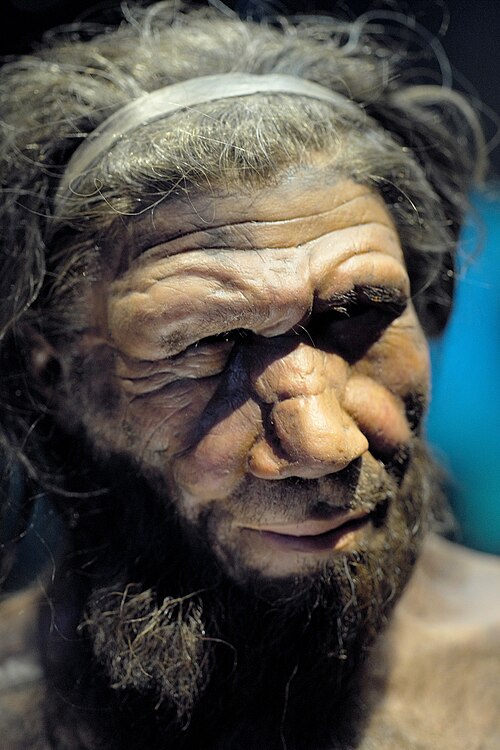
Golding thought The Inheritors was his finest novel. It tells the story of a band of people about to be displaced by stronger incomers. The twist is the people are Neanderthals, and the incomers are modern humans,
Like all of Golding’s work, there is a moral subtext. Lok, Fa and the other Neanderthals in this tale of The Fall are innocent and without sin, while the Homo Sapiens are licentious, drunk, and violent.
What makes this book extraordinary is the language Golding uses to craft Lok’s inner world. His Neanderthals inhabit a rich sensory world heavily imbued with life force, capable of almost telepathically sharing images, and without much in the way of concepts. We are immersed in a strange and charmed world.
How does Golding achieve this effect?
The grammar of an alien mind
When we are in Lok’s head, sentences are short and staccato. The book opens “Lok was running as fast as he could.” The Neanderthals’ speech is simple and declarative, dealing with the immediate and the concrete.
Of course, a novel composed entirely of such clipped sentences would be like a child’s reading primer. So Golding complements this with highly sensory and lyrical description, especially of colour.
By contrast, the Homo sapiens use longer sentences with subordinate clauses. This is a speech capable of conveying abstract thought, of understanding the relations between things. Consider the metaphoric quality of :
“His teeth were wolf’s teeth and his eyes like blind stones.”
Transitive and intransitive verbs
The passages dealing with Lok and the Neanderthals rarely (18.47%) uses transitive verbs, while in the passages from the perspective of modern humans such verbs are more common (40%)[1] Transitive verbs are those which require an object to complete them (for example, “Vivani was doing her hair”) whereas intransitive verbs are complete actions in themselves (for example, “Lok ran”). Clearly, we use transitive verbs to express more complex ideas and understand our being in the world.
Fa, the cleverest of the Neanderthals, almost imagines the idea of container for carrying water from the river. But the mental effort proves too much for her and the picture vanishes. Lok is often unable to piece together complex cause and effect. This is clearest in the passage where Lok first encounters a man from the new species:
The man turned sideways in the bushes and looked at Lok along his shoulder. A stick rose upright and there was a lump of bone in the middle. Lok peered at the stick and the lump of bone and the small eyes in the bone things over the face. Suddenly Lok understood that the man was holding the stick out to him but neither he nor Lok could reach across the river. He would have laughed if it were not for the echo of the screaming in his head. The stick began to grow shorter at both ends. Then it shot out to full length again. The dead tree by Lok’s ear acquired a voice.
Clop!
His ears twitched and he turned to the tree. By his face there had grown a twig: a twig that smelt of other, and of goose, and of the bitter berries that Lok’s stomach told him he must not eat. This twig had a white bone at the end. There were hooks in the bone and sticky brown stuff hung in the crooks. His nose now examined this stuff and did not like it. He smelled along the shaft of the twig. The leaves on the twig were red feathers and reminded him of goose. He was lost in a generalised astonishment and excitement.
Lok is unable to work out that the man has shot an arrow at him.[2]
Identity
The uncanny sense of being in an alien mind isn’t just about sentence structure. Lok’s sense of identity is also different from ours. Parts of his body lead an autonomous life:
Lok’s ear spoke to Lok.
“?”
But Lok was asleep.
Or:
Lok’s feet were clever.
Everything has a life
Everything in their world is alive and participates in a common animation. The log, for example, has agency and has “gone away”, as if of its own volition, and the sun “hid again”.
Lok finds it difficult to stay focused on a task for long, being easily distracted by needs for food and sex. The others say “Lok has many words but few pictures.”
When the group discuss something they share mental images. If they don’t get it, they say “I do not see this picture.” They can even merge their consciousnesses to a shared picture in a kind of hive mind.
When things become confusing for Lok, particularly when the new people attack, he defaults to a genial optimism. He is unable to conceive that they have killed his comrades and abducted the two young ones. He looks forward to the girl, Liku, coming back when the new ones return her. It is Fa who works out that they are under mortal threat.
Homo neanderthalis and Homo sapiens
Unlike the modern humans, these people live gently on the earth, never killing to eat, subsisting on a diet of plants and roots, and meat only when they can scavenge from a predator’s kill.
By contrast, we see the Homo sapiens through Lok’s eyes as incomprehensible creatures who inspire wonder and fear. Their actions are rapacious and chaotic, while their bird-chirp language seems full of admonishment, sly manipulation, and domination.
The outcome
We already know that Lok and his friends will not survive this encounter, because they are gone, and only we are left. Golding is questioning whether that has been a good thing, whether we are a good thing, though he does not suggest we had a choice. For him, we belong on the upsweep of the evolutionary trajectory, represented by the river that runs like time through the novel’s landscape. But perhaps he mourns the fall of that innocence.
[2] See Sam Browse (2018) From functional to cognitive grammar in stylistic analysis of Golding’s The Inheritors,Journal of Literary Semantics, 47 (2), 121-146 https://shura.shu.ac.uk/23149/
I recently noted that at least one main novel competition was looking for stories driven by an inciting incident. An inciting incident is the event or thing that forces the protagonist to leave the status quo and which drives the rest of the story forward.
Many stories are impelled by inciting incidents. But not all. The following books have no inciting incident.
Virginia Woolf’s To the Lighthouse
Harper Lee’s To Kill a Mockingbird
Dostoeveksy’s Notes from the Underground
Gordon Lish’s Peru
Proust’s A La Recherche du Temps Perdu
The question now is what sets a story in motion if it lacks an inciting incident? Does it also lack change and momentum?
Let’s consider the most widely loved of the example stories, To Kill a Mockingbird. There’s certainly change and momentum as Scout grows up and learns the truth behind her father’s advice to understand other people. Particularly so as the dreadful events of the rape accusation and the trial unfold. But what drives the story is no “call to action” setting in motion a “quest”, or any other variant of the inciting incident. Rather, the driver Lee uses is repeating cycles of rejection and acceptance (or defeat and recovery) at the levels both of personal behaviour and of social structures.
Part 1: Boo. Scout her brother and her friend mock the reclusive Boo Radley. He returns only kindness. Scout’s father, Atticus, tells her that she should learn to see the world through others’ eyes. When the children sneak into the Radley house, Boo’s brother shoots at them. In their flight, Scout’s brother tears his trousers and loses them. They later find the trousers repaired and hanging on the fence.
Part 2: The Trial. When a black man is accused of raping a white woman, Atticus agrees to defend him, causing the community to shun him. The family’s black maid takes the children to her church where they are welcomed. They watch the trial from the “coloured” balcony. Though Atticus marshals evidence to disprove the charge, the all-white jury finds the accused guilty.
The aftermath: Boo again. The accused man runs and is lynched. The accuser’s father holds a grudge against Atticus and sets out for revenge. He attacks the children. Boo fights in their defence and kills the attacker. The sheriff agrees to pretend it was an accident. Scout understands her father’s advice.
Though the rape accusation is perhaps the most dramatic part of the story, raising the issue of racism. the real motif is the reclusive Boo Radley. He is mocked by Scout, her brother, and their friend at the beginning yet returns only kindness to them. By the end, when Boo saves the children, Scout learns to truly understand and respect him.
This does not make the children’s contact with Boo an inciting incident. It does not light the touchpaper to the chain of events that follow.
All the works in the list could be described as literary. So perhaps the conclusion is that genre stories will usually (perhaps always) have an inciting incident while literary stories do not necessarily need one. I might argue that among the inciting incident’s functions is telling the reader what kind of story to expect. If there’s a body in the library, you can be sure this is a mystery. If the protagonist feels a palpitation in her bosom when a brooding stranger appears, you can be sure this is romance. In other words, inciting incidents are reassuring genre signals. But they are not necessary for a story full of change, conflict, and momentum.
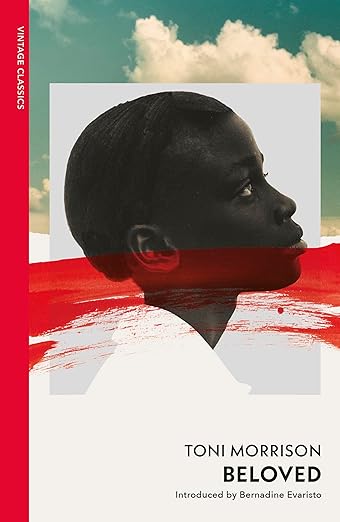
Beloved is a masterwork. It takes its inspiration from a true story of an escaped slave who killed her baby rather than let it be taken back from the north of the US to the slave south, It is a novel about slavery, yes. But more, it’s about humanity and the enduring wounds injustice inflicts. Baby Suggs, for example, reflects on the danger of loving:
“The last of [Baby Suggs’] children, whom she barely glanced at when he was born because it wasn’t worth the trouble to try to learn features you would never see change into adulthood anyway. Seven times she had done that: held a little foot; examined the fat fingertips with her own—fingers she never saw become the male or female hands a mother would recognize anywhere. She didn’t know to this day what their permanent teeth looked like; or how they held their heads when they walked.”
And also it’s about memory. The past is not done and buried in Sethe’s world. It lives on, most particularly in the form of Beloved, who she believes is the baby she killed, and who first returns as the poltergeist that haunts her home, then as the creature that sucks her dry.
These are strong, deeply human characters. Not just Black characters but people who show us what it means to be a person. There is, of course, the many-headed hydra of racism and the lies racists tell themselves to justify their oppression:
“Whitepeople believed that whatever the manners, under every dark skin was a jungle. Swift unnavigable waters, swinging screaming baboons, sleeping snakes, red gums ready for their sweet white blood. In a way, he thought, they were right…. But it wasn’t the jungle blacks brought with them to this place from the other (livable) place. It was the jungle whitefolks planted in them.”
But there is also the ambiguity that is at the heart of all of us:
“Sethe learned the profound satisfaction Beloved got from storytelling. It amazed Sethe… because every mention of her past life hurt…. But, as she began telling about the earrings, she found herself wanting to, liking it”
Is there redemption in Sethe’s easing of her isolated pain? Or is it capture?
How does Morrison achieve these effects?
She does this in a variety of ways.
The existence of the past in the present is not just something Sethe asserts. It’s built into the structure of the novel with flashbacks and point of view changes that constantly braid past and present. The past, of course, is not a comforting time of fond memory, but one of humiliation and pain. Paul D’s tobacco tin of repressed memories exemplifies this:
“It was some time before he could put Alfred, Georgia, Sixo, schoolteacher, Halle, his brothers, Sethe, Mister, the taste of iron, the sight of butter, the smell of hickory, notebook paper, one by one, into the tobacco tin lodged in his chest. By the time he got to 124 nothing in this world could pry it open.”
Like Sethe, there is much about the past that is dangerous to him, Paul D’s tobacco tin is one of a number of recurring symbols. Another symbol is the whipping scar on Sethe’s back, which is described as being like a chokecherry tree. Does it symbolise the fraudulent beauty of “Sweet Home”, the place of Sethe and Paul D’s enslavement? Does it symbolise the ability of beauty to grow, even in horror? Or does it, perhaps, convey both meanings?
Biblical images and references are scattered through the story. The horsemen who come to take Sethe back to slavery are four in number. Baby Suggs’ sin of pride (if such it is) that restrains the community from warning Sethe of the coming of the four horsemen, is a huge feast that evokes the miracle of the loaves and the fishes.
And finally there is the symbol provided by Beloved herself. Dead baby, poltergeist, cunning and vengeful reincarnation. Sethe and her daughter Denver are seduced by Beloved, wanting her for themselves. Paul D is driven away by the apparition. What is she? Perhaps the burden of guilt, perhaps the desire for connection, perhaps … well you decide.
Stories are among our oldest cultural creations. They tell us what’s important and what’s unimportant; what goes with what; who to praise and who to blame.
Stories are different from real-life events. Real life is lived forwards with unknowable endings, whereas the meaning of stories is inferred backwards: stories are about events in the light of their endings. A good ending, it is said, should have the effect of being inevitable and yet surprising.
Character
We may be intrigued by plot, but it is characters we fall in love with. In many ways, character is at the heart of storytelling. When you have a character with a want, you already have the beginnings of a plot. When you have another character with an opposing want, you have drama.
Authors create characters in many ways. By far the most common, and the least interesting is to resort to archetypes. There are many different notions of who the archetypal characters are, but what they all have in common is the reassurance that we already know everything about them. They will not surprise us.
Better, much better, is a full, rich, complex, and contradictory character. Such characters create the illusion of being real people. Though, as Nobel Prize winning author Orhan Pamuk argues, real people do not have as much character as is found in novels.
Plot and story
Some definitions are advisable here. A story and a plot are different things. Plot is the time sequence of events, their causes and effects. But the plot may be told in different ways. If the events of a plot are A, B, C and D, they may be told in this order.
But they may also be told out of time sequence. For example, the telling may begin with C and then flash back to A and B before revealing the dénouement at D.
Plot is the time sequence of events. Story is the way those events are recounted. A poor plot can be saved by clever storytelling.
Of course, the telling of a story is much more than this. Vocabulary, sentence structure, pacing, voice, and many other things go into the making of a story.
Narrative
A third definition, in addition to plot and story, may be important. I will call this narrative, to distinguish it from the first two. A narrative exists when it leaves the author’s head and enters the heads of readers or listeners. The reception of the tale is simple passive process. The listener or reader actively collaborates in imagining the setting, the characters, their actions and what these all mean. There are as many narrative variants of a single story as there are listeners. Some of these variants may be significantly different from the author’s intention.
An author may say that they can’t control how an audience responds to their work. And that is true. But an author can anticipate some likely responses and misunderstandings.
Layers, Symbols and Meaning
Layering refers to the hidden depths of a story. This depth can make all the difference between a work that chugs along satisfactorily and one that stays in the reader’s memory for long after the last page is turned. There are different kinds of layers. For simplicity, I’ll categorise them into three types:
Story layers. A layered story has more than one plotline. For example, Elif Shafak’s ambitious novel There are Rivers in the Sky attempts to braid three timelines: ancient Mesopotamia, Victorian London, and the present day. She does this by alternating chapters. Of course, in the end, a story of this type must bring all the subplots together at the end. To repeat, stories are events in the light of their endings.
Character layers. In modern Western writing, the plot is generally driven by the protagonist’s desire for something (their want). More interesting and deeply-crafted characters have layered depths though. Often, the protagonist’s want may be in conflict with their true need. Katiniss in Suzanne Collins’ The Hunger Games, for example, wants to win the Games at any cost, but what she truly needs is to learn to sacrifice herself to preserve her own autonomy. The reader’s experience of redemption comes from the protagonist recognising what their true need is and finding completion.
Symbolic layers. This is perhaps the most literary of the layering types. The things that happen on the surface have an additional symbolic meaning. The trick of authors who do this well is not to hit the reader over the head with the meaning, but rather to allow them to find the meaning themselves. Once found, this meaning illuminates the whole story. A classic example here is the theme of unachievability in F Scott Fitzgerald’s The Great Gatsby. Many elements are knitted together to underscore this theme. There is, of course, Gatsby’s unrequited love for Daisy, the endless parade of motor cars, and the recurring symbol of the green light across the bay. Fitzgerald intends this symbolic layer to capture the destruction of the American Dream.
Putting together a story
Characters with multiple dimensions. Stories that achieve the most intriguing telling of their plot. Tales that carry layers of meaning, making the story resonate with deeper issues. These are the elements of good story-telling, stories that can make their way into the world as narratives which reverberate with the sympathy and questioning for readers.
Regular readers of this blog will know I’m a big fan of ProWritingAid for spelling and grammar checking. Now it has branched out with a whole AI-powered manuscript critique service, and they offered me a free trial (normal charge £50 or $50).
Manuscript Analysis is broken down into five sections:
About My Story: Gives you key information about your story’s genre, narrative elements, and competitive landscape.
Narrative Themes: Highlights the key narrative threads throughout your story, and flags themes that are working well along with themes that could use some adjustments.
Plot & Structure: Highlights plot points that are working well, as well as those that might need improvement.
Characters: Examines important characterization moments and highlights areas where a particular character is working well or could use some closer examination.
Setting: Analyzes how your use of setting contributes to the overall narrative structure of your manuscript. This section flags if you need to improve any aspect of your setting, and what you might do to make it stronger.
So, how good is it? The short answer is “not great.” On the plus side, it showed a reasonable grasp of the story and quite accurately identified three comparable titles (two of which were among those I’d already chosen). The “unique narrative structure” was commended, though I’m hard put to it to understand how an alternation between two narrators might be a unique narrative structure,
Less impressive was the actionable feedback. There were 20 suggestions on plot and structure. Of these, only two were moderately helpful, and some were plain wrong.
Lest this seem to be a fit of pique on my part, I’ll give a couple of examples. The AI was troubled by:
“The timing of Ansna’s second pregnancy and miscarriage is unclear. It seems to occur shortly after the previous miscarriage, which feels rushed and lacks emotional weight.”
There is, in fact, only one miscarriage, something a human reader would have understood. Another chapter is said to have little consequence or outcome:
“The initiation ritual, while descriptive, lacks a clear impact on Ansna’s character development or the broader narrative. The lessons learned seem to have little consequence. Show how the ritual’s lessons influence Ansna’s later decisions or interactions.”
In fact, the character recalls such lessons in five subsequent chapters.
On Character, the AI notes three areas of concern, none of which I accepted. For example, a conflict between two characters is said to be “undeveloped”. This is because it’s a conversation, not a conflict. One of the three is illuminating:
“Ansna and Kautia’s relationship is inconsistently portrayed. Ansna expresses deep love for Kautia, but their interactions often lack warmth or genuine connection, and Kautia’s feelings remain ambiguous.”
I spent some time considering this comment before rejecting it. Ansna is conflicted in her feelings for Kautia. Again, I decided a human reader would not have read this as an inconsistent portrayal. Indeed, no human reader has made such a comment.
“Despite the bizarre events, Alice rarely expresses strong emotions. Her reactions are often muted, which makes it hard for the reader to engage with her experience.”
The driving force behind this criticism is, perhaps, the emphasis in modern Western novels on emotional exploration. But Alice is a Victorian upper-class girl, stiff-upper-lipped and confident of the social rules, even as they are buffeted by the absurdity of the Wonderland creatures. She behaves entirely consistently with her background and class. Emoting would be entirely wrong. This failure to grasp the nuances of the setting underlies another critical comment:
“The symbolic meaning of Alice’s experiences is not fully developed. The lack of thematic depth makes the story feel somewhat superficial.”
I would beg to differ. First, this is a book for children, so too much symbolic depth would be inappropriate. Second, and more important, the fundamental symbolism is abundantly clear in the repeated challenges to Alice’s sense of order by the other characters.
This leads me to my conclusion about the app. If the tool makes interpretations that no human would, this is no surprise. The AI does not “understand” a story. It merely follows algorithms that look for patterns of word associations its database says are probable. The net result, in the present stage of development of the technology, is to default to tropes. Though it is an impressive leap to be able to (more or less) follow a narrative arc over tens of thousands of words, my judgement is that the release of this tool is premature. More work will be needed to give the tool a better grasp of context and psychology.
Sunset Song by Lewis Grassic Gibbon is, in my view, one of the great books of the twentieth century. Re-reading it now, I am struck by how achingly beautiful and how angry it is, and by how cleverly it is constructed.
“She walked weeping then, stricken and frightened because of that knowledge that had come on her, she could never leave it, this life of toiling days and the needs of beasts and the smoke of wood fires and the air that stung your throat so acrid, Autumn and Spring, she was bound and held as though they had prisoned her here. And her fine bit plannings!–they’d been just the dreamings of a child over toys it lacked, toys that would never content it when it heard the smore of a storm or the cry of sheep on the moors or smelt the pringling smell of a new-ploughed park under the drive of a coulter.”
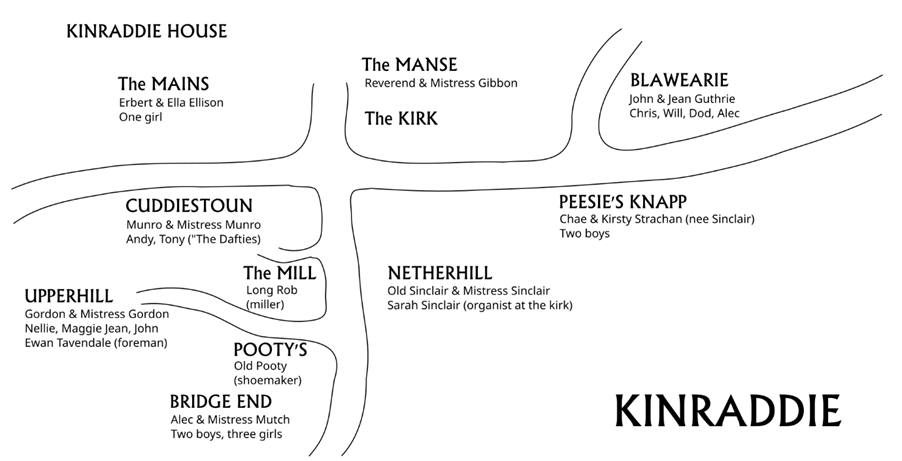
If it has any parallel in it picture of the bustling small life of the folk of Kinraddie, it can only be Dylan Thomas’ Under Milk Wood.
Themes
Above all, the theme is the land. The land which abides when all the folk who till it are dead and gone. Both the prelude and the epilude which bracket the book have the same title, “The Unfurrowed Field”, representing the unworked land. The book is a lyrical, brawling, angry and tormented paean to the dying age of the Scots peasant. And here too is a theme: of change and changelessness.
The protagonist, Chris Guthrie is herself the land (or perhaps all of Scotland). In Chapter 1, Ploughing, she is new ploughed for the immense changes that are coming. All the chapter titles represent the cycle of the growing season and the maturation of Chris. Chapter 2 is Drilling (in which her mother commits suicide and her abusive father is stricken with paralysis). Chapter 3, Seed Time, sees Chris’ father die and her inherit the croft. She marries Ewan. In Chapter Four, Harvest, Chris gives birth, Ewan leaves Chris after an unresolved argument to soldier in the First World War, where he is shot as a deserter. Many of the chapters open and close with Chris at the ancient standing stones, a symbol of deep time that brings Chris peace.
There is the theme of ambiguity. Chris is continually loving and hating things, afraid and intrigued. This replicates the author’s ambivalent feelings towards the birthplace he shunned.
And there is also the theme of social justice, a thrumming disdain for those who put on airs or who exploit others.
“Maybe there were some twenty to thirty holdings in all, the crofters dour folk of the old Pict stock, they had no history, common folk, and ill-reared their biggins clustered and chaved amid the long, sloping fields. The leases were one-year, two-year, you worked from the blink of the day you were breeked to the flicker of the night they shrouded you, and the dirt of gentry sat and ate up your rents but you were as good as they were.”
Humour
None of this makes it a dour book. It is full of humanity and the bantering humour of the dying crofter folk.
“John Guthrie himself got a gun, a second-hand thing he picked up in Stonehaven, a muzzleloader it was, and as he went by the Mill on the way to Blawearie Long Rob came out and saw it and cried Ay, man, I didn’t mind you were a veteran of the ’45. And father cried Losh, Rob, were you cheating folk at your Mill even then? for sometimes he could take a bit joke, except with his family.”
The author’s craft
Grassic Gibbon uses several devices to achieve his effect. The main one is, undoubtedly, the use of the Doric Scots dialect of the northeast. In his hands, there is nothing of Walter Scott’s invention of a romantic Scotland. It is the real people of Scotland we hear, small minded, big-hearted, dreaming and dying. The language, of course, has a sad and lyrical music to it. And it also creates the illusion that we are part of a gossipy chat around a fireside, the true stream of consciousness of the narrators. This effect is strengthened by summary sentences that end many sections which begin “So that was how ….”
There are three narrators: an unnamed voice, Chris Guthrie herself, and Greek chorus of the whole gossiping community. And the telling uses a combination of first, second and third person. The use of the second person augments the conversational and confessional nature of the read: Chris is telling us how she feels and acts.
Deep time is another of his devices, creating the sense that this brief flickering and dying of the light of his cast of characters is part of a longer story of constant change. The Prelude sketches a huge antiquity that links Cospetric and his slaying of the gryphon through all the ages of Scotland from William Wallace’s rebellion against English occupation, through the Reformation and French Revolution and finally the clearances and on to the coming of John Guthrie and his family to the croft at Blawearie. And older still are the standing stones by the loch, the place of peace and safety to which Chris repairs in times of turmoil. Many of the chapters open and close at the standing stones.
A lyricism of nature pervades the detail of all the writing, with the call of the birds, the smell of the new-ploughed earth and the feel of the snow and the wind.
Grassic Gibbon frequently makes use of repetition:
“As the gnomons of a giant dial the shadows of the Standing Stones crept into the east, snipe called and called”
The effect of the repeated words is, at once, powerfully poetic and reassuringly conversational.
Character
The central character is Chris. And an extraordinary character she is, for a male author to have had such insight into the life and dreams and fears of a woman. Chris is strong and determined and fearful and doubting. The book opens with her dreaming of becoming a teacher. But this Chris fades and dies. She thinks of this one as the English Chris. When her mother commits suicide she becomes the second Chris, the Scots Chris of the land who must tend to the house. Released by the death of her sour and abusive father, the third Chris is claimed by that coarse tink Ewan Tavendale:
“He looked over young for the coarse, dour brute folk said he was, like a wild cat, strong and quick, she half-liked his face and half-hated it”
Ewan loves and marries her and then, gone for a soldier in the First World War, returns and ill uses her before being shot as a deserter. Though there is love, it is a love as clear-sighted and hard-headed as the folk of Kinraddie.
Vivien Heilbron as Chris and James Grant as Ewan in the BBC television series
“She felt neither gladness nor pain, only dazed, as though running in the fields with Ewan she had struck against a great stone, body and legs and arms, and lay stunned and bruised, the running and the fine crying in the sweet air still on about her, Ewan running free and careless still not knowing or heeding the thing she had met. The days of love and holidaying and the foolishness of kisses–they might be for him yet but never the same for her, dreams were fulfilled and their days put by, the hills climbed still to sunset but her heart might climb with them never again and long for to-morrow, the night still her own. No night would she ever be her own again, in her body the seed of that pleasure she had sown with Ewan burgeoning and growing, dark, in the warmth below her heart. And Chris Guthrie crept out from the place below the beech trees where Chris Tavendale lay and went wandering off into the waiting quiet of the afternoon, Chris Tavendale heard her go, and she came back to Blawearie never again.
… Turning to look at him, suddenly Chris knew that she hated him, standing there with the health in his face, clear of eyes–every day they grew clearer here in the parks he loved and thought of noon, morning and night; that, and the tending to beasts and the grooming of horses, herself to warm him at night and set him his meat by day. What are you glowering for? he asked, and she spoke then at last, calmly and thinly, For God’s sake don’t deave me. Must you aye be an old wife and come trailing after me wherever I go?”
None of these Chrises are offered by the widow Chris Tavendale to her new husband, the Reverend Robert Colquohoun, who spirits her from Kinraddie and into the next book of the trilogy, Cloud Howe.
Though Colquohoun appears in the book only at the end, it is his voice, giving the dedication to the fallen of the place, that words Grassic Gibbon’s meaning.
“Nothing, it has been said, is true but change, nothing abides, and here in Kinraddie where we watch the building of those little prides and those little fortunes on the ruins of the little farms we must give heed that these also do not abide, that a new spirit shall come to the land with the greater herd and the great machines.
For greed of place and possession and great estate those four had little head, the kindness of friends and the warmth of toil and the peace of rest–they asked no more from God or man, and no less would they endure.
So, lest we shame them, let us believe that the new oppressions and foolish greeds are no more than mists that pass. They died for a world that is past, these men, but they did not die for this that we seem to inherit. Beyond it and us there shines a greater hope and a newer world, undreamt when these four died. But need we doubt which side the battle they would range themselves did they live to-day, need we doubt the answer they cry to us even now, the four of them, from the places of the sunset?”
It is a testament to the greatness of the book that I find myself dreaming in Kinraddie, and its rich vocabulary coming, unsummoned, to my tongue. And the word that comes to mind is “blithe”. It’s a blithe book and no mistake.
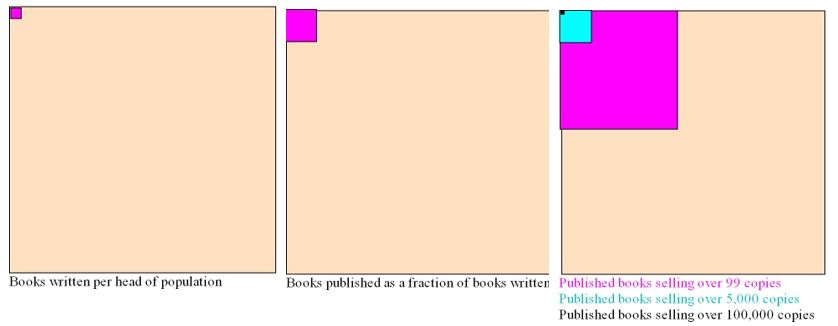
Of course, some authors release more than one book and some books are reissues of dead authors, but the number means roughly one person in two thousand writes a book . Only 3% of people who set out to write a book finish it. Less than one person in a thousand ever writes a book. If you’re writing one, your pool of competition is down to 4 million other people.
What proportion of books get published?
Between 1 and 2% of submitted manuscripts get traditionally published.
How many can you expect to sell?
in 2004, 950,000 titles out of the 1.2 million tracked by Nielsen Bookscan sold fewer than 99 copies. Another 200,000 sold fewer than 1,000 copies. Only 25,000 sold more than 5,000 copies. This is the general rule of thumb for success in publishing. And only a miniscule 500 titles sold over 100,000 copies (the little black dot in the top left corner).
So,
the odds of you writing a book are 0.5%-1% of the whole world’s population. Around 8 million people have written a book.
The odds of your book being traditionally published are around 1.5% of all submitted manuscripts.
The odds of your book selling more than 5,000 copies are around 2% of all published books, and of selling more than 100,000 copies are 0.004%.
Would you trust an AI to edit and produce your book?
Spines is, in the spirit of the tech bros, a disrupter. It describes its mission on its website as “Harnessing the power of cutting-edge AI, Spines revolutionises every facet of the publishing journey, including proofreading, formatting, cover design, distribution, and marketing across all major channels and platforms.” They aim to cut, from months to weeks, the process of producing a book.
What exactly do they offer? They deny that are a vanity publisher or self-publishing service, but, of course, that is exactly what they are. What is different is the automation. The Israeli start-up plans to produce 8,000 books this year.
Predictably, the community of authors and publishers have been scathing in their criticism. “These aren’t people who care about books or reading or anything remotely related,” said author Suyi Davies Okungbowa. “These are opportunists and extractive capitalists.”
So what does the customer get? Oddly, for a publisher, they don’t list their books on their website. To find their books I had to go here. I examined a sample of 18 of these books
What do they charge?
Authors are charged between $1,824 and $5,496 for a print on demand service. By comparison, an established self-publisher, Troubador, charges £600 (about $730) to produce an e-book and £2,295 (around $2,800) for 200 printed copies. So Spines are not offering significant cost savings for cutting out human labour.
How well are their books selling?
To estimate the sales of these 18 books, I converted the Amazon Book Sales Rank into numbers of books using TCK’s calculator. On average, the sample sold 1.29 books a month. Six of them sold none at all and the largest sales were 4 a month.
The books are also not attracting a lot of marketing attention. On average, these books received 4.29 review.
How good is the production quality?
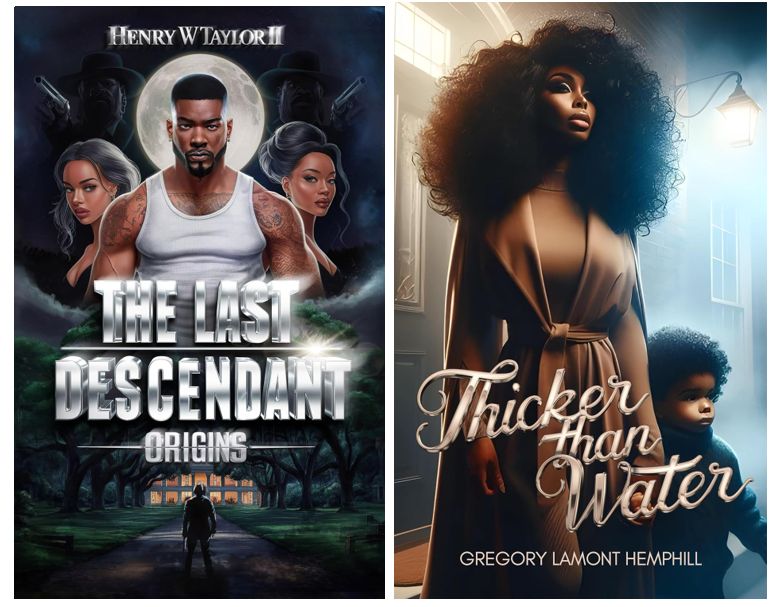
To assess this, I looked at the cover designs for the two fiction books in my sample. Design is, of course, an art, not a science. Personally, I found the covers stereotyped and banal, but I am not the target readership. Since I am assessing AI publishing, I gave two AIs a crack at the cover analysis. Both were assessed as high quality by Joel books. The Last Descendant got a rating of B from ebookfairs, while Thicker than Water got a C.
How well are the books edited?
This is the acid quality test of the hyped AI tools. A careful editor and proof-reader will ensure that the text is free of errors and that the words flow, as well as paying attention to structure and consistency. I examined only The Last Descendant, and only the first paragraph and the cover blurb. The cover blurb has one spelling mistake. The first paragraph contained six grammar mistakes, ranging from unnecessary commas, overuse of two words and one confused word. Judge for yourself:
“The vibrant atmosphere of the office holiday party at 12 Greenway Plaza in Houston, TX, enveloped Jason as he moved through the crowd. Laughter, music, and the aroma of LES BBQ, filled the air, creating a festive ambiance. Surrounded by employees, Jason basked in the joy of the season, drink in hand, and the sounds of celebration surrounded him. Jason Martinez was a man who knew how to make an impression. His brown skin and muscular frame contrasted with his crisp white shirt and black pants, giving him an air of confidence and authority. His face was framed by a neat and lined-up barbarian-style beard, which added a touch of ruggedness to his handsome features. His eyes sparkled with intelligence and ambition, and his smile was charming and persuasive. On his right hand, he wore a Bochic Burma ring, a stunning piece of jewelry that featured a single ruby encrusted in diamonds. The ring was a symbol of his success and power, as well as his taste and style. Jason was a man who had everything he wanted, and was not afraid to show it.”
The spelling and grammar mistakes aside, this opening paragraph has several problems. Sentence variety is low with little variation in length and structure. There is no character complexity—Jason is simply handsome, rich, and powerful. There is, as yet, no tension or plot to engage the reader, simply a character description, making for a slow-paced read. The description is all told by the narrator, rather than shown in Jason’s actions or thoughts.
Conclusion
Going with Spines is not cheap, offers no marketing support, and the editing is noticeable by its absence.
‘Don’t tell me the moon is shining. Show me the glint of light on broken glass,’ Anton Chekhov is said to have advised.
The rise of the “show, don’t tell” advice coincides, or maybe not entirely coincidentally, with the rise of the movies. It can be dated to the 1920s and Percy Lubock’s book, The Craft of Fiction. Perhaps readers, glutted on the new moving pictures, demanded to see the story rather than hear it.
You can, of course, find examples of “showing” before this time. But, in general, stories were told rather than shown. Narration tended to be in the “omniscient” mode, as if by a god who saw all and who could peer into character’s souls. Take a look at some of the classics. The legend of Gilgamesh: telling. Beowulf: telling. The Icelandic sagas: telling. The Iliad and the Odyssey: telling. Characters had no interiority because what they felt was of no importance. It was what they did that mattered. This only began slowly to change in the 12th century.
Two things flow from this. Firstly, telling has a venerable history and is NOT wrong. Secondly, audiences today want immersion in the lives of their protagonists, and, therefore, some showing is now normal. If there is a rule, it is not “show, don’t tell” it is “show, when appropriate, and tell, when appropriate.”
Knowing when to use the one and when to use the other is a matter of practice and experience. There are no simple algorithms to determine this, but here are some likely instances (though there will be counter-examples for all of them) where you’d want to tell, not show:
Dialogue (because most dialogue is unembellished reportage)
Backstory
Where you want to convey necessary information without making it slow the flow
In the transition between settings
When you want to highlight something significant
When you want to balance other passages of showing
Narrative distance
The idea of narrative distance provides a more fine-grained distinction than the all-or-nothing “show, don’t tell.” Narrative distance refers to what it sounds like: how close we are to the character’s thoughts and feelings. In first person, we are almost always right inside the character’s head. But in third person, the distance can be subtly varied by word choice and by what is focused on and what is omitted.
Consider these examples:
A tall man stepped out from the shadows. (Straight telling).
The rain lashed down on the tall man as he stepped from the shadows. (Telling but with a bit of atmospheric detail).
Henry pulled his collar up against the rain as he stepped from the shadows. (We know his name and we’re much closer to the character now, getting a sense of his discomfort).
Bloody hell, would this weather never stop? Drenched to the skin, Henry stepped from the shadows, morosely pulling up his collar against the lashing rain. (Lots of showing, We’re right in the character’s sensations and mood now, though still imbedded in third person narration. This is known as “free indirect discourse”, where the character’s mentality appears within the narration without the use of speech or thought tags—there is no “he thought” or “he said”).
Note that moving down the scale from telling to showing, decreasing the “narrative distance”, tends to elongate things. This is obvious, because we’re adding more detail and emotion.
Emily H. Wilson has performed a heroic feat of retelling in her Sumerian trilogy.
If you were setting out to retell a classic tale from the ancient world, you’d have many problems to surmount. Understanding the customs and meanings of that world would not be simple. But, more than this, you’d come to realise that what constitutes a story was also different in the olden days. There are many cultural reasons for this, but fundamentally they boil down to one thing. Fiction had not yet been invented, and, as we’ll see, would not be invented until the twelve century of the current era, at least in the West. Almost certainly, earlier stories were intended to be received as descriptions of events, as histories.
Consider what Beowulf, the Icelandic Sagas, The Iliad, and The Odyssey all have in common—they are tales of heroic deeds. There are heroes and monsters, but all these characters are “flat”. By that I mean, they have no internal life. We occasionally see their reactions to things—love, anger, grief—in between the slaying, but we don’t have access to their thoughts and feelings. And, of course, we wouldn’t if these are intended to be understood as true accounts. Everyone knows the bittersweet sadness of never being able to know what goes on in another person’s head and heart. It would therefore be absurd to pretend to know what was in Achilles’ mind or Beowulf’s. Such a conceit would break the reader’s or listener’s belief in the story. Nor was there any reason to wonder what was in the hero’s mind. It follows logically from their character. When Achilles mourns the death of Patrocles by dragging around Hector’s body—an offence to men and gods—the listener understood it as an expression of his heroic character.
Nor is there ever any doubt that Odysseus will free himself from Circe’s spell, reject her, and continue on to be reunited with his wife, Penelope. To do anything else would be a disharmony in the tale and a contradiction of his fundamental nature.
We are so used to fiction now that we don’t remark on its strangeness. To us, there is nothing remarkable about this passage from Jane Austen’s Pride and Prejudice:
“Darcy only smiled; and the general pause which ensued made Elizabeth tremble lest her mother should be exposing herself again. She longed to speak, but could think of nothing to say…”
Yet here we are inside Elizabeth’s mind, experiencing what she experiences, though it is betrayed by no action. For fiction to come into existence, with its pretence that we can live inside another person’s thoughts and feelings and, indeed, believe that there is anything worthy of interest in those thoughts and feelings, several things have to happen.
These conditions are eloquently argued by Laura Ashe in her 2018 article The Medieval Invention of Fiction. They came together in Europe, and specifically England, in the twelfth century. There came into existence a class of people, the feudal elite. with the wealth and the leisure to become patrons of storytelling. In medieval England, this elite was educated in French, English and Latin. Before the Norman conquest, Anglo Saxon literature had cared nothing for individuals or their wants. What mattered was that the warrior held his place in the shield wall and made good on his boasts in the mead hall. Ango-Norman feudalism overturned this, celebrating the individual knight for his own sake. At the same time, theological interpretation of the nature of sin began to move from the act to consideration of the intention. This opened the way to interest in the interior life and a consideration of selfhood. Selfhood, Ashe points out, is not yet individuality, and the Church was, indeed, profoundly suspicious of the prideful sin of individualism. The final piece of the puzzle is the invention of “courtly love”. Note, she is not saying that love did not exist in the literature of previous ages. It did, but often as an ambivalent, or even destructive, force that distracts the hero from his duty.
Courtly love was a new thing, a new idea, carried in the songs of the troubadours. Love becomes the purpose of the knight’s actions. The duty the knight owes to his liege lord becomes metaphorically displaced to submission to his lady. Ashe writes.
“Love takes the place of the higher cause which the hero serves and yet simultaneously represents his own self-fulfilment as the ultimate goal of the narrative. Now and only now is fiction made possible, for now the individual is justified for his own sake; his achievement of self-fulfilment is enough in itself to feed narrative representation. The love-plot is fictional, for it requires attention to the inner lives of at least two distinguishable individuals and asserts that their emotional experience, in the author’s imagination, is valuable for its own sake. This is the literary paradigm which gives us the novel: access to the unknowable inner lives of others, moving through a world in which their interior experience is as significant as their exterior action.”
So, how now does an author retell a classic tale that is both modern and yet true to the original? The core of the problem lies in how to give interiority to the flat characters of the ancients. Emily H. Wilson faced this dilemma in writing her retelling of the Sumerian Epic of Gilgamesh. This epic is perhaps the earliest written story in the history of literature, coming down to us in cuneiform inscribed on clay tablets. Before talking about Wilson’s magnificent books (two volumes of her trilogy have now been published), let me say something about the original story.
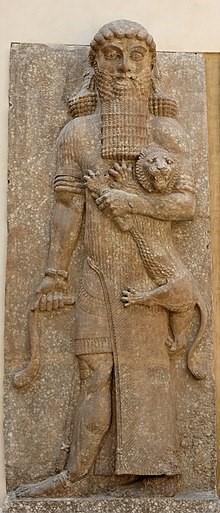
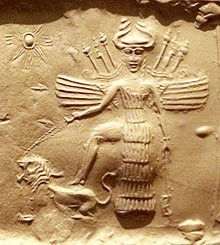
Gilgamesh is a hero, so what he does is the work of heroes. He braves perils, he slays monsters, he treats with gods and goddesses (being two thirds god himself). The Sumerian version of the epic comes down to us in five fragmentary tales on clay tablets. The later Akkadian version collects together some of these tales and includes others. The goddess Innana makes brief appearances in this epic, and becomes central to Wilson’s retelling. Innana is a seriously cool and long-lived deity. She is not only the goddess of love, but also the goddess of war, is later known as Ishtar, and survives all the way into the classical period as Aphrodite and Venus. The relationship between Gilgamesh, King of Uruk, and Innana varies from tale to tale. In Gilgamesh, Enkidu and the Netherworld Innana is Gilgamesh’s sister. By the time we get to Gilgamesh and the Bull of Heaven, she is his jealous foe, thwarted in her desire for Gilgamesh. In Wilson’s version, the two are allies and sometimes lovers, though their paths rarely cross. To be clear, it’s not that Gilgamesh lacks character. In fact, a surfeit of character is what distinguishes ancient literary figures. They do what they do because that is their character. To quote Virginia Woolf in her essay On Not Knowing Greek,
“In six pages of Proust we can find more complicated and varied emotions than in the whole of Electra. But in the Electra or in the Antigone we are impressed by something different, by something perhaps more impressive–by heroism itself, by fidelity itself. In spite of the labour and the difficulty, it is this that draws us back and back to the Greeks; the stable, the permanent, the original human being is to be found there.”
Ancient protagonists need no internal life because their motives are inscribed in their character, which, in turn, expresses archetypes rather than individual people. So Gilgamesh has emotions and traits. He starts the Epic of Gilgamesh, as a cruel and capricious ruler. The gods punish him by creating the wild man, Enkidu to humble him. The pair wrestle and Gilgamesh prevails, but they develop a bromance, setting out on adventures to prove their mettle. When Gilgamesh spurns Innana’s advances, she unleashes the Bull of Heaven against him and Enkidu. Because they slay the Bull of Heaven, one of them must die, and the gods decree the victim must be Enkidu. Gilgamesh mourns his friend, travelling into the wilderness dressed in animal skins. So far so intelligible. The proud man finds love, loses love, and is humbled by his grief. But none of this is really motivation in the modern sense. The ending of the Epic makes this clear. Gilgamesh seeks out Utnapishtim, survivor of the great flood and the only mortal men on whom the gods bestowed immorality. He wants to learn the secret of immortality. Why does he do this? Not, surely, so that his grief can endure through all the ages of Man. Rather, it’s a result of his nature: born part god, part mortal man, he seeks immortality. His quest need not be driven by any internal dialogue—it’s given in what he is.
How then does Wilson animate and flesh out Gilgamesh? Her retelling follow four main characters: Gilgamesh, Innana, Ninshubar (Innan’s vizier and a goddess herself); and Marduk (of whom more later). Wilson’s Gilgamesh is a bit of a Jack-the-lad—cheeky, cheerful, and trying his luck. But, as Wilson tells us herself, it was the desire to resuscitate Innana that motivated her. And why not, indeed? Innana is probably the great survivor among the ancient gods. Worshipped in Sumer around 4,000 BCE, she became Ishtar to the conquering Akkadians, Astarte to the Egyptians, and then Aphrodite and Venus to the Greeks and Romans. Her cult survived until around the fourth or fifth century of the current era.
Whereas Gilgamesh leaps from the page, Innana is on a slower burn, only gradually becoming herself. She starts the trilogy as a child, aware that she is the goddess of love, but not yet the goddess of war. This contradictory nature is a gift to any modern storyteller. At first, Innana is docile, sexually abused by her grandfather and then handed over as wife to an oafish husband. Relatively passive and indeed weakened after her descent into the underworld, she is dependent on Ninshubar’s help and vigilance. Only gradually does she come into herself, becoming something powerful and terrible towards the end of the second book. Ninshubar is the most exotic of the main characters, a huntress from the far south, wild and mortal-born who becomes a goddess only after being saved from death. And Marduk is the most mysterious. Pale-skinned and red-haired, he is rescued and adopted and then lost again to Ninshubar, who spends much of the first two books seeking him. He has been enslaved. But there are hints that he is much more than he seems.
It’s not all sandals and swords though. There are teasing hints of sci-fi, particularly in the underworld’s gates and the fact that it can also fly.
Gilgamesh is probably the most developed character in Wilson’s cast list. But she has other tricks up her sleeve. This is a thoroughly modern re-telling, yet it retains some of the feel of the original, with subtle nods to the Sumerian storytelling tradition. As in the original, the characters go off on quests, wandering and battling around the landscape of Sumer. And, with hints of the original, there are repeating refrains, such as Ninshubar’s “one step and then the next.”
The first book, Innana, is arguably closest to the original, incorporating several of the ancient stories. Here we get Gilgamesh’s bromance with Enkidu, and here too we get Innan’s descent into the underworld (which is the subject of a different surviving myth). The mes, which Innana steals from the god Enki in Sumerian myth, are the attributes of civilisation (positive and negative). They reappear in Wilson’s hands as mees. amulets of power. The cities and fields of ancient Sumer are there, the temples and palaces, even the smells.
By book two, Gilgamesh, great forces are in motion, devastating the lives of the humans and gods of Sumer. Sumer’s enemies overrun the city states and we learn that the gods, the Annunaki, are not the only gods in Heaven. Another, older, group of gods seek revenge on their kin. Here too, Wilson draws on antique sources, plaiting together stories that ran through Mesopotamian legend, creating a huge mythological landscape. The Enuma Elish is the earliest complete creation myth that has come down to us. In this myth, the primordial being, Tiamat, Mother of All Things, fights her grandchildren and is overthrown by her grandson, Marduk. By the end of the second of Wilson’s book, Tiamat is there and seems to have declared war on the Annunaki. My bet is that Marduk is going to slay her in the final book of the trilogy.












 Neil MacDonald Author