196. Stories need not have an inciting incident

I recently noted that at least one main novel competition was looking for stories driven by an inciting incident. An inciting incident is the event or thing that forces the protagonist to leave the status quo and which drives the rest of the story forward.

Many stories are impelled by inciting incidents. But not all. The following books have no inciting incident.

  • Virginia Woolf’s To the Lighthouse
  • Harper Lee’s To Kill a Mockingbird
  • Dostoeveksy’s Notes from the Underground
  • Gordon Lish’s Peru
  • Proust’s A La Recherche du Temps Perdu

The question now is what sets a story in motion if it lacks an inciting incident? Does it also lack change and momentum?

Let’s consider the most widely loved of the example stories, To Kill a Mockingbird. There’s certainly change and momentum as Scout grows up and learns the truth behind her father’s advice to understand other people. Particularly so as the dreadful events of the rape accusation and the trial unfold. But what drives the story is no  “call to action”  setting in motion a “quest”, or any other variant of the inciting incident. Rather,  the driver Lee uses is repeating cycles of rejection and acceptance (or defeat and recovery) at the levels both of personal behaviour and of social structures.

Part 1: Boo. Scout her brother and her friend mock the reclusive Boo Radley. He returns only kindness. Scout’s father, Atticus, tells her that she should learn to see the world through others’ eyes. When the children sneak into the Radley house, Boo’s brother shoots at them. In their flight,  Scout’s brother tears his trousers and loses them. They later find the trousers repaired and hanging on the fence.

Part 2: The Trial. When a black man is accused of raping a white woman, Atticus agrees to defend him, causing the community to shun him. The family’s black maid takes the children to her church where they are welcomed. They watch the trial from the “coloured” balcony. Though Atticus marshals evidence to disprove the charge, the all-white jury finds the accused guilty.

The aftermath: Boo again. The accused man runs and is lynched. The accuser’s father holds a grudge against Atticus and sets out for revenge. He attacks the children. Boo fights in their defence and kills the attacker. The sheriff agrees to pretend it was an accident. Scout understands her father’s advice.

Though the rape accusation is perhaps the most dramatic part of the story, raising the issue of racism. the real motif is the reclusive Boo Radley. He is mocked by Scout, her brother, and their friend at the beginning yet returns only kindness to them. By the end, when Boo saves the children, Scout learns to truly understand and respect him.

This does not make the children’s contact with Boo an inciting incident. It does not light the touchpaper to the chain of events that follow.

All the works in the list could be described as literary. So perhaps  the conclusion is that genre stories will usually (perhaps always) have an inciting incident while literary stories do not necessarily need one. I might argue that among the inciting incident’s functions is telling the reader what kind of story to expect. If there’s a body in the library, you can be sure this is a mystery. If the protagonist feels a palpitation in her bosom when a brooding stranger appears, you can be sure this is romance. In other words, inciting incidents are reassuring genre signals. But they are not necessary for a story full of change, conflict, and momentum.

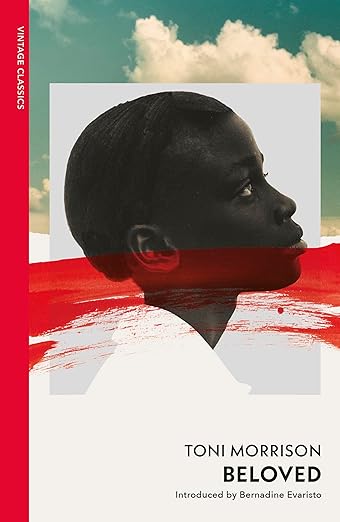
194. How did she do that? Toni Morrison’s “Beloved”

Beloved is a masterwork. It takes its inspiration from a true story of an escaped slave who killed her baby rather than let it be taken back from the north of the US to the slave south, It is a novel about slavery, yes. But more, it’s about humanity and the enduring wounds injustice inflicts. Baby Suggs, for example, reflects on the danger of loving:

“The last of [Baby Suggs’] children, whom she barely glanced at when he was born because it wasn’t worth the trouble to try to learn features you would never see change into adulthood anyway. Seven times she had done that: held a little foot; examined the fat fingertips with her own—fingers she never saw become the male or female hands a mother would recognize anywhere. She didn’t know to this day what their permanent teeth looked like; or how they held their heads when they walked.”

 And also it’s about memory. The past is not done and buried in Sethe’s world. It lives on, most particularly in the form of Beloved, who she believes is the baby she killed, and who first returns as the poltergeist that haunts her home, then as the creature  that sucks her dry.

These are strong, deeply human characters. Not just Black characters but people who show us what it means to be a person. There is, of course, the many-headed hydra of racism and the lies racists tell themselves to justify their oppression:

 “Whitepeople believed that whatever the manners, under every dark skin was a jungle. Swift unnavigable waters, swinging screaming baboons, sleeping snakes, red gums ready for their sweet white blood. In a way, he thought, they were right…. But it wasn’t the jungle blacks brought with them to this place from the other (livable) place. It was the jungle whitefolks planted in them.”

But there is also the ambiguity that is at the heart of all of us:

“Sethe learned the profound satisfaction Beloved got from storytelling. It amazed Sethe… because every mention of her past life hurt…. But, as she began telling about the earrings, she found herself wanting to, liking it”

Is there redemption in Sethe’s easing of her isolated pain? Or is it capture?

How does Morrison achieve these effects?

She does this in a variety of ways.

The existence of the past in the present is not just something Sethe asserts. It’s built into the structure of the novel with flashbacks and point of view changes that constantly braid past and present. The past, of course, is not a comforting time of fond memory, but one of humiliation and pain. Paul D’s tobacco tin of repressed memories exemplifies this:

“It was some time before he could put Alfred, Georgia, Sixo, schoolteacher, Halle, his brothers, Sethe, Mister, the taste of iron, the sight of butter, the smell of hickory, notebook paper, one by one, into the tobacco tin lodged in his chest. By the time he got to 124 nothing in this world could pry it open.”

Like Sethe, there is much about the past that is dangerous to him, Paul D’s tobacco tin is one of a number of recurring symbols. Another symbol is the whipping scar on Sethe’s back, which is described as being like a chokecherry tree. Does it symbolise the fraudulent beauty of “Sweet Home”, the place of Sethe and Paul D’s enslavement? Does it symbolise the ability of beauty to grow, even in horror? Or does it, perhaps, convey both meanings?

Biblical images and references are scattered through the story. The horsemen who come to take Sethe back to slavery are four in number. Baby Suggs’ sin of pride (if such it is) that restrains the community from warning Sethe of the coming of the four horsemen, is a huge feast that evokes the miracle of the loaves and the fishes.

And finally there is the symbol provided by Beloved herself. Dead baby, poltergeist, cunning and vengeful reincarnation. Sethe and her daughter Denver are seduced by Beloved, wanting her for themselves. Paul D is driven away by the apparition. What is she? Perhaps the burden of guilt, perhaps the desire for connection, perhaps … well you decide.

191. How are stories built?

Stories are among our oldest cultural creations. They tell us what’s important and what’s unimportant; what goes with what; who to praise and who to blame.

Stories are different from real-life events. Real life is lived forwards with unknowable endings, whereas the meaning of stories is inferred backwards: stories are about events in the light of their endings. A good ending, it is said, should have the effect of being inevitable and yet surprising.

Character

We may be intrigued by plot, but it is characters we fall in love with. In many ways, character is at the heart of storytelling. When you have a character with a want, you already have the beginnings of a plot. When you have another character with an opposing want, you have drama.

Authors create characters in many ways. By far the most common, and the least interesting is to resort to archetypes.  There are many different notions of who the archetypal characters are, but what they all have in common is the reassurance that we already know everything about them. They will not surprise us.

Better, much better, is a full, rich, complex, and contradictory character. Such characters create the illusion of being real people. Though, as Nobel Prize winning author Orhan Pamuk argues, real people do not have as much character as is found in novels.

Plot and story

Some definitions are advisable here. A story and a plot are different things. Plot is the time sequence of events, their causes and effects. But the plot may be told in different ways. If the events of a plot are A, B, C and D, they may be told in this order.

But they may also  be told out of time sequence. For example, the telling may begin with C and then flash back to A and B before revealing the dénouement at D.

Plot is the time sequence of events. Story is the way those events are recounted. A poor plot can be saved by clever storytelling.

Of course, the telling of a story is much more than this. Vocabulary, sentence structure, pacing, voice, and many other things go into the making of a story.

Narrative

A third definition, in addition to plot and story, may be important. I will call this narrative, to distinguish it from the first two. A narrative exists when it leaves the author’s head and enters the heads of readers or listeners. The reception of the tale is simple  passive process. The listener or reader actively collaborates in imagining the setting, the characters, their actions and what these all mean. There are as many narrative variants of a single story as there are listeners. Some of these variants may be significantly different from the author’s intention.

An author may say that they can’t control how an audience responds to their work. And that is true. But an author can anticipate some likely responses and misunderstandings.

Layers, Symbols and Meaning

Layering refers to the hidden depths of a story. This depth can make all the difference between a work that chugs along satisfactorily and one that stays in the reader’s memory for long after the last page is turned. There are different kinds of layers. For simplicity, I’ll categorise them into three types:

  • Story layers. A layered story has more than one plotline. For example, Elif Shafak’s ambitious novel There are Rivers in the Sky attempts to braid three timelines: ancient Mesopotamia, Victorian London, and the present day. She does this by alternating chapters. Of course, in the end, a story of this type must bring all the subplots together at the end. To repeat, stories are events in the light of their endings.
  • Character layers. In modern Western writing, the plot is generally driven by the protagonist’s desire for something (their want). More interesting and deeply-crafted characters have layered depths though. Often, the protagonist’s want may be in conflict with their true need. Katiniss in Suzanne Collins’ The Hunger Games, for example, wants to win the Games at any cost, but what she truly needs is to learn to sacrifice herself to preserve her own autonomy. The reader’s experience of redemption comes from the protagonist recognising what their true need is and finding completion.
  • Symbolic layers. This is perhaps the most literary of the layering types. The things that happen on the surface have an additional symbolic meaning. The trick of authors who do this well is not to hit the reader over the head with the meaning, but rather to allow them to find the meaning themselves. Once found, this meaning illuminates the whole story. A classic example here is the theme of unachievability in F Scott Fitzgerald’s The Great Gatsby. Many elements are knitted together to underscore this theme. There is, of course, Gatsby’s unrequited love for Daisy, the endless parade of motor cars, and the recurring symbol of the green light across the bay. Fitzgerald intends this symbolic layer to capture the destruction of the American Dream.

Putting together a story

Characters with multiple dimensions. Stories that achieve the most intriguing telling of their plot. Tales that carry layers of meaning, making the story resonate with deeper issues. These are the elements of good story-telling, stories that can make their way into the world as narratives which reverberate with the sympathy and questioning for readers.

190. What is the oldest story? Part 2: The contribution of archaeology

A previous post looked at techniques borrowed from biology to reconstruct ancients stories. If biological analogies are suspect, can archaeology perhaps provide clues?  The picture below is taken from an 11,000 year-old wall in a communal enclosure at the Neolithic settlement of Sayburç in Türkiye.

Does this represent an 11,000 year-old story? According to the discoverer, yes[1].The frieze occurs on a bench 60-80 cm high and 60 cm wide. The whole thing is 3.7 m long, Two humans, two leopards, and a bull are depicted side by side in a long scene, or a set of two scenes. Among the reasons for suggesting that this is a story is that all the figures, animal and human, are on one horizontal level. Other carvings from this culture, such as the T-pillars at Göbekli Tepe, have a vertical relationship between human and animal, The orientation of the figures from two main sections is like the panels from a comic strip or like bible scenes from a church mural.

The one on the right is the most striking at first glance, with a man standing in the centre and a leopard facing him on either side. Unlike the others, this male figure is rendered in high relief and does not face either of the leopards, but looks straight ahead into space, indicating perhaps that he is not threatened. The figure is depicted in a seated position, holding his phallus with his right hand. He wears a triangular neck adornment similar to those seen on the Yeni Mahalle sculpture (also known as Urfa man) and on some T-pillars from Göbekli Tepe. The leopards on either side of him are depicted in a state of attack, with their forelegs slightly raised, their mouths open and their teeth visible.

The panel on the left is a man with his back to the leopard scene and a bull, head down, opposite him. The man is shown in a slightly crouched position and motion. His arms are raised and bent at the elbow. In his open left hand, six fingers can be counted, while in his right hand, he holds something that has been variously interpreted as a sling, an inverted snake, or a rattle.

The bull facing him is shown in an attacking position, like the leopards, with its front legs slightly raised. Though the body of the bull is depicted side-on, its head and dangerous horns are shown from above. The man may be recoiling from the bull or perhaps preparing to leap onto it. One of the main features of the Sayburç reliefs is that the movement is just as important as the figures which suggests that events are as prominent as figures, whether human or animal.

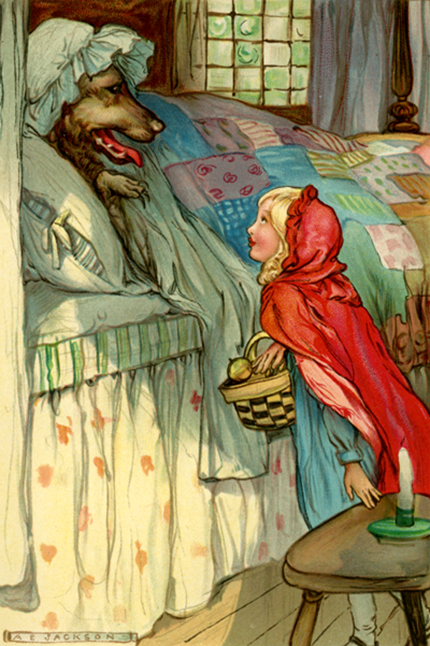
People at the time would undoubtedly have recognised the figures and what was happening, much as we would instantly recognise the story of Little Red Riding Hood from the single image below. Today, we can only speculate.  

Phalluses are the only elements that identify the sex of the Sayburç  figures, and the emphasis is on the predatory and aggressive features of the animal world, such as teeth and horns, which has also been observed at other sites in the area. The Sayburç reliefs, however, differ in that the figures can be interpreted as forming a narrative, with the two individual scenes appearing to be related to each other as scenes in a story or set of stories. The comparable stature of men and animals in the Sayburç relief may suggest a new dimension recognised in the narratives of pre-Ceramic Neolithic people.

Again, the claim that these scenes form a story can be questioned. What really Is the evidence? That the relationship between the figures are arranged horizontally, rather than vertically? Well, they are inscribed into a horizontal feature, a bench, so a vertical arrangement was not possible. That the figures are shown, dynamically, in motion? The same might be said of the birds from pillar 43 in nearby Göbekli Tepe, one possibly playing with a  human head.

Features of the panels

  • The animals (leopards and a bull) are wild and savage
  • Both humans are male
  • The high relief human figure on the right between the leopards is different from the crouching human on the left.
    • The high relief may signal a different status to the other human
    • He is not perturbed by, or even interacting with, the leopards. Is he in control of them (a Master of Animals)? Note, however, that he in not resting his hands on the animals as in other depictions of Masters of Animals). In some myths, the Master of Animals controls the game animals, releasing a few to humans as food
    • He wears a V-shaped neck adornment, a motif also found at Göbekli Tepe, and on Urfa Man and a similar statue at Karahan Tepe.  Martin Sweatman (2022)[2] interprets this symbol as representing a lunar month and the V necklace as indicating controller of time, but this interpretation is highly contested.
  • The Master of Animals figure is not the centre of the story. He is rendered as nothing other than  his status. It is the other figure who is in motion and individualised with six fingers and s held object. The object may be a sling (is he therefore hunting?) or perhaps an inverted snake (similar to the Gilgamesh carving above) or a rattle.
    • If he is the centre of the story, it seems plausible to suggest that he has come into conflict with the Master of Animals or the proper behaviour the Master represents. Perhaps he has failed to engage in the correct rites before the hunt and now is alone, confronted by the bull.
    • If so, how this story ended might depend on the location in which it is graved. What was this enclosure for? The enclosure has still only been partly excavated. But other sites. such as Göbekli Tepe, have been more fully explored. There is much debate about the function of the large enclosures there: sanctuaries, cultic centres, communal houses?. If these enclosures were spiritual in purpose, the role of the story might have been to underscore what was fitting to do. If they were domestic or recreational, the story might have been more mischievous. In all probability, these societies did not make a distinction between the sacred and the profane.
    • So, perhaps an interpretation of the story, if there is a story, might be something as follows.

A man desires to hunt for meat, but, being impatient, sets out without consulting the Master of Animals. [This is a serious violation of the natural order. It is the role of the Master of Animals to ascertain where the herds are and to propitiate their spirits before any hunt]. The man is a giant, with six fingers on each hand and six toes on each foot and believes he can do just as he wishes.

The man treks all day, finding only a rabbit. Though he is after bigger game, he is hungry and brings the rabbit down with his sling. He skins the animal and skewers it over the fire to cook. Tired, he finds his eyes closing, and leaves his arse to guard his prize. While he is asleep, foxes come and steal the cooking coney. When the man awakes and finds the bounty gone, he is furious. “I left you to guard the rabbit while I slept,” he says, “and now look what’s happened. I’ll teach you.” He grasps a burning log from the fire and rams it into his bottom. The pain is intense. “What?” he cries, “Must I bear your punishment too?”

The man proceeds gingerly on his way.  The Master of Animals sends a deer into his path. “I am yours,” says the deer to the man. Haughtily, he replies, “Though your antlers are magnificent, I am after more dangerous game than you.” So the Master of Animals has a ferocious boar stray into the man’s path. “I am yours, if you have the courage,” says the boar. The man strokes his great chin, “It is true your tusks are sharp and deadly,” the man says, “but I am after bigger game than you, something that can feed my whole clan.”

So, the Master of Animals decides to teach the man a lesson and sends a huge aurochs, taller than two men standing on each other’s shoulders, charging at him. “Ho, man,” says the bull, lowering his horns, “what do you think you are doing, walking the hills armed only with a sling?” The giant bull charges, forcing the man to jump out of its way at the last moment, narrowly avoiding being gored. At the next charge, the man cries out in alarm, “Oh save me, for I will surely die.”

The Master of Animals takes pity, summoning the spirits of the sky to lift hunter and beast up into the heavens, where they still confront each other today.

This story is built on three elements. The first is the analysis above of the carving, which provides the set-up of the tale. The second, to add scatological humour that might have been expected around the night fires, is the theft of the rabbit and the burning stick from the fire. This element has been borrowed from the North American Crow myth cycle. The third element, the intervention of the Master of Animals to save the man by transforming him and the bull into constellations, is, of course, the Cosmic Hunt, described above. This provides a satisfactory ending.  It is all entirely speculative.


[1] https://www.cambridge.org/core/journals/antiquity/article/sayburc-reliefs-a-narrative-scene-from-the-neolithic/3A35B54B3265C7224CB225FE70EBDD02

[2] https://www.tandfonline.com/doi/full/10.1080/1751696X.2024.2373876#abstract

187 How did he do that? “Sunset Song”

Sunset Song by Lewis Grassic Gibbon is, in my view, one of the great books of the twentieth century. Re-reading it now, I am struck by how achingly beautiful and how angry it is, and by how cleverly it is constructed.

“She walked weeping then, stricken and frightened because of that knowledge that had come on her, she could never leave it, this life of toiling days and the needs of beasts and the smoke of wood fires and the air that stung your throat so acrid, Autumn and Spring, she was bound and held as though they had prisoned her here. And her fine bit plannings!–they’d been just the dreamings of a child over toys it lacked, toys that would never content it when it heard the smore of a storm or the cry of sheep on the moors or smelt the pringling smell of a new-ploughed park under the drive of a coulter.”

If it has any parallel in it picture of the bustling small life of the folk of Kinraddie, it can only be Dylan Thomas’ Under Milk Wood.

Themes

Above all, the theme is the land. The land which abides when all the folk who till it are dead and gone. Both the prelude and the epilude which bracket the book have the same title, “The Unfurrowed Field”,  representing the unworked land. The book is a lyrical, brawling, angry and tormented paean to the dying age of the Scots peasant. And here too is a theme: of change and changelessness.

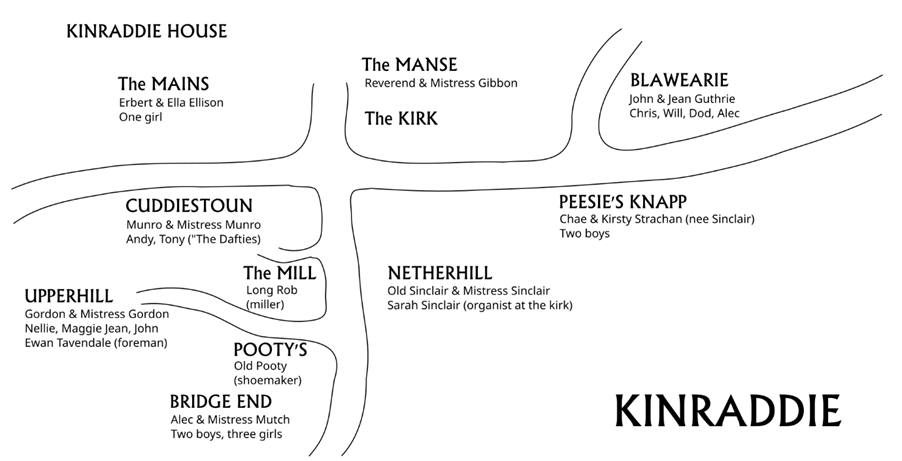
The protagonist, Chris Guthrie is herself the land (or perhaps all of Scotland).  In Chapter 1, Ploughing, she is new ploughed for the immense changes that are coming. All the chapter titles represent the cycle of the growing season and the maturation of Chris. Chapter 2 is Drilling (in which her mother commits suicide and her abusive father is stricken with paralysis). Chapter 3, Seed Time, sees Chris’ father die and her inherit the croft. She marries Ewan. In Chapter Four, Harvest, Chris gives birth, Ewan leaves Chris after an unresolved argument to soldier in the First World War, where he is shot as a deserter. Many of the chapters open and close with Chris at the ancient standing stones, a symbol of deep time that brings Chris peace.

There is the theme of ambiguity. Chris is continually loving and hating things, afraid and intrigued. This replicates the author’s ambivalent feelings towards the birthplace he shunned.

And there is also the theme of social justice, a thrumming disdain for those who put on airs or who exploit others.

“Maybe there were some twenty to thirty holdings in all, the crofters dour folk of the old Pict stock, they had no history, common folk, and ill-reared their biggins clustered and chaved amid the long, sloping fields. The leases were one-year, two-year, you worked from the blink of the day you were breeked to the flicker of the night they shrouded you, and the dirt of gentry sat and ate up your rents but you were as good as they were.”

Humour

None of this makes it a dour book. It is full of humanity and the bantering humour of the dying crofter folk.

“John Guthrie himself got a gun, a second-hand thing he picked up in Stonehaven, a muzzleloader it was, and as he went by the Mill on the way to Blawearie Long Rob came out and saw it and cried Ay, man, I didn’t mind you were a veteran of the ’45. And father cried Losh, Rob, were you cheating folk at your Mill even then? for sometimes he could take a bit joke, except with his family.”

The author’s craft

Grassic Gibbon uses several devices to achieve his effect. The main one is, undoubtedly, the use of the Doric Scots dialect of the northeast. In his hands, there is nothing of Walter Scott’s invention of a romantic Scotland. It is the real people of Scotland we hear, small minded, big-hearted, dreaming and dying. The language, of course, has a sad and lyrical music to it. And it also creates the illusion that we are part of a gossipy chat around a fireside, the true stream of consciousness of the narrators. This effect is strengthened by summary sentences that end many sections which begin “So that was how ….”

There are three narrators: an unnamed voice, Chris Guthrie herself, and Greek chorus of the whole gossiping community. And the telling uses a combination of first, second and third person. The use of the second person augments the conversational and confessional nature of the read: Chris is telling us how she feels and acts.

Deep time is another of his devices, creating the sense that this brief flickering and dying of the light of his cast of characters is part of a longer story of constant change. The Prelude sketches a huge antiquity that links Cospetric and his slaying of the gryphon through all the ages of Scotland from William Wallace’s rebellion against English occupation, through the Reformation and French Revolution and finally the clearances and on to the coming of John Guthrie and his family to the croft at Blawearie. And older still are the standing stones by the loch, the place of peace and safety to which Chris repairs in times of turmoil. Many of the chapters open and close at the standing stones.

A lyricism of nature pervades the detail of all the writing, with the call of the birds, the smell of the new-ploughed earth and the feel of the snow and the wind.

Grassic Gibbon frequently makes use of repetition:

“As the gnomons of a giant dial the shadows of the Standing Stones crept into the east, snipe called and called”

The effect of the repeated words is, at once, powerfully poetic and reassuringly conversational.

Character

 The central character is Chris. And an extraordinary character she is, for a male author to have had such insight into the life and dreams and fears of a woman. Chris is strong and determined and fearful and doubting. The book opens with her dreaming of becoming a teacher. But this Chris fades and dies. She thinks of this one as the English Chris. When her mother commits suicide she becomes the second Chris, the Scots Chris of the land who must tend to the house. Released by the death of her sour and abusive father, the third Chris is claimed by that coarse tink Ewan Tavendale:

“He looked over young for the coarse, dour brute folk said he was, like a wild cat, strong and  quick, she half-liked his face and half-hated it”

Ewan loves and marries her and then, gone for a soldier in the First World War, returns and ill uses her before being shot as a deserter. Though there is love, it is a love as clear-sighted and hard-headed as the folk of Kinraddie.

Vivien Heilbron as Chris and James Grant as Ewan in the BBC television series

“She felt neither gladness nor pain, only dazed, as though running in the fields with Ewan she had struck against a great stone, body and legs and arms, and lay stunned and bruised, the running and the fine crying in the sweet air still on about her, Ewan running free and careless still not knowing or heeding the thing she had met. The days of love and holidaying and the foolishness of kisses–they might be for him yet but never the same for her, dreams were fulfilled and their days put by, the hills climbed still to sunset but her heart might climb with them never again and long for to-morrow, the night still her own. No night would she ever be her own again, in her body the seed of that pleasure she had sown with Ewan burgeoning and growing, dark, in the warmth below her heart. And Chris Guthrie crept out from the place below the beech trees where Chris Tavendale lay and went wandering off into the waiting quiet of the afternoon, Chris Tavendale heard her go, and she came back to Blawearie never again.

… Turning to look at him, suddenly Chris knew that she hated him, standing there with the health in his face, clear of eyes–every day they grew clearer here in the parks he loved and thought of noon, morning and night; that, and the tending to beasts and the grooming of horses, herself to warm him at night and set him his meat by day. What are you glowering for? he asked, and she spoke then at last, calmly and thinly, For God’s sake don’t deave me. Must you aye be an old wife and come trailing after me wherever I go?

None of these Chrises are offered by the widow Chris Tavendale to her new husband, the Reverend Robert Colquohoun, who spirits her from Kinraddie and into the next book of the trilogy, Cloud Howe.

Though Colquohoun appears in the book only at the end, it is his voice, giving the dedication to the fallen of the place,  that words Grassic Gibbon’s meaning.

Nothing, it has been said, is true but change, nothing abides, and here in Kinraddie where we watch the building of those little prides and those little fortunes on the ruins of the little farms we must give heed that these also do not abide, that a new spirit shall come to the land with the greater herd and the great machines.

For greed of place and possession and great estate those four had little head, the kindness of friends and the warmth of toil and the peace of rest–they asked no more from God or man, and no less would they endure.

So, lest we shame them, let us believe that the new oppressions and foolish greeds are no more than mists that pass. They died for a world that is past, these men, but they did not die for this that we seem to inherit. Beyond it and us there shines a greater hope and a newer world, undreamt when these four died. But need we doubt which side the battle they would range themselves did they live to-day, need we doubt the answer they cry to us even now, the four of them, from the places of the sunset?”

It is a testament to the greatness of the book that I find myself dreaming in Kinraddie, and its rich vocabulary coming, unsummoned, to my tongue. And the word that comes to mind is “blithe”. It’s a blithe book and no mistake.

186. Negotiating the publishing minefield: what are the odds of success?

What are the chances your book will be a success? I looked into the numbers.

There are around eight billion people in the world. Around 4 million books are published every year (both traditionally and self-published and including all formats).

How common is it to write a book?

Of course, some authors release more than one book and some books are reissues of dead authors, but the number means roughly one person in two thousand writes a book . Only 3% of people who set out to write a book finish it. Less than one person in a thousand ever writes a book. If you’re writing one, your pool of competition is down to 4 million other people.

What proportion of books get published?

Between 1 and 2% of submitted manuscripts get traditionally published.

How many can you expect to sell?

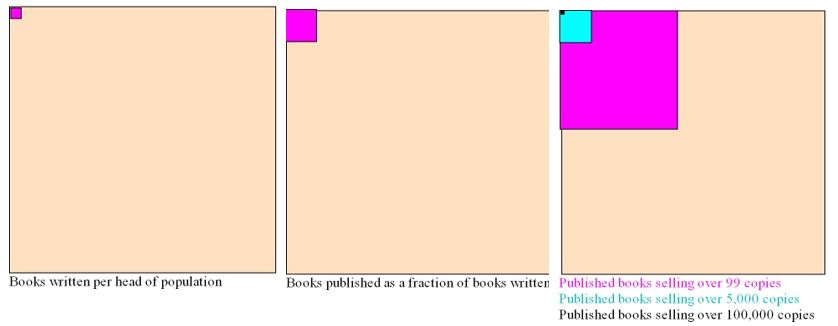
in 2004, 950,000 titles out of the 1.2 million tracked by Nielsen Bookscan sold fewer than 99 copies. Another 200,000 sold fewer than 1,000 copies. Only 25,000 sold more than 5,000 copies. This is the general rule of thumb for success in publishing. And only a miniscule 500 titles sold over 100,000 copies (the little black dot in the top left corner).

So,

  • the odds of you writing a book are 0.5%-1% of the whole world’s population. Around 8 million people have written a book.
  • The odds of your book being traditionally published are around 1.5% of all submitted manuscripts.
  • The odds of your book selling more than 5,000 copies are around 2% of all published books, and of selling more than 100,000 copies are 0.004%.

185. Spines: Would you trust a robot to craft your book?

Would you trust an AI to edit and produce your book?

Spines is, in the spirit of the tech bros, a disrupter. It describes its mission on its website as “Harnessing the power of cutting-edge AI, Spines revolutionises every facet of the publishing journey, including proofreading, formatting, cover design, distribution, and marketing across all major channels and platforms.” They aim to cut, from months to weeks, the process of producing a book.

What exactly do they offer? They deny that are a vanity publisher or self-publishing service, but, of course, that is exactly what they are. What is different is the automation. The Israeli start-up plans to produce 8,000 books this year.

Predictably, the community of authors and publishers have been scathing in their criticism. “These aren’t people who care about books or reading or anything remotely related,” said author Suyi Davies Okungbowa. “These are opportunists and extractive capitalists.”

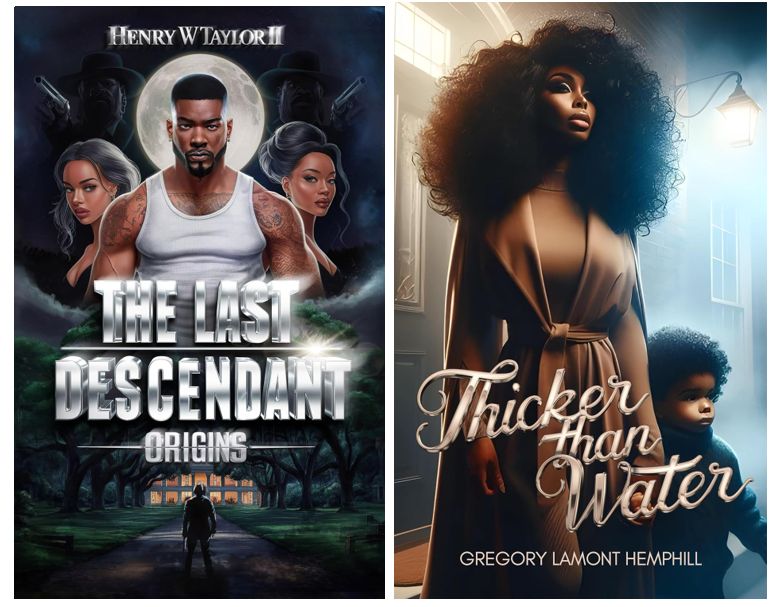
So what does the customer get? Oddly, for a publisher, they don’t list their books on their website. To find their books I had to go here. I examined a sample of 18 of these books

What do they charge?

        Authors are charged between $1,824 and $5,496 for a print on demand service. By comparison, an established self-publisher, Troubador, charges £600 (about $730) to produce an e-book and £2,295 (around $2,800) for 200 printed copies. So Spines are not offering significant cost savings for cutting out human labour.

        How well are their books selling?

        To estimate the sales of these 18 books, I converted the Amazon Book Sales Rank into numbers of books using TCK’s calculator. On average, the sample sold 1.29 books a month. Six of them sold none at all and the largest sales were 4 a month.

        The books are also not attracting a lot of marketing attention. On average, these books received 4.29 review.

        How good is the production quality?

        To assess this, I looked at the cover designs for the two fiction books in my sample. Design is, of course, an art, not a science. Personally, I found the covers stereotyped and banal, but I am not the target readership. Since I am assessing AI publishing, I gave two AIs a crack at the cover analysis. Both were assessed as high quality by Joel books. The Last Descendant got a rating of B from ebookfairs, while Thicker than Water got a C.

        How well are the books edited?

        This is the acid quality test of the hyped AI tools. A careful editor and proof-reader will ensure that the text is free of errors and that the words flow, as well as paying attention to structure and consistency. I examined only The Last Descendant, and only the first paragraph and the cover blurb. The cover blurb has one spelling mistake. The first paragraph contained six grammar mistakes, ranging from unnecessary commas, overuse of two words and one confused word. Judge for yourself:

        “The vibrant atmosphere of the office holiday party at 12 Greenway Plaza in Houston, TX, enveloped Jason as he moved through the crowd. Laughter, music, and the aroma of LES BBQ, filled the air, creating a festive ambiance. Surrounded by employees, Jason basked in the joy of the season, drink in hand, and the sounds of celebration surrounded him. Jason Martinez was a man who knew how to make an impression. His brown skin and muscular frame contrasted with his crisp white shirt and black pants, giving him an air of confidence and authority. His face was framed by a neat and lined-up barbarian-style beard, which added a touch of ruggedness to his handsome features. His eyes sparkled with intelligence and ambition, and his smile was charming and persuasive. On his right hand, he wore a Bochic Burma ring, a stunning piece of jewelry that featured a single ruby encrusted in diamonds. The ring was a symbol of his success and power, as well as his taste and style. Jason was a man who had everything he wanted, and was not afraid to show it.”

        The spelling and grammar mistakes aside, this opening paragraph has several problems. Sentence variety is low with little variation in length and structure. There is no character complexity—Jason is simply handsome, rich, and powerful. There is, as yet, no tension or plot to engage the reader, simply a character description, making for a slow-paced read. The description is all told by the narrator, rather than shown in Jason’s actions or thoughts.

        Conclusion

        Going with Spines is not cheap, offers no marketing support, and the editing is noticeable by its absence.

        183. Show, don’t tell is flawed advice

        ‘Don’t tell me the moon is shining. Show me the glint of light on broken glass,’ Anton Chekhov is said to have advised.

        Don’t Show, Don’t Tell

        The rise of the “show, don’t tell” advice coincides, or maybe not entirely coincidentally, with the rise of the movies. It can be dated to the 1920s and Percy Lubock’s book, The Craft of Fiction. Perhaps readers, glutted on the new moving pictures, demanded to see the story rather than hear it.

        You can, of course, find examples of “showing” before this time. But, in general, stories were told rather than shown. Narration tended to be in the “omniscient” mode, as if by a god who saw all and who could peer into character’s souls. Take a look at some of the classics. The legend of Gilgamesh: telling. Beowulf: telling. The Icelandic sagas: telling. The Iliad and the Odyssey: telling. Characters had no interiority because what they felt was of no importance. It was what they did that mattered. This only began slowly to change in the 12th century.

        Two things flow from this. Firstly, telling has a venerable history and is NOT wrong. Secondly, audiences today want immersion in the lives of their protagonists, and, therefore, some showing is now normal. If there is a rule, it is not “show, don’t tell” it is “show, when appropriate, and tell, when appropriate.”

        Knowing when to use the one and when to use the other is a matter of practice and experience. There are no simple algorithms to determine this, but here are some likely instances (though there will be counter-examples for all of them) where you’d want to tell, not show:

        • Dialogue (because most dialogue is unembellished reportage)
        • Backstory
        • Where you want to convey necessary information without making it slow the flow
        • In the transition between settings
        • When you want to highlight something significant
        • When you want to balance other passages of showing

        Narrative distance

        The idea of narrative distance provides a more fine-grained distinction than the all-or-nothing “show, don’t tell.” Narrative distance refers to what  it sounds like: how close we are to the character’s thoughts and feelings. In first person, we are almost always right inside the character’s head. But in third person, the distance can be subtly varied by word choice and by what is focused on and what is omitted.

        Consider these examples:

        • A tall man stepped out from the shadows. (Straight telling).
        • The rain lashed down on the tall man as he stepped from the shadows. (Telling but with a bit of atmospheric detail).
        • Henry pulled his collar up against the rain as he stepped from the shadows. (We know his name and we’re much closer to the character now, getting  a sense of his discomfort).
        • Bloody hell, would this weather never stop? Drenched to the skin, Henry stepped from the shadows, morosely pulling up his collar against the lashing rain. (Lots of showing, We’re right in the character’s sensations and mood now, though still imbedded in third person narration. This is known as “free indirect discourse”, where the character’s mentality appears within the narration without the use of speech or thought tags—there is no “he thought” or “he said”).

        Note that moving down the scale from telling to showing, decreasing the “narrative distance”, tends to elongate things. This is obvious, because we’re adding more detail and emotion.