Would you trust an AI to edit and produce your book?
Spines is, in the spirit of the tech bros, a disrupter. It describes its mission on its website as “Harnessing the power of cutting-edge AI, Spines revolutionises every facet of the publishing journey, including proofreading, formatting, cover design, distribution, and marketing across all major channels and platforms.” They aim to cut, from months to weeks, the process of producing a book.
What exactly do they offer? They deny that are a vanity publisher or self-publishing service, but, of course, that is exactly what they are. What is different is the automation. The Israeli start-up plans to produce 8,000 books this year.
Predictably, the community of authors and publishers have been scathing in their criticism. “These aren’t people who care about books or reading or anything remotely related,” said author Suyi Davies Okungbowa. “These are opportunists and extractive capitalists.”
So what does the customer get? Oddly, for a publisher, they don’t list their books on their website. To find their books I had to go here. I examined a sample of 18 of these books
What do they charge?
Authors are charged between $1,824 and $5,496 for a print on demand service. By comparison, an established self-publisher, Troubador, charges £600 (about $730) to produce an e-book and £2,295 (around $2,800) for 200 printed copies. So Spines are not offering significant cost savings for cutting out human labour.
How well are their books selling?
To estimate the sales of these 18 books, I converted the Amazon Book Sales Rank into numbers of books using TCK’s calculator. On average, the sample sold 1.29 books a month. Six of them sold none at all and the largest sales were 4 a month.
The books are also not attracting a lot of marketing attention. On average, these books received 4.29 review.
How good is the production quality?
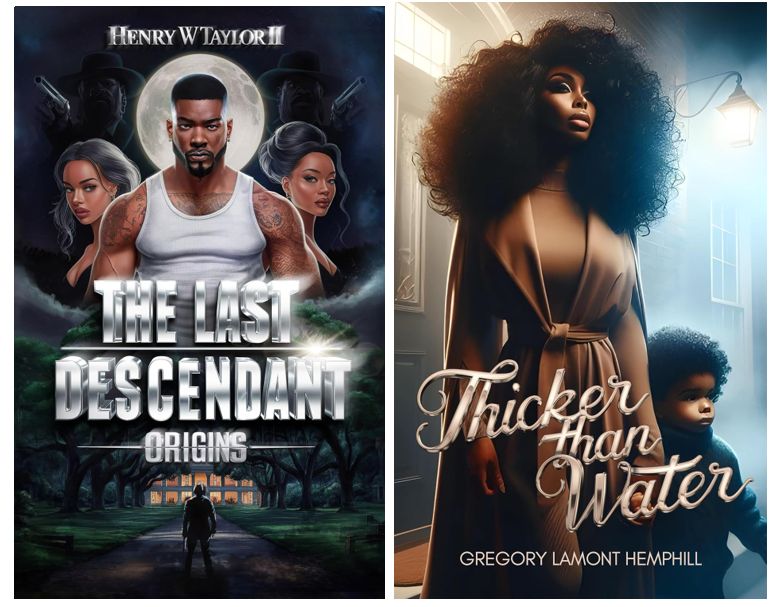
To assess this, I looked at the cover designs for the two fiction books in my sample. Design is, of course, an art, not a science. Personally, I found the covers stereotyped and banal, but I am not the target readership. Since I am assessing AI publishing, I gave two AIs a crack at the cover analysis. Both were assessed as high quality by Joel books. The Last Descendant got a rating of B from ebookfairs, while Thicker than Water got a C.
How well are the books edited?
This is the acid quality test of the hyped AI tools. A careful editor and proof-reader will ensure that the text is free of errors and that the words flow, as well as paying attention to structure and consistency. I examined only The Last Descendant, and only the first paragraph and the cover blurb. The cover blurb has one spelling mistake. The first paragraph contained six grammar mistakes, ranging from unnecessary commas, overuse of two words and one confused word. Judge for yourself:
“The vibrant atmosphere of the office holiday party at 12 Greenway Plaza in Houston, TX, enveloped Jason as he moved through the crowd. Laughter, music, and the aroma of LES BBQ, filled the air, creating a festive ambiance. Surrounded by employees, Jason basked in the joy of the season, drink in hand, and the sounds of celebration surrounded him. Jason Martinez was a man who knew how to make an impression. His brown skin and muscular frame contrasted with his crisp white shirt and black pants, giving him an air of confidence and authority. His face was framed by a neat and lined-up barbarian-style beard, which added a touch of ruggedness to his handsome features. His eyes sparkled with intelligence and ambition, and his smile was charming and persuasive. On his right hand, he wore a Bochic Burma ring, a stunning piece of jewelry that featured a single ruby encrusted in diamonds. The ring was a symbol of his success and power, as well as his taste and style. Jason was a man who had everything he wanted, and was not afraid to show it.”
The spelling and grammar mistakes aside, this opening paragraph has several problems. Sentence variety is low with little variation in length and structure. There is no character complexity—Jason is simply handsome, rich, and powerful. There is, as yet, no tension or plot to engage the reader, simply a character description, making for a slow-paced read. The description is all told by the narrator, rather than shown in Jason’s actions or thoughts.
Conclusion
Going with Spines is not cheap, offers no marketing support, and the editing is noticeable by its absence.




 Neil MacDonald Author