

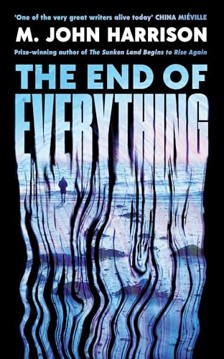
The End of Everything is a haunting tale of a genteel apocalypse. An alien species, the iGhetti have invaded, creating a catastrophe. A war continues, confined entirely to the financial district of London. On the Kent coast of England, people are muddling through. Phillip Tennant survives by beachcombing the iGhetti artefacts that wash up on the shore, reminiscent of The Picnic by the Strugatsky brothers. His aunt, Marnie, is a retired artist who plunders supplies from the abandoned holiday cottages. She’s confused and sweet, if occasionally murderous. Many people have set sail towards the shrouding mist in the hope that the Continent still exists and will offer sanctuary. Through it all, there’s a very British ethos of “Keep Calm and Carry On.”
The novel was longlisted for the Booker Prize 2026. This is no mean feat for a science fiction novel. What does it all mean? You decide. For me, it’s a baroque reflection on fallible human nature.
More tangibly, how does Harrison create his effects? First, the aliens. We meet them only at the end of the book, where they’re described as follows:
“Looking north, she made out a single vast procession of the iGhetti, towering above the houses of Catford, Lewisham and Blackheath, moving east towards the sea—sometimes like the pure white plums of a phosphorous explosion, sometimes like great glittering chandeliers.”
Up to this point, we haven’t been clear what they were, or even if they existed at all. Harrison achieves this by offering tantalising snippets of conflicting rumour:
“Competing authorities associated the iGhetti with dark matter or with the banking crisis of the late 2000s, while others believed it to be less an invasion than a ‘re-enchantment of the world’, a process of spiritual tourism and gentrification pursued by advanced civilisations from a mooted ninth planet. More popularly, they were seen as having ‘come out of the internet… The Truth was simpler. They had leaked into our world long before, from the astral plane’.”
Second, Harrisson creates a malleable and unsettling world, where things don’t remain stable but can transform. The biological artefacts that Phillip harvests gradually become doppelgangers of their owners. And here, in a memorable passage, there’s a murmuration of pensioners:
“Too soon it was the hour of the soft warm light just before dinner, when the tourists take their drinks on to the balcony so they can sit and watch the ghosts of old men drawn out to sea, released from the mysterious dawn-to-dusk confinement of their commemorative benches along the north shore, to rise until they face out towards the lost continent. They arrive in ones and twos at first, unsteady-looking, balancing infirmly in the air, then suddenly there are hundreds, perhaps thousands of them rising from the warped mouldy slats and mysteriously folded ironwork of all the other benches in all the other towns of the Henry the Eighth Heritage Trail, and they’re driven out to sea until they’ve lost all individuality and they go wheeling through the characteristic yet unpredictable swings, the sudden folds, and recursive figures of the murmuration.”

