

Can systems reproduce what a genius does intuitively? I’m a sucker for the idea, and every now and again I take a look at a new writing method. I usually end up disappointed.
There are many systems for constructing, analysing and editing stories. The most elaborate are the Snowflake method, the Scene and Sequel method and the Story Grid.
There are also methods based on templates, such as the Hero’s Journey and the Contour software suite .
I’ve covered the Scene–Sequel method in a previous post . In this post I’ll look at Story Grid.
Why a system?
Systems are seductive. They carry the promise that anyone can copy the skills of craft masters by following a step-by-step recipe. In the business world, the equivalents are the strategic planning methods which claim to turn the mental processes of successful entrepreneurs into guides that the averagely gifted executive can follow. And so it is with story systems.
Story Grid
Story Grid is at pains to say that it’s an analytical tool, not a recipe. It derives from the editing process of identifying problems and fixing them, rather than from the writing process. The method rests on two elements: an analysis of genre and of scenes. It also includes a useful template for analysing the entire arc in a single page (the Foolscap summary originally developed by Norm Stahl).
Story Grid and genre
The first question Story Grid asks about a work is “What is the genre?” The second question is “What are the conventions and obligatory scenes for that genre?”
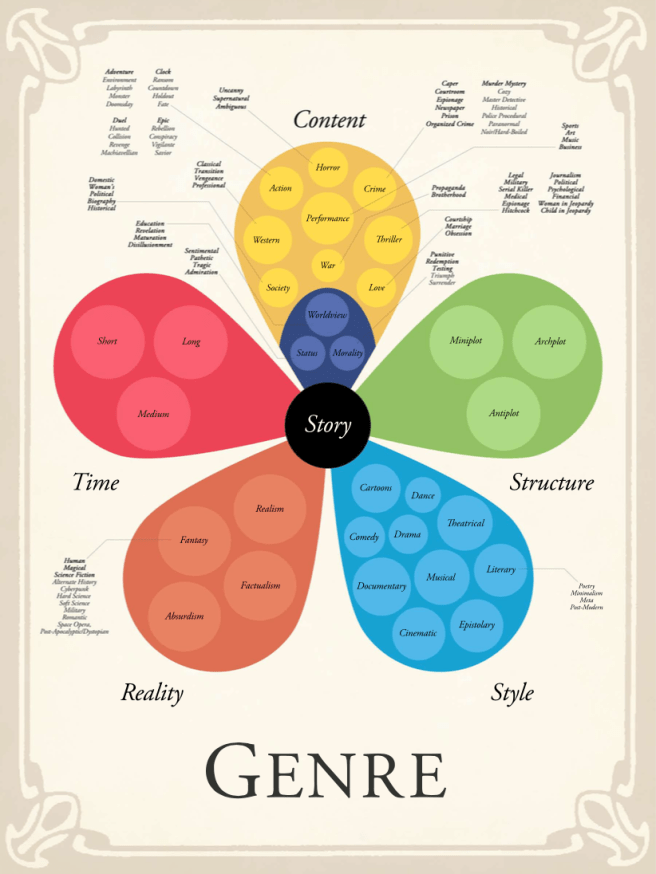
Their notion of genre is a little different from normal. When we think of genres we normally mean Westerns, Thrillers, Romance and so on. Those categories, which it calls Content, are there in Story Grid. But there are four other categories too—Reality, Style, Structure and Time.
Rather oddly, Science Fiction and Fantasy, which most readers would consider to be Content genres along with Romance and Thrillers, are part of the Reality category. This troubles me. The Content category also includes elements you won’t find as part of the shelving classification in your bookshop—Society, Performance, Status, Worldview, and Morality.
In part, this is because of a rather interesting idea about what content genres are. Each is related to a different human need. Some social theories postulate that human needs follow a hierarchy from the physical requirement for food, water, air and shelter to more spiritual goals like self-actualisation. When we’ve met our physical needs, safety becomes important. When we can assure our safety, we seek love, and so on. Story Grid attempts to relate this hierarchy to content genres that respond to each need.
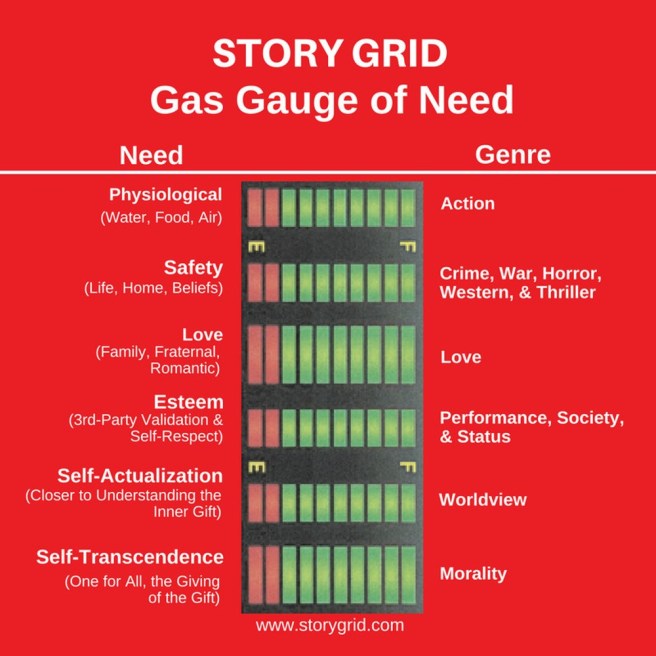
Hence the need to invent (or discover) unusual genres at the more spiritual end of the hierarchy. These new genres trouble me. How troubled you are will depend on what you think genres are.
The method also has interesting notions about the controlling idea behind different genres and the core emotion each genre must evoke in the reader.
Genres are for readers
I believe genres are for readers. Some writers decry genre, equating it with formulaic tales and denying that their work should be constrained by genre. Readers rarely do this. They know what kind of books they enjoy and seek out similar stories. Genre assists their selection. They expect certain elements to be there when they pick up a book in a particular genre. Romance fans, for example, will expect that the lovers must meet, surmount obstacles, get together, break-up (usually in an all-is-lost moment), and then get together again in a proof-of-love climax.
This doesn’t mean they want formulaic repetitive stories. On the contrary, most readers want to be surprised and delighted by the inventiveness with which an author plays with the conventions of their favourite genre.
We only become writers when we create for readers. Complaining about these reader expectations is as pointless as complaining about their insistence that we use words which have agreed and understood meanings. Everything in writing is circumscribed by rules—of grammar, spelling, prosody, narrative structure and genre.
Story Grid and obligatory scenes
It follows from the argument that genres embody readers’ expectations, that there will be defining features of each genre. I don’t have a problem with Story Grid arguing that there are conventions and obligatory scenes, though this will rub a few writers up the wrong way.
Obligatory scenes are, as the name suggests, scenes that must be there for the work to fall under that genre. For example, the lovers’ break-up in Romance, or exposure of the crime/caper in Crime.
Conventions are not scenes. They are elements like cast of characters, setting, and method of turning the plot. That said, the Story Grid website exhibits occasional confusion between scenes and conventions with features appearing as conventions for some genres and scenes for others.
I did two exercises to check how useful these lists of scenes and conventions were. The first was to assess my own work-in-progress against them. I classified my book as a Status genre and was pleased to find most of the five conventions and eight obligatory scenes for the genre.
But that made me wonder. Since I’d never heard of the Status genre when I drafted the novel, how had I matched so closely with the expectations? Another writer who’d done the same exercise told me:
“To be honest, it wasn’t hard to make it fit, but only because I was able to re-interpret inner meanings and motives of what I’d written to suit the criteria it was supposed to meet. The actual prose I’d written didn’t need to change at all to tick the boxes – I just had to alter my interpretation of its purpose at that particular point.”
The second exercise I did was to tabulate all the obligatory scenes and conventions for seven genres (Action, Thriller, Crime, Love, Society, Status, and Worldview). This was a way of testing how unique to each genre those lists were. The yellow shading indicates areas where the overlap between lists was greater than 33%.
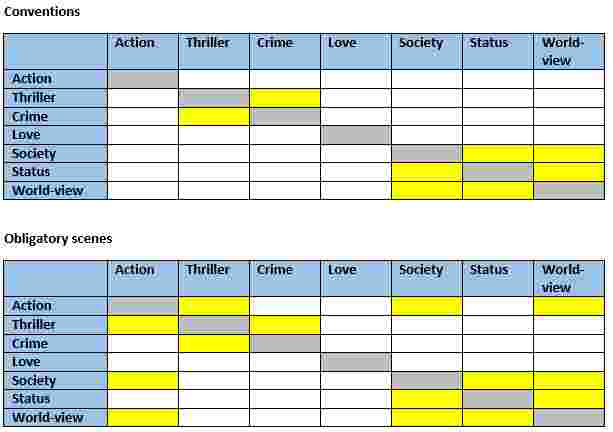
The overlap between criteria at the “survival” end of the hierarchy of needs (Action, Crime and Thriller) is perhaps not surprising. Nor, arguably, is the overlap at the social end (Society, Status and World-view).
What is more astonishing is the overlap of obligatory scenes between Action and Society and World-view. This should only occur if the scenes are inappropriately vague and generic. And that is, indeed, the case. The scenes that cause the problem include:
- Protagonist avoids responsibility to act
- Initial strategy to defeat antagonist fails
- All-is lost-moment: Protagonist must change approach
You could push such scenes into almost any work. I conclude that the obligatory scenes list in particular is too vague.
Story Grid and scene analysis
The other major part of the method is the scene-by-scene analysis. A scene is the atomic unit of the story where something changes. Scene analysis allows the writer to check that the story contains changes that will interest the reader and to identify precisely where a story goes wrong and fix the problem. Typically, a novel will contain between 50 and 75 scenes. Story Grid uses an extensive list of 13 elements to analyse each scene. I won’t go into the detail because there are lots of different methods of analysing scenes.
The big distinction of Story Grid is that it uses this fine tooth-comb to build back into a big picture analysis. The chart below is their analysis of Silence of the Lambs.
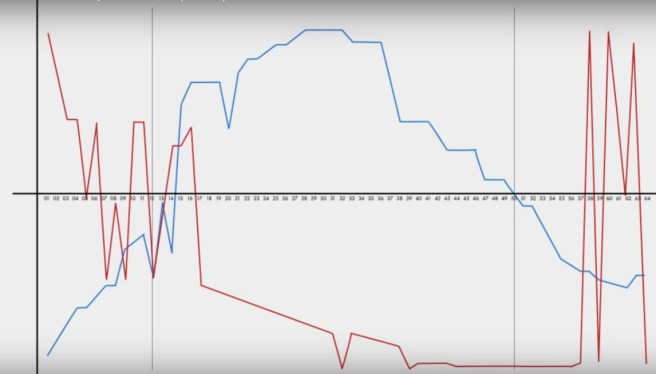
The blue line is the character arc of the protagonist, Clarice Starling. The red line is the plot arc. Here’s where I wanted to understand the magic. It turns out there is no magic. You construct the arc by subjectively assessing the magnitude of the change in each scene and whether it’s positive or negative. Well, I can do that without the Story Grid method. And once I’ve done it, all I’ve really checked is that the arc … well … arcs. It doesn’t tell me where any big structural problems might lie or how to fix them.
The bottom line
In summary:
- A lot of thought has gone into Story Grid. The initial summary format is useful
- The comparison of genre and the hierarchy of needs is interesting
- The list of genres is odd, including categories that don’t fit with reader ideas of genre, and not including some major genres like Science Fiction and Fantasy in the list of content genres is a (forced) omission
- The lists of conventions and obligatory scenes for each genre are deficient. They do not uniquely identify each genre and create meaningless overlaps between very different genres
- The scene-by-scene analysis is not unique to the method and, like other forms of scene analysis do not lend themselves to better analysis of the large-scale structure




 Neil MacDonald Author