


I’ve previously commented on ProWritingAid’s Manuscript Analysis, which left me underwhelmed. The same is not true of their Chapter Critique, which showed a level of “insight” I had not expected from AI. I tried it out on my current project, The Dictator’s Wife. This novel deals with the gradual transformation of Ava Arslan, wife of the dictator of Carpathia, from a moderniser into a tyrant.
Chapter Critique will analyse up to 6,000 words—in this case, the first six chapters. It provides feedback on a number of areas, particularly:
• Tension & Pacing
• The Protagonist’s Arc
• Pacing & Flow
• Language & Style
• Characters
• Dialogue
It “understood” my intent. Here’s a flavour of how it worked.
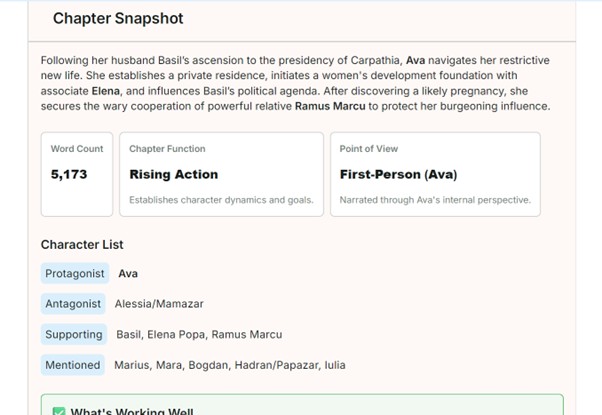
- Did the machine “understand” the story?
The report highlighted the principal element of the first chapters, particularly the protagonist’s motivation for agency and legacy. Under the heading What’s Working Well, it noted, “The … most prominent element is Ava’s sophisticated navigation of soft power. She demonstrates an ability to manage her husband’s insecurities and the country’s patriarchal structures to carve out her own agency. This establishes the complexity of her character, providing a foundation for her role as a modernizing force within a traditionalist regime.” - Did the machine “understand” other key elements of the writing?
Among other things, it noted “Ava’s sophisticated narrative voice” and spotted that subtext in the interaction between Ava and the powerful and dangerous Ramus—”a masterclass in soft power and social ‘minuet.’” - Did the machine detect problems?
Praise is, of course, nice, even from a machine. But the test of whether it’s useful is its ability to spot problems. The report noted seven problems in total. All were reasonable, and two were particularly helpful.
• The analysis highlighted the episodic nature of the chapters, saying this “prevents the reader from settling into the immediate tension of a specific moment, making the transition from ‘accidental First Lady’ to ‘political strategist’ feel rushed. The story moves quickly through time, often summarizing events (like the village tours) rather than dwelling in them.” More than this, it suggested two possible fixes: either “what if one of these time jumps was bridged by a recurring sensory detail or a continuous thread of conversation?”; or extending the scene.
• The analysis noted that the voices of Ava and her collaborator, Elena, were nearly identical. - These diagnoses were as acute as I might have expected from a professional editor. I’m impressed.

