

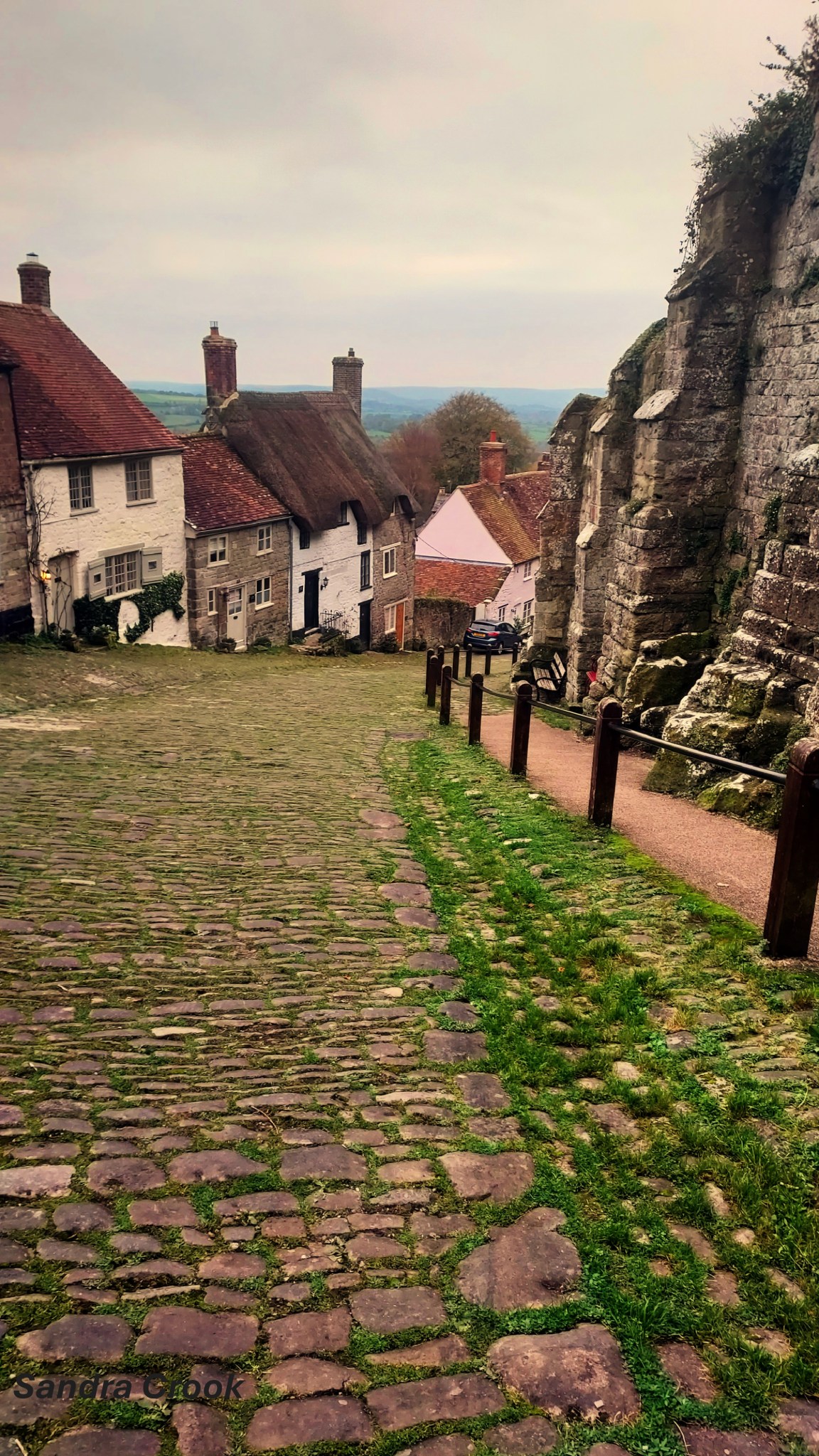
There’s a baker’s boy. Alfred. He’s pushing his bicycle up the steep cobbled lane. Dvorak’s New World Symphony swells. And I am transported back to a simple untroubled age of honest labourers and glittering toffs.
As the boy reaches the top of the hill, one of his loaves falls from the basket and tumbles down the lane. With a sigh, he retraces his steps. The conductor mops his brow and taps his baton as the lad collects the loaf and begins his trudge back up again.
Alfred made this Abbey wall. He burned the cakes. The Danes are coming.
.
As a note of explanation to non-Brits, this lane featured in a bread advert and Alfred was King of the Anglo Saxons in the late 9th Century. The story is a reflection on the way we create and recreate historical myths. Friday fictioneers is a weekly challenge set by Rochelle Wisoff Fields to write a 100-word story in response to a photo prompt. You can find other stories here
 Neil MacDonald Author
Thanks for adding that information!
LikeLiked by 1 person
It seemed necessary in this case. I could have also explained that Alfred united the Anglo Saxon kingdoms in a war on the Viking invaders, and that there is a charming story of him burning the cakes he had been left to tend when he was in hiding from the Vikings earlier in his life. The goodwife who had left him to tend the cakes boxed his ears for his transgression
LikeLiked by 2 people
Thanks again 🙂
LikeLike
I agree with Reena. Thanks for adding that additional information.
LikeLiked by 1 person
My pleasure
LikeLiked by 1 person
The image of a young boy trudging his bike up the hill like Sisyphus to the tune of New World Symphony is priceless and my little half-smile is emerging once again. Nicely evocative tale, Neil.
LikeLiked by 1 person
Thanks so much, Nancy
LikeLiked by 1 person
Dear Neil,
I appreciate the historical info. Fascinating. Yes. We have our historical myths in the States, too. 😉
Shalom,
Rochelle
LikeLiked by 1 person
Lovely word: trudge, and I remember that era and its illusion of honest labourers and glittering toffs. Another enjoyable look askance at life.
LikeLiked by 1 person
Thanks so much, Jilly
LikeLike
Though not a Brit, I an an anglophile. I think that happens a lot to people who teach history and English 🙂 Anyway, I was familiar with all the references except the bread advert. Really enjoyed your take on this picture.
LikeLiked by 1 person
Thanks so much, Linda. There was bit of Greek myth thrown in for good measure
LikeLiked by 1 person
I really like what you’ve done here, Neil. Ancient and relatively modern!
LikeLiked by 1 person
Thanks so much, Keith
LikeLike
Thanks for adding the explanation, Neil. That definitely helps give the story depth for us who don’t know the background. 🙂
-David
LikeLike
I should have added that the wall in the picture was built by King Alfred
LikeLike
The story of our times, slogging away for a slice of our daily bread.
LikeLike
It was ever thus
LikeLiked by 1 person
I’m not familiar with the history, but I particularly loved how the second paragraph and how it ended. What an image!
LikeLiked by 1 person
Thanks so much, Angela
LikeLike
Hovis – it seemed to depict all that was wholesome and good about life. I wonder what would be the appropriate symbol today. Glad you remembered the advert – i loved the music.
LikeLike
I’m not sure there is an equivalent symbol today. Thanks, Sandra
LikeLike
the background info did help in reading your story. well done.
LikeLiked by 1 person
Thanks so much
LikeLiked by 1 person
I remember the advert, great blending of myth and television. Clever stuff
LikeLiked by 1 person
Thanks so much
LikeLike
This is a fascinating tale, past woven into the present skillfully. Of course the context matters and it’s difficult to provide it in such a short piece. I’ve heard of Alfred (lots of documentaries about the Vikings, Lindisfarne etc. on ARTE atm.) but didn’t know he was a baker’s boy.
LikeLiked by 1 person
Thanks so much. To be clear, Alfred (the only British King to be given the labe;l “the Great”) eas not a baker’s boy. He was the son of Aethelwulf, King of the West Saxons. His legendary association with baking was while he was in hiding in the marshes from the Viking invasion. His host, a peasant woman, asked him to mind the wheaten cakes on the fire but he forgot and allowed them to burn
LikeLiked by 1 person
Thank you. I was wondering about that, don’t know anything about his background.
LikeLike
Thank you for the explanation because I didn’t know what to think after reading it. Thanks to Bernard Cornwell I have a passing knowledge of Alfred.
LikeLiked by 2 people
I’ll try not to do it again
LikeLiked by 1 person
thanks for the additional info, the story made for sense to this Kiwi. Expressions like ‘earning a crust’ spring to mind when reading.
LikeLiked by 1 person
Thanks so much, Fleur
LikeLiked by 1 person
You are welcome 😊
LikeLike
Excellent! (Once I had an explanation)
LikeLiked by 2 people
Thanks so much, Dawn
LikeLiked by 1 person