
A previous post looked at techniques borrowed from biology to reconstruct ancients stories. If biological analogies are suspect, can archaeology perhaps provide clues? The picture below is taken from an 11,000 year-old wall in a communal enclosure at the Neolithic settlement of Sayburç in Türkiye.

Does this represent an 11,000 year-old story? According to the discoverer, yes[1].The frieze occurs on a bench 60-80 cm high and 60 cm wide. The whole thing is 3.7 m long, Two humans, two leopards, and a bull are depicted side by side in a long scene, or a set of two scenes. Among the reasons for suggesting that this is a story is that all the figures, animal and human, are on one horizontal level. Other carvings from this culture, such as the T-pillars at Göbekli Tepe, have a vertical relationship between human and animal, The orientation of the figures from two main sections is like the panels from a comic strip or like bible scenes from a church mural.
The one on the right is the most striking at first glance, with a man standing in the centre and a leopard facing him on either side. Unlike the others, this male figure is rendered in high relief and does not face either of the leopards, but looks straight ahead into space, indicating perhaps that he is not threatened. The figure is depicted in a seated position, holding his phallus with his right hand. He wears a triangular neck adornment similar to those seen on the Yeni Mahalle sculpture (also known as Urfa man) and on some T-pillars from Göbekli Tepe. The leopards on either side of him are depicted in a state of attack, with their forelegs slightly raised, their mouths open and their teeth visible.
The panel on the left is a man with his back to the leopard scene and a bull, head down, opposite him. The man is shown in a slightly crouched position and motion. His arms are raised and bent at the elbow. In his open left hand, six fingers can be counted, while in his right hand, he holds something that has been variously interpreted as a sling, an inverted snake, or a rattle.

The bull facing him is shown in an attacking position, like the leopards, with its front legs slightly raised. Though the body of the bull is depicted side-on, its head and dangerous horns are shown from above. The man may be recoiling from the bull or perhaps preparing to leap onto it. One of the main features of the Sayburç reliefs is that the movement is just as important as the figures which suggests that events are as prominent as figures, whether human or animal.
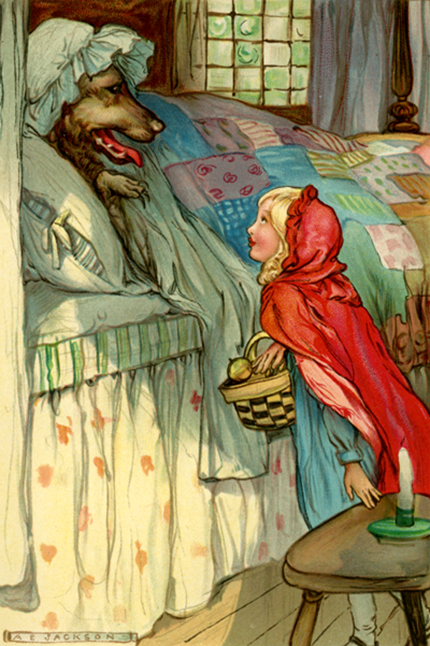
People at the time would undoubtedly have recognised the figures and what was happening, much as we would instantly recognise the story of Little Red Riding Hood from the single image below. Today, we can only speculate.
Phalluses are the only elements that identify the sex of the Sayburç figures, and the emphasis is on the predatory and aggressive features of the animal world, such as teeth and horns, which has also been observed at other sites in the area. The Sayburç reliefs, however, differ in that the figures can be interpreted as forming a narrative, with the two individual scenes appearing to be related to each other as scenes in a story or set of stories. The comparable stature of men and animals in the Sayburç relief may suggest a new dimension recognised in the narratives of pre-Ceramic Neolithic people.
Again, the claim that these scenes form a story can be questioned. What really Is the evidence? That the relationship between the figures are arranged horizontally, rather than vertically? Well, they are inscribed into a horizontal feature, a bench, so a vertical arrangement was not possible. That the figures are shown, dynamically, in motion? The same might be said of the birds from pillar 43 in nearby Göbekli Tepe, one possibly playing with a human head.

Features of the panels
- The animals (leopards and a bull) are wild and savage
- Both humans are male
- The high relief human figure on the right between the leopards is different from the crouching human on the left.
- The high relief may signal a different status to the other human
- He is not perturbed by, or even interacting with, the leopards. Is he in control of them (a Master of Animals)? Note, however, that he in not resting his hands on the animals as in other depictions of Masters of Animals). In some myths, the Master of Animals controls the game animals, releasing a few to humans as food
- He wears a V-shaped neck adornment, a motif also found at Göbekli Tepe, and on Urfa Man and a similar statue at Karahan Tepe. Martin Sweatman (2022)[2] interprets this symbol as representing a lunar month and the V necklace as indicating controller of time, but this interpretation is highly contested.
- The Master of Animals figure is not the centre of the story. He is rendered as nothing other than his status. It is the other figure who is in motion and individualised with six fingers and s held object. The object may be a sling (is he therefore hunting?) or perhaps an inverted snake (similar to the Gilgamesh carving above) or a rattle.
- If he is the centre of the story, it seems plausible to suggest that he has come into conflict with the Master of Animals or the proper behaviour the Master represents. Perhaps he has failed to engage in the correct rites before the hunt and now is alone, confronted by the bull.
- If so, how this story ended might depend on the location in which it is graved. What was this enclosure for? The enclosure has still only been partly excavated. But other sites. such as Göbekli Tepe, have been more fully explored. There is much debate about the function of the large enclosures there: sanctuaries, cultic centres, communal houses?. If these enclosures were spiritual in purpose, the role of the story might have been to underscore what was fitting to do. If they were domestic or recreational, the story might have been more mischievous. In all probability, these societies did not make a distinction between the sacred and the profane.
- So, perhaps an interpretation of the story, if there is a story, might be something as follows.
A man desires to hunt for meat, but, being impatient, sets out without consulting the Master of Animals. [This is a serious violation of the natural order. It is the role of the Master of Animals to ascertain where the herds are and to propitiate their spirits before any hunt]. The man is a giant, with six fingers on each hand and six toes on each foot and believes he can do just as he wishes.
The man treks all day, finding only a rabbit. Though he is after bigger game, he is hungry and brings the rabbit down with his sling. He skins the animal and skewers it over the fire to cook. Tired, he finds his eyes closing, and leaves his arse to guard his prize. While he is asleep, foxes come and steal the cooking coney. When the man awakes and finds the bounty gone, he is furious. “I left you to guard the rabbit while I slept,” he says, “and now look what’s happened. I’ll teach you.” He grasps a burning log from the fire and rams it into his bottom. The pain is intense. “What?” he cries, “Must I bear your punishment too?”
The man proceeds gingerly on his way. The Master of Animals sends a deer into his path. “I am yours,” says the deer to the man. Haughtily, he replies, “Though your antlers are magnificent, I am after more dangerous game than you.” So the Master of Animals has a ferocious boar stray into the man’s path. “I am yours, if you have the courage,” says the boar. The man strokes his great chin, “It is true your tusks are sharp and deadly,” the man says, “but I am after bigger game than you, something that can feed my whole clan.”
So, the Master of Animals decides to teach the man a lesson and sends a huge aurochs, taller than two men standing on each other’s shoulders, charging at him. “Ho, man,” says the bull, lowering his horns, “what do you think you are doing, walking the hills armed only with a sling?” The giant bull charges, forcing the man to jump out of its way at the last moment, narrowly avoiding being gored. At the next charge, the man cries out in alarm, “Oh save me, for I will surely die.”
The Master of Animals takes pity, summoning the spirits of the sky to lift hunter and beast up into the heavens, where they still confront each other today.
This story is built on three elements. The first is the analysis above of the carving, which provides the set-up of the tale. The second, to add scatological humour that might have been expected around the night fires, is the theft of the rabbit and the burning stick from the fire. This element has been borrowed from the North American Crow myth cycle. The third element, the intervention of the Master of Animals to save the man by transforming him and the bull into constellations, is, of course, the Cosmic Hunt, described above. This provides a satisfactory ending. It is all entirely speculative.
[1] https://www.cambridge.org/core/journals/antiquity/article/sayburc-reliefs-a-narrative-scene-from-the-neolithic/3A35B54B3265C7224CB225FE70EBDD02
[2] https://www.tandfonline.com/doi/full/10.1080/1751696X.2024.2373876#abstract
 Neil MacDonald Author
This was fascinating, and I thoroughly enjoyed the story as well. I think one of these relief drawings would make an excellent prompt somewhere.
LikeLiked by 1 person
Thanks so much. Violet
LikeLiked by 1 person