
They have an acronym for it: P (E)—the Probability of Extinction (sometimes called P Doom). It hit the news again this week when Jacob Coxon, a researcher from the AI firm Anthropic, put the P (E) of the technology wiping out the human race at 10% https://www.theguardian.com/technology/2026/sep/09/ai-superintelligence-risks-warnings-scientists-politicians
What should we make of this? The first thing to say is that this is not a probability like the risk of dying in a car crash (around 1 in 100 over a lifetime in the UK) or from a meteor strike (1 in 700,000). We can estimate these probabilities because there’s a lot of data from past such events, and because we understand the processes involved.
There is no data behind the estimates of AI killing us all. There are no similar past events, and our understanding of the processes involved is sketchy. These are not probability estimates but scenarios, stories if you like.
But if these warnings are coming from people in the industry, shouldn’t we assume they know what they’re talking about? Maybe, but maybe not. It depends whether they’re speaking from within a corpus of expertise. When the team building the first atomic bomb in Los Alamos during the Second World War recognised, there was a chance the explosion could ignite the atmosphere, this was a potential risk indicated by the physics. The risk from AI comes from no such body of science. If anything, it’s an older body of fear: the fear of the End Days. It also needs to be said that invoking awe of the power of the technology probably does no harm to the prospects for Anthropic’s imminent stock market floatation (expected to be in the region of one trillion dollars), though this may be a cynical suggestion.
The term Artificial Intelligence is a misnomer. Chat-GPT and Claude and other AIs are not intelligent—they’re pattern recognising machines. This is what makes them so good at solving problems, like how proteins fold or how to construct sentences from prompts. They’re not smart (albeit not as smart as us yet) because that’s not what they do. They can find patterns that humans don’t see, and they can do it very fast. But this is not thinking.
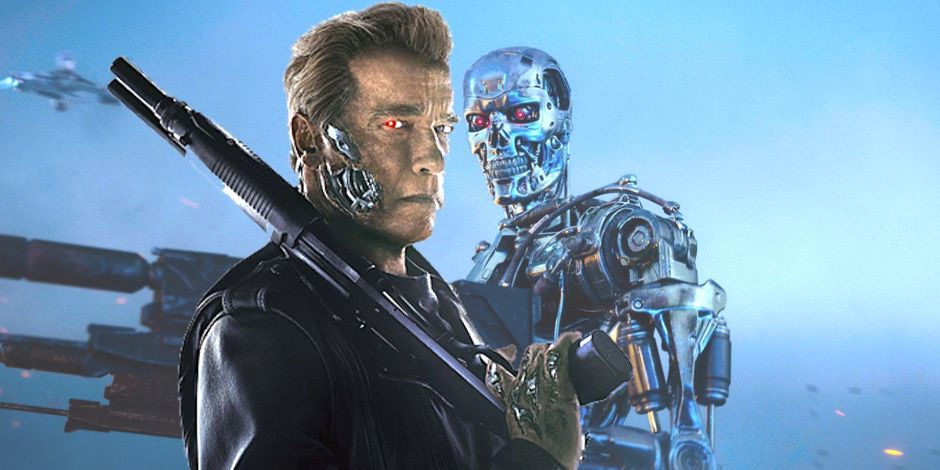
For AI to live up to the Terminator threat, we’d need a different kind of machine—an Artificial General Intelligence (AGI), one that can think and act like (or better than) a human.
Many teams are trying to build an AGI, but nobody’s quite sure what the term means https://www.newscientist.com/article/2432005-what-is-artificial-general-intelligence-and-is-it-a-useful-concept/, or even whether it means anything at all. There’s no scientific consensus on what intelligence is, even in living things. Nobody is clear how soon, if ever, an AGI will be built. The 10% P (E) scare looks like hokum. This is not to say there is no threat, but we simply can’t say how big or when.
To become a Terminator, AI would need to be able to think, form plans antithetical to ours, carry them out, and evade counter-measures. None of this is on the immediate horizon. Sure, as a writer, I could invent lots of scenarios. But it doesn’t make them real.
Does this mean we shouldn’t worry? No, there’s lots to worry about, but it’s not the stuff making the headlines:
- UNEMPLOYMENT. AI is already threatening millions of jobs, from call-centres to radiographers, from actors to lawyers.
- SERVICES. Power-hungry data centres may threaten electricity supplies to ordinary people.
- MISINFORMATION. In addition to deep-fakes, AIs are prone to “hallucinate” (make stuff up). The spread of chatbots use may also spread this misinformation.
- INEQUALITY. The technology is being developed by large corporations, concentrating more wealth in the hands of a tiny elite.
If an extinction event is not foreseeably on the cards in the immediate future, the same is not true of accidents, catastrophic and small. As more and more systems (including critical infrastructure) are run by AIs, glitches, outages and sabotage may take them down. As a trivial example, I have a smart hot-water tank that’s supposed to economise by learning my use pattern. I’ve had to take it offline because its learning was rubbish.
Arguably, all the End Days hype is distracting us from the real problem.


Has anyone analysed what AI needs to survive autonomously? Would biological life be irrelevant? Would the systems crash if the information data is contradictory and false and have multiple updates and changes.
Who would own the kill switch?
LikeLiked by 1 person
Thanks. James
LikeLiked by 1 person
The next year’s will be crucial for our human race.
LikeLiked by 1 person
Thanks. Maggie
LikeLiked by 1 person
Neil, thank you for writing your essay. I feel less worried about near and imminent extinction.
LikeLiked by 1 person
Least I could do after killing off the whole human race in my Friday Fictioneers this week
LikeLiked by 1 person
I’ve always liked that WWII moment:
“When the team building the first atomic bomb in Los Alamos during the Second World War recognised, there was a chance the explosion could ignite the atmosphere,”
I don’t think the word hubris really captures the level of egoism on display… and no amount of ‘well, look, they were right, nothing bad happened (to us)…
same with the AI stuff* ” sure there might be a risk, but better it me than anyone else’
*more like that wonderful scene in the Wizard of Oz (“I am Oz. The great and powerful!”)
good post
LikeLiked by 1 person
Thanks. Clark
LikeLiked by 1 person