181. The Shape of Stories II: Assessing similarity in stories

You’ve had the experience, I’m sure, of reading a new story and thinking, “I’ve read this before.” What similarity creates this sense? In part, it’s the shape of the story arc. Some time ago, I wrote a post about the shape of stories. Stories with similar arcs can feel similar. Think of the rags-to-riches trope.

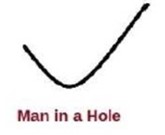
Or the “man-in-a-hole” trope of the overcoming of adversity.

Such simple diagrams give us a sense of the story arc. Other methods are available[1].

In the simple examples above, which come from Kurt Vonnegut, the shapes are made by the changes in the protagonist’s fortunes over time. And this corresponds roughly with what we mean by plot.

But what of other features of stories, irrespective of plot? For example, the personality of the lead characters, the tempo (pace) of the story, or the complexity and imagery of vocabulary? The first of these is often characteristic of series, where characters recur. The next two have more to do with the distinctive “voice” or style of an author. Might stories with similar plot arcs feel different to readers? Or might radically different plot arcs feel similar?

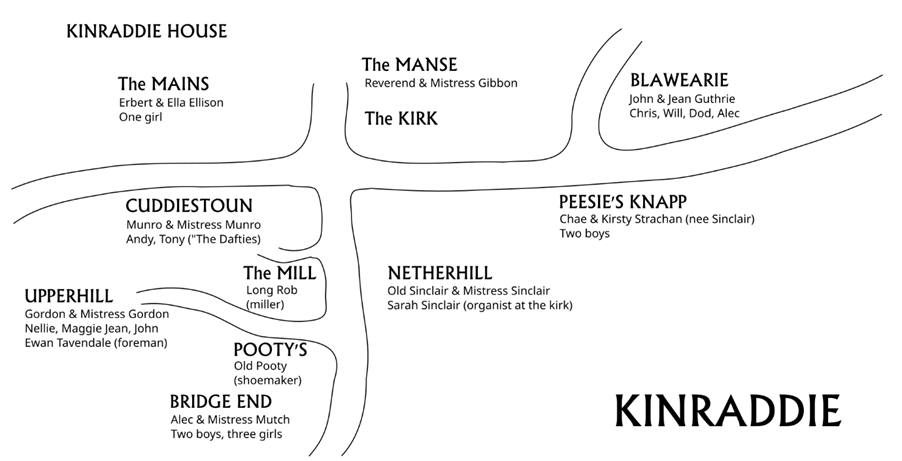
I decided to run a chapter from the novel I’m working on, The People of the Bull, through several text analysers. Here’s a sample of the opening:

The day Hecta, my mechter’s mechter, died much like to any other day was. Listen and I will tell. My mechter, Serega, and Iennos, zirs brechter, the flocks tended. Hecta’s mate Arcu, my mechter’s pichter, nothing knew and in the far valleys the great tawros stalking was. Yes, ill Hecta was, but sickness common is. Most recover.  But being ended and becoming arrived.  The shaking sickness it was, and many in the weyk that dreadful spring, sudden as a wykwos, it carried off.”

The oddity of the language is deliberate. The story is set eight thousand years in the past, and the vocabulary and the grammar are a simulation of the language these people may have spoken: Proto-Indo-European.

None of the analytical engines commented on this oddity. The “I Write Like” engine decided, improbably, that I wrote like J.K. Rowling. Readability Formulas assessed it as readable at around fifth grade level and as having above average lexical density (measures the proportion of lexical words—nouns, adjectives, verbs, and adverbs—to the total number of words.) and below average word diversity.

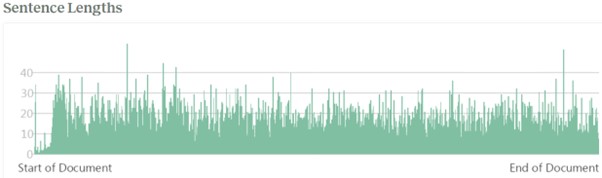
ProWritingAid is arguably one of the more sophisticate tools. It identified that words like mechter were unknown, and calculated average sentence length at 11.15 words with a good variety of lengths.  For comparison, texts generally have an average sentence length of 8.2 words. J.K. Rowling’s average sentence length is 17.45 words (so, not very similar).

I was, perhaps, more similar to Salman Rushdie whose sentences averaged 14.95 words.

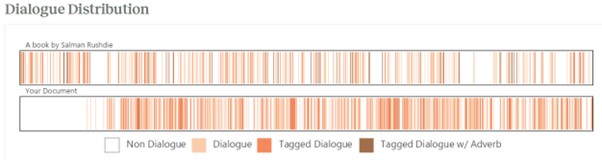
I was also significantly less dialogue rich than Rowling, but more than Rushdie.

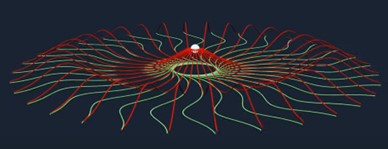
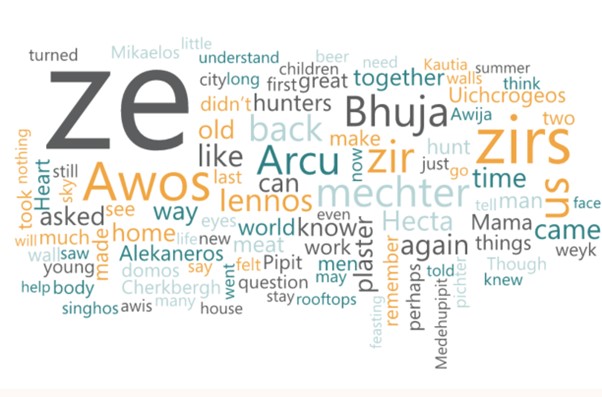
It also scored writing style[2] as 86% and engagement at 93%. It yielded the following word cloud for the first five chapters:

The pacing  shows slow paced text alternating with faster paced.

So what can tools like ProWritingAid tell us about the similarities and differences between stories? They can analyse some of the elements of the language used: are the sentences short or long? How complex are they? How much of the story is dialogue?  Here is a comparison from ProWritingAid  and Readability Formulas of the similarities and differences of my story with works of some other writers.

 MeAverageJ.K RowlingSalaman RushdieAnthony DoerrBill BrysonZora Neale Hurson
Sentence length11.15 words8.2 words17.45 words14.95 words11.6  words15.7 words12.95 words
Sentence variety6.7?5.510.58.110.75.0
Conjunction starts9.5%1.5%5.6%8.7%4.8%5,2%8.7%
Dialogue52%20%64%39%39%30%48%
Lexical density55.3%45%47.25%55.2%58.4%53.1%60.5%
Lexical diversity34.3%45%  58.1%46.3%  62.2%  50.647.1%  

You can see that on none of the indicators is my writing much like that of J.K. Rowling. Most similar, overall, of the writers examined here, is Zora Neale Hurston. This may be because of her extensive use of dialect and substantial use of dialogue, but also, like me, she is prone to start sentences with a conjunction (such as “and” or “but”).  Here is a sample of her writing from the opening of her wonderful book Their Eyes Were Watching God.

Ships at a distance have every man’s wish on board. For some they come in with the tide. For others they sail forever on the horizon, never out of sight, never landing until the Watcher turns his eyes away in resignation, his dreams mocked to death by Time. That is the life of men.

Now, women forget all those things they don’t want to remember, and remember everything they don’t want to forget. The dream is the truth. Then they act and do things accordingly.

So the beginning of this was a woman and she had come back from burying the dead. Not the dead of sick and ailing with friends at the pillow and the feet. She had come back from the sodden and the bloated; the sudden dead, their eyes flung wide open in judgment.

The people all saw her come because it was sundown. The sun was gone, but he had left his footprints in the sky. It was the time for sitting on porches beside the road. It was the time to hear things and talk. These sitters had been tongueless, earless, eyeless conveniences all day long. Mules and other brutes had occupied their skins. But now, the sun and the bossman were gone, so the skins felt powerful and human. They became lords of sounds and lesser things. They passed nations through their mouths. They sat in judgment.

Seeing the woman as she was made them remember the envy they had stored up from other times. So they chewed up the back parts of their minds and swallowed with relish. They made burning statements with questions, and killing tools out of laughs. It was mass cruelty. A mood come alive, Words walking without masters; walking altogether like harmony in a song.

“What she doin coming back here in dem overhalls? Can’t she find no dress to put on? – Where’s dat blue satin dress she left here in? – Where all dat money her husband took and died and left her? – What dat ole forty year ole ‘oman doin’ wid her hair swingin’ down her back lak some young gal? Where she left dat young lad of a boy she went off here wid? – Thought she was going to marry? – Where he left her? – What he done wid all her money? – Betcha he off wid some gal so young she ain’t even got no hairs – why she don’t stay in her class?”


[1] See for example topological and other approaches such as:  Golizafeh et al (2018) Topological Signature of 19th Century Novelists: Persistent Homology in Text Mining Big Data Cogn. Comput. 2018, 2(4), 33; https://doi.org/10.3390/bdcc2040033; Lois Mooiman (2015) Comparing Stories with the use of Petri Nets,  Bachelor Thesis, University of Amsterdam https://staff.fnwi.uva.nl/b.bredeweg/pdf/BSc/20142015/Mooiman.pdf, Anni Doshi et al (2024) Generative AI enhances individual creativity but reduces the collective diversity of novel content, Science Advances 10, 28 https://www.science.org/doi/10.1126/sciadv.adn5290?adobe_mc=MCMID%3D51225740793224612401754393803669772565%7CMCORGID%3D242B6472541199F70A4C98A6%2540AdobeOrg%7CTS%3D1720804936#body-ref-R26 (which uses AI-supported text embedding to assess similarity between stories);

[2] This assesses elements like clarity, excessive adverb usage, hidden verbs, lengthy subordinate clauses, repeated sentence starts, excessive use of passive voice, and more.

180. Clarity, Simplicity, and Transparency

Is transparent writing the same thing as clear writing?  Are either the same as simple writing?

A text is transparent when the writing doesn’t  draw attention to itself. The most obvious example is the use of the verb “to say” in dialogue tags. We tend to read through “he said”, registering without noticing the information about who is speaking. But if you want the reader’s attention to be snagged, substitute another verb, for example, “he ululated.”

Evidently, transparent is not necessarily the same thing as clear writing. Writing may be clear and yet revel in the juiciness of its word choice, providing a feast for the senses and the mind. It may also be immensely complex in its length and sub-clauses and still be clear. To take just one example—the opening sentence of Dickens’ Tale of Two Cities:

“It was the best of times, it was the worst of times, it was the age of wisdom, it was the age of foolishness, it was the epoch of belief, it was the epoch of incredulity, it was the season of Light, it was the season of Darkness, it was the spring of hope, it was the winter of despair, we had everything before us, we had nothing before us, we were all going direct to Heaven, we were all going direct the other way — in short, the period was so far like the present period, that some of its noisiest authorities insisted on its being received, for good or for evil, in the superlative degree of comparison only.”

One note of caution about transparency and clarity. These are not just features of the writer’s skill, but also of the reader’s and of the cultural moment. What is clear to some may not be clear to others. Anne Leckie points out that even if we have the translation of an ancient Babylonian story we lack the cultural context and the conventions to make it an easy read.

179. Why do we believe a story needs conflict?

It has become a truism of Western writing advice: that stories are built on conflict, a character overcoming obstacles to solve a story-problem. The three (or five) act structure illustrates this classic form. Act 1 sets up a problem, Act 2 is the conflict over the problem (often, but not necessarily, violent), and Act 3 resolves the problem. It is a tale of winners and losers.

There is no doubt that conflict is the author’s magic go-to sauce. Sprinkled over a stewing plot, it adds body and savour. But the fact that it’s commonly used does not make it universal. Nor is the absence of conflict necessarily a plotting flaw.

The classic bildungsroman may or may not contain struggle, but it’s driven by the process of maturation, not conflict. In Viriginia Woolf’s To the Lighthouse, there is little that could be labelled conflict. Indeed there is little that could be labelled events, since most of the book is taken up by the internal thoughts of the various characters. Or, consider Albert Camus’ The Stranger. The essence of the protagonist, Mersault, is that he feels nothing, not when his mother dies, nor when he shoots the Arab, nor when he is tried for the crime and sentenced to death. You might want to argue that Mersault’s conflict is with society and its expectations, but this would be shoehorning in the notion of conflict, since his role in the conflict is essentially passive.

Other cultures

Many other cultures tell stories that do not follow the Western three act format. Conflict is not a necessary feature of all storytelling, merely a characteristic of much modern Western fiction. Consider, for example, the four-act structure known as Kishōtenketsu, found in Japanese, Chinese and Korean literature.  By contrast in a Kishōtenketsu story, Act 1 sets up a situation, Act 2 develops the situation. Nothing much changes until Act 3, which throws in a twist, while the final Act resolves the tension between the starting situation and the twist.

From: https://stilleatingoranges.tumblr.com/post/25153960313/the-significance-of-plot-without-conflict

There are other non-conflict story structures. The Nicaraguan Robleto, for example, shares with many oral storytelling traditions a characteristic repetition. The tale opens with a short and poignant statement, which is the repeated element and then introduces the protagonist. This is followed by a climax. Next comes a Journy or Journies in which other characters or situations are related. At the end of each journey, the key statement is repeated. The structure is one of a spiral of Introduction, Climax and Journey, ending finally in a Close in which all issues are resolved. .

You can find an example of a Robleto in The Farmer Who Became a Doctor https://www.youtube.com/watch?v=FuKgH3p7Hx0

“Many people here believe I am a doctor who became a  farmer. But that’s not so. I am a farmer who became a doctor. The origin of this is that my father and my grandfather lived just right over there. Right over where that house is. My father was born there. They are people from here. Originals. They were country folk. My father didn’t know how to read or write. It was hard for him to even write his name. All his life, he worked the land. But he didn’t want me to become a farmer. He never taught me anything about farming. Nothing, absolutely nothing.  Because he wanted me to be a doctor.

“I am a farmer who became a doctor. I started my clinic here. Things went well, more or less. My father never said ‘This calf is yours’ because he never wanted me to be a farmer. He always wanted me to be a doctor. So I opened my clinic, and it went well, thank God. Because everything I now have is thanks to my clinic. Then, someone was selling this little farm, and they said ‘Let’s go see it.’ And I said, ‘Why do you want to see it? Why do we want a farm? It’s abandoned. There’s nothing there.’ But, with much insistence, I bought it. There was a lady—I was her doctor and I had visited her in her house during my duties.  And one day she said to  her son, Santiago, ‘Look, Santiago, give a calf for the doctor. Look for a good one.’ And so, they gave me a calf, a Holstein. And that was my first cow.

“My first cow was given to me by a patient. Then that calf grew and I got more cows. I cleaned up and arranged the abandoned farm. I always dedicate myself to my clinic, but the truth is, my passion is the farm and my animals. It’s quite a story. I’m someone who was born here in the countryside, but my father didn’t want me to be a farmer. He wanted me to be a doctor, and , thanks to God, I became a doctor, but now I have returned to my roots and I also dedicate myself to my farm. I am a farmer who became a doctor.”

There are other examples of structures without conflict. Often cited in lists of such structures, for example, is the Rashomon story, after the famous film of the same name (itself inspired by Akutagawa’s short story, In a Grove). In such stories the same events are recounted repeatedly through multiple points of view, with no necessary guide to which, if any, version is true.

Are there any universals?

If a story need not involve conflict, what, if anything, are the universal essentials of a story? Many would say change and/or tension. To a degree, arguing that a story requires change is a truism. If nothing changes, we remain at the first frame of the film. But we need to be careful here. The dominant Western model of narrative stipulates that the fundamental change should be in the protagonist and possibly in other characters too. This need not be so. It is quite possible to have story-telling traditions in which the change is in the situation rather than in the character. Though various Asian traditions are often cited in this respect, there are venerable Western genres, entirely plot-driven, in which the protagonist undergoes no change. Prime among these is the detective story: Holmes remains Holmes, but he solves the case. It’s also worth looking back at our own past in the West. Until roughly the time of the troubadours, who invented the Western love story, the internal lives of characters was of no interest to storytellers or audiences—only their actions mattered. It is also possible to have stories with no change in either the protagonist or the situation but rather in the reader. I’ll come to this again below.

So, what of tension? Again, by definition, there must be some sort of tension. The reader must want to know “what happens next?” But this tension need not be created by a problem or a threat to be surmounted. Here, once more, we come back to the importance of the reader. Stories are not just (or even primarily) about how well the character is drawn, nor about how adroitly the character solves the story problem. A story is, above all things, a device for taking a reader on an emotional and/or intellectual journey. It takes a reader to bring a story to life. We can give the name “plot” to the things that happen, and “story” to the way this plot is recounted. There is a third concept: “narrative”. Narrative here means how the story is received by the reader or listener or viewer. How does this relate to the question of tension? Suppose, for example, we have a tale in which neither the character nor the situation changes. Rather, over successive moments, the reader gets an increasingly full picture of what is happening and why it is happening, as if a camera were panning out. Such revelation can be intensely satisfying to a reader. Though much Western writing advice will focus on the binary choice of plot-driven vs character-driven stories, there is a third alternative: understanding-driven stories, in which the reader gets to explore a situation or a world. I might, perhaps, offer Alice in Wonderland as an example of such a story.

Beyond this,  it’s instructive to ask how variable can other elements be that we uncritically take to be universal elements of story-telling.

  • Does there need to be an individual protagonist with whom we identify? Or can a tale be about a collectivity? There is clearly an issue here about societies based on individualism and those based on collectivity. Traditional southeast Asian stories often have no protagonist in a Western sense. But there are Western stories too that use a first-person- plural narrator. Joseph Conrad’s The Nigger of the Narcissus, in part, used this voice. Jeffrey Eugenides’ The Virgin Suicides is narrated by a group of boys.
  • Do we need to get straight to the point (the old saw about starting in media res) starting in the middle of the action? Or can a story also build up context, lay out its organizing themes, before getting to the action? Again, cultural predilections are in play here. Where the past is relatively unimportant and the drive towards the future is what matters, we are in a recognizably United States mindset. Travel further south to Latin America and context and history may be everything. Think, perhaps, of Gabriel Garcia Marquez’ One Hundred Years of Solitude.
  • Is there always a linear structure of cause and effect, leading logically from the beginning to the ending?  Not necessarily. Story-telling can just as easily, for example, start at the end and work back to the beginning. Arundhati Roy’s The God of Small Things may offer an example here. In addition, there are story forms in which there is no real beginning or end. In Frame stories such as The 1001 Nights, the beginning is simply a frame to hold a diverse collection of unrelated stories. Chaucer’s Canterbury Tales is another example of a frame.
  • Is a story necessarily a “conversation” between one writer and one reader? Clearly not. Oral storytelling presumes a collective audience, and such audiences often participate in the story-telling through comment, call-and-response, dance, and re-enactment. Such stories are often non-linear, meandering or looping back. Native American stories such as the Trickster myth cycle follow this rubric as do a number of African traditions. One common, though not essential, feature of such traditions is that they often explore the reasons for things being as they are  and conclude by underscoring a “moral”.

178. How did she do that? Magda Szabo’s Iza’s Ballad

Magda Szabo was an award-winning Hungarian author. Among her best known works is the stunning The Door. I have just finished reading an earlier work, Iza’s Ballad, and found the turning-point chapter so compelling I re-read it four times to understand how she achieved the effect.

In this chapter, Iza learns that her mother has died while on a visit to their home village. Iza rushes to find her partner, Domokos, who drives her to the village. There, they encounter Iza’s, ex-husband Antal, who now lives in her childhood home. Iza is confronted by a grief she did not expect, and all the characters change in this chapter. How, I wondered, did Szabo craft the wild grief and the dissociation the chapter so powerfully conveys. Much of the rendering of grief and loss is achieved by changes in the writing style, rapid shifts of point of view, and dreamlike interleaving of things.

Close analysis showed the chapter is divided into fourteen movements.

  1. Iza is enjoying the prospect of a day alone, with her mother and lover gone. The writing is indulgent and languorous.
  2. A long-distance phone call. Iza is  angry that she can’t be left alone. Antal speaks two sentences (which we are not given at that time) and puts the phone down.
  3. Iza struggles to comprehend and experiences animal pain. The writing here is staccato hammer beats. There is a list-like effect, with many sentences starting with “She”.
  4. Because she is alone, every past wound opens. Having neither mother nor father “felt new and raw, like drawing her fingers along both edges of a knife”. There is an explosion of emotion, followed by chemical calm as Iza takes a tranquillizer and plans what to do.
  5. She goes in search of Domokos. The effect is dissociative. She can’t remember where he went, because she wasn’t sufficiently interested to listen properly, but knows she will be able to recall it if she tries.
  6.  She arrives at the hall where Domokos is speaking. Iza’s presence is like a rot or contamination, destroying things. She observes Domokos behaving in a way he doesn’t with her. Her arrival destroys his calm. People are annoyed, as if they witness something shameful.
  7. It feels good to be with Domokos who takes charge. She compares being with Domokos and with Antal. Iza wonders how Domokos knows she can’t go back to flat alone: because he is a writer? Or because he loves her? This is the first moment of reappraisal of relationships.
  8. They drive to the village. This movement is in Domokos’ point of view. It is distanced and interrogative. He notes the rarity of the autumn landscape; wonders who Iza is; wonders how the old woman died;  wonders if marrying Iza would be good idea. What could have happened? He listens to Iza speak of her old life in a way she hasn’t before. He does not like that Iza is afraid to meet Antal. What will Antal be like? He realises how much he doesn’t know about her.
  9. They arrive at the village. There is a rapid alternation of point of view that creates an effect like anxious darting eyes.. In Iza’s POV: Where has my mother gone? Where has my father gone? In Domokos’ POV: This doesn’t look like Iza’s description. In Iza’s POV: How much has changed in the village and how much remained the same. In Domokos’ POV: Watches Iza pulling at the bellpull like a child.
  10. They go to Antal’s house, because the neighbour is not there. In Domokos’ POV: wonders if he will hate Antal, but likes him. Antal explains about accommodation options but Iza is not taking it in. Domokos, for the first time, takes in the scene not as a writer storing memories, but as a person. In Iza’s POV: she wonders who the “we” is in Antal’s account who searched for the old woman. The effect of this movement is that of a distanced observer.
  11. They discuss sleeping arrangements. There is one place with Antal, one at the clinic. The gap continues to widen between Domokos and Iza, Domokos realises Iza does not want him to stay with Antal, and that he doesn’t care if Iza sleeps in same house as her ex-husband.
  12. Antal walks Domokos to the clinic. As they leave, Iza notes Domokos speaking with Antal in a way he doesn’t with her. Again, she feels his alienness.
  13. Iza is alone in the house. This is an extended passage filled with nostalgia. She reprimands herself for her cowardice in not wanting to leave the two men together. Thinks that old woman would not have died if she hadn’t stayed with Antal. Objects come alive around her—”she could almost hear them breathing”. Unable to bear to sit down, she wanders from room to room. Finds the old woman’s belongings but cannot touch them. She feels everything is as it was in her childhood and the old woman has only popped out for a minute and will return.
  14. Antal returns and she takes his room. Iza says she can’t sleep where her mother’s things are. Antal agrees she can have his room. She needs to be consoled and feels if he embraces her the sadness will go. But he takes her pulse. It angers her that he is touching her as a doctor not a man. He offers a sleeping pill which she rejects. Door no longer creaks as it did in her father’s time. Past and present coexist. Antal leaves. Iza is quite alone.

The people of the bull

I have started work on a new novel. set 9,000 years in the past in the ancient city of Çatalhöyük (on the Konya plain of what is now central Turkey).

This is a challenge. How did these people think? What was important to them? Writing had not yet been invented, so there are no texts to tell us what stories they told, what language they spoke, or what they called themselves. All of this has to be pieced together from the material remains of their impressive 2,000 year history. We know equality must have been very important to them. We can say this because, with minor differences, all the houses were pretty much the same.

Artist’s impression of Çatalhöyük

There were no temples, no palaces, and hence, no priestly class or kings. There was no indication of warfare. Their bones show that everyone was pretty well fed, with no nutritional differences between men and women. By this time, they had domesticated plants, goats and sheep. They could have domesticated cattle too, but chose not to because the hunt of the wild giant bulls, the aurochs, and ritual feasting was fundamental to their way of life. We know this because of the feasting remains and because they celebrated the hunt in extraordinary murals.

This article examines a selection of these murals, those found in house F.V.1 which dates from around 6,500 B.C. It was decorated on all four walls with the painting applied to a single layer of plaster. Why have I chosen to analyse these paintings in detail? Because there are clues here to what they believed, and from those and other clues I can try to rebuild a version of what their lives may have been like. I should stress, I am an author, not an archaeologist. It’s my job to make stuff up, but I want what I make up to be wholly consistent with what’s known from the archaeology.

In a journey round all four walls of the house starting from the south, these are the murals. A detailed description of the paintings and their location can be found in a paper by Grant Cox[1].

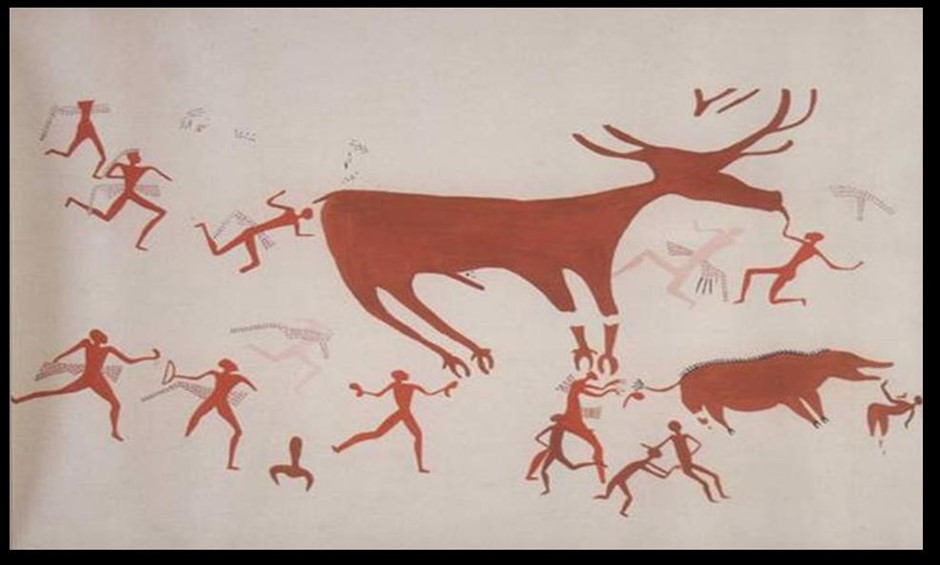
Painting 1. The Stag. Southwest corner

The painting shows 16 humans with a stag. There are no weapons, so this seems to indicate a scene of playing or baiting (one of the figures tugs on the reluctant animal’s tongue, one on its tail, one its antlers and one its hoof).  The scene may be symbolic. Several of the figures are incomplete with missing and disarticulated body parts, including perhaps two missing their heads. The latter may suggest ritual or mythological significance. Alternatively, this may simply be the result of fading or damage to the painting

Several of the humans are rendered in some detail, showing noses, chins, hair and beards. One of the figures, rendered in pink, is unusual in not being a silhouette, the only such figure in all the murals. It is possible he is leaping on the stag’s back (though it is just as plausible to suggest he is behind the animal). Two of the human figures at the bottom of the picture are smaller (children?) and one is a woman (bottom right), Near the woman is what may be a dog.

There are indications of differences between the men. One has pink skin. Some wear leopard skin kilts and others what appears to be of a different animal (goat?)

 Pink skin colourRed skin colourTotal
Men112 13
Women 1 1
Children 2 2
Disarticulated 4 
Weapons00 
Leopard kilt15 
Other kilt 4 
No kilt 5 

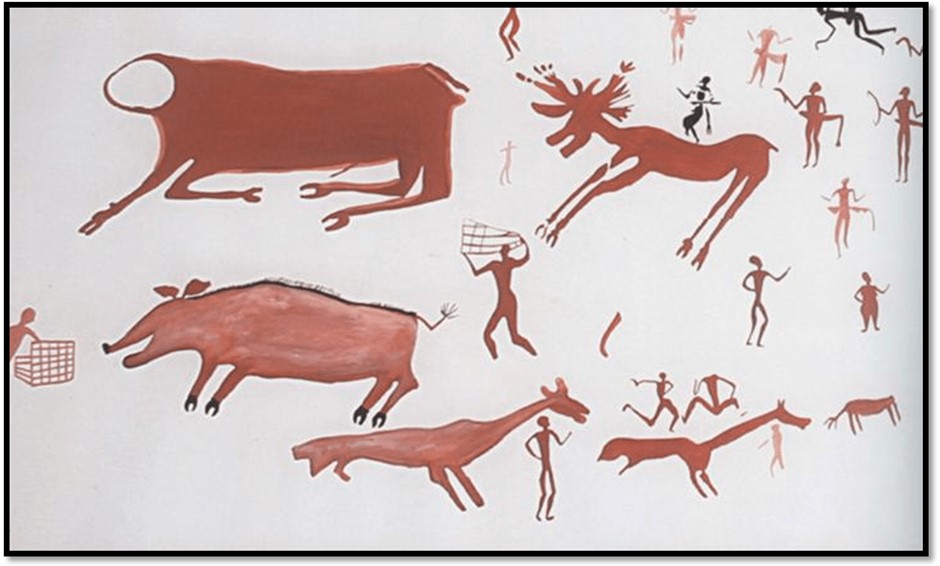
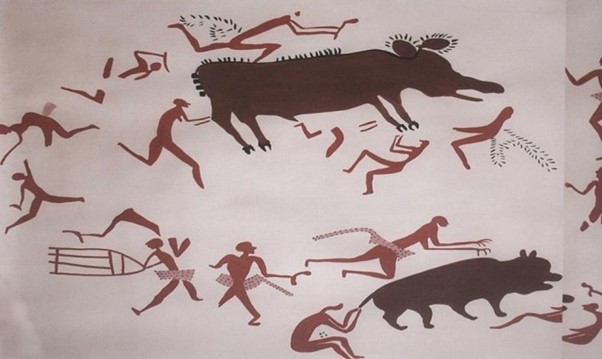
Painting 2. Several animals. Northwest wall.

After a separation by a plaster pillar, this painting appears above a long frieze of what appears to be a line of asses. Several animals are shown and 17 humans. This time, six of the people are armed. The top of the painting is dominated by two animals, one of them headless. Melaart interpreted them both as deer, the smaller one to the right being a different species (perhaps a fallow deer). However, the larger headless animal is rendered unusually for a deer and may be a bull or a cow. Again, headlessness may have a symbolic ritual meaning. Two of the humans are also headless, as is a small animal at the bottom right. Two of the humans are trying to net the boar. One of the men may be trying to balance on the back of the fallow deer and two on one of the asses (though it is equally possible they are simply depicted as being behind the animals).

Again, there is one woman on the bottom right and there are differences between the humans, with skin colours of black, red, and pink. None of them is wearing anything that can be clearly identified as a leopard skin kilt.

 Pink skin colourRed skin colourBlack skin colourTOTAL
Men57214
Women (no kilt) 1 1
Children (no kilt)2?  2?
Disarticulated 11 
Weapon (bow) 1  
Weapon (boomerang) 21 
Weapon (other)    
Net11  
Leopard kilt    
Other kilt21  
No kilt    

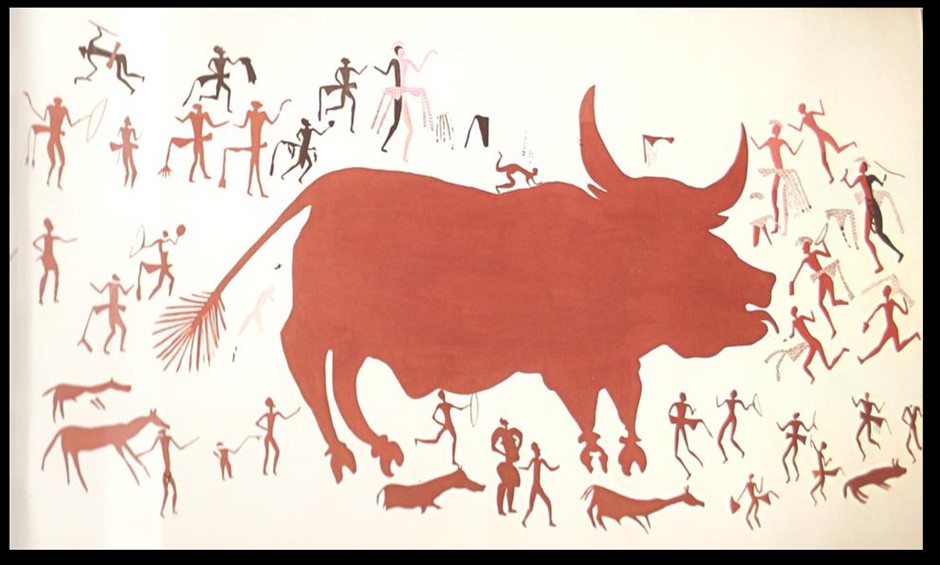
Painting 3. The Bull. North wall

This mural is dominated by the giant bull which dwarfs the people. Several of the people are armed. The skin colour is not easy to distinguish here as between red and pink. Some of the people have a lighter tinge, but not as light as pink and have been interpreted as red. Two of the  figures are unique in being half tone (one half red and half black, the other half pink and half black). Both these figures also have leopard skin kilts, weapons and headdresses, indicating they may be high prestige. Again, there is one woman in the picture, apparently pregnant (just below the bull) and one child, seemingly tethered to an adult (just behind the bull).

 Red skin colourBlack skin colourHalf toneTOTAL
Men2342 (pink & black, red and black)29
Women (Pregnant)1  1
Children1  1
Disarticulated1   
Weapon (bow)4 (2 kilt, 2 no kilt)   
Weapon (boomerang)2 1 
Weapon (other)421 
Net    
Leopard Headdress2 2 
Leopard kilt1442 
Other kilt (red)101  
Other kilt (black)4   
No kilt11   

Painting 4. Northeast corner continuing onto the east wall

15 men are teasing a stag and a bear, pulling on tongue and tail. The empty leopard skins suggest there might have been more people, lost through the poor condition of this part of the wall. Though three of the men are armed, this does not seem to be a hunting scene. The two figures below the  stag’s jaw appear to be in synchrony. Is the pale on a cosmic mirror of the red one? The figure just below the stag’s forefeet and trying to pull the bear’s tail appears to be a human-animal hybrid, with spines on its back and extended claws.

There are no women or obvious children in this scene, though it’s possible the bending figure just below the bear’s rump is a child.

 Pink skin colourRed skin colourBlack skin colourTOTAL
Men213 15
Women    
Children    
Disarticulated 2  
Weapons (bow) 1  
Weapons (boomerang) 2  
Leopard kilt14  
Other kilt    
No kilt 10  

Continuation of painting 4 on north side of east wall

The painting continues onto the east wall, showing a boar and bear apparently being baited. Again, weapons are present, as well as a mysterious harp or flail like object. Only one type of person is represented (with red skin).  The figures just below the boar’s snout and the one apparently on its back may be wearing feathers.

Of particular interest is the figure leaping at the back of the bear, another seeming human/animal hybrid with extended claws.

 Pink skin colourRed skin colourBlack skin colourTOTAL
Men 12 12
Women (no kilt)    
Children (no kilt)    
Disarticulated 2  
Weapon (bow) 0  
Weapon (boomerang) 2  
Weapon (other) 2?  
Net 0  
Leopard kilt 3  
Other kilt 0  
No kilt 9  

Painting 4 continued (southern part of east wall)

This panel (though it is a continuation of the previous one) is the only one that contains no animals, though the majority (perhaps all if the paint has fade)  of the 13 men wear leopard skin kilts as if they were about to face dangerous game. Perhaps this represents the aftermath of a hunt, or a ceremony preceding a hunt. The figures appear to be circled (dancing?) around a magnificently dressed central figure, whose leopard skin seems to be feathered (as is that of the figure on the top left). Again, there may once have been more figures who have faded leaving only their leopard skins at the bottom of the picture. Only one person holds what may be a weapon (a boomerang) and one, on the right of the central figure holds a mysterious object with tines.

 Pink skin colourRed skin colourBlack skin colourTOTAL
Men112 13
Women (no kilt)    
Children (no kilt)    
Disarticulated1   
Weapon (bow)    
Weapon (boomerang) 1  
Weapon (other) 1 (tined)  
Net    
Leopard kilt19  
Other kilt 0  
No kilt 3  

Painting 5 (South side of east wall)

The image begins after the bench on the east wall and continues to the ladder. Preservation was particularly poor here. A large pink feline creature (possibly a leopard although there are no spots) is surrounded by at least 9 people (more may have been lost to fading), none of whom are armed, though all are wearing leopard skins. The skins this time appear to be feathered. All are men and all are coloured red. The men appear to be holding hands and may be dancing One of the men, with a fine double kilt, is also wearing a leopard skin hat.

 Pink skin colourRed skin colourBlack skin colourTOTAL
Men 9 9
Women (no kilt)    
Children (no kilt)    
Disarticulated ? (damage)  
Weapon (bow) 0  
Weapon (boomerang) 0  
Weapon (other) 0  
Net 0  
Leopard kilt 9  
Other kilt 0  
No kilt 0  

South wall

The murals conclude with an incomplete set of human and animal images on the south wall.

Interpretation

  1. The collection of images are not of hunting alone. Indeed, only the bull mural seems to depict anything that could be considered a hunting scene. But the other scenes may be part of a wider symbolic complex: the prowess-teasing-hunting-feasting complex. The bull mural is the only one in which almost half the participants are carrying weapons (14 weapons among the 31 participants). By contrast, the proportion of weapons in the two stag teasing scenes (painting 1 and painting 4) are zero  and 3-in-15 respectively. Teasing (a display of prowess) was probably an important part of the symbolic complex. Even in the bull hunt scene, one of the participants seems to be performing an acrobatic tumble on the bull’s back. Other images too may indicate participants vaulting the animals (paintings 2 and 4, possibly painting 1).
  2. These scenes depict predominantly, if not exclusively, adult male activities. The individual women present in several of the scenes may have been symbolic, particularly because one seems heavily pregnant. It is probable that boys would have been part of the hunt when they came of age.
  3. Though the bull hunt scene shows 31 individual (which is probably the minimum number that would have been required to hunt the wild aurochs) these scenes should probably not be read as a realistic depiction of actual activities and may be highly symbolic in nature. Reasons for believing this include
    • The probably symbolic nature of the female presence in three of the panels
    • The scale, with the animals represented larger than life
    • The presence of hybrid figures who may be symbolic or mythological. The first two are status hybrids, while the second two seem to be animal-human hybrids. The projections from the back of the upright figure in painting 4 may be spines (maybe an iguana or a chameleon?) or feathers (feathers being more likely since it appears predatory: maybe an eagle?). The leaping figure in painting 4 may be a leopard-human hybrid.
  • The disarticulated bodies (particularly the headless ones) may be indication of a spiritual state. At least some, however, may just easily be the result of damage and fading. Headlessness, however, was an important feature of ritual life. Skulls were retrieved from some corpses and subject to manipulation. On closure of a house, the heads and limb extremities were struck off the splayed figure reliefs.

Headless bodies also occur in the vulture paintings found in level VI

4. There are various differentiators between people in the images

  • The colour coding of the figures is intriguing. Did red, pink and black indicate different social groupings (perhaps those clustered around a “history house”) or, alternatively, different occupations or, yet again, different ages? Red figures predominate in all the scenes, reflecting perhaps the lineage that lived in this house. It is possible that pink wasn’t a real category but the result of red paint fading. The half-tone figures in the bull mural may represent some status (again, perhaps mythological) that bridged the two groups. The fact that there are no three-tone figures, may add weight to the suggestion that the pink is an artefact of ageing, because more than two house groups would have been required for the hunt. It seems most plausible that the colour coding represents neigbourhoods.
    • Do the colours represent house groups? The minimum number of hunters to successfully bring down a bull was probably around 30. Assuming an average of two adult males per household, this figure would require cooperation between at least 15 houses. With five or six houses grouped together around a “history house”, the minimum hunting number would have required cooperation of at least three such house groups, and probably more participated. If the colour-coding represented such house groups, at least three colours would be required, but probably more. Yellow was a colour available to the painters but was not used. It seems likely, therefore, that the colour coding did not represent house groups. It could however have represented the neighbourhood level. Houses were clustered into neighbourhoods or quarters of around 30 houses[2]. If a hunt was organized by a neighbourhood, with some members of other neighbourhoods participating, the colour coding would find a ready explanation. The half-tone figures would also be explained as individuals whose lineage or affiliation spanned neighbourhoods.Do the colours represent occupation? The idea that the colour coding represented different occupations (for example herders, carvers, millers) also seems unlikely for two reasons: firstly, in this early and highly egalitarian society, it seems likely that most people performed most activities. Undoubtedly some may have specialized, being recognized as having an expertise in, say, stone working or painting, but they would undertaken other work too. The second argument is that these scenes appear symbolic, reflecting aspects of life that were spiritually important. There are no representations of the mundane activities that would have occupied the majority of people’s work time (farming, gathering, herding, stone-working etc.). Any distinctions between people in these paintings would have reflected spiritual not temporal differences. This argument would not apply, of course, to different roles within the hunt (such as drivers who moved the beasts towards the hunters who killed them, trackers, bearers).Do the colours represent spiritual status? Age would be the most obvious marker of such status. Children would have dependent status and youths (represented in black?) would have a candidate status relative to adult hunters (represented in red?). However, against this interpretation is the fact that apparent children are colour coded with what should be adult status (red).  Also against this equation of colour with age grade or other spiritual status is the fact that some of the figures in black are wearing leopard skin kilts (which may have been a badge of status).

    • Dress is a significant differentiator too: particularly whether or not a person wore a kilt, and, if so, whether it was leopard skin or some other skin. Leopard caps are also worn by some. The fact that leopard kilts predominate in the bull mural (worn by 18 of the 31 people, compared with 6 of the 16 in the stag teasing scene of painting one and with 5 of the 15 people in the teasing scene of painting four, suggests leopard skins had a particular status. When you went out to kill a bull, you needed the leopard’s protection. Interestingly some figures are dressed in kilts that appear to have been other animals (possibly goat), perhaps indicating they had no yet reached leopard rank. Interestingly, all those with the leopard in painting four (which is not a hunting scene but may represent a ritual) are wearing leopard skins. A final noteworthy feature about dress is the feathering worn on the skins by a few individuals in painting four (southeast wall) and painting five.

5. The meaning. The paintings represent much about the spiritual practices involved in the hunt, though interpretation is conjectural. Painting five shows a group of hunters invoking the spirit of the leopard to strengthen and protect them in the hunt. This would perhaps have marked the stage before they set off. The invocation was not simply symbolic. They did not simply dress as leopards in the skins of the animals, but they “became” leopards. Painting four shows the hunt in progress, with one hunter who has transformed into a leopard, leaping on the back of a bear. Other animal spirits too would come to the aid of the hunters. In the course of the hunt, much time was spent demonstrating bravery by teasing the wild animals, including vaulting over the animals, like the daring bull leaping perhaps shown in painting three. At the end of the hunt, there might have been further rituals. We know that feasting was the important ritual terminus, but it seems possible that the panel of painting 4 on the south-east wall may represent a dance of thanks. The seasoned hunters, dressed in leopard skins, are circulating round a magnificently dressed central figure, and one has what may be a musical instrument.

6.  Mystery objects

7. What were these paintings for? They should not be thought of as “decoration” or “art” in the modern sense, because they would have been hard to view in the dim interior of buildings lit only from the entry hole in the roof. It is likely that they memorialized important events in the prowess-teasing-hunting-feasting cultural complex. It has been suggested that, in general, the act of making  pictures may have been more important than the viewing of them. Wall paintings were normally quickly covered up by annual replastering of the walls, though this particular house had only a single layer of plaster. Given that unusual fact, it is possible that the pictures were used in celebrations and perhaps in initiation rituals within the group who used this house.

8. The aesthetic that flowered in levels VI and V (around 6.500 B.C.) was brief. Such paintings are not encountered again after level II (around 6,100 B.C.). Did aesthetic preferences change, or the culture as whole? Evidence is that the culture itself was changing, with more demands on labour time cutting into the time for collective activities like the bull hunt, together with a growing individualism. Aesthetic activities were now increasingly expressed in the more mobile pottery and seal stamps, perhaps as social bonds loosened. My novel is set at the time of this change.


[1] Grant Cox (2015) Çatalhöyük – The Shrine of the Hunters (F.V.I) https://artasmedia.com/2015/03/10/catalhoyuk-the-shrine-of-the-hunters-f-v-i/

[2] Bleda S. During (2005) Building Continuity in the Central Anatolian Neolithic: Exploring the Meaning of Buildings at Asıklı Höyük and Çatalhöyük Journal of Mediterranean Archaeology 18.1 (2005) 3-29 https://www.researchgate.net/publication/279697424_Building_continuity_in_the_Central_Anatolian_Neolithic_exploring_the_meaning_of_buildings_at_Asikli_and_catalhoyuk

177. Replaying a lost age: Bronowski’s Ascent of Man

Memory is an odd thing. It is nothing like a photo album. Every time we take out a memory to look at it, we change it, until all we’re left with of the original is a story constructed in the present.

I say this because the BBC’s rescreening of Jacob Bronowski’s trail-blazing The Ascent of Man series, 50 years on, has been an opportunity to compare past and present.

First aired in 1973, the 13-part documentary series is infused with Bronowski’s desire to put scientific literacy on a par with cultural literacy:  an odyssey of the evolution of knowledge to parallel the 1969 series, Civilisation, by Kenneth Clark on the evolution of art.  As a mathematician and a poet, Bronowski was eminently well-placed for this task. I remember being enthralled by the series.

Seen again, half a century on, there is much that seems fresh and modern in the intention and the production values. There is also much that obviously reminds us that “the past is another country: they do things differently there.” For instance, the lavish use of locations and the use of computer graphics (albeit clunky) is strikingly modern. And yet the very title comes from another age, as well as sentiments such as “”Man is a singular creature. He has a set of gifts which make him unique among the animals: so that, unlike them, he is not a figure in the landscape – he is a shaper of the landscape.” Not a mention of woman.

There are also some details where the science has changed. The suggestion in episode 1 that Homo sapiens evolved in the Middle East would no longer be made. Despite this, Bronowski’s profound humanity shines through in his recognition that earlier species of Homo were tool users, not so different from us.

All these connections and disjunctures from today’s thought, I had expected. It was in episode 2 that I began to be aware of a gulf I hadn’t anticipated, though I should have. It was, perhaps, no accident that the treatment of rock art in the first episode was located in a European cave. There is no visit to the prehistoric rock art of Africa or of Australia. Art, that defining physical evidence of symbolic appreciation of the world, was reserved a special place in the scholarship of the time. It had emerged, so the account ran, in Europe because it was European humans who took the first leap towards civilisation. There is, of course, a post-imperial project at work here, preserving and transmitting the earlier imperial idea of European exceptionalism and destiny.

I am not arguing that Bronowski was racist: episode 11 was partly filmed in Auschwitz. What I am arguing is that ideas which struck me on the rewatching as part of a racist canon were common scientific currency back then. In episode two, Bakhtiari nomads are described as fixed in an eternal and recurring present, repeating the same patterns and unable to innovate or develop, a life without futures. This dismissal shocked me. Today, our trope about such peoples has changed 180o. If anything, we romanticise them as living lightly on the land, close to nature, and being deeply spiritual. In fact, the Bakhtiari make stone carvings to guard their posterity into the future.

What episode two made me realise was how much, in the last 50 years, we have questioned and rejected the idea of development and progress. A voice from another age of optimism spoke to us in that episode as Bronowski moved on to the invention of agriculture. In the following episode, he tracks the rise of civilisation, literally the move to live in cities.  He traces the move from mud houses to stonemasonry as intellectual: “the distinction between the moulding action of the hand and the splitting action of the hand … nothing has been discovered about nature herself when man imposes these warm rounded feminine artistic shapes on her.” He contrasts this with the splitting of wood or stone to reveal the pattern that nature has put there. This, he says, is the origin of science. A laying bare of nature which parallels our own ascent: “We, human beings, are joined in families. The families are joined in kinship groups, the kinship groups in clans, the clans in tribes, the tribes in nations. And that sense of hierarchy, of a pyramid, in which layer is imposed on layer.” All of this is accompanied by the sound track of a periodically tolling bell.

Let’s follow Bronowski and split this open to reveal the pattern within. He wants to argue that every city follows the same recipe: an agricultural hinterland yielding a surplus on which rises a strong central authority. The ascent of man is linear and inevitable. It runs from stone tools through the invention of agriculture, to cities, craftsmen, kings and soldiers, and on to increasingly sophisticated knowledge and art. And I remember now how natural and seductive this evolutionary schema seemed to me half a century ago.

We know now, of course, from archaeological investigation there was agriculture without cities, cities without agriculture, and cities without kings or hierarchy. The ascent of man was not linear and inevitable but rambling loops of creative experimentation with different ways of living together, of making meaning, and of making a living. Though Bronowski celebrates the experimentation and imagination of the inventions of the set-square, the plumbline, the arch and the flying buttress in the fashioning of civic structures like cathedrals, he ignores our equal inventiveness with social structure.

I grew up with this idea of set stages in social evolution and progress that led ever-upward. It was written into the history I learned and the books that I marvelled at. The confident idea of progress had its apogee in the Victorian era and its swan song in the world of the 1950s and 1960s after the Second World War. This idea too was a cultural invention.

He is no apologist for the hierarchies of civilisation. At the end of episode three, he says “The monuments are supposed to commemorate kings and religions, heroes, dogmas, but in the end the man they commemorate is the builder.” Nonetheless, watching The Ascent of Man again is an archaeology of the mind, a picking through and reconstruction of a world that has gone or is vanishing.

173. Appeal to intellect or emotion?

Durncilla Drysdale

Do stories have to appeal to either the intellect or the emotions? Can they do both? Can they do neither and still work as stories?

I am instinctively suspicious of setting up a duality of intellect and emotion. What we know shapes what we feel and what we feel shapes what we know, Consider this passage from Night by Elie Wiesel:

“But we had reached a station. Those who were next to the windows told us its name:

‘Auschwitz.’

No one had ever heard that name.”

This is a gut-punch. But only if you know what Auschwitz was Without that knowledge, the lines are bland.

All good stories have to appeal to our emotions, I think. That is to say, they have to engage us, make us care and want to read on. The most fundamental story technique for doing that is to make us empathise with the characters. But empathy is not the only technique or the only emotion stories deploy. 

Consider the well-known “hook”. This usually comes right at the beginning of the story: the device that makes us sit up and take the bait. The normal emotion here is intrigue, or curiosity. For example, this opening to Dodie Smith’s I Capture the Castle:

“I write this sitting in the kitchen sink.”

Who can resist reading on to discover why she is in the sink?

Curiosity is an emotion with a heavy dose of intellect. It is the emotion that drives scientific enquiry.  Even in empathetic reading, there is a strong dose of curiosity. The reader asks themselves “If I were in this situation, how would I react?”, because reading fiction is, among other things, a rehearsal for social life. We may enter story worlds to engage with situations we have never experienced (at least not in quite the same form) and to learn how we might behave and how we might exercise greater courage or to discover a more authentic way of being ourselves.

I would argue that stories that deploy emotion without intellect are almost always composed of “easy” emotional ploys: tropes we instantly recognise without occasioning any need for examination or self-examination. The king is good, the stepmother is bad, the innocent princess is imperilled. Such stories are almost always sentimental, giving us a simple and affirming “hit” of emotion without troubling us in any way. The emotions have bulk, but they fail to nourish us, Similarly, stories can appeal to intellect without engaging emotion: they deploy puzzles where we are interested in discovering the solution, even if the characters are flat. Detective fiction often falls into this category.

Finally, can a story appeal neither to emotion nor to intellect?  I would argue not, but I stand open to persuasion.

172. Verbing

“Verbing” (or denominalisation) is the practice of turning nouns into verbs. For example, Matt Damon in The Martian saying “I’m gonna have to science the shit out of this.” The noun “science” here becomes a verb.

My enquiry into the habit began when I queried the use of the verb “to mirror” in a friend’s novel set in the early nineteenth century. I wondered if this was a modern habit, perhaps derived from the compressed speech of texts and Twitter.

Verbing is old. Really old.

Some verbing is so old, we no longer recognize it. We are unfazed by “rain” as a verb, or by the act of “buttering bread”. And the practice goes even further back. The verb “enchant” is a borrowing from Old French.

Techniques for verbing

As with enchant, putting the suffix “en” in front of a noun is a common way of making new verbs. Shakespeare was a great one for doing this. For example, Iago says to Othello “Do but encave yourself”. Many other examples of Shakespearean coinages can be found in David Crystal’s article Verbing: Shakespeare’s linguistic innovation.

Substituting a name for an action is another common technique. Hence we get the verb boycott (after Charles C Boycott, an English land agent in 19th century Ireland who refused to reduce rents for his tenants and was, in consequence, ignored by local residents). We also get the verbs hoover and google in this way.

Finally, of course, a noun can simply become a verb. Consider these lines from Shakespeare’s Richard II “Within my mouth you have enjailed my tongue, Doubly portcullised with my teeth and lips.” There are two examples here: enjailed and portcullised.

A powerful and direct, if not creative, example of this previous technique comes from the exasperated threat of parents to importuning children.  “Can I have an ice cream? Please?” “Ice cream? I’ll ice cream you.”

Why do we verb?

One motive may be impact. Compressed expression has an immediacy that a full exposition may not. For example. Burt Lancaster’s demand for a light, “Match me,” in the 1957 The Sweet Smell of Success. The brevity of the line conveys the contempt and power of Lancaster’s character for the character he’s addressing. Much more so than had he said, “Will you light my cigarette, please?”

The desire for brevity has two sources, a linguistic shortcut and the attempt to collide words together, as if in a particle accelerator, to study what new meanings come off. The shortcutting (the word is itself a verbing) is most evident in acronyms. LOL is a text abbreviation for Laugh Out Loud (and not, as David Cameron believed. Lots of Love). Like verbing, acronyms have a long history. Consider, for example, the ancient Roman SPQR (Senatus Populsque Romanus—the Senate and People of Rome) added as a stamp of anything official.

But, finally, let’s consider the particle-smashing element of verbing. When a noun (a thing) and a verb (an action) are smashed together, we get something new: a process, a thing that changes and evolves in time. Nouns and verbs (as well as pronouns, conjunctions, prepositions, adjectives and adverbs) are just convenient ways of cataloguing our linguistic world, not necessarily a reflection of the real world. It’s possible everything may be a process rather than an object or an action.  What would our world be like if we saw it this way? Here’s to the catting sitting matting!

171. ChatGPT, the Chinese Room, and the future of human creativity

Could an AI write a story? Yes, they already exist. I the Road was published in 2018. Here is a list of some others. World Clock was published in 2013, Dinner Depression in 2019. The Day a Computer Writes a Novel was entered in 2015 for the third Hoshi Sinichi award, a Japanese sci-fi competition, and proceeded past the first judging round. There is also a collection of books entirely written by AIs.

None of these stories are perfect, and those that were not edited by humans tend to be rambling and incoherent. AI-generated fiction was still not very good. The plots tended to be prosaic and the characterisation shallow. But the field is advancing by leaps and bounds.

Chat GPT

The third generation of the language generating AI, Generative Pre-trained Transformer (GPT3), introduced in 2020, can hold remarkably human-like conversations and write passable fiction.  You can play with GPT3 and explore its abilities through ChatGPT (though you’ll have to surrender both your e-mail address and your telephone number) or through writing apps such as Sudowrite and Jasper.

The consensus of technical opinion is that GPT3 is “scary good” at tasks such as copywriting, composing essays, and holding human-like conversations. However, it does also make mistakes, so don’t rely on its output. Its makers admit it can create “plausible-sounding but incorrect or nonsensical answers.” This is, perhaps, because according to some critics, it’s very good at putting words into an order that makes sense from a statistical point of view, but with no awareness of the meaning or its correctness. This may be an overly harsh judgment. ChatGPT was good enough to score between B and B- in an MBA exam, though it made a fairly monumental arithmetical error.

Here’s where the field gets philosophically interesting.

The debate

There has been quite a debate about whether an AI might surpass the abilities of a human writer. Below is a flavour of some of the positions from a writing website to which I belong:

“Better than quite a few writers, for sure. I’ve literally seen worse. So, impossible that AI could someday be indistinguishable from a real human? It’s already on par with a lot of real people, if not better than the worst writers.”

“It also doesn’t matter to those looking for literary fiction if the genre readers are getting their books through a computer software program. What these readers want, the software cannot provide.”

“As writers, we are somehow biased by the ethical question – some of us see AI-generated text as a mere tool (as Photoshop is for visual artists), while others consider it cheating. For me, speaking solely as a reader, if the book is good, I wouldn’t mind that it’s written partly or entirely by an AI.”

“I think this is hella cool. It’s at least a basic foundation some writers can use upon which to flesh out their ideas, if they so choose. They’re still writing the story, executing the ideas in their own unique way.”

“I can’t think of any technology that has, or could, replace human creativity.”

“Can it ever deliver emotionally and philosophically illuminating stories in ways that skilled and experienced authors can? Personally, I doubt it, because story telling isn’t just plot. Or characters. Or subplots and twists and opening sentences and all the “rules” people like to clutter their imaginations with.”

“Compared to my very limited life, and the pathetically tiny amount of literature I have consumed, ChatGPT in its current form already has vastly more experience to drawn upon than me. Even with just a short time playing with it, it has written short stories with characters and settings that I could never have dreamed of writing, and come up with ideas that I could never have thought of.”

“I really can’t believe the people who are saying AI will never write better than humans. It literally writes better than me at this moment.”

“But what about meaning? What about the illuminating ideas of self and behaviour and memory and emotion and justice? Do you believe that personal expression – the epiphany of the author in the scenes they write and the meaning they are trying to share with others is something that software can create?”

There are several views here. One holds that AI is a tool for authors, much as dictionaries, thesauri, word processors, grammar and spelling checkers are tools. Another holds that a sufficiently complex AI should be able to write works that would satisfy readers. Still another holds that, while AI may be capable of writing formulaic genre fiction, only a human writer can be truly creative.

The second and third positions are philosophical arguments about what it is to be human. To be human, the third position argues, is to attach meaning to things and manipulate them symbolically to create new things. The second position implicitly denies there is anything particularly special about creativity: that it’s just a highly complex set of mental operations.

Brain and consciouness

Let’s explore these two positions about humanity. I acknowledge from the start that machines are not conscious (at least not yet) and do not “understand”. GPT3 is a language program trained on a huge data set of writing. There is a reason that understanding consciousness is labelled “the hard problem” by philosophers and neuro-scientists. We know quite a lot about what brains are and how they work, but consciousness has evaded scientific explanation (to date). So machine learning is not capable of understanding meaning. Instead, GPT works by detecting language patterns, following rules it has generated about what words are likely to follow other words.

I’m going to present three concepts here that may help in unravelling the problem. The first is the Turing Test; the second is the Chinese Room problem; and the third is the role of metaphor in creativity.

First, the Turing Test. Proposed in 1950 by the mathematician Alan Turing, the test assesses whether people can tell when they are conversing with a machine. If the evaluator cannot reliably tell the machine from the human, the machine would be said to have passed the test.

Second, the Chinese Room. This is a 1980 thought experiment by the philosopher John Searle in rebuttal of the Turing Test. He imagines he is a sealed room with access to the instructions used by a language computer which can answer questions in Chinese. Questions are fed in through a slot and he follows the instructions, enabling him to write out entirely correct answers without speaking a word of Chinese. This, Searle argues, is what artificial intelligence is doing. You will see that my position concurs with Searle that the machine does not “understand” anything.

The question is, does it matter that the machine understands nothing? Since we don’t know what consciousness is, we can’t measure it directly, but we can infer (though again without proof) that other people possess it. If our judgment of a respondent’s humanity is all we can rely on, we would have to conclude that the ability to perform as if conscious is indistinguishable from being conscious. In the case of creative writing, the reader’s response is the arbiter. The Turing Test becomes: could a sufficiently discerning reader tell that a piece of fiction was written by a computer? Already, this may be difficult and will certainly become more so as AI advances.

The nature of creativity

This brings me to the third element: the nature of creativity. The quotes from the writers’ discussion above contain the view that while a machine can follow the rules of a formula, it would be incapable of investing this with original meaning and creativity. Let us grant the fact many readers enjoy repetitions of formulae. That is what the strictures of genre mean. There is no shortage of formulae available to writers. The Hero’s Quest is among the most popular. So let’s consider only writing that possesses greater literary “depth” and that explores complex meaning.

Where does that depth and meaning come from? It would, in principle, be possible to write a set of rules for deep writing by specifying what the meaning behind the story is, and some recurring motifs to express this. But would a machine be able to use these effectively and creatively? What is creativity? The Cambridge Dictionary defines it as “the ability to produce or use original and unusual ideas”, which is good enough for my purpose here. Understanding creativity is, arguably, almost as difficult a problem as consciousness. But there are techniques and routines for developing the habit of creativity, such as Edward de Bono’s methods. If you’re stuck in thinking, try to add a wild card to free up creativity (for example, “how could you use spaghetti to solve this problem?”). One of the GPT apps, Sudowrite, offers a facility for “adding a twist” to a story.

Most spaghetti ideas don’t work, but a few do. And exploring them frees up creativity.

 I want to finish by suggesting a mechanistic answer to how creativity works, which is an extension of the spaghetti idea. It’s not my concept but one developed by Donald Schon in his book Invention and the Evolution of Ideas. He argues, and this pleases me as a writer, that metaphor is at the root of creativity, whether in the arts or the sciences. A metaphor or simile relates unlike things (“my love is like a red, red rose”). We know they’re unlike, but in conjoining them, our sense of each of them changes, the one illuminates our understanding of the other. James Clerk Maxwell used the well-understood properties of waves to explore the mathematics of electricity and magnetism and uncovered the physics of electro-magnetism. He used water waves as a metaphor for electrical waves.

If there are, indeed, “algorithms” for creativity, a machine should be programmable to replicate it.

 In the skies above the port, the neon lights and holographic advertisements flickered and pulsed like the synapses of some vast, artificial brain, the electric nerves of the city stretched taut against the darkness. The port itself was a glittering hive of activity, a mass of chrome and steel, the beating heart of the sprawling metropolis.

Was this passage written by a person or a machine? It has metaphor. As does this one:

Sometimes the scattered thoughts of their deaths run like a jagged red seam of fire inside me and I burn from the inside out, like a lightning-struck tree; the outside whole, the inside, that carried the lightning’s charge, a coal. At other times, I feel empty, transparent, a child of the wind…they are gone, I tell myself. Nothing comes back

One of these passages was written by ChatGPT. The other by a prize-winning human author. Can you tell the difference? It would be great to hear your decision and the reasons for it.


170. Is verbosity always bad?

Judges for the 2018 Man Booker Prize appealed to authors to edit. “Occasionally we felt that inside the book we read, was a better one – sometimes a thinner one – wildly signalling to be let out,” said chair of the judging panel, Kwame Anthony Appiah.

I have great sympathy with this appeal. A few years ago, I wrote a blog post bemoaning the sharp increase in the length of novels after 1950. I also remarked there that this is an odd phenomenon in age in which, we are told, attention  span is shortening and instant gratification is the norm.

The modern reader, confronted with this opening of Dicken’s A Tale of Two Cities, might be expected to scrawl TL;DR (too long; didn’t read) and move on:

“It was the best of times, it was the worst of times, it was the age of wisdom, it was the age of foolishness, it was the epoch of belief, it was the epoch of incredulity, it was the season of Light, it was the season of Darkness, it was the spring of hope, it was the winter of despair, we had everything before us, we had nothing before us, we were all going direct to heaven, we were all going direct the other way — in short, the period was so far like the present period, that some of its noisiest authorities insisted on its being received, for good or for evil, in the superlative degree of comparison only.”

The reason for the discrepancy between short attention span and long novels is probably that the novels I used for comparative analysis are those that received critical approval, not necessarily those from the mass market.

Though I enjoy brevity, I want to make a few points here in defence of verbosity:

  1. To be verbose is not necessarily to be imprecise. The opposite of verbose is “succinct”, not “precise”.
  2. There is pleasure to be had in lush description.
  3. Verbosity has real narrative function.

Look back at the Dickens excerpt. What is he telling us? He is writing about the era of the French revolution, and contrasting two opposed worlds: one of radical change and the other of conservative stasis. He could, of course, have just said that. Instead, he makes us experience the contradiction. In the mode of the writing coach, I might say he “shows” us, rather than “tells” us. And, surely, that is the job of the writer—to allow us to live for a moment in another’s reality.

Excessive description (with a few exceptions like the Biblical Song of Solomon) is largely absent from literature before the advent of the modem novel. Just take a look at Homer’s spare prose, if you doubt this.

The classics of earlier eras are plot-rich. There was little drive to explore the inner life of protagonists because their goodness or evil was a function of their actions, not their thoughts and feelings. These stories were created for homogeneous communities with a shared understanding of the world. So, exploration of inner worlds would have been superfluous.They also describe worlds where change generally came slowly and yesterday was much like today.

Today, many of us live in diverse communities where the pace of change is dizzyingly fast. Understanding that diversity and capturing the fleeting present is one of the functions of description in fiction.

If I want to understand you, I need to appreciate your perception and your motivation, not just your actions. We all experience things differently. And, perhaps, the modern obsession with recording everything, and of “making memories” rather than simply experiencing things, is the clue to why verbosity matters.  If the slow world of the past generated stories full of fast action, our fast world needs slow stories that capture the moments before they’re gone.