117 The Shape of Stories

Stories have structures, or arcs as authors like to call them. When we think of stories in this way, we can begin to see story-types.

The simplest stories

There are two very simple structures. They’re so basic they don’t really qualify as satisfying stories.

simplest stories

In Rags to Riches, everything gets better. In Riches to Rags, everything gets worse. Though few self-respecting authors would tell such a naïve tale, politicians tell them all the time.

The simplest viable story

Freytag

This is the Freytag triangle. It follows Aristotle’s injunction that a story should have a beginning, a middle, and an end (the Three-Act structure).

The beginning comprises the exposition and the inciting incident. The exposition phase introduces essential information about the characters and setting, while the inciting incident launches the action.

Tension rises in the middle as the protagonist struggles to achieve something. There is a turning point. And tension falls towards the resolution.

In the ending, the problem is resolved and there is a denouement where all the loose ends are tied up.

There are many ways of structuring a story, but the Freytag triangle is a classic on which a lot of others are built.

The W Diagram

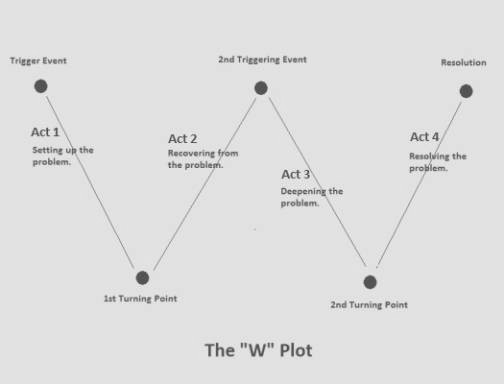
This is essentially a Freytag triangle with a high point where everything appears to be resolved before the rug is pulled out from under the protagonist and a new trial begins.

W Diagram

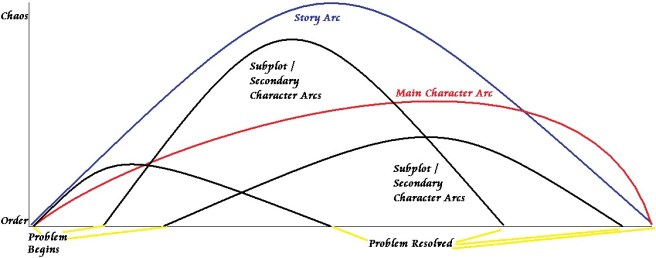
A complex story like a novel may have several hills and valleys. There may also be subplots with arcs of their own.


multiple arcs
Hacktext


Kurt Vonnegut’s Shape of Stories

In a humorous talk, the writer Kurt Vonnegut outlined the shape of stories, based on his rejected Master’s thesis. The diagrams and text from Vonnegut’s talk here are from Mcclure.

Vonnegut Man in a Hole

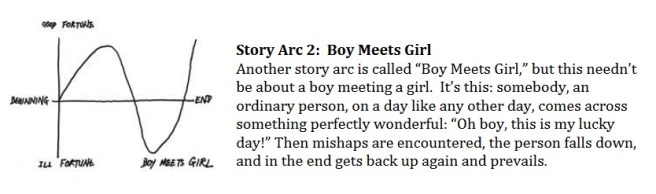
Vonnegut Boy Meets Girl

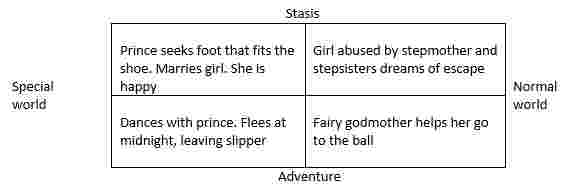
Vonnegut Cinderella.jpg

Machine intelligence analysis of story shapes

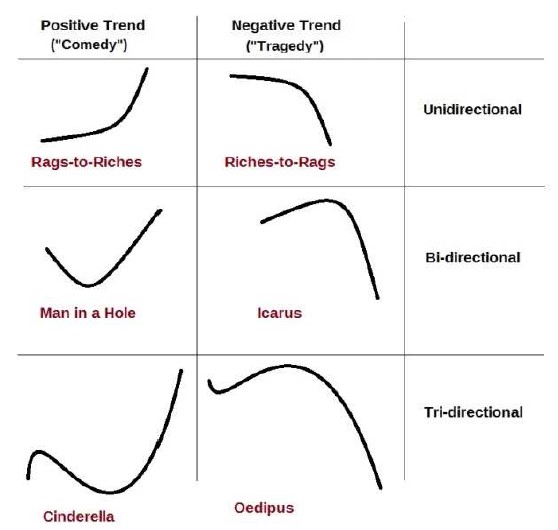
Researchers from the Universities of Vermont and Adelaide tried to test Vonnegut’s idea using machine analysis of sentiment in 1,327 Western stories. They found the stories grouped into 6 basic types. The diagrams here are from Munson Missions.

six story arcs

For those of you who like to understand method, read on. For those of you who don’t care, skip to the Hero’s Journey. These shapes were generated by analysing the words in the stories and scoring them for the degree of happiness they convey. Words like love and laughter score high, while words like terrorist and death score low. You can check this out yourself at the authors’ Hedonometer site.

Before you get too excited about this, consider the following sentence:

“Trekking through the vale of tears, dark, clammy and terrifying, we were ambushed by the monster and killed it for all of you.”

Almost every word here in unhappy, but the overall sense is one of hope. The meaning of a set of words depends on context and not just the words by themselves.

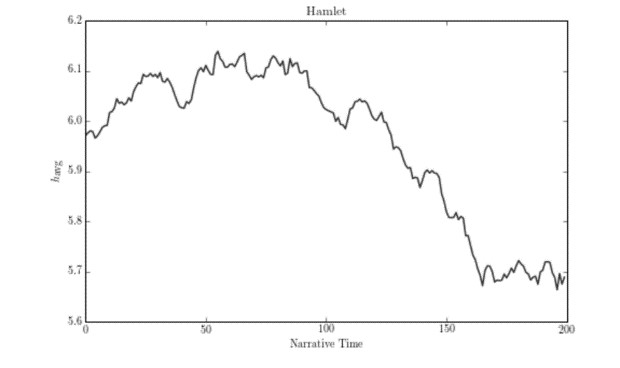
The shape generated by a machine intelligence, of course, depends on the method used. Compare these two shapes for Shakespeare’s Hamlet. This comparison was done by Kirsten Menger-Anderson.

Hamlet plot Hedonometer

Hamlet plot sentiment

The first was generated by the Hedonometer. The second by another machine intelligence routine that rates sentiment (positive or negative). They don’t look much alike.

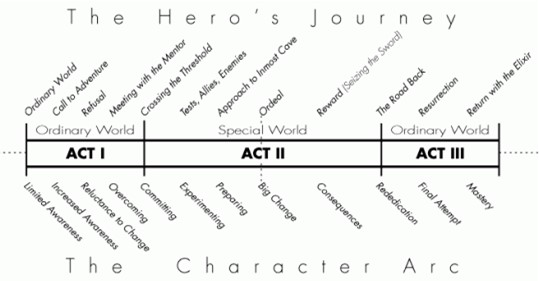
The Hero’s Journey or Quest

Heros journey linear

The Hero’s Journey is among the most commonly used story templates. It derives from the work of Joseph Campbell, who believed all stories, at root, followed the same archetype. George Lucas used it to structure the first Star Wars movie.  In Act 1 the protagonist receives the call to adventure and is assisted by a mentor to accept the challenge and move into the “special world”.  In Act 2, the protagonist is subjected to a road of trials, before winning the reward and starting back to the everyday world. Act 3 follows the road back where the protagonist delivers the reward.

For those who don’t like straight lines

The quest structure, such as the Hero’s Journey, can be represented by a “there and back” circle.

Heros journey circular

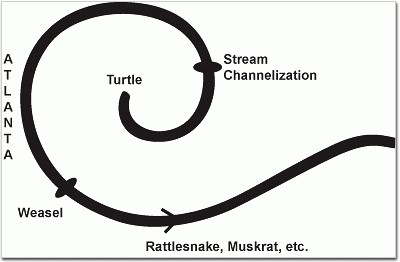
Stories that loop back on themselves are very satisfying. Though, since a circle contains no change, a spiral may be a more appropriate shape. The diagram below was made by John McPhee to illustrate the structure of his Travels in Georgia

McPhee Spiral

And finally

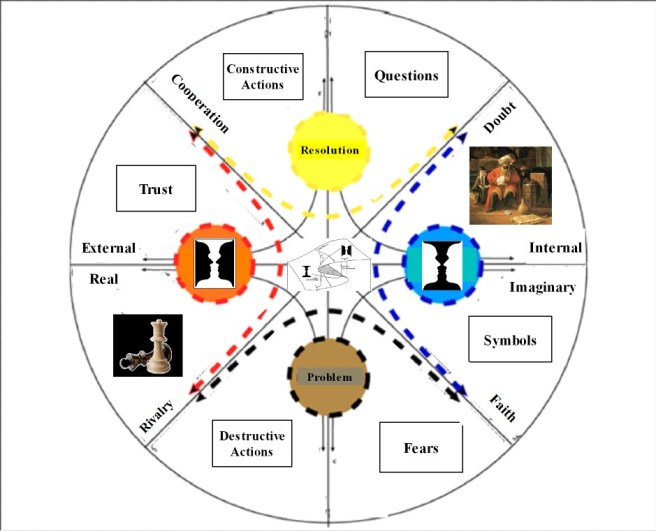
Tears of Boabdil structure 3

This was the structure diagram I constructed while writing my novel The Tears of Boabdil to try to capture the layering.

Are there any major story arc devices I’ve missed out? Let me know.

114. From tiny tickles to character reveals: tropisms

What makes the inner world of a fictional character really sing? The author can, of course, have the character think ideas, speak, and carry out actions. But, besides and more interesting than this, is the way they respond to the world and understand things. After all, the universe inside every head seems magically different from the one inside my own.

Tropisms

I’ve just come across an author who tried to render that inner world, using an idea borrowed from biology. Plants grow towards the light. Biologists call this stimulus and response phototropism.


tropism
Encyclopaedia of Human Thermodynamics

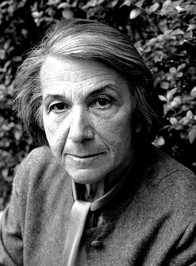
The French writer Nathalie Sarraute used the metaphor of tropism to highlight the origins of actions, speech, and feelings in the momentary experiences on the fringe of consciousness.

In the first vignette in her 1939 book Tropisms, she writes

They seemed to spring up from nowhere, blossoming out in the slightly moist tepidity of the air, they flowed gently along as though they were seeping from the walls, from the boxed trees, the benches, the dirty sidewalks, the public squares.

This seems to be a plague of weeds or vermin. In fact, she is describing people staring into shop windows.  But these are not people as characters. Rather, stripped of identifiable shapes and personalities they become sensations. Sarraute eliminated plot or character from her work, in order to explore the “impulses, desires, processes that exist before speech, before comprehension, before consciousness”, as Allison Noelle Conner puts it.

nathalie Sarraute
Nathalie Sarraute

Sarraute would devote pages to exploring the mechanisms that intervened between the stimulus and the response.

The objective correlative

Though I don’t buy into Sarraute’s analysis that plot and character are conventional masks that prevent us exploring mentality, I do find something intriguing in her approach. T.S. Elliot had a similar insight in his idea of the “objective correlative”—a sequence of things or events which creates the sensation the writer is trying to summon in the reader. He described this: “when the external facts, which must terminate in sensory experience, are given, the emotion is immediately evoked.”


Other techniques

This clearly has connections with the often tiresome writers’ dictum of “show, don’t tell”. But it takes this instruction further. It makes location, conversation, and events a means of conveying character.

It also might seem similar to Swain’s technique of the Motivation-Reaction Unit (MRU), which also works on a stimulus-response basis. However, these work on the basis of a chain from feeling to action to speech, whereas in tropism, all of these are preceded by a simple sensory experience. I wrote about my experiment with MRUs in a previous post.


A method for illuminating mentality

I’ve used the insight about pre-conscious stimuli to rework the opening chapter of my current book, The Star Compass. Robert, a bookish recluse, has come to the remote Pacific island of Yap. All his life he has avoided ever learning anything about the South Seas so he might believe there is one place on the planet where nature is bountiful and people are nice to each other. Now he is forced to have a confrontation with reality. The chapter begins:

He paused at the bottom rung of the stairway. Then stepped onto the tarmac and off the edge of the world.

Here all his maps ran out. Here be dragons.

The humid tropical night wrapped itself like a moist towel around his nose. The bulk of his body began to cook from the inside. Sweat pooled in his armpits, beaded his brow, and trickled down his spine. The perspiration felt clammy. He wanted to turn, run back into the plane, and get away from this island.

But he continued to shuffle forward towards the door of the tiny airport, keeping his place in the line of a hundred other passengers and urged on by those behind. The terminal complex was so small it lacked an immigration hall and they queued on the apron. Thankfully, it wasn’t raining, though puddles evaporating on the tarmac indicated an earlier downpour.

Things had happened here before he arrived. The island had its own hidden history. Anything might lurk here in the unknown South Pacific.

He reached the portal where souls were divided. One door for visitors, and the other for citizens of the Federated States of Micronesia. The sleepy official took his landing card, examined his passport. Robert Urquhart, UK citizen, fifty-one years old.

Yap airport
Yap International Airport

In making this revision, I hunted for small sensations in the draft and considered these as stimuli. I then checked that there was a response for every stimulus and a stimulus for every response. For example, the action of stepping onto the tarmac provokes the sensation that he’s stepped off the edge of the world. Or the stimulus of the humidity makes him want to turn and run. And the realisation from the rain puddle that the things have happened here before he arrived, triggers a fear that anything might happen here now. I aimed to render Robert’s profound unease through these small almost pre-conscious moments. Sometimes, it involved taking a small moment and expanding it.


I’d love to hear whether you’ve tried or come across anything similar.


113. The third variety of fiction

Fiction is stories, right? The protagonist encounters a challenge, sets off in pursuit, and after many travails achieves a resolution. Much genre writing fits this mould.

There is another kind of fiction where the plot can be incidental or even non-existent. This is writing based on character rather than story. Often this type is called literary.

But that’s not all. There is a third, though rare, kind of fiction, which executes its code in your brain as you read. It rewires your consciousness.

I was very struck by this again reading Nick Harkaway’s Gnomon, a literary science fiction novel set in a near future total-surveillance Britain.

gnomon

The plot revolves around a detective’s efforts to understand how a suspect could have died under a mind-mapping session. It turns out that the suspect invented a series of narratives to keep her own consciousness secret. The book loops back and forth through these stories.

There is a sequence where Harkaway’s method is evident. One of the narrative personas is brought together with a woman who he is told is his dead lover, Stella.  The text oscillates between the possibility that she is an imposter and the possibility that, if she occupies Stella’s place in the world, she is Stella. Layers of philosophical hocus pocus, of metaphor, and of narrative exposition create a universe in which this transubstantiation is plausible.

Yeah, I hear you say, all fiction does that. It invites us to suspend disbelief. But what Harkaway does is more than world-building which postulates orcs and elves and offers us an escape into magic. He transforms your sense of reality such that we understand personal identity in a new way. We don’t escape into a fantasy world. Rather, reality changes.

old-bridges-26__880

I described this technique in an earlier post.

Words can create illusions. They can bridge impossible gaps allowing magical connections to be made between unlinked things. This is the stuff of fantasy, but also the stuff of poetry and of magic realism. Imagination can stitch together things never connected in the real world. Recurring words and images can stitch together these magic connections

Harkaway describes in a blog the process of writing the book:

This was like weaving a tapestry thread by thread while holding the entire design in your head, and my head just wasn’t big enough. Meanings intersected with other meanings, with consequences. I had to go back, again and again, re-work, re-conceive, re-imagine. Sure, yeah, I know: writing is re-writing. I’m familiar with the re-write. This was more like starting a new book every four months or so. The number of plotlines and their interactions meant a kind of exponential multiplication of possibility. I’d made a maze in my own mind and I kept getting lost in it. The book was smarter than I was.

Reading Gnomon was more like taking a mind-altering drug than like narration. A few other books have done this. One was Juan Rulfo’s Pedro Paramo.

Another was A U Latif’s Songs from the Laughing Tree (currently out of print). In a review of Latif’s book I wrote

Our brains are evolved to seek pattern and meaning, and Latif plays with this. The figures of the stories loop and dive, and create impossible or magical meanings that are whimsically held together by no more than a concatenation of words, an ellipsis of adjectives.

Have you encountered books in this third type of fiction?

109. Complexity or intensity: is sentimentality bad fiction?

Much has been written about the sin of sentimentality in fiction. But is it really so bad?

What is sentimental writing?

It has to be more than simply writing that inspires emotion, a sensation of tenderness. Writing is supposed to move the reader. Sentimentality, as apposed to sentiment, is something shallow that cheapens or simplifies that emotion in order to tug at the reader’s heartstrings.

If it makes you go “aww” it’s probably an example of sentimentality.

If a story contains these stock themes, it’s likely to involve sentimentality (though these themes do also occur in deeper fiction):

  • A child’s tears
  • A sick pet
  • The forgiving father
  • The individual who stands up for right
  • The kind and wise grandparent
  • A triumph over adversity

puppies

Is it elitist to abhor sentimentality?

There was an interesting debate on sentimentality in the New York Times between authors Zoë Heller and Leslie Jamison. Heller argued that “Sentimental fiction is a kind of pablum: Excessive amounts can spoil the appetite for reality, or at least for more fibrous forms of art.” Jamison responded that “I would argue that one of the deep unspoken fears beneath the sentimentality taboo is really the fear of commonality, the fear of being just like everyone else or telling a story just like everyone else’s.”

Jamison’s point about elitism is interesting. “We all have the same stories to tell,” she writes. And it’s true that the accusation of sentimentality tends to be levelled by intellectuals at writers of pulp fiction.  Perhaps they’re just sneering at emotions they disagree with.

John Irving, writing in the New York Times, points out the hypocrisy of context. Dickens’ A Christmas Carol is among the best-loved works in English. Yet its theme of redemption is arguably sentimental, as is the tear-jerking ending where Tiny Tim says “God bless us, every one”. And yet the indulgence we afford tales of kindness at Christmas time doesn’t extend to other seasons. Critical fire greeted Dickens late grafting of a happy ending onto Great Expectations.  And I’d probably agree with the critics.

Some say the sin of sentimentality is that the author manipulates the reader into feeling certain emotions. But I think that’s true of all writing. The events on the page of a story don’t really exist—the writer simulates them to create an effect.

The reader’s collusion with sentimentality

Maybe the most useful definition of sentimentality is Oscar Wilde’s aphorism that it affords “the luxury of having an emotion without paying for it”. This definition emphasises the cheapness of the effect. But, interestingly, it also makes the consumer share responsibility for the sin with the producer.

So perhaps the issue is less to do with the emotion evoked than with what we’re enabled to do afterwards. Tropes and clichés are poor art because they confirm stereotypes rather than challenging them. In the same way, perhaps sentimentality is poor art because it denies us an understanding of how to cope with real loss or engage generously with others. If the writing doesn’t surprise and elucidate in some way, can it be good?

Jamison, in another essay, makes a similar point. She argues that sentimentalism strokes our ego by titillating our capacity to feel while simultaneously denying us genuine emotion.

I guess I’m arguing in favour of the pleasure of complexity and against the pleasure of simple intensity. Sentimentality irons out ambiguity. Whether you enjoy complexity or intensity may be no more than a matter of preferences.

What do you think? Is sentimentality a writing sin? Or is this just an elitist prejudice?


105. Magic realism vs fantasy vs surrealism

I am writing a magic realist novel. So I thought I’d better clarify for myself what the genre is. How does it differ from fantasy and surrealism, for example? Is it another name for fabulism? Where does science fiction fit?

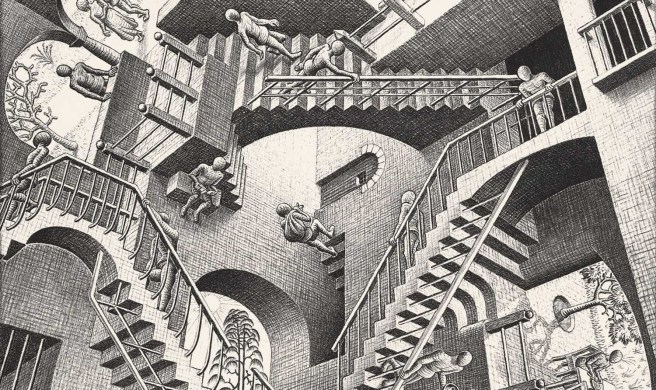
MC Escher stairs
M.C. Escher

Magic Realist writing emerged in Latin America. An example is Gabriel Garcia Marquez’s One Hundred Years of Solitude. The genre integrates, into the everyday world, elements whose logic and rules of causality are different. In magic realism, the fantastic has to be plausible, the impossible is reframed as real. Characters do extraordinary things without realising it or knowing why. Its magic is ordinary and very firmly located in reality.

In this sense it is different from fantasy, whose purpose is to create magical alternate worlds. An example is Tolkein’s Lord of the Rings. Perhaps more importantly, the purpose of the two groups of writers is different. Whereas fantasy authors are generally offering escapism, magic realist authors are often advancing a critique of the real world. In Latin America it has roots in the critique of neo-colonialism.

Marquez, one of the originators of the genre, expressed this in his speech on accepting the Nobel Prize for literature in 1982: “our crucial problem has been a lack of conventional means to render our lives believable.”

In this, magic realism also differs from surrealism. Both genres explore illogical or non-realist aspects of existence, but surrealism invites us to look inwards to the subconscious machinery of imagination, while magic realism’s focus tends to be on society.

I have written several stories that I describe as fabulism. Some people see fabulism as a branch of magic realism. And that makes sense, if you consider the purpose. Like magic realism, fabulist writing tends to offer social commentary. But the technique is different, Fabulism need not be realist. It draws on tropes of myth and fable, often combining them in unusual ways to create a new, hybrid story.

Finally, all of these genres are different from science fiction, which requires a plausible extrapolation of existing scientific knowledge to explain the extraordinary. A goose that lays golden eggs is fairy tale. A goose, genetically engineered so that it metabolises gold and deposits the metal in its shell, is science fiction.

Do you think genre descriptions matter? Do you have different definitions? Leave a comment and join the debate.

103. Two steps forward, one step back

step in sand

Last month I talked about some ways to drive more traffic to your site, and said I was going to experiment with some of the ideas.

  • Guest posts on other blogs
  • Building an e-mail list
  • Joining an online writing community

The guest post is still scheduled. I can now report on the other two.

Building an e-mail list

I used MailChimp to mail a newsletter to a list of 158 people who follow my blog and/or who have commented regularly and thoughtfully on my writing. The draft newsletter was pilot tested with nine people.

The mailing didn’t go hugely well.  Yes, on the one hand the response was well above industry benchmarks. On average, 22% of e-mails in the media and publishing industry are opened. My open-rate was 42.7%. Again, the industry benchmark for “click rate” (clicking on “subscribe”) is 4.66%, while in my case it was 14.6%.

But something went horribly wrong. I should have received 23 subscription notifications. But I only got three. Some people told me independently that they had signed up, bringing my e-mail list to eight. So, I’m missing 15 subscriptions. I guess I made some mistake with MailChimp.

subscribe


The Scribophile writing community

Scribophile is a large members-only community of writers, and claims 858,776 critiques for 145,608 works, an average of just under six responses per work. Being a closed group, it has the advantage that it shouldn’t prevent you submitting your work elsewhere. I joined it last month, and I’m pretty impressed.

It runs, like any successful community, on the basis of reciprocity. You can’t post your own writing without first contributing, most particularly by critiquing others’ work. There are groups for people with particular interests, bulletin boards, competitions. And, of course, posting your writing for critique. I’ve used it to test out whether readers will tolerate breaking some pretty fundamental rules about first chapters.

I’m a newbie on the site – you start with the rank of “Scribbler” and can rise to “Scribomaster”; I have reached the dizzying heights of Typesetter. Despite that, I can track 16 visits to my blog originating from Scribophile. I also have 13 followers on the site.

102. The bots are reading your mind! Not

Do we need to be scared of big data and its claimed spooky ability to know more about us than our partners, to mould our behaviour like puppeteers?

An e-mail dropped into my inbox today from Amazon. I won’t name the book or the author the tech giant’s algorithm was trying to market to me. Usually I delete Amazon’s recommendations unread, but this time I looked at the book. Not because I expected I’d want to read it, but because I wanted to understand the marketing. The book was described as “An emotional psychological thriller with a twist.”  That already annoyed me: why both psychological and emotional? And, yeah, of course it has a twist. The only thing it didn’t tell me is what reading level I need in order to follow the prose.

I began to read the taster. It began with an odd question. That was designed to intrigue and to hook my attention. The meaning of the question is explained by the bottom of the first page, in case my patience flags. There’s a hammer-beat of short staccato sentences, designed to lunge for my heart. There’s a bit of backstory. Hmm. Backstory on the first page? That’s a mistake when we’re supposed to be in the relentless attention-grabbing now.

The machine algorithm is marketing something to me I wouldn’t read in a million years. Primarily because it feels like it was assembled by a machine according to a formula. Facebook’s algorithms keep showing me pictures of cute dogs. Actually, it’s my wife who’s keen on cute dogs, not me.

My point is despite all that machine learning and big data, these two tech giants still have little clue who I am and what I like.

facebook fingers crossed
Image credit Wired


So, exactly how afraid should we be of Cambridge Analytica? The data breach that allowed the company to harvest the details of 50 million Facebook users is undoubtedly serious. But did it get Donald Trump elected President of the US? Did similar dirty tricks swing the Brexit referendum in the UK?  Let’s examine what they’re able to do with the data.

The core of the data analysis seems to be a personality quiz app, developed by a Cambridge University academic and downloaded by 27,000 people. The quiz broke people down into groups, dominated by traits like agreeableness, openness, neuroticism etc. We’ve all done such tests in magazines. There are 72 different online personality tests available on the website of Cambridge University’s (not to be confused with Cambridge Analytica) Psychometrics Centre. Clearly this is not an exact science.

What was different in this case was the ability to look for correlations between the personality quiz results and Facebook records, such as what people liked. Here it does start to get a bit more sinister. For example, a 2013 research paper by three academics from the Psychometrics Centre showed that it was possible to predict intimate information about a person from their Facebook likes, information such as sexuality and political leanings.

In some cases, the correlations were pretty obvious – liking the “No H8” campaign and being gay. In others they were less clear. For example, users who liked the “Hello Kitty” brand tended to be high on “Openness” and low on “Conscientiousness”, “Agreeableness”, and “Emotional Stability”. They were also more likely to have Democratic political views (75%) and to be of African-American origin (82%), predominantly Christian (69%), and slightly below average age.

While it’s not precise, what this does is allow micro-targeting. Instead of standing at a hustings and bellowing the same message to everyone, a political candidate can whisper different messages to different groups – threat messages to the fearful, for example, and optimistic messages to the bold. The Cambridge Analytica whistle-blower, Christopher Wylie, said this is exactly what the company did.

Was that enough to lose Hilary Clinton the US presidential election? We don’t yet know. A scientific test would require demonstration that micro-targeted ads outperform random ads in changing consumer actions. But my guess is that Cambridge Analytica was better at marketing itself to sleazy clients than it was at targeting and changing voters’ behaviour. Predicting personality attributes is not the same thing as changing behaviour. And, despite the hype, it’s not at all clear that the algorithm is any better at prediction than a human would be.  If Amazon can’t even get my reading preferences right, what chance big data can make me vote for someone whose politics I don’t like?

101. The novel as self-discovery

I don’t just write – I write myself at the same time as the stories. Or at least, I explore myself in the act of writing, and discover things I didn’t know.

There are now enough novels under my belt (five) to constitute an oevre (yay). As an avid analyser, I can now explore what this tells me.

  1. Each novel is a in a different genre. The first is an amalgam of detective, sci-fi, and psychological thriller. The second, is literary travel– a journey of the mind coupled with a journey to an exotic location. The third, historical fantasy. The fourth, an amalgam of historical and detective. The fifth is again literary, and a romantic political thriller. So, if I don’t follow a genre (almost certainly a marketing mistake) what do my books have in common that marks them as mine?
  2. The main male character is almost always flawed and, at least in part, hard to like. They are often unreliable narrators. The only exception to this is the historical fantasy novel.
Scream2
Edvard Munch The Scream
  1. The stories are almost always told in close third or first person by a single narrator. Again, the historical fantasy novel is the exception. In this one I experimented with multiple point-of-view characters.
  2. The stories are multi-threaded. There is usually a surface narrative which conforms roughly to a genre format, and then there are other threads. The fifth book, The Tears of Boabdil, does this is spades. There is a fairly simple story of an undercover policeman attempting to penetrate what he believe is a terrorist cell, and falling for the sister of the cell’s leader. Yet there is little of the tension you would expect from a thriller because the narrator gives away in the first chapter most of what subsequently happens. This follows the advice of Boris Fishman

If your story has a secret reveal it from the top.

The drama of the story is in how the protagonist deals with his secret.  But there are also magic realist elements of a parallel story of a wandering minstrel in Moorish Spain. What connects both of these strands, which begin to interweave, is a commentary on truth in which identity becomes the story we tell ourselves and other people.

  1. There is a common human preoccupation behind all of these stories. The main character is usually confused or conflicted about what is really important to him. Though there are antagonists in all but the literary travel story, the real barrier to be overcome is internal. Many of the lead characters are of dubious sanity. There is often a helper character who is female and who is usually strong and whole. In some of the stories, the confusion gets the better of the protagonist. In others, he overcomes his barrier.
  2. There is a political (with a small “p”) preoccupation behind many of these stories. Part of what the protagonist confronts is social injustice, and the way in which different cultures or sub-cultures get labelled as “other”. The politics is most explicit in the historical fantasy novel, which tracks the attempt of two very different Kings to maintain the integrity of their realms and the allegiance of their peoples.

Now that is all pretty interesting to me (though whether it is to you, only you can say). I hadn’t set out with the intention of writing flawed protagonists. Noble heroes are much easier to like (though arguably much less interesting). Readers identify with heroes, but their sympathy is engaged by flaws. So I guess, a first principle of my writing is

Your protagonist doesn’t have to be likeable, but s/he does have to be interesting

Clockwork orange
Malcolm McDowell as Alex in A Clockwork Orange

Am I using my characters’ flaws to explore something in myself? Possibly, but if so, I don’t know what it might be. The characters all have different flaws. I don’t think they’re me, though each of them has some aspect of me. I didn’t consciously decide to write conflicted protagonists. It just happened. So, I reassure myself that I just enjoy the depth that a flawed character allows.

Meaning snoopy

The preoccupation with what things mean is definitely me, and the idea that we are all stories is certainly a recurring theme. The first book is even called Identity.

Facts are everything that exists. Stories are the connections between them. Stories tell us what goes with what, what is important and what is unimportant, who to praise and who to blame.

The multi-threading is also a signature. I like stories with layers, especially where the layers “rhyme”.  Just as a piece of music is dull if it only has a simple beat and melody, so with a story.

Complexity rewards the reader’s attention when s/he recognises recurring motifs. Complexity also adds ambiguity, blurring certainty. It makes the reader part of the story’s construction, because there is no single reading, there are as many stories as there are readers. A story only belongs to the author up to the moment of publication. From then on, it belongs to the readers.

complexity

Images and metaphors from myth and religion recur frequently in my work, even more so in the short stories. Which is odd really, since I’m not religious. Or maybe I am, and I just don’t know it. I wrote a story, Cara’s Saga, which is a deliberate bricolage (a delicious French world, meaning a construction from a variety of a diverse range of things). And that, of course, is the attraction of bricolage. The story invents a world which is part Inca, part Australian aboriginal, part Canadian northwest seaboard, wrapped up in a homage to Norse sagas. I loved writing it. The Sumerian goddess Ishtar is a character in The Tears of Boabdil.

And there’s a clue there to the pre-occupation underlying it. I’ve been planning to write for most of my working life, but decided not to (at least not write fiction) until I could write whatever I damned well pleased without having to worry about whether it was commercial. I always imagined I’d write science fiction. And yet, I’ve written very little of that genre. I like to explore different worlds, both for the curiosities I encounter there and for the underlying music of the universal human spirit at work. It turns out that the most interesting worlds to me are not those with elves and dragons (I actively dislike elves and dragons), or empires in other galaxies. The most interesting worlds are those inside people’s heads. I’m interested in the ways that people understand things, and how that makes them act.

Stories should take us to places we’ve never been before, and introduce us to characters we’ve never met before. The writer constructs a new world for us. But you don’t have to cross galaxies to do this. Inside every head there is a world which, to the rest of us, is unimaginably different and strange. Since we can never enter these worlds in reality, it’s the job of fiction to take us there and show us our friends, our partners, and our children as they really are.

If we were all aliens beneath the skin, that would be as scary as the pod people in the classic (McCarthy era and anti-communist) sci-fi movie Invasion of the Body Snatchers. So the work of fiction is not to render people as “other” but as (at least in part) delightfully like us. We have to be able to understand and empathise with the alien universes inside their heads.

I think getting a handle on how those mystifying creatures around me think and feel and construct meaning is my main motivation for writing.

And that’s probably why I’m so drawn to religion and myth. I wasn’t even really aware of this until I was doing a reading at a “Lit Live” event in Frensham and the poet, Jo Young asked me why I used so much religious reference. The impulse is literary, not a religious. These are simply great stories, the best our species has created. And why are they so great? Because they have been the glue which binds communities and peoples together. They express universal longings and fears, and explain, in their distinct and unique ways, cultures to themselves.

Religion and myth are a wonderful toolkit of story pieces.

electronic hobbyist

Like an electronic hobbyist, the writer can take characters and themes and events from them, and plug these into the circuit board of a story. And when narrative current is passed through them, they resonate with deep energy that draws in the freight of hundreds or thousands of years of storytelling.

97. My Writing Year

Personally I don’t make resolutions, but that may not be true of you. It may be important to resolve, for example, to make time to write every day, or to complete what you’ve started, or to edit more, or any number of things.

I do plan, though, what I can realistically achieve this year as a writer. Luckily, most of those decisions are already taken for me in 2018.

January 1 Make plans

I have a first draft of a novel, The Tears of Boabdil, that I’m really excited about AND that I believe has commercial possibilities. The year is book-ended by the opening and closing of a 12-month long mentorship I’ve been awarded by Cinnamon Press. In that time, I plan to get my novel into a publishable state.

January Enter short story competitions I’m more likely to win

For several years, I’ve been unsuccessfully entering some of the biggest competitions the literary world has to offer – the Bridport, the Sunday Times EFG, the Costa, for example. I will probably enter them again this year. But with the chances of placing ranging from just over 1% to less than a quarter of a per cent, the odds are not in my favour.

So this year I am also entering competitions with more favourable odds. I have sent stories to competitions where the odds of placing are around 4% to 5%:

·         Exeter, which closes on 28 February

·         Bath, which closes on 23 April

·         Yeovil, which closes on 31 May

I have entered all of these, as well as the BBC National Short Story Competition, which closes on 12 March and the Winchester Writers Festival short story competition, which closes on 11 April.

February – December Rework the novel

Comments from my mentor should be back by the end of February. If I enter the Bridport Novel Competition, I may want to concentrate in the first half of the year on the initial 15,000 words.

April – May Bridport Competition

This closes 31 May. I ‘m thinking of entering the novel competition rather than the short story.

June – August Sunday Times EFG Competition

Details not yet announced. But will probably open in June and close in September.

Winchester Writers’ Festival

15-17 June.

Costa Short Story Award

Details not yet announced. But will probably open in July and close in August.

September – November Farnham Short Story Competition

Not one to enter, but to run.

Writers’ Retreat

Ty’n y Coed, November, run by Cinnamon Press

95. I won, I won, I won

It’s been a lean year for writing plaudits. In the 12 months to the end of November only 6.2% of the stories I submitted were published, compared with 14.7% for 2016. To be fair, this doesn’t include the analysis piece I wrote for Writers’ Forum, and also I’m now submitting to magazines with lower acceptance rates. But despite all the quibbles, it’s glum-making.

So, I was encouraged to get the e-mail telling me I’d won the Plot of Gold Challenge with the outline of my work in progress, The Tears of Boabdil, which I mentioned in an earlier post. This contest run by two literary software companies, ProWritingAId and Beemgee, was open during October and November. Using the Beemgee outlining package, contestants developed characters, plot outlines, and synopses.

beemgee

This was the first time I’d used Beemgee (short for Boy Meets Girl) and I was impressed, for two main reasons. Firstly, it connects character organically to plot, embodying the principle that, if you know what your characters want, you have a plot. Secondly, because it invites you to think about your expectations of audience response to your characters and how this might go wrong. I’ve been using the ProWritingAid editing package for several years now, and swear by it as an effortless way to check grammar, punctuation, and word-use.

“Ideas were unconventional and daring, narrative strong and complex, characters were sympathetic and compelling. Stunningly ambitious with great literary potential.”

The elevator pitch for my book was “When a policeman infiltrates a terrorist group, he embarks on a doomed taboo liaison with a beautiful quarry. He must choose to betray his love or his duty. This story, about politics and passion, tracks the magic and tragedy of a lie.” This isn’t a spoiler because I followed the principle of “if you have a secret, give it away right at the top”. We learn in Chapter 5 that he is an undercover police agent.

The judges said of my outline and that of CL Lynch with whom I shared the winning spot “Huge congratulations to both of these hugely talented authors. Their ideas were unconventional and daring. Their narratives were strong and complex. Their characters were sympathetic and compelling. One is superbly structured and instantly moving, the other stunningly ambitious with great literary potential.”

Winning boosted my flagging spirits. And I take home a lifetime licence for Beemgee and ProWritingAid. Congratulations to my co-winner, CL Lynch, and thanks to both companies.