Much has been written about the sin of sentimentality in fiction. But is it really so bad?
What is sentimental writing?
It has to be more than simply writing that inspires emotion, a sensation of tenderness. Writing is supposed to move the reader. Sentimentality, as apposed to sentiment, is something shallow that cheapens or simplifies that emotion in order to tug at the reader’s heartstrings.
If it makes you go “aww” it’s probably an example of sentimentality.
If a story contains these stock themes, it’s likely to involve sentimentality (though these themes do also occur in deeper fiction):
A child’s tears
A sick pet
The forgiving father
The individual who stands up for right
The kind and wise grandparent
A triumph over adversity
Is it elitist to abhor sentimentality?
There was an interesting debate on sentimentality in the New York Times between authors Zoë Heller and Leslie Jamison. Heller argued that “Sentimental fiction is a kind of pablum: Excessive amounts can spoil the appetite for reality, or at least for more fibrous forms of art.” Jamison responded that “I would argue that one of the deep unspoken fears beneath the sentimentality taboo is really the fear of commonality, the fear of being just like everyone else or telling a story just like everyone else’s.”
Jamison’s point about elitism is interesting. “We all have the same stories to tell,” she writes. And it’s true that the accusation of sentimentality tends to be levelled by intellectuals at writers of pulp fiction. Perhaps they’re just sneering at emotions they disagree with.
John Irving, writing in the New York Times, points out the hypocrisy of context. Dickens’ A Christmas Carol is among the best-loved works in English. Yet its theme of redemption is arguably sentimental, as is the tear-jerking ending where Tiny Tim says “God bless us, every one”. And yet the indulgence we afford tales of kindness at Christmas time doesn’t extend to other seasons. Critical fire greeted Dickens late grafting of a happy ending onto Great Expectations. And I’d probably agree with the critics.
Some say the sin of sentimentality is that the author manipulates the reader into feeling certain emotions. But I think that’s true of all writing. The events on the page of a story don’t really exist—the writer simulates them to create an effect.
The reader’s collusion with sentimentality
Maybe the most useful definition of sentimentality is Oscar Wilde’s aphorism that it affords “the luxury of having an emotion without paying for it”. This definition emphasises the cheapness of the effect. But, interestingly, it also makes the consumer share responsibility for the sin with the producer.
So perhaps the issue is less to do with the emotion evoked than with what we’re enabled to do afterwards. Tropes and clichés are poor art because they confirm stereotypes rather than challenging them. In the same way, perhaps sentimentality is poor art because it denies us an understanding of how to cope with real loss or engage generously with others. If the writing doesn’t surprise and elucidate in some way, can it be good?
Jamison, in another essay, makes a similar point. She argues that sentimentalism strokes our ego by titillating our capacity to feel while simultaneously denying us genuine emotion.
I guess I’m arguing in favour of the pleasure of complexity and against the pleasure of simple intensity. Sentimentality irons out ambiguity. Whether you enjoy complexity or intensity may be no more than a matter of preferences.
What do you think? Is sentimentality a writing sin? Or is this just an elitist prejudice?
I am writing a magic realist novel. So I thought I’d better clarify for myself what the genre is. How does it differ from fantasy and surrealism, for example? Is it another name for fabulism? Where does science fiction fit?
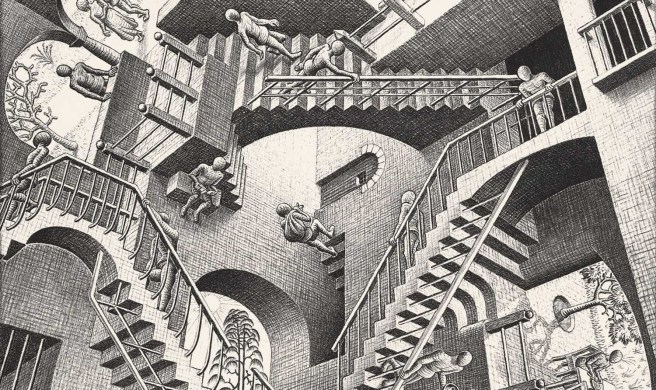
M.C. Escher
Magic Realist writing emerged in Latin America. An example is Gabriel Garcia Marquez’s One Hundred Years of Solitude. The genre integrates, into the everyday world, elements whose logic and rules of causality are different. In magic realism, the fantastic has to be plausible, the impossible is reframed as real. Characters do extraordinary things without realising it or knowing why. Its magic is ordinary and very firmly located in reality.
In this sense it is different from fantasy, whose purpose is to create magical alternate worlds. An example is Tolkein’s Lord of the Rings. Perhaps more importantly, the purpose of the two groups of writers is different. Whereas fantasy authors are generally offering escapism, magic realist authors are often advancing a critique of the real world. In Latin America it has roots in the critique of neo-colonialism.
Marquez, one of the originators of the genre, expressed this in his speech on accepting the Nobel Prize for literature in 1982: “our crucial problem has been a lack of conventional means to render our lives believable.”
In this, magic realism also differs from surrealism. Both genres explore illogical or non-realist aspects of existence, but surrealism invites us to look inwards to the subconscious machinery of imagination, while magic realism’s focus tends to be on society.
I have written several stories that I describe as fabulism. Some people see fabulism as a branch of magic realism. And that makes sense, if you consider the purpose. Like magic realism, fabulist writing tends to offer social commentary. But the technique is different, Fabulism need not be realist. It draws on tropes of myth and fable, often combining them in unusual ways to create a new, hybrid story.
Finally, all of these genres are different from science fiction, which requires a plausible extrapolation of existing scientific knowledge to explain the extraordinary. A goose that lays golden eggs is fairy tale. A goose, genetically engineered so that it metabolises gold and deposits the metal in its shell, is science fiction.
Do you think genre descriptions matter? Do you have different definitions? Leave a comment and join the debate.
The guest post is still scheduled. I can now report on the other two.
Building an e-mail list
I used MailChimp to mail a newsletter to a list of 158 people who follow my blog and/or who have commented regularly and thoughtfully on my writing. The draft newsletter was pilot tested with nine people.
The mailing didn’t go hugely well. Yes, on the one hand the response was well above industry benchmarks. On average, 22% of e-mails in the media and publishing industry are opened. My open-rate was 42.7%. Again, the industry benchmark for “click rate” (clicking on “subscribe”) is 4.66%, while in my case it was 14.6%.
But something went horribly wrong. I should have received 23 subscription notifications. But I only got three. Some people told me independently that they had signed up, bringing my e-mail list to eight. So, I’m missing 15 subscriptions. I guess I made some mistake with MailChimp.
The Scribophile writing community
Scribophile is a large members-only community of writers, and claims 858,776 critiques for 145,608 works, an average of just under six responses per work. Being a closed group, it has the advantage that it shouldn’t prevent you submitting your work elsewhere. I joined it last month, and I’m pretty impressed.
It runs, like any successful community, on the basis of reciprocity. You can’t post your own writing without first contributing, most particularly by critiquing others’ work. There are groups for people with particular interests, bulletin boards, competitions. And, of course, posting your writing for critique. I’ve used it to test out whether readers will tolerate breaking some pretty fundamental rules about first chapters.
I’m a newbie on the site – you start with the rank of “Scribbler” and can rise to “Scribomaster”; I have reached the dizzying heights of Typesetter. Despite that, I can track 16 visits to my blog originating from Scribophile. I also have 13 followers on the site.
Do we need to be scared of big data and its claimed spooky ability to know more about us than our partners, to mould our behaviour like puppeteers?
An e-mail dropped into my inbox today from Amazon. I won’t name the book or the author the tech giant’s algorithm was trying to market to me. Usually I delete Amazon’s recommendations unread, but this time I looked at the book. Not because I expected I’d want to read it, but because I wanted to understand the marketing. The book was described as “An emotional psychological thriller with a twist.” That already annoyed me: why both psychological and emotional? And, yeah, of course it has a twist. The only thing it didn’t tell me is what reading level I need in order to follow the prose.
I began to read the taster. It began with an odd question. That was designed to intrigue and to hook my attention. The meaning of the question is explained by the bottom of the first page, in case my patience flags. There’s a hammer-beat of short staccato sentences, designed to lunge for my heart. There’s a bit of backstory. Hmm. Backstory on the first page? That’s a mistake when we’re supposed to be in the relentless attention-grabbing now.
The machine algorithm is marketing something to me I wouldn’t read in a million years. Primarily because it feels like it was assembled by a machine according to a formula. Facebook’s algorithms keep showing me pictures of cute dogs. Actually, it’s my wife who’s keen on cute dogs, not me.
My point is despite all that machine learning and big data, these two tech giants still have little clue who I am and what I like.
So, exactly how afraid should we be of Cambridge Analytica? The data breach that allowed the company to harvest the details of 50 million Facebook users is undoubtedly serious. But did it get Donald Trump elected President of the US? Did similar dirty tricks swing the Brexit referendum in the UK? Let’s examine what they’re able to do with the data.
The core of the data analysis seems to be a personality quiz app, developed by a Cambridge University academic and downloaded by 27,000 people. The quiz broke people down into groups, dominated by traits like agreeableness, openness, neuroticism etc. We’ve all done such tests in magazines. There are 72 different online personality tests available on the website of Cambridge University’s (not to be confused with Cambridge Analytica) Psychometrics Centre. Clearly this is not an exact science.
What was different in this case was the ability to look for correlations between the personality quiz results and Facebook records, such as what people liked. Here it does start to get a bit more sinister. For example,a 2013 research paper by three academics from the Psychometrics Centre showed that it was possible to predict intimate information about a person from their Facebook likes, information such as sexuality and political leanings.
In some cases, the correlations were pretty obvious – liking the “No H8” campaign and being gay. In others they were less clear. For example, users who liked the “Hello Kitty” brand tended to be high on “Openness” and low on “Conscientiousness”, “Agreeableness”, and “Emotional Stability”. They were also more likely to have Democratic political views (75%) and to be of African-American origin (82%), predominantly Christian (69%), and slightly below average age.
While it’s not precise, what this does is allow micro-targeting. Instead of standing at a hustings and bellowing the same message to everyone, a political candidate can whisper different messages to different groups – threat messages to the fearful, for example, and optimistic messages to the bold. The Cambridge Analytica whistle-blower, Christopher Wylie, said this is exactly what the company did.
Was that enough to lose Hilary Clinton the US presidential election? We don’t yet know. A scientific test would require demonstration that micro-targeted ads outperform random ads in changing consumer actions. But my guess is that Cambridge Analytica was better at marketing itself to sleazy clients than it was at targeting and changing voters’ behaviour. Predicting personality attributes is not the same thing as changing behaviour. And, despite the hype, it’s not at all clear that the algorithm is any better at prediction than a human would be. If Amazon can’t even get my reading preferences right, what chance big data can make me vote for someone whose politics I don’t like?
I don’t just write – I write myself at the same time as the stories. Or at least, I explore myself in the act of writing, and discover things I didn’t know.
There are now enough novels under my belt (five) to constitute an oevre (yay). As an avid analyser, I can now explore what this tells me.
Each novel is a in a different genre. The first is an amalgam of detective, sci-fi, and psychological thriller. The second, is literary travel– a journey of the mind coupled with a journey to an exotic location. The third, historical fantasy. The fourth, an amalgam of historical and detective. The fifth is again literary, and a romantic political thriller. So, if I don’t follow a genre (almost certainly a marketing mistake) what do my books have in common that marks them as mine?
The main male character is almost always flawed and, at least in part, hard to like. They are often unreliable narrators. The only exception to this is the historical fantasy novel.
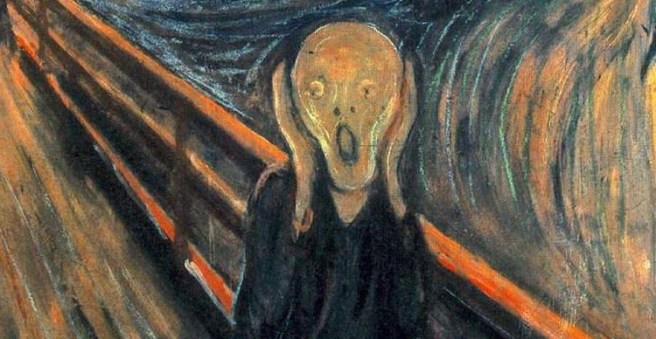
Edvard Munch The Scream
The stories are almost always told in close third or first person by a single narrator. Again, the historical fantasy novel is the exception. In this one I experimented with multiple point-of-view characters.
The stories are multi-threaded. There is usually a surface narrative which conforms roughly to a genre format, and then there are other threads. The fifth book, The Tears of Boabdil, does this is spades. There is a fairly simple story of an undercover policeman attempting to penetrate what he believe is a terrorist cell, and falling for the sister of the cell’s leader. Yet there is little of the tension you would expect from a thriller because the narrator gives away in the first chapter most of what subsequently happens. This follows the advice of Boris Fishman
If your story has a secret reveal it from the top.
The drama of the story is in how the protagonist deals with his secret. But there are also magic realist elements of a parallel story of a wandering minstrel in Moorish Spain. What connects both of these strands, which begin to interweave, is a commentary on truth in which identity becomes the story we tell ourselves and other people.
There is a common human preoccupation behind all of these stories. The main character is usually confused or conflicted about what is really important to him. Though there are antagonists in all but the literary travel story, the real barrier to be overcome is internal. Many of the lead characters are of dubious sanity. There is often a helper character who is female and who is usually strong and whole. In some of the stories, the confusion gets the better of the protagonist. In others, he overcomes his barrier.
There is a political (with a small “p”) preoccupation behind many of these stories. Part of what the protagonist confronts is social injustice, and the way in which different cultures or sub-cultures get labelled as “other”. The politics is most explicit in the historical fantasy novel, which tracks the attempt of two very different Kings to maintain the integrity of their realms and the allegiance of their peoples.
Now that is all pretty interesting to me (though whether it is to you, only you can say). I hadn’t set out with the intention of writing flawed protagonists. Noble heroes are much easier to like (though arguably much less interesting). Readers identify with heroes, but their sympathy is engaged by flaws. So I guess, a first principle of my writing is
Your protagonist doesn’t have to be likeable, but s/he does have to be interesting
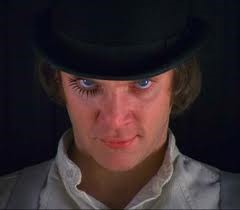
Malcolm McDowell as Alex in A Clockwork Orange
Am I using my characters’ flaws to explore something in myself? Possibly, but if so, I don’t know what it might be. The characters all have different flaws. I don’t think they’re me, though each of them has some aspect of me. I didn’t consciously decide to write conflicted protagonists. It just happened. So, I reassure myself that I just enjoy the depth that a flawed character allows.
The preoccupation with what things mean is definitely me, and the idea that we are all stories is certainly a recurring theme. The first book is even called Identity.
Facts are everything that exists. Stories are the connections between them. Stories tell us what goes with what, what is important and what is unimportant, who to praise and who to blame.
The multi-threading is also a signature. I like stories with layers, especially where the layers “rhyme”. Just as a piece of music is dull if it only has a simple beat and melody, so with a story.
Complexity rewards the reader’s attention when s/he recognises recurring motifs. Complexity also adds ambiguity, blurring certainty. It makes the reader part of the story’s construction, because there is no single reading, there are as many stories as there are readers. A story only belongs to the author up to the moment of publication. From then on, it belongs to the readers.
Images and metaphors from myth and religion recur frequently in my work, even more so in the short stories. Which is odd really, since I’m not religious. Or maybe I am, and I just don’t know it. I wrote a story, Cara’s Saga, which is a deliberate bricolage (a delicious French world, meaning a construction from a variety of a diverse range of things). And that, of course, is the attraction of bricolage. The story invents a world which is part Inca, part Australian aboriginal, part Canadian northwest seaboard, wrapped up in a homage to Norse sagas. I loved writing it. The Sumerian goddess Ishtar is a character in The Tears of Boabdil.
And there’s a clue there to the pre-occupation underlying it. I’ve been planning to write for most of my working life, but decided not to (at least not write fiction) until I could write whatever I damned well pleased without having to worry about whether it was commercial. I always imagined I’d write science fiction. And yet, I’ve written very little of that genre. I like to explore different worlds, both for the curiosities I encounter there and for the underlying music of the universal human spirit at work. It turns out that the most interesting worlds to me are not those with elves and dragons (I actively dislike elves and dragons), or empires in other galaxies. The most interesting worlds are those inside people’s heads. I’m interested in the ways that people understand things, and how that makes them act.
Stories should take us to places we’ve never been before, and introduce us to characters we’ve never met before. The writer constructs a new world for us. But you don’t have to cross galaxies to do this. Inside every head there is a world which, to the rest of us, is unimaginably different and strange. Since we can never enter these worlds in reality, it’s the job of fiction to take us there and show us our friends, our partners, and our children as they really are.
If we were all aliens beneath the skin, that would be as scary as the pod people in the classic (McCarthy era and anti-communist) sci-fi movie Invasion of the Body Snatchers. So the work of fiction is not to render people as “other” but as (at least in part) delightfully like us. We have to be able to understand and empathise with the alien universes inside their heads.
I think getting a handle on how those mystifying creatures around me think and feel and construct meaning is my main motivation for writing.
And that’s probably why I’m so drawn to religion and myth. I wasn’t even really aware of this until I was doing a reading at a “Lit Live” event in Frensham and the poet, Jo Young asked me why I used so much religious reference. The impulse is literary, not a religious. These are simply great stories, the best our species has created. And why are they so great? Because they have been the glue which binds communities and peoples together. They express universal longings and fears, and explain, in their distinct and unique ways, cultures to themselves.
Religion and myth are a wonderful toolkit of story pieces.
Like an electronic hobbyist, the writer can take characters and themes and events from them, and plug these into the circuit board of a story. And when narrative current is passed through them, they resonate with deep energy that draws in the freight of hundreds or thousands of years of storytelling.
Personally I don’t make resolutions, but that may not be true of you. It may be important to resolve, for example, to make time to write every day, or to complete what you’ve started, or to edit more, or any number of things.
I do plan, though, what I can realistically achieve this year as a writer. Luckily, most of those decisions are already taken for me in 2018.
January 1
Make plans
I have a first draft of a novel, The Tears of Boabdil, that I’m really excited about AND that I believe has commercial possibilities. The year is book-ended by the opening and closing of a 12-month long mentorship I’ve been awarded by Cinnamon Press. In that time, I plan to get my novel into a publishable state.
January
Enter short story competitions I’m more likely to win
For several years, I’ve been unsuccessfully entering some of the biggest competitions the literary world has to offer – the Bridport, the Sunday Times EFG, the Costa, for example. I will probably enter them again this year. But with the chances of placing ranging from just over 1% to less than a quarter of a per cent, the odds are not in my favour.
I have entered all of these, as well as the BBC National Short Story Competition, which closes on 12 March and the Winchester Writers Festival short story competition, which closes on 11 April.
February – December
Rework the novel
Comments from my mentor should be back by the end of February. If I enter the Bridport Novel Competition, I may want to concentrate in the first half of the year on the initial 15,000 words.
April – May
Bridport Competition
This closes 31 May. I ‘m thinking of entering the novel competition rather than the short story.
June – August
Sunday Times EFG Competition
Details not yet announced. But will probably open in June and close in September.
Winchester Writers’ Festival
15-17 June.
Costa Short Story Award
Details not yet announced. But will probably open in July and close in August.
It’s been a lean year for writing plaudits. In the 12 months to the end of November only 6.2% of the stories I submitted were published, compared with 14.7% for 2016. To be fair, this doesn’t include the analysis piece I wrote for Writers’ Forum, and also I’m now submitting to magazines with lower acceptance rates. But despite all the quibbles, it’s glum-making.
So, I was encouraged to get the e-mail telling me I’d won the Plot of Gold Challengewith the outline of my work in progress, The Tears of Boabdil, which I mentioned in an earlier post. This contest run by two literary software companies, ProWritingAId and Beemgee, was open during October and November. Using the Beemgee outlining package, contestants developed characters, plot outlines, and synopses.
This was the first time I’d used Beemgee (short for Boy Meets Girl) and I was impressed, for two main reasons. Firstly, it connects character organically to plot, embodying the principle that, if you know what your characters want, you have a plot. Secondly, because it invites you to think about your expectations of audience response to your characters and how this might go wrong. I’ve been using the ProWritingAid editing package for several years now, and swear by it as an effortless way to check grammar, punctuation, and word-use.
“Ideas were unconventional and daring, narrative strong and complex, characters were sympathetic and compelling. Stunningly ambitious with great literary potential.”
The elevator pitch for my book was “When a policeman infiltrates a terrorist group, he embarks on a doomed taboo liaison with a beautiful quarry. He must choose to betray his love or his duty. This story, about politics and passion, tracks the magic and tragedy of a lie.” This isn’t a spoiler because I followed the principle of “if you have a secret, give it away right at the top”. We learn in Chapter 5 that he is an undercover police agent.
The judges said of my outline and that of CL Lynch with whom I shared the winning spot “Huge congratulations to both of these hugely talented authors. Their ideas were unconventional and daring. Their narratives were strong and complex. Their characters were sympathetic and compelling. One is superbly structured and instantly moving, the other stunningly ambitious with great literary potential.”
Winning boosted my flagging spirits. And I take home a lifetime licence for Beemgee and ProWritingAid. Congratulations to my co-winner, CL Lynch, and thanks to both companies.
George Monbiot’s book, Out of the Wreckage, is the second this year to explore the idea that what the planet needs is a new story. Like Alex Evans in The Myth Gap, Monbiot suggests that people are mobilised to action by stories, not by facts and evidence.
This is clearly an idea whose time has come, and one which resonates with a “post-truth” world. I won’t rehearse again my concerns with the anti-rationality of the idea, which I covered in a review of Evans’ book. And, in fairness, Monbiot advocates a new story based on science. I do agree with both authors that we need new stories to confront the challenges of our times.
Stories, as I said in my review of The Myth Gap “are among the oldest human devices for encoding and sharing knowledge. They have the huge advantage over collections of facts that they tell us what goes with what, what is important and what is unimportant, who to praise and who to blame.”
Monbiot goes further than Evans in suggesting the structure of this new story.
“Disorder afflicts the land, caused by powerful and nefarious forces working against the interests of humanity. The hero – who might be one person or a group of people – revolts against this disorder, fights the nefarious forces, overcomes them despite great odds and restores order.”
He calls this the Restoration Story and says “stories that follow this pattern can be so powerful that they sweep all before them, even our fundamental values.” He suggests that this is an archetype, which is common to both social democratic and neoliberal narratives, and he may indeed be right in saying this.
However, the interesting thing about the idea is how timid it is, with its narrative of “restoring order”. And it isn’t the only archetypal story we tell about the future. I know this because I did some research a few years ago, analysing 64 futures scenarios (“Futures and Culture”, Futures 44 (2012) 277–291). All these stories fitted into four broad classes – Progress, Catastrophe, Reversion and Transformation.
Progress is, as the name suggests, one where existing trends lead towards the expected goals. This story was dominant during the brash optimism of the nineteenth century.
Catastrophe is also simple – the outcomes prevent us realising our expected goals. In the darker years of the twentieth century, dystopian visions became more common.
Reversion, which is essentially Monbiot’s Restoration, is a little more complicated, and involves a return to previous conditions in order to maintain viability. These stories often have a sentimental view of a simpler earlier time.
Finally, the Transformation story involves, as the name suggests, a fundamental change in the “rules of the game“, leading to a new and unexpected end-state.
I would suggest that to get out of the wreckage we need Transformation stories not Reversion stories. Monbiot would probably agree, but perhaps he might want to rethink his narrative archetypes.
It only recently occurred to me that the concept of point of view in literature is a metaphor, borrowed from painting. I am still struggling to see if anything profound flows from this realisation. Bear with me, please.
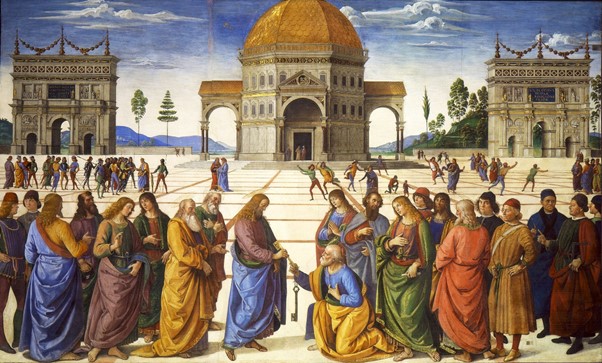
When we write from the point of view of a particular character, we see events from a particular place in the story world. Point of view in fiction is like perspective in painting. Perspective creates the illusion of an image as seen by the eye if viewed from one particular spot.
Pietro Perugino, fresco from Sistine Chapel 1481-82
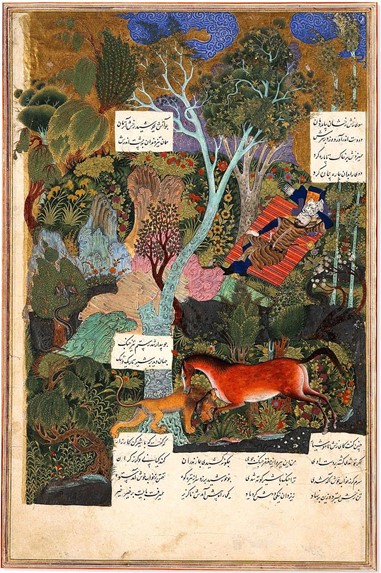
Perspective is intended to create an illusion of realism. We are so used to seeing it in painting that we don’t notice it as a technique and see it as representational. But of course there were and are other conventions in the history of art. In the Persian tradition of miniature illustration, recession into the distance is indicated not by size but by being placed higher up the picture, horses are generally depicted from the side and the scene is often viewed from above. Viewing from above is akin to the world as seen by God.
Probably by Sultan Mohammed 1515-20
Can there be fiction without perspective?
If there can painting without perspective can there also be a fiction without perspective, without point of view? It’s a seductive but impossible idea. All fiction has an inescapable point of view. A story has to be told by someone. But stories can be told in different ways and this has echoes of different conventions of representation in painting.
The world as seen and the world as it is
These days, a first-person or close-third-person narration is common. It makes our experience of the narrator more intimate, but it also adds perspective to the telling. There are objects that are hidden from the view of the narrator, and the constant possibility of distortion – the narrator misunderstanding the meaning of events.
By contrast, a century and half ago, the omniscient narrator was common. Like the period before perspective in art, the narrator could dip in and out of the heads of different characters, revealing their thoughts and their intentions. Important events could be foregrounded. This was like the technique of drawing a scene not as viewed by the painter but the real scene as viewed by God.
The dimension of time
I sense there may be something more interesting in comparing perspective and point of view, but I can’t discover what it is. It may have to do with the way in which painting and writing are different. While a painting is fixed, a story always has some sort of motion in time. Unlike artists, writers have enormous freedom to explore and play with time. Few stories are told linearly from beginning to end. Rather there are flashbacks, fore-shadowing, cliff-hangers, misdirection, and ellipses. There may be stories within stories. And, in the technique of metalepsis, logical boundaries between story levels can be transgressed, as when the narrator intrudes into a world being narrated. The timeline can become extensively fractured in some tales. This too is like the fracturing of perspective in modern art.
Help
Can you do anything to take these insights further?
Does a writer have to eschew ideology in favour of empathy?
This topic was heavily explored in an online writing course on Identity and Social Issues that I have just finished with the University of Iowa. Ruel Johnstone, for example, argued that a writer, even a political writer, must take off ideological lenses. You have to look at people, he says, much more closely than in ideology. Jane Bledsoe argued that explicitly trying to push a political agenda or a social justice agenda usually fails. Kia Corthron, Inara Verzemnieks, Tim Bascom, Janine di Giovanni, and Vladimir Poleganov all argued similar points.
When so many people agree, they must either be expressing an obvious truth, or they must be speaking from a similar point of view. It is, of course, a defining characteristic of a dominant ideology that its adherents believe they have no ideology. George Orwell wrote that “In our age there is no such thing as ‘keeping out of politics.’” How might we tell the difference between these two alternatives?
There does seem to be a self-evident truth to the Iowa argument. As readers, we identify with characters, and so a writer must approach political or social issues through their impact on the character. But, then again, who anyone is and what they want depends on where they sit in society.
And several of the presenters in the course acknowledged they were still expressing an ideological position, and that the reader would probably figure this out. Some offered advice about how to slip information in, so the reader wasn’t aware of it. So the neutral empathetic stance of the writer is not all it seems to be at first sight. Sneaky people those writers!
The dominant view in Western cultures is some form of liberal tolerance. But that’s not necessarily how things really work. Equality of opportunity, for example, is meaningless without the opportunity of equality first. It seems to me that it’s a writer’s responsibility to explore and expose how things really work, to show the clockwork beneath the mask.
Ideology is part of character
I think we need to approach the question by thinking carefully about what ideology is. Ideology is not false consciousness. On the contrary, it only works because it makes sense of a person’s lived reality and experience. For the investor, it is his (or her) money that creates wealth. For the worker, it is her or his labour. For the person who loses their job to a foreigner, immigration will seem a problem. Ideology isn’t false consciousness, any more than being kind or religious or miserly is false consciousness. It’s simply reality as viewed through the personality and experience of an individual.
In other words, ideology is a part of character. When we render the mental and spiritual world of a character, we are, among other things, rendering that character’s ideology – that character’s understanding of why the world is as it is. If we don’t understand our characters’ ideology well, we will render it as a stereotype. And that will lead to stereotyped characters because it’s poor writing, not because it’s ideological.
If, for example, we want to explore why ordinary decent people in the right circumstances can be persuaded to engage in genocide, it just won’t do to label them as monsters and say “never again”. Because it does keep happening again, and again. We need to get inside their heads and explore their ideology, and the very human hopes and fears that drive it. They’re people pretty much like us.
We never just let the reader come to their own conclusions
I think it’s a fantasy that we allow the reader to come to their own conclusion. How could they? We select the events, we craft the order in which they’re told, we polish and shape in order to create the effect we desire. Creative writing describes events in the light of the ends we ordain for them. The open-endedness is an illusion. Of course, no two readers ever render exactly the same story in their minds, I accept that. They may even disagree with our conclusions, depending on their own concerns and life experiences. Even so the writer is not only witness, but also advocate, judge and jury.
An alternative approach
If we want to authentically render the way the social realm shapes character, we have to build character on more than just individual psychology. In the Iowa course, Karim Alrawi advocated starting from relationships, rather than just the individual. He described his own practice as in his novel Book of Sands set in the Arab Spring, of seeking out and dramatizing the underlying metaphors, not people or events. And Jennifer Cognard noted that identity is never singular, it’s always plural.