129. How does a story mean?

The meaning of a story exists outside the text. I was struck recently by the way a story can be simple but its meaning can be perplexing.

sparkler

A story is a set of events linked by causality—the kingdom withered because the king died of grief. The king was sad because the queen had died.

Meaning depends on understanding how things fit together. The meaning of an event in the story (the queen died) lies in the part it plays in the whole, what it causes (the king died).

Stories tell us what goes with what, what is important and what is unimportant, who to praise and who to blame.

But the chain of meaning also extends beyond the story. To follow it, we need to know what a king is, what marriage is, what love is. This knowledge pre-exists and lies outside the tale. Meanings are social—they depend on how a particular community understands the world. These shared references and a stock of agreed narratives allow an audience to decode the story and clad it in meaning.

So, it is possible to create a story in which the chain of linked events is clear, but the meaning is opaque because it depends on assumptions that subvert social understanding of how to code events.

An example

This is what happened with a story I wrote. It imagines a world being destroyed by a race of giants. The giants are the offspring of people and angels. A man and his grandson are chased by a giant. The grandson says the angels have warned him a great flood is coming and that he should build a boat. The old man argues the important thing is not to survive the flood but to stop it by preventing the destruction of the world.  He believes the angels’ mischief is the root cause of the problem and decides the solution lies in taming the giants and putting their great strength to work in repairing the world.

giant

Simple, right?

Yet many readers were perplexed. I wondered why. One told me he didn’t understand bad angels—angels, he felt, were good. The Noah figure, with his Old Testament resonances, who wants to build the boat is young and credulous rather than old, wise, and virtuous. This too creates what psychologists call cognitive dissonance—the discomfort caused by trying to hold two contradictory beliefs.

If we lack the key to decode the story’s meaning, the story doesn’t work for us, even if all the events and the connections between them are clear. This, I believe, is what happened with my tale.

Allegory, unreliable narrators, and allusion

The allegorical implications also perplexed readers. Did the giants represent machines, they wondered? Were the angels fallen angels? In allegory, the meanings necessarily exist outside the story itself since everything in the story is doubled by a set of mappings onto another space.

But there are other circumstances than allegory where a simple story may have an opaque meaning. An obvious example is the unreliable narrator, where not only the credibility of the narrator but also of the events is brought into question. Another is stories that make extensive reference to other stories, which may not be familiar to the audience. The use of classical allusion, once readily understandable among educated people, may be an example here.

Plot, Story, and Narrative

Here’s a simple way of thinking about this.

  • Plot is the causal sequence of a tale (the WHAT of a tale).
  • Story is the way this sequence is told (the HOW of a tale),
  • Narrative is what it means (the WHY of a tale), the interpretation of events and characters within the tale.

Note that narrative can only come into existence when a work is read or heard. The writer may have intended something, but the reader may pick up quite a different interpretation. Meaning comes in existence through an interaction between the writer and from the reader, not from the text. Both writer and reader participate in the creation of meaning.  In an important sense then, meaning must always lie outside the story itself.

127. Twenty novels that shaped literature

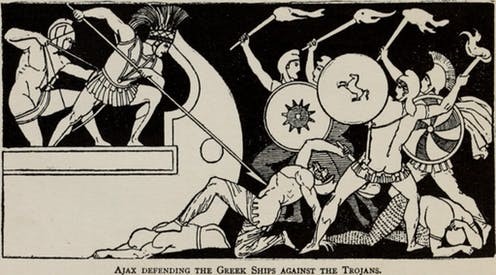
The novel is a fairly recent invention. The history of fiction goes back much further with works such as Chaucer’s 1387 Canterbury Tales, Shishuo Xinyu’s fifth century A New Account of Tales of the World and Homer’s eighth century BCE Iliad.

Iliad

The novel, however, is a distinctly modern and European. Its earliest examples can’t be traced back further than the seventeenth century and its real flowering was in the eighteenth.

The word novel comes from the Italian “novella” meaning a story. A novel is a prose work longer than a short story in which the trials and tribulations of a central character is a major feature.

The rise of the novel reflects the growth of a middle class with the leisure to read and the money to buy books. It is no accident that many of the early novels were written in English in the United Kingdom, where the industrial revolution created such conditions.

The eighteenth century English novel was concerned with complex, middle class characters struggling with morality and circumstances. The first half of the nineteenth century was the era of romanticism, but the impact of industrialism forced a growing engagement with social reality in the Victorian era. In the twentieth century, two world wars, the struggle for the emancipation of women and the dismantling of the old European empires led to a flowering of new voices from those who had hitherto been silent and silenced in literature.

Though I can make no claim to full inclusivity or canonical justification, this is my list of the 20 most important novels that shaped the way we read and write.

  1. Don Quixote by Miguel de Cervantes’ (1605) can lay (contested) claim to being the first novel in the modern sense.
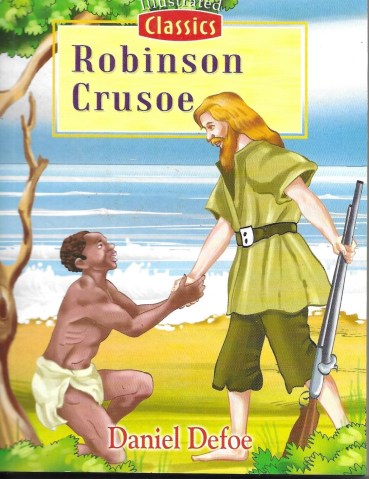
  2. Robinson Crusoe by Daniel Defoe (1719) is arguably the first modern novel in English, following over a century after Don Quixote. An adventure story, it invented many of the tropes of colonial literatureRobinson Crusoe
  3. Gulliver’s Travels by Jonathan Swift (1726) spawned the genre of social satire.
  4. Tom Jones by Henry Fielding (1749) is among the earliest coming of age stories.
  5. The Castle of Otranto by Horace Walpole (1764) is the first Gothic novel, combining magic with realistic settings.
  6. Sense and Sensibility by Jane Austen (1811) ushered in the realist novel, which dealt with everyday life
  7. Waverley by Walter Scott (1814) pioneered the first historical novel.
  8. Frankenstein by Mary Shelley (1818) though Gothic, can be seen as the first science fiction novel and also the first horror novel.
  9. The Pickwick Papers, Charles Dickens’ first novel (1836). Though less socially engaged than much of his later work, it nonetheless paints sharp portraits of English life. Like many of his novels, it was first written as a serial and thus introduces a succession of cliffhangers.
  10. Murders in the Rue Morgue by Edgar Allen Poe (1841) features the first fictional detective. He pioneered the rational analysis of truth which influenced the subsequent development of the genre.
  11. Uncle Tom’s Cabin by Harriet Beecher Stow (1852) is less significant for its literary quality than for the way it fused fiction with the abolitionist events of the day.
  12. Madame Bovary by Gustav Flaubert (1856) codified literary realism
  13. War and Peace by Leo Tolstoy (1869) broke new ground in Russian literature by abandoning narrative in favour of philosophical reflections in large parts of the book. Tolstoy did not even see it as a novel and regarded Anna Karenina (1873) as his first novel.
  14. The Sheik by Edith Maude Hull (1919) forged the tropes of the modern romance genre.
  15. Ulysses by James Joyce (1922) pioneered stream of consciousness writing
  16. The Lord of the Rings by JRR Tolkien (1936) is the first modern work of fantasy.
  17. The Catcher in the Rye by JD Salinger (1945) articulated the angst and rebellion of post-war teenagers. Though by no means the first coming of age story (among which might be included Henry Fielding’s 1749 Tom Jones, Voltaire’s 1759 Candide and Laurence Sterne’s 1759 Tristram Shandy) Salinger’s book arguably opened up the YA market.
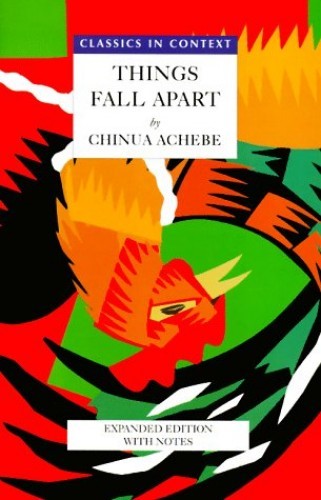
  18. Things Fall Apart by Chinua Achebe (1958) is a classic of post-colonial literature.Things Fall Apart
  19. Wide Sargasso Sea by Jean Rhys (1966) is an anti-colonial and feminist riposte to Charlotte Bronte’s Jane Eyre.
  20. One Hundred Years of Solitude by Gabriel Garcia Marquez (1967) is a seminal work of magic realism, using fantastical elements to express the absurdity of social reality.

126. The mystery rhythm of Sam was a Man

rhythm2

Mastering rhythm is important to any writing. If a sentence doesn’t sound right, something will go clunk in the reader’s head. This is why every fiction writer should read poetry. Rhythm is fundamental to poetry. Consider, for example, these line from John Masefield’s Cargoes:

Quinquireme of Nineveh from distant Ophir,

Rowing home to haven in sunny Palestine.

And

Dirty British coaster with a salt-caked smoke stack,

Butting through the Channel in the mad March days.


The first couplet has a stately rhythm, while second, full of short words and plosive consonants, is frenetic.

There is no doubt about the music of the lines, Speak the words aloud and they set the tempo.

But consider, ee cummings’ poem below. The rhythm appears staccato, broken. And yet, cummings was a master craftsman.

ee cummings

Is this simply a bad poem, or has he buried a secret in the heart of the words?

rain or hail
sam done
the best he kin
till they digged his hole

:sam was a man

stout as a bridge
rugged as a bear
slickern a weazel
how be you

(sun or snow)

gone into what
like all them kings
you read about
and on him sings

a whippoorwill;

heart was big
as the world aint square
with room for the devil
and his angels too

yes, sir

what may be better
or what may be worse
and what may be clover
clover clover

(nobody’ll know)

sam was a man
grinned his grin
done his chores
laid him down.

Sleep well

It’s a puzzle. There’s no obvious cadence when you read it aloud. Vincent Perischetti made a modernist choral arrangement of the poem

But I don’t believe cummings intended anything so cerebral. Instead, it’s a hymn to the (American) common man. Try reading the poem to the rhythm of an American barn dance caller and it suddenly makes sense.

barn dance


124. Does politics mar literature?

Let me get the answer out of the way right from the top—no, of course not. George Orwell said, “No book is genuinely free from political bias. The opinion that art should have nothing to do with politics is itself a political attitude.” Our lives are political, so what we write is also political. Even fairy tales are political. If storytelling wasn’t political, tyrants wouldn’t trouble to ban or burn books.

Alice

What does political mean?

So, next, a definition. I don’t mean political with a small “p”, party politics, though some stories may legitimately be about such partisanship. I mean political with a capital “P”—the way power is distributed and how it affects everyday life. If a character doesn’t have enough to eat and must choose between paying the rent and buying school kit, that is a political context. If a character is saved from domestic drudgery by a prince, that too is political.

Breaking writing rules

But doesn’t this cut across so many writing rules? Literature, after all, is art, not propaganda. Readers don’t want to be yelled at or told what to think.

Yes, fiction writing isn’t propaganda, or political science, or journalism. But this doesn’t mean fiction doesn’t deal with politics. It just deals differently with the subject. Fiction makes political situations personal.

Characters makes us care

Fiction is about character. Even in plot-driven stories, it’s the characters who make us care. A story in which the characters are simply vehicles for a political argument would be dull. The politics of Orwell’s 1984 isn’t particular subtle or nuanced. It’s the plight of Winston Smith that engages us. There’s nothing special about the role of politics here. This is not different than any other over-indulgence in plot or theme. If the characters spend the whole story blowing each other away or discussing particle physics, it would be equally dull.

Characters live in three circles. They have an inner life and a circle of intimates, friends and colleagues. But they also have a third circle—the social setting that defines their concerns, their view of the world, and their beliefs. Ideology is a strong determinant of the third circle.

Readers don’t like being told what to think

You get this comment a lot in discussions about political fiction.  And, when you come to consider it, this is odd. Nobody ever complains they feel manipulated when a writer equips a character with some other trait like selfishness or courage. Writers devote a lot of care to telling readers what to think.  They craft the characters to engage sympathy, structure the plot to create peaks and troughs of tension. So, maybe the principle is readers don’t like being told to think in ways that challenge their preconceptions.  But isn’t that precisely what literature is supposed to do?

“Some people will suggest that dealing with themes is ‘didactic.’  Don’t be fooled.  Those same writers will put themes in their own works, and usually they’re taking stands that oppose yours.  For example, if you argue that morality is innate and central to what a human is, they’ll argue that it’s situational and we’re all just animals.  They don’t oppose the idea of stories having themes; they may just be opposed to your views.  So make sure that your arguments are rigorous and persuasive.”

David Farland How to Win Writing Contests and Big Publishing Contracts

We tend to notice ideology and feel we’re being preached at when the text departs from our unconscious biases about the world. There is a saying that the ideology of the powerful is the belief that their view isn’t ideological, just common sense. What makes an ideology work is that it articulates a lived sense of the world. One person’s common sense is another person’s propaganda. Readers who react with fury to having an ideological viewpoint thrust on them by authors rarely respond in a similar vein to, say, thrillers or romance.  Yet both tend to have a fairly transparent ideology.

Thrillers typically pit a plucky hero against the forces of evil. Over time these forces have varied from the Nazis, the Soviet Union, Islamic fundamentalists, shadowy corporations, and elite cabals, depending on who the “enemy of the day” is. The politics goes unnoticed because it’s an assumption about the forces of good and evil shared between author and reader.

Less obviously, romance too contains an ideology about people and relationships. In the classic romance (consider Tristan and Isolde, Romeo and Juliet) love is a force that is stronger than human will, incompatible with everyday life, and its proper end is death. More contractual or rational bondings are out, as is working at a relationship.


Readers should be left to make up their own minds

This is the “writer as witness” idea and it’s really back to the “readers don’t like to be told what to think” argument. The notion is that the writer should present the facts and leave the reader to judge their meaning.  And it’s an odd view, because it applies more to journalism than to fiction. Though, it has become such a truism among fiction writers that it tends to be said without question.

In reality, most of us writers don’t operate like this. The writer surreptitiously shapes the reader’s perceptions in a thousand subtle ways. How could the reader come to their own conclusion? We select the contents, we craft the order in which they’re displayed, we polish and shape in order to create the effect we desire. Creative writing describes events in the light of the ends we ordain for them. The open-endedness is an illusion. Of course, no two readers ever render exactly the same story in their minds, I accept that. They may even disagree with our conclusions, depending on their own concerns and life experiences. Even so the writer is not only witness and advocate but also judge and jury.

Everything reflects an ideology

What could be more natural than a fictional world with protagonists and villains in which characters undergo an arc of change? This is, surely, the ABC of how to write a story. And yet this too is a product of a particular (wealthy and individualistic) social order. There are literary traditions in other cultures that use very different conventions. I argued in an earlier blogpost:

There is a view of the person and of development contained within these formulae.

  • We are individuals
  • We choose our own fate and can change

These principles of character arc seem so obvious we hardly even notice them as assumptions. But they come from a particular kind of society and, to other cultural traditions, they are far from obvious. How about these propositions:

  • People become people through other people. This is the core principle of the Ubuntu cultures of Southern Africa. In other words, humanity is a quality we owe each other. Or, in the European tradition, John Donne’s famous “no man is an island”.
  • The number of people on the planet who can choose their own fate is extremely limited. The starting conditions of wealth, gender, race, status and caste circumscribe our choices. For many people, change is unthinkable. Those who do escape their circumstances are not representative of their peers.

These differences are not only narrative, but moral. The first principles are individualistic, the second communitarian.
 

120. Stories that are hidden from us

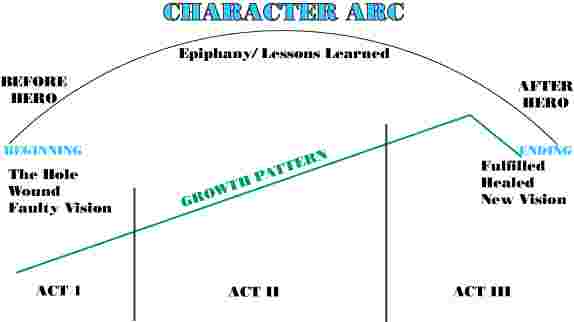
A character arc is a fancy was of describing the changes a character goes through from the beginning to the end of a story. There is a hidden assumption in the idea of character arc that stops us seeing the possibility of other stories.

character arc

Consider the classic three act story. An individual is confronted by a problem (an external challenge or an internal flaw). They encounter trials and tribulations in which they are tested. They emerge better than before. Or, of course if the story is a tragedy, they succumb to the problem and emerge worse than before.

What does this remind you of? All those self-help and personal growth programmes perhaps? There is a view of the person and of development contained within these formulae.

  • We are individuals
  • We choose our own fate and can change

These principles of character arc seem so obvious we hardly even notice them as assumptions. But they come from a particular kind of society and, to other cultural traditions, they are far from obvious. How about these propositions:

  • People become people through other people. This is the core principle of the Ubuntu cultures of Southern Africa. In other words, humanity is a quality we owe each other. Or, in the European tradition, John Donne’s famous “no man is an island”.
  • The number of people on the planet who can choose their own fate is extremely limited. The starting conditions of wealth, gender, race, status and caste circumscribe our choices. For many people, change is unthinkable. Those who do escape their circumstances are not representative of their peers.

These differences are not only narrative, but moral. The first principles are individualistic, the second communitarian. What would character arcs be like if we used this second set of principles?

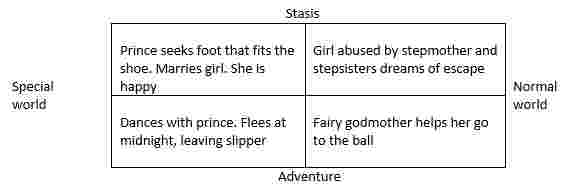
Let’s take an example of well-known tale. Here it is using the first formula. Follow the grid clockwise from top right to top left for the character arc.

Cinderella plot

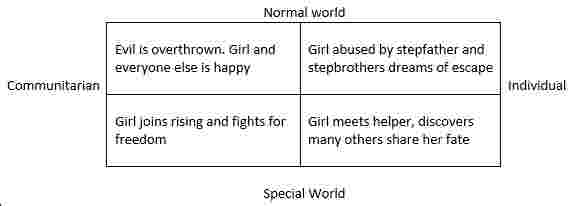
Using the second formula, the story might look like this.

Cinderella communitarian plot

The Cinderella story has morphed into something more like The Handmaid’s Tale.

Other cultures’ story-telling traditions can be very different. While the modern Western tradition requires dualities between subject (the character who acts) and object (the world which is acted upon), protagonist and antagonist (who represent good and evil), this is not true of all cultures. Many use ambiguous Trickster figures who are neither good nor evil. The European tradition used to have Trickster figures but this has now been lost.

Similarly, some traditions don’t require the protagonist to undergo change. In some Japanese literature the character remains unchanged and the reader’s interest is maintained by growing understanding of the character. Similarly, in many Japanese stories the character’s goal is irrelevant: the plot is driven by causality.  Though Japanese literature recognises the Three Act structure, they also have a Four Act structure (introduction, development, twist, reconciliation) and Western readers may find it hard to recognise anything they consider as an ending.

Another way of representing the classic, individualistic, character arc of the Western tradition is:

  • Goal: what does the character want to achieve?
  • The Lie: misconception that prevents them reaching their true potential
  • The Truth: character rejects the lie and embraces the truth, leading to self-improvement

What if the conventional character arc is the lie? It describes a fantasy world in which most of us do not live.

In a complex modern economy, we are materially dependent on each other but socially indifferent. The goods and services on which we depend are furnished by strangers about whom we know and care nothing. This one fact contains the possibility for a huge variety of drama.

119. Brexit, uncertainty and the toast Jesus

In 2004, a woman in Florida sold for US$28,000 a grilled cheese sandwich on which she claimed to see the image of Jesus Christ. The toast Jesus phenomenon tells us something interesting about knowledge.

toast Jesus

Our brains are programmed to seek and find patterns in things. Not all the patterns we see are real. Random events can create an illusion of structure where none really exists. We think we’ve seen a signal in the noise but all we’ve seen is random noise.

Michael Blastland delivered a lecture at the Royal Society of Arts on this theme. One of his examples comes from the announcement in January 2018 by the Office for National Statistics that unemployment in the UK had fallen by 3,000 people to 1.44 million.  So far so certain. But in the methodology section of the report they acknowledge that statistically this figure has a 95% chance of being true, plus or minus 77,000. In other words, unemployment might have fallen by as much as 80,000, but it might just as easily have risen by 74,000.

Blastland argues that the great threat to progress is not ignorance, it’s the illusion of knowledge.

So how do we get from the toast Jesus problem to Brexit? Andrew Neil on 12 July 2019 interviewed the two candidates for leadership of the UK Conservative Party and hence for the Prime Ministership of the country. He took Jeremy Hunt to task for not being willing to promise that the UK would have left the European Union by the 31 October deadline.

Andrew Neil Jeremy Hunt

Hunt explained, not unreasonably, that nobody could know what would happen if no deal was agreed with the EU. He noted that Parliament might block a no-deal exit and that this might lead to an election. Hunt said he was simply being honest, but Neil accused him of being slippery and untrustworthy.

We human beings prefer certainty to uncertainty. At least for some things. It’s true that we prefer not to be told how a novel turns out before we read it. And we can cope with uncertainty in weather reports. But we don’t care for it much in our politicians. Perhaps we’ll only get the politicians we really deserve when we’re less insistent on easy certainty.

117 The Shape of Stories

Stories have structures, or arcs as authors like to call them. When we think of stories in this way, we can begin to see story-types.

The simplest stories

There are two very simple structures. They’re so basic they don’t really qualify as satisfying stories.

simplest stories

In Rags to Riches, everything gets better. In Riches to Rags, everything gets worse. Though few self-respecting authors would tell such a naïve tale, politicians tell them all the time.

The simplest viable story

Freytag

This is the Freytag triangle. It follows Aristotle’s injunction that a story should have a beginning, a middle, and an end (the Three-Act structure).

The beginning comprises the exposition and the inciting incident. The exposition phase introduces essential information about the characters and setting, while the inciting incident launches the action.

Tension rises in the middle as the protagonist struggles to achieve something. There is a turning point. And tension falls towards the resolution.

In the ending, the problem is resolved and there is a denouement where all the loose ends are tied up.

There are many ways of structuring a story, but the Freytag triangle is a classic on which a lot of others are built.

The W Diagram

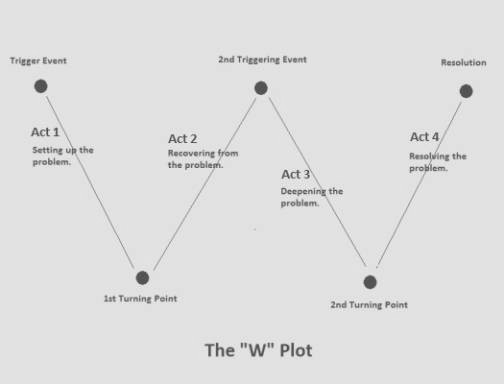
This is essentially a Freytag triangle with a high point where everything appears to be resolved before the rug is pulled out from under the protagonist and a new trial begins.

W Diagram

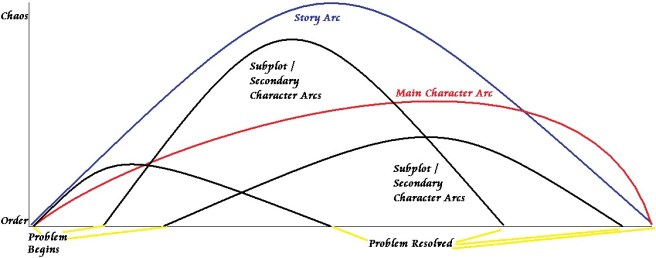
A complex story like a novel may have several hills and valleys. There may also be subplots with arcs of their own.


multiple arcs
Hacktext


Kurt Vonnegut’s Shape of Stories

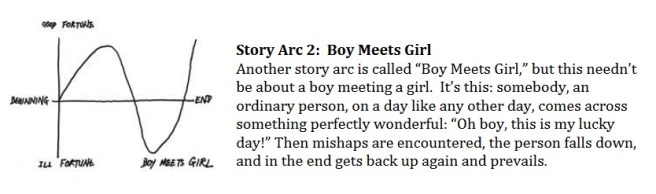
In a humorous talk, the writer Kurt Vonnegut outlined the shape of stories, based on his rejected Master’s thesis. The diagrams and text from Vonnegut’s talk here are from Mcclure.

Vonnegut Man in a Hole

Vonnegut Boy Meets Girl

Vonnegut Cinderella.jpg

Machine intelligence analysis of story shapes

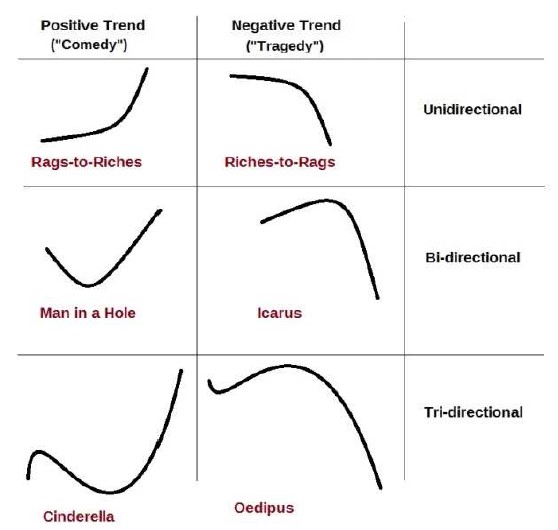
Researchers from the Universities of Vermont and Adelaide tried to test Vonnegut’s idea using machine analysis of sentiment in 1,327 Western stories. They found the stories grouped into 6 basic types. The diagrams here are from Munson Missions.

six story arcs

For those of you who like to understand method, read on. For those of you who don’t care, skip to the Hero’s Journey. These shapes were generated by analysing the words in the stories and scoring them for the degree of happiness they convey. Words like love and laughter score high, while words like terrorist and death score low. You can check this out yourself at the authors’ Hedonometer site.

Before you get too excited about this, consider the following sentence:

“Trekking through the vale of tears, dark, clammy and terrifying, we were ambushed by the monster and killed it for all of you.”

Almost every word here in unhappy, but the overall sense is one of hope. The meaning of a set of words depends on context and not just the words by themselves.

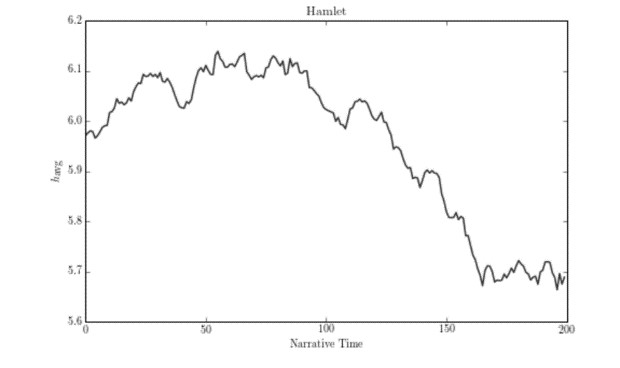
The shape generated by a machine intelligence, of course, depends on the method used. Compare these two shapes for Shakespeare’s Hamlet. This comparison was done by Kirsten Menger-Anderson.

Hamlet plot Hedonometer

Hamlet plot sentiment

The first was generated by the Hedonometer. The second by another machine intelligence routine that rates sentiment (positive or negative). They don’t look much alike.

The Hero’s Journey or Quest

Heros journey linear

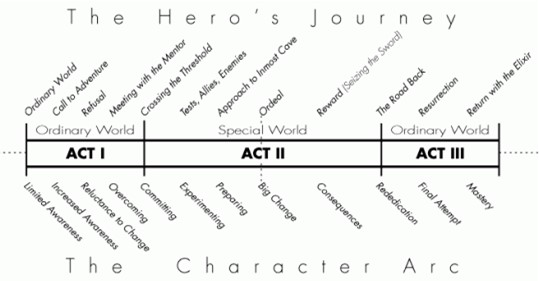
The Hero’s Journey is among the most commonly used story templates. It derives from the work of Joseph Campbell, who believed all stories, at root, followed the same archetype. George Lucas used it to structure the first Star Wars movie.  In Act 1 the protagonist receives the call to adventure and is assisted by a mentor to accept the challenge and move into the “special world”.  In Act 2, the protagonist is subjected to a road of trials, before winning the reward and starting back to the everyday world. Act 3 follows the road back where the protagonist delivers the reward.

For those who don’t like straight lines

The quest structure, such as the Hero’s Journey, can be represented by a “there and back” circle.

Heros journey circular

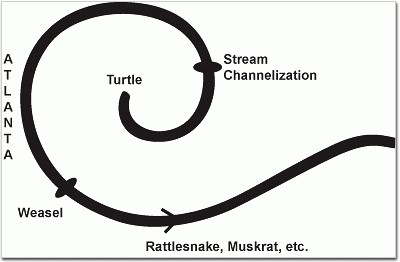
Stories that loop back on themselves are very satisfying. Though, since a circle contains no change, a spiral may be a more appropriate shape. The diagram below was made by John McPhee to illustrate the structure of his Travels in Georgia

McPhee Spiral

And finally

Tears of Boabdil structure 3

This was the structure diagram I constructed while writing my novel The Tears of Boabdil to try to capture the layering.

Are there any major story arc devices I’ve missed out? Let me know.

114. From tiny tickles to character reveals: tropisms

What makes the inner world of a fictional character really sing? The author can, of course, have the character think ideas, speak, and carry out actions. But, besides and more interesting than this, is the way they respond to the world and understand things. After all, the universe inside every head seems magically different from the one inside my own.

Tropisms

I’ve just come across an author who tried to render that inner world, using an idea borrowed from biology. Plants grow towards the light. Biologists call this stimulus and response phototropism.


tropism
Encyclopaedia of Human Thermodynamics

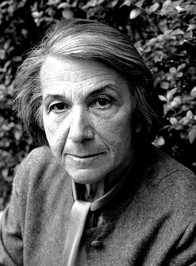
The French writer Nathalie Sarraute used the metaphor of tropism to highlight the origins of actions, speech, and feelings in the momentary experiences on the fringe of consciousness.

In the first vignette in her 1939 book Tropisms, she writes

They seemed to spring up from nowhere, blossoming out in the slightly moist tepidity of the air, they flowed gently along as though they were seeping from the walls, from the boxed trees, the benches, the dirty sidewalks, the public squares.

This seems to be a plague of weeds or vermin. In fact, she is describing people staring into shop windows.  But these are not people as characters. Rather, stripped of identifiable shapes and personalities they become sensations. Sarraute eliminated plot or character from her work, in order to explore the “impulses, desires, processes that exist before speech, before comprehension, before consciousness”, as Allison Noelle Conner puts it.

nathalie Sarraute
Nathalie Sarraute

Sarraute would devote pages to exploring the mechanisms that intervened between the stimulus and the response.

The objective correlative

Though I don’t buy into Sarraute’s analysis that plot and character are conventional masks that prevent us exploring mentality, I do find something intriguing in her approach. T.S. Elliot had a similar insight in his idea of the “objective correlative”—a sequence of things or events which creates the sensation the writer is trying to summon in the reader. He described this: “when the external facts, which must terminate in sensory experience, are given, the emotion is immediately evoked.”


Other techniques

This clearly has connections with the often tiresome writers’ dictum of “show, don’t tell”. But it takes this instruction further. It makes location, conversation, and events a means of conveying character.

It also might seem similar to Swain’s technique of the Motivation-Reaction Unit (MRU), which also works on a stimulus-response basis. However, these work on the basis of a chain from feeling to action to speech, whereas in tropism, all of these are preceded by a simple sensory experience. I wrote about my experiment with MRUs in a previous post.


A method for illuminating mentality

I’ve used the insight about pre-conscious stimuli to rework the opening chapter of my current book, The Star Compass. Robert, a bookish recluse, has come to the remote Pacific island of Yap. All his life he has avoided ever learning anything about the South Seas so he might believe there is one place on the planet where nature is bountiful and people are nice to each other. Now he is forced to have a confrontation with reality. The chapter begins:

He paused at the bottom rung of the stairway. Then stepped onto the tarmac and off the edge of the world.

Here all his maps ran out. Here be dragons.

The humid tropical night wrapped itself like a moist towel around his nose. The bulk of his body began to cook from the inside. Sweat pooled in his armpits, beaded his brow, and trickled down his spine. The perspiration felt clammy. He wanted to turn, run back into the plane, and get away from this island.

But he continued to shuffle forward towards the door of the tiny airport, keeping his place in the line of a hundred other passengers and urged on by those behind. The terminal complex was so small it lacked an immigration hall and they queued on the apron. Thankfully, it wasn’t raining, though puddles evaporating on the tarmac indicated an earlier downpour.

Things had happened here before he arrived. The island had its own hidden history. Anything might lurk here in the unknown South Pacific.

He reached the portal where souls were divided. One door for visitors, and the other for citizens of the Federated States of Micronesia. The sleepy official took his landing card, examined his passport. Robert Urquhart, UK citizen, fifty-one years old.

Yap airport
Yap International Airport

In making this revision, I hunted for small sensations in the draft and considered these as stimuli. I then checked that there was a response for every stimulus and a stimulus for every response. For example, the action of stepping onto the tarmac provokes the sensation that he’s stepped off the edge of the world. Or the stimulus of the humidity makes him want to turn and run. And the realisation from the rain puddle that the things have happened here before he arrived, triggers a fear that anything might happen here now. I aimed to render Robert’s profound unease through these small almost pre-conscious moments. Sometimes, it involved taking a small moment and expanding it.


I’d love to hear whether you’ve tried or come across anything similar.


113. The third variety of fiction

Fiction is stories, right? The protagonist encounters a challenge, sets off in pursuit, and after many travails achieves a resolution. Much genre writing fits this mould.

There is another kind of fiction where the plot can be incidental or even non-existent. This is writing based on character rather than story. Often this type is called literary.

But that’s not all. There is a third, though rare, kind of fiction, which executes its code in your brain as you read. It rewires your consciousness.

I was very struck by this again reading Nick Harkaway’s Gnomon, a literary science fiction novel set in a near future total-surveillance Britain.

gnomon

The plot revolves around a detective’s efforts to understand how a suspect could have died under a mind-mapping session. It turns out that the suspect invented a series of narratives to keep her own consciousness secret. The book loops back and forth through these stories.

There is a sequence where Harkaway’s method is evident. One of the narrative personas is brought together with a woman who he is told is his dead lover, Stella.  The text oscillates between the possibility that she is an imposter and the possibility that, if she occupies Stella’s place in the world, she is Stella. Layers of philosophical hocus pocus, of metaphor, and of narrative exposition create a universe in which this transubstantiation is plausible.

Yeah, I hear you say, all fiction does that. It invites us to suspend disbelief. But what Harkaway does is more than world-building which postulates orcs and elves and offers us an escape into magic. He transforms your sense of reality such that we understand personal identity in a new way. We don’t escape into a fantasy world. Rather, reality changes.

old-bridges-26__880

I described this technique in an earlier post.

Words can create illusions. They can bridge impossible gaps allowing magical connections to be made between unlinked things. This is the stuff of fantasy, but also the stuff of poetry and of magic realism. Imagination can stitch together things never connected in the real world. Recurring words and images can stitch together these magic connections

Harkaway describes in a blog the process of writing the book:

This was like weaving a tapestry thread by thread while holding the entire design in your head, and my head just wasn’t big enough. Meanings intersected with other meanings, with consequences. I had to go back, again and again, re-work, re-conceive, re-imagine. Sure, yeah, I know: writing is re-writing. I’m familiar with the re-write. This was more like starting a new book every four months or so. The number of plotlines and their interactions meant a kind of exponential multiplication of possibility. I’d made a maze in my own mind and I kept getting lost in it. The book was smarter than I was.

Reading Gnomon was more like taking a mind-altering drug than like narration. A few other books have done this. One was Juan Rulfo’s Pedro Paramo.

Another was A U Latif’s Songs from the Laughing Tree (currently out of print). In a review of Latif’s book I wrote

Our brains are evolved to seek pattern and meaning, and Latif plays with this. The figures of the stories loop and dive, and create impossible or magical meanings that are whimsically held together by no more than a concatenation of words, an ellipsis of adjectives.

Have you encountered books in this third type of fiction?

109. Complexity or intensity: is sentimentality bad fiction?

Much has been written about the sin of sentimentality in fiction. But is it really so bad?

What is sentimental writing?

It has to be more than simply writing that inspires emotion, a sensation of tenderness. Writing is supposed to move the reader. Sentimentality, as apposed to sentiment, is something shallow that cheapens or simplifies that emotion in order to tug at the reader’s heartstrings.

If it makes you go “aww” it’s probably an example of sentimentality.

If a story contains these stock themes, it’s likely to involve sentimentality (though these themes do also occur in deeper fiction):

  • A child’s tears
  • A sick pet
  • The forgiving father
  • The individual who stands up for right
  • The kind and wise grandparent
  • A triumph over adversity

puppies

Is it elitist to abhor sentimentality?

There was an interesting debate on sentimentality in the New York Times between authors Zoë Heller and Leslie Jamison. Heller argued that “Sentimental fiction is a kind of pablum: Excessive amounts can spoil the appetite for reality, or at least for more fibrous forms of art.” Jamison responded that “I would argue that one of the deep unspoken fears beneath the sentimentality taboo is really the fear of commonality, the fear of being just like everyone else or telling a story just like everyone else’s.”

Jamison’s point about elitism is interesting. “We all have the same stories to tell,” she writes. And it’s true that the accusation of sentimentality tends to be levelled by intellectuals at writers of pulp fiction.  Perhaps they’re just sneering at emotions they disagree with.

John Irving, writing in the New York Times, points out the hypocrisy of context. Dickens’ A Christmas Carol is among the best-loved works in English. Yet its theme of redemption is arguably sentimental, as is the tear-jerking ending where Tiny Tim says “God bless us, every one”. And yet the indulgence we afford tales of kindness at Christmas time doesn’t extend to other seasons. Critical fire greeted Dickens late grafting of a happy ending onto Great Expectations.  And I’d probably agree with the critics.

Some say the sin of sentimentality is that the author manipulates the reader into feeling certain emotions. But I think that’s true of all writing. The events on the page of a story don’t really exist—the writer simulates them to create an effect.

The reader’s collusion with sentimentality

Maybe the most useful definition of sentimentality is Oscar Wilde’s aphorism that it affords “the luxury of having an emotion without paying for it”. This definition emphasises the cheapness of the effect. But, interestingly, it also makes the consumer share responsibility for the sin with the producer.

So perhaps the issue is less to do with the emotion evoked than with what we’re enabled to do afterwards. Tropes and clichés are poor art because they confirm stereotypes rather than challenging them. In the same way, perhaps sentimentality is poor art because it denies us an understanding of how to cope with real loss or engage generously with others. If the writing doesn’t surprise and elucidate in some way, can it be good?

Jamison, in another essay, makes a similar point. She argues that sentimentalism strokes our ego by titillating our capacity to feel while simultaneously denying us genuine emotion.

I guess I’m arguing in favour of the pleasure of complexity and against the pleasure of simple intensity. Sentimentality irons out ambiguity. Whether you enjoy complexity or intensity may be no more than a matter of preferences.

What do you think? Is sentimentality a writing sin? Or is this just an elitist prejudice?