93. Stories for change – restoration or transformation?

George Monbiot’s book, Out of the Wreckage, is the second this year to explore the idea that what the planet needs is a new story. Like Alex Evans in The Myth Gap, Monbiot suggests that people are mobilised to action by stories, not by facts and evidence.

WWF
Image © WWF https://www.youtube.com/watch?v=ASwq1XITrOI

This is clearly an idea whose time has come, and one which resonates with a “post-truth” world. I won’t rehearse again my concerns with the anti-rationality of the idea, which I covered in a review of Evans’ book.  And, in fairness, Monbiot advocates a new story based on science. I do agree with both authors that we need new stories to confront the challenges of our times.

Stories, as I said in my review of The Myth Gap “are among the oldest human devices for encoding and sharing knowledge. They have the huge advantage over collections of facts that they tell us what goes with what, what is important and what is unimportant, who to praise and who to blame.”

Monbiot goes further than Evans in suggesting the structure of this new story.

“Disorder afflicts the land, caused by powerful and nefarious forces working against the interests of humanity. The hero – who might be one person or a group of people – revolts against this disorder, fights the nefarious forces, overcomes them despite great odds and restores order.”

He calls this the Restoration Story and says “stories that follow this pattern can be so powerful that they sweep all before them, even our fundamental values.”  He suggests that this is an archetype, which is common to both social democratic and neoliberal narratives, and he may indeed be right in saying this.

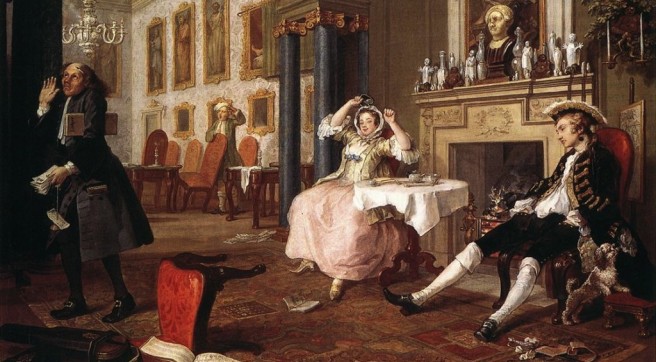
Restoration
Restoration – The Tête-à-Tête, from Marriage à-la-mode, William Hogarth

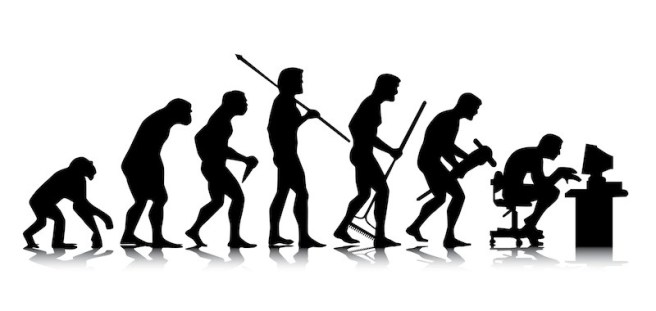
However, the interesting thing about the idea is how timid it is, with its narrative of “restoring order”. And it isn’t the only archetypal story we tell about the future. I know this because I did some research a few years ago, analysing 64 futures scenarios (“Futures and Culture”, Futures 44 (2012) 277–291). All these stories fitted into four broad classes – Progress, Catastrophe, Reversion and Transformation.

  • Progress is, as the name suggests, one where existing trends lead towards the expected goals. This story was dominant during the brash optimism of the nineteenth century.
  • Catastrophe is also simple – the outcomes prevent us realising our expected goals. In the darker years of the twentieth century, dystopian visions became more common.
  • Reversion, which is essentially Monbiot’s Restoration, is a little more complicated, and involves a return to previous conditions in order to maintain viability. These stories often have a sentimental view of a simpler earlier time.
  • Finally, the Transformation story involves, as the name suggests, a fundamental change in the “rules of the game“, leading to a new and unexpected end-state.

I would suggest that to get out of the wreckage we need Transformation stories not Reversion stories. Monbiot would probably agree, but perhaps he might want to rethink his narrative archetypes.

89. Point of view and perspective

It only recently occurred to me that the concept of point of view in literature is a metaphor, borrowed from painting.  I am still struggling to see if anything profound flows from this realisation.  Bear with me, please.

When we write from the point of view of a particular character, we see events from a particular place in the story world. Point of view in fiction is like perspective in painting. Perspective creates the illusion of an image as seen by the eye if viewed from one particular spot.

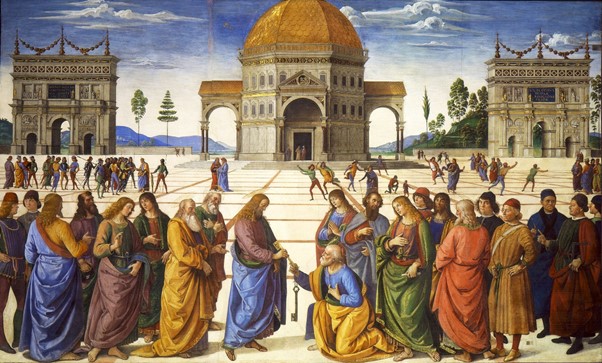
perspective
Pietro Perugino, fresco from Sistine Chapel 1481-82

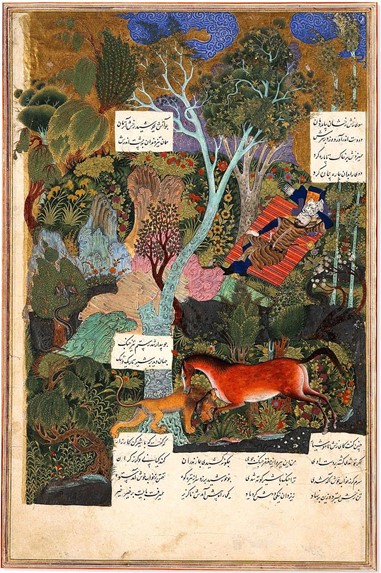
Perspective is intended to create an illusion of realism. We are so used to seeing it in painting that we don’t notice it as a technique and see it as representational. But of course there were and are other conventions in the history of art. In the Persian tradition of miniature illustration, recession into the distance is indicated not by size but by being placed higher up the picture, horses are generally depicted from the side and the scene is often viewed from above. Viewing from above is akin to the world as seen by God.

Sultan Mohammed miniature
Probably by Sultan Mohammed 1515-20

Can there be fiction without perspective?

If there can painting without perspective can there also be a fiction without perspective, without point of view? It’s a seductive but impossible idea. All fiction has an inescapable point of view. A story has to be told by someone. But stories can be told in different ways and this has echoes of different conventions of representation in painting.

The world as seen and the world as it is

These days, a first-person or close-third-person narration is common. It makes our experience of the narrator more intimate, but it also adds perspective to the telling. There are objects that are hidden from the view of the narrator, and the constant possibility of distortion – the narrator misunderstanding the meaning of events.

By contrast, a century and half ago, the omniscient narrator was common. Like the period before perspective in art, the narrator could dip in and out of the heads of different characters, revealing their thoughts and their intentions. Important events could be foregrounded. This was like the technique of drawing a scene not as viewed by the painter but the real scene as viewed by God.

The dimension of time

I sense there may be something more interesting in comparing perspective and point of view, but I can’t discover what it is. It may have to do with the way in which painting and writing are different. While a painting is fixed, a story always has some sort of motion in time. Unlike artists, writers have enormous freedom to explore and play with time. Few stories are told linearly from beginning to end. Rather there are flashbacks, fore-shadowing, cliff-hangers, misdirection, and ellipses. There may be stories within stories. And, in the technique of metalepsis, logical boundaries between story levels can be transgressed, as when the narrator intrudes into a world being narrated. The timeline can become extensively fractured in some tales. This too is like the fracturing of perspective in modern art.

Help

Can you do anything to take these insights further?


88. Ideology and fiction

Does a writer have to eschew ideology in favour of empathy?

This topic was heavily explored in an online writing course on Identity and Social Issues that I have just finished with the University of Iowa. Ruel Johnstone, for example, argued that a writer, even a political writer, must take off ideological lenses. You have to look at people, he says, much more closely than in ideology. Jane Bledsoe argued that explicitly trying to push a political agenda or a social justice agenda usually fails. Kia Corthron, Inara Verzemnieks, Tim Bascom, Janine di Giovanni, and Vladimir Poleganov all argued similar points.

When so many people agree, they must either be expressing an obvious truth, or they must be speaking from a similar point of view. It is, of course, a defining characteristic of a dominant ideology that its adherents believe they have no ideology. George Orwell wrote that “In our age there is no such thing as ‘keeping out of politics.’” How might we tell the difference between these two alternatives?

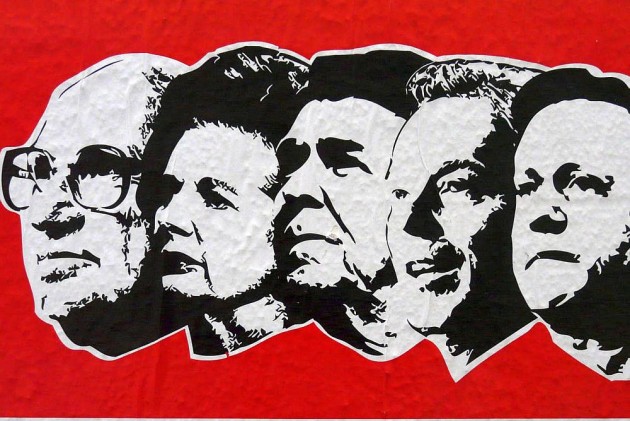
neoliberalism20160420_630_630
Image: Outlook

There does seem to be a self-evident truth to the Iowa argument. As readers, we identify with characters, and so a writer must approach political or social issues through their impact on the character. But, then again, who anyone is and what they want depends on where they sit in society.

And several of the presenters in the course acknowledged they were still expressing an ideological position, and that the reader would probably figure this out. Some offered advice about how to slip information in, so the reader wasn’t aware of it. So the neutral empathetic stance of the writer is not all it seems to be at first sight. Sneaky people those writers!

The dominant view in Western cultures is some form of liberal tolerance. But that’s not necessarily how things really work. Equality of opportunity, for example, is meaningless without the opportunity of equality first. It seems to me that it’s a writer’s responsibility to explore and expose how things really work, to show the clockwork beneath the mask.

Ideology is part of character

I think we need to approach the question by thinking carefully about what ideology is. Ideology is not false consciousness. On the contrary, it only works because it makes sense of a person’s lived reality and experience.  For the investor, it is his (or her) money that creates wealth. For the worker, it is her or his labour. For the person who loses their job to a foreigner, immigration will seem a problem. Ideology isn’t false consciousness, any more than being kind or religious or miserly is false consciousness. It’s simply reality as viewed through the personality and experience of an individual.

In other words, ideology is a part of character. When we render the mental and spiritual world of a character, we are, among other things, rendering that character’s ideology – that character’s understanding of why the world is as it is. If we don’t understand our characters’ ideology well, we will render it as a stereotype. And that will lead to stereotyped characters because it’s poor writing, not because it’s ideological.

If, for example, we want to explore why ordinary decent people in the right circumstances can be persuaded to engage in genocide, it just won’t do to label them as monsters and say “never again”. Because it does keep happening again, and again. We need to get inside their heads and explore their ideology, and the very human hopes and fears that drive it. They’re people pretty much like us.

We never just let the reader come to their own conclusions

I think it’s a fantasy that we allow the reader to come to their own conclusion. How could they? We select the events, we craft the order in which they’re told, we polish and shape in order to create the effect we desire. Creative writing describes events in the light of the ends we ordain for them. The open-endedness is an illusion. Of course, no two readers ever render exactly the same story in their minds, I accept that. They may even disagree with our conclusions, depending on their own concerns and life experiences. Even so the writer is not only witness, but also advocate, judge and jury.

An alternative approach

If we want to authentically render the way the social realm shapes character, we have to build character on more than just individual psychology. In the Iowa course, Karim Alrawi advocated starting from relationships, rather than just the individual. He described his own practice as in his novel Book of Sands set in the Arab Spring, of seeking out and dramatizing the underlying metaphors, not people or events.  And Jennifer Cognard noted that identity is never singular, it’s always plural.


86. Rejection is your friend

26782696-stamp-denied-with-red-text-over-white-background

Rejection can be hurtful. But all writers have to learn to accept it. It seems like someone is telling you that your writing is no good. But there’s a huge amount of subjectivity in the decision-making process, which a writer doesn’t normally glimpse.

I just had a story rejected by Every Day Fiction with enough feedback to illuminate the process of decision-making. There are several reasons why a story might get turned down:

  • The writing is no good
  • The writing is good, but the story doesn’t work
  • The writing is good and the story works, but it’s not what the editors are looking for

The first two reasons are objective, the third is subjective. But, of course, the first and second reasons also involve judgements by people and can also be subjective. You rarely discover what has led to a rejection.

In this case, the magazine sent me the reports by the four readers. They had to score the submission between 1 and 5, and their scores varied between 1 and 4: a 4, a 3, a 2 and 1. If scoring were purely objective, this would not be possible.

The reader who scored me 1 said “This is an interesting beginning to a story but not a complete short tale as yet”. So that was a rejection reason two.

The reader who scored me 4 said “I love it when a story takes me by surprise, as yours did. Usually I find the ‘it was a dream’ motif a pretty hard sell. But here, the dream (or initiation) was an integral part of the narrative. Also, you capture quite a story in very few words. Nice. Your prose is gorgeous, too. I was taken in by its imagery and sound quality”. So that was an acceptance.

The remaining two readers also offered variants of rejection reason two. “The ending was a let-down” said one, who also commented “very strong writing”. They offered me the opportunity to rewrite and resubmit. Confident that the writing was good, I looked again at the structure.

I know enough about reactions to my endings to understand I have a problem here. I like open-endings. Readers, by and large, don’t.  I’m working on beefing up the ending now.

Rejection, as Sylvia Plath once wrote, shows that you’re trying. Make rejection your friend. It can help you try better. And editors who tell you the reasons for the rejection are priceless.

85. Writing Gracefully

I have a new goal as an author – writing gracefully. This goal arrived by accident. I came across the magazine Metaphorosis (“intelligent, beautifully written stories for adults”), whose editor has posted a helpful description on their website of what they’re looking for. He writes of quality prose “it’s not a question of adornment, but of grace”, and cautions against going overboard with images and metaphors. I wonder if I might be in danger of writing without grace.

Japanese 1

My journey as a writer

First successes as a writer came in 2015. My initial publication was a short sci-fi story about time travel and the grandfather paradox. Two other stories were accepted that year.

In the years before my breakthrough, I had submitted eight stories. But, though I didn’t know it at the time, the magazines I contacted accept on average only 0.82% of what they received. Well beyond my ability level

The big change from previous years was (a) my writing was improving, and (b) I was more targeted about where I sent my stories.  .

In 2015, I was much more realistic, submitting 23 stories to journals which had an average acceptance rate of 16.99%. The publication I was most proud of was a slipstream story, Zhuang Zhu’s Dream, published in Gold Dust, which then accepted 6.67% of the material sent to it. Last year, my greatest achievement was the story Interstices, published in Structo, which then accepted 3.85% of submissions. You can read both stories by clicking on the links on the sidebar. Two other pieces were also accepted in 2016.

This year, I’ve been more adventurous. So far, I’ve submitted 14 stories to magazines which have an average acceptance rate of 3.15%. I’ve had one story accepted since January. And yet I wondered if my writing had really improved enough to merit targeting more difficult publications.


Starting simple

When I look back at what I was writing before I got published, I can certainly see a change. As a teenager I wrote stories. One was even submitted to a magazine and rejected. I wish I still had that rejection slip – it would have been revealing. Hazily I remember it as saying something like “nice idea but needs more work”.

In 2011, I joined a local writers’ group, a diverse bunch of novelists, poets, and authors of short-stories. Later I also linked up with an online writing community.  My apprenticeship to fiction began. Both groups were really helpful in critiquing and improving my work. I learned and practised many of the basic craft skills of structure, character, point of view, and, of course, grammar. I discovered that I already had a natural facility with wordcraft, perhaps based on an adolescent foundation of intense poetry scribbling.

The stories I was writing then are much simpler than my current stuff. They are generally built around a single idea, written with beginning, middle and end. The end is often a twist. Here’s one from that period:

For the first time ever, the August temperature hit 42 degrees. John Campell leaned his head against the aircon-cooled window of the Maglev shuttle as it ran parallel with the freeway and looked at the empty cracking asphalt. It was cars he missed most.  At 21, so many years ago, that metallic blue Tigra had been his power and his freedom. His grandchildren didn’t miss cars at all. As the elevated track crossed the causeway over tidally sodden land he looked down at the empty places where he used to walk, go to school, and play. And soon the city came into view, its silver SmartPaint dazzling in the 42-degree late afternoon sun.

How he wished it hadn’t been him; that he hadn’t been born, when he was, in 1990. Born to pass through what the media now dubbed “the bottleneck”, when everything changed. How he wished it wasn’t his generation that was paying the price for mending the planet. After the It had taken a tough alliance between the Moralez administration in the US and the Fanoniste governments abroad to create a blueprint a frightened and reluctant world would follow.

Still there was money to be made out of saving the planet. And GaeiaTek was making its share. He transferred from the shuttle to a company bike and made his way to the conference room. As he pedalled, he rehearsed his presentation on algal seeding for carbon sequestration off the Ecuador coast

.Was this simplicity the essence of grace?


Experimentation and growth

evolution

Around 2014 I began to experiment. In one story, for example, I tried to describe the same event from the point of view of two different protagonists. I also explored more complex, and not necessarily likeable, characters, and to read more adventurously. My first whimsical experiments with what you might call fabulism and slipstream originate from this period.

Slipstream is a kind of non-realistic fiction that crosses conventional genre boundaries between science fiction, fantasy, and literary fiction.

Fabulism is the intrusion of fantastical and mythological elements into a realistic setting.

The slipstream probably originates from a childhood fed by science fiction. The fabulism derives from my lifelong fascination with myth. There’s a particular sensation I have when I write this kind of story – I can feel the air blowing free and wild, and writing it is a guilty pleasure. It always feels like something I’m doing just for fun. And I never think they’re really “serious” until I’ve put them away in my bottom drawer and let them germinate. The tale I published in this genre, Interstices, was first drafted in 2014. Oddly, my science fiction and fabulist stories have been the most successful. Four of my seven publications are in those categories. Yet it’s my socially-grounded writing that I consider more important, though only one of them has so far been published.

The next big change, in 2015, the year I got published, was triggered by joining the University of Iowa Writers Programme MOOC (Massive Open Online Course). I’ve already blogged about what I learned from this so I won’t cover it again.  I was resistant to this change at first because it was a turn to more complex literary writing. Literary fiction had always seemed rarefied and elitist. And yet I’m drawn to complexity, to layers in stories, and to motifs that repeat. The earlier work travelled in too much of a straight line from start to end.  This made the tales “flat”.

I discovered the writer can forge a sense of deeper meaning and immersion through the artifice of repetition and by having different characters, situations and timelines echo and resonate with each other. Chains of words can create the illusion of causal connection or bridges between elements that are, in the prosaic world, distinct and incommensurable.

A tutor in the University of Iowa MOOC told me “If we are just worried about the pieces to make the events line up for some big climactic moment, then we might not be paying attention to building a world that is primed for resonances, for moments that, when plucked, make other moments spring back to life, thereby creating vibrations across the entire narrative world.”

To illustrate what I mean about layers of complexity, this is a diagram I drew to help plan the plot threads for a story, Short Circuit, I’m currently working on:

Short Circuit

The setting is the Abbey of Lindisfarne at the time of the Viking raid in the year 793. The green line traces the life of the protagonist, a monk called Billfrith, who is illuminating a manuscript for the King of Northumbria. Woven through this life are abrupt changes, short-circuits, which have to do with a tension between construction and destruction. Billfrith associates the destruction with iron and his old life as a blacksmith’s apprentice; and the construction with the knowledge his current contemplative life in the Abbey allows him to develop. There is another text which captures his attention, describing alchemical experiments. He experiences a revelation just before the attack forces him to confront his past and drives him to desperation. Motifs of iron and fire are woven throughout the story.

So my writing has definitely changed. But is it better?


The challenge of grace – back to simplicity?

The post on the Metaphorosis website offers very useful detail about what an editor is looking for: a strong opening, quality prose, and a satisfying and appropriate ending. Quality prose, the editor says, often works on two levels at once.  So I’m on the right lines there. Other major reasons for rejection are:

  • Awkward backstory, info-dump
  • Grammar
  • Character not credible or distant
  • No story/resolution. “A surprising number of stories don’t have enough story to them. That is, they’re slice-of-life pieces, or vignettes, or for some other reason add up to ‘So what?’”

I’m pretty confident I’ve learned how to do all of those things. But the editor’s stricture that quality prose is “not a question of adornment, but of grace” rang a warning bell.  Was this me? An overly-literary fascination with complexity? Certainly, some of my readers have warned me against big words and subtle turns.

Yeats once expressed his aim as being to “think like a wise man but communicate in the language of the people.” I applaud that aim.  I was reminded of the subtle power of simplicity recently reading the gorgeous Palm of the Hand Stories by Yasunari Kawabate. In his 1968 Nobel Prize lecture Kawabata said, referring to Japanese art, “The heart of the ink painting is in space, abbreviation, what is left undrawn.”  His writing is as spare as a Zen drawing. For example, this description from his story Thunder in Autumn: “It was early autumn, when the young girls returned from the sea and went walking about the town like fine chestnut horses”.

less_is_more

One of the forms I enjoy writing is very short 100-word flash fiction. This enforces that Zen discipline of using what’s left unsaid. I wonder if maybe I should apply the same discipline to my longer works. Deciding that the only way to test whether I write with grace was to submit something to Metaphorosis, which has a 2.4% acceptance rate, I was rejected.

Please let me know what you think.

Please let me know what you think.