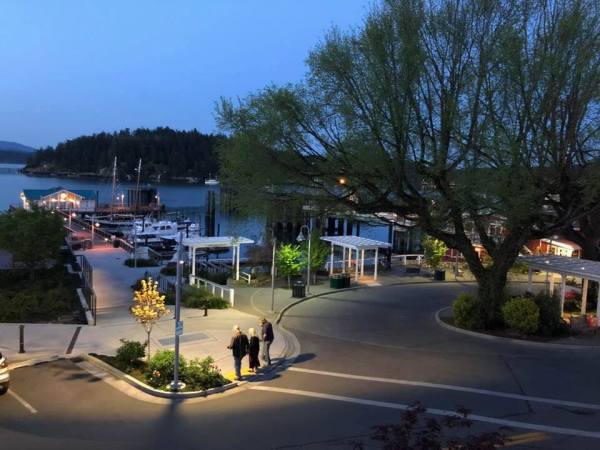
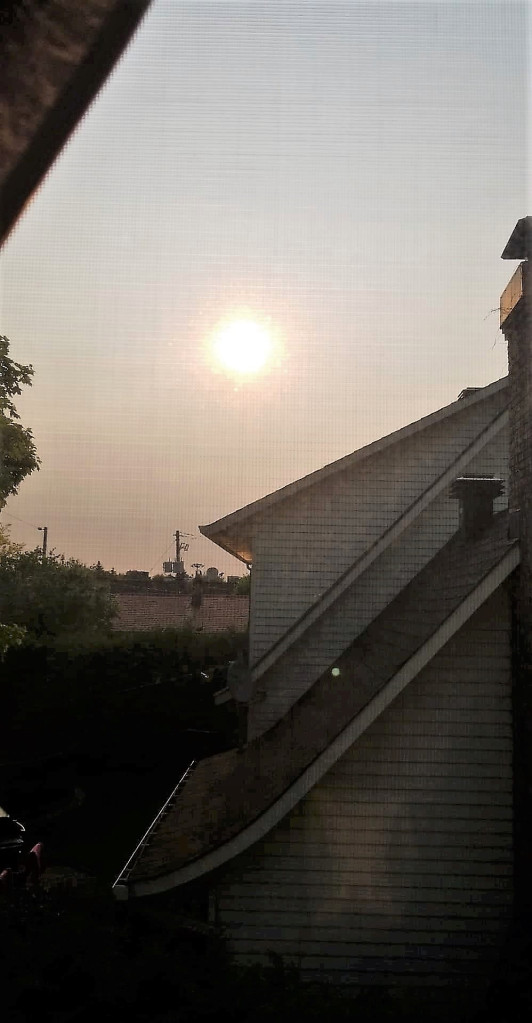
In the whole village, only I still remember Dan Grimes. He lived, carried to the fields the scythe he called Excalibur, drank ale, married Bess, and died, all before living memory.
The young uns don’t credit it when I say Dan would walk half way across the county for work.
“Why didn’t he get the bus?” they ask.
“Weren’t no buses then,” I say, and they ponder this in silence.
When folk say Joseph Grimes has his mother’s crabbiness, I tell ‘em the viciousness is purely Dan’s. And they respect my lore.
But Dan weren’t vicious when he were young. He were sweet. Just not sweet on me. He comes to me in my dreams.
Friday fictioneers is a weekly challenge set by Rochelle Wisoff Fieldsto write a 100-word story in response to a photo prompt. You can find other stories here
“My father is late,” she says as if this would somehow explain why she hadn’t turned up for work.
“I see,” I say. But I don’t see. “Where has he gone?”
The only answer is a shrug. How can she tell? Nobody knows. Her eyes, russet flecked with gold like sunspots on two stars, are filled with sadness and with resolve.
“Perhaps he’ll come back soon,” I suggest helpfully.
But she looks like I might be a little crazy.
“He’s late,” she repeats slow, as you might to a child.
I’m still not giving her the response she clearly expects.
“Late. Dead,” she says
I am overwhelmed by embarrassment.
Friday fictioneers is a weekly challenge set by Rochelle Wisoff Fields to write a 100-word story in response to a photo prompt. You can find other stories here
There, in the top right corner, that blur. See it? No, it’s not a smudge, it’s real. This is a special kind of camera. No holiday snaps of laughing kids here. The device strips away the flesh, to reveal … see? Your ribs, your radius, humerus and ulna. The miraculous complexity of the wrist. The radium camera reveals what you’re made of. But the blur isn’t a bone – it’s your spirit.
No, you can’t keep the image, sorry. We hold them in safe keeping. Sometimes we spread them all out on the floor and compare souls, judge who’s most worthy.
Friday fictioneers is a weekly challenge set by Rochelle Wisoff Fieldsto write a 100-word story in response to a photo prompt. You can find other stories here.
Synthesis is building something new out of simpler elements. Analysis is understanding something by breaking it down into its constituent parts. On the face of it, writing seems to be a synthetic activity. But not always. Sometimes creation involves analysis, as this example shows.
A member of my writing group said they’d like to see more of the main female character, Ayesha, in my novel The Tears of Boabdil. The plot, in summary, is about an undercover policeman (Vince) infiltrating an Islamist group and having a forbidden love affair with the sister (Ayesha) of his main targets. The theme is duplicity, that we are all stories we tell ourselves and other people.
My friend suggested she’d like to see Ayesha angry, receiving a gift about which she has to feign pleasure, and being observed by Vince in a situation that shows the reader the difference between her real nature and Vince’s fantasy about her.
I liked these suggestions. The first two were relatively straightforward. The third posed creative problems. The story is entirely told from Vince’s point of view, lies and all. He’s a classic unreliable narrator. The reader can only see what Vince sees. So, how to show Ayesha in a different light?
The process I went through to structure this scene was:
Firstly to make a list of Ayesha’s attributes. She’s generous, tolerant, intelligent, whimsical, dutiful, frustrated by her life, and overly trusting. Vince sees all of these qualities, bar the last.
So it was obvious I needed to focus on trust as the basis of the scene. Given the theme of the book, it was a good fit, underscoring for the reader the danger Ayesha runs in trusting Vince. So the next question was who, besides Vince, was Ayesha going to inappropriately trust? And how was Vince going to misunderstand it? Answering the second question seemed to promise a resolution of the first. Since Vince is a manipulator, a story-teller, perhaps he would mistake Ayesha’s trust for guile. He sees her as his talisman and guide into the terrorist conspiracy.
I didn’t want to introduce extraneous characters, so that implied the interaction would have to be between Ayesha and her brothers. A good place to locate it was a chapter in which one of the brothers invites Vince to lunch with his family.
Finally, I had to work out some stakes for the mistake. Dramatic irony occurs when the reader knows something important that a character doesn’t know. A classic example occurs in Shakespeare’s Macbeth, when King Duncan arrives trustingly at Macbeth’s castle, not knowing his hosts plot to murder him. Ayesha’s brothers might well kill her if they suspect her of sleeping with Vince. By seeing Ayesha as being like him, Zami can ignore her vulnerability, and hence his responsibility to protect her. Instead he sees her as protecting him.
As a last touch, I thought it might be nice to see if I could work in a reference to Macbeth and Duncan, which will serve the dual purpose of providing a literary echo and of alerting the reader to the dramatic irony.
So there I had all the component materials for my new synthesis. Like a flat-pack furniture kit, all I had to do was assemble them into something functional and pleasing.
You ask what I meant, and I tell you frankly that I cannot say. When it lived inside me, I knew its shape and smell. But, speaking, I expelled it for you.
I gave it legs to travel, though, inside me, it had no limbs. Wealth it carries in its pockets to pay its way. And I gave it voices to speak, though the language is one not known to me. All of this I did so you might know it. Life becomes something else when spoken.
So, instead, I ask you to tell me what I meant.
Friday fictioneers is a weekly challenge set by Rochelle Wisoff Fieldsto write a 100-word story in response to a photo prompt. You can find other stories here
There are marks on the pages, made by people long, long ago. They trigger electrical discharges in his brain. Not like a seizure, but precise tiny currents. These fluxes form things that cannot exist: a fish breathing air, a wicked witch, snow in the desert. On these little sparks, rising from the bonfire of his mind, he escapes.
Much later he watches a documentary. “They exist,” he cries, “fish with lungs”.
He sells up, and treks the scalding Sahara, searching for snow. Eventually he reaches the white-capped Atlas Mountains and stumbles on to Marrakech, sure he will find the witch.
Friday fictioneers is a weekly challenge set by Rochelle Wisoff Fields to write a 100-word story in response to a photo prompt. You can find other stories here
There are spitfires over my garden. Mrs Christie next door cheers.
“Hello,” I say. And then I add “Magnificent aren’t they?”
There’s a pause as she eyes me. “Kept us safe in the War. The Few.”
I sing “There’ll be blue birds over, the white cliffs of Dover.”
That seems to do it. She grudgingly invites me in for a nice cup of tea.
Spitfires don’t bother me. But when the helicopter comes over, I again see the barrel bomb falling and taste the choking gas.
“It must be hard for you people,” she says, and I feel utterly alone.
Friday fictioneers is a weekly challenge set by Rochelle Wisoff Fields to write a 100-word story in response to a photo prompt. You can find other stories here
I didn’t plan to steal your dog, it just happened. A watery sun was rising, the morning still largely made of shadows. Slipping between the shadow of an acacia and the one lapping your house, I tried to walk right up without setting him barking. And he came to me, tail going like a metronome.
You must be musical because I saw the Steinway through your window. Perhaps you loved that piano more than your dog, or why was he locked out in the garden? I scratched his ear. He nuzzled my hand.
I left your music, but you didn’t deserve that dog. I call him Beethoven.
Friday fictioneers is a weekly challenge set by Rochelle Wisoff Fields to write a 100-word story in response to a photo prompt. You can find other stories here
They say we are never so much ourselves as when we’re wearing a mask. But what do you do when your mask is inside? I feel him slowly filling my skull, peeking out through my eye sockets, wriggling white in the pupal case that once was me.
He started innocently as a pen name. Then he became a younger, more active, version of me. He frequented trendy bars, and sprang lithe across the fells with his Borzoi hounds. Last night, he fucked my wife, and she screamed in pleasure.
I may have to take drastic measures.
Friday fictioneers is a weekly challenge set by Rochelle Wisoff Fields to write a 100-word story in response to a photo prompt. You can find other stories here
I am cursed with brevity. It’s really hard for me to write a long book. My novel is currently a svelte 40,000 words. Yet the trend is against me. With long-haul holidays comes the “airport blockbuster”, a novel massive enough to last a flight across the world.
Blockbusters aren’t new. In the days when the reading classes tended to be the leisured classes, blockbusters were de rigeur. Think, for example, of what may be the longest novel in the English language, Samuel Richardson’s 1748 Clarissa, weighing in at 467,870 words. It’s a Sumo wrestler of a book.
Not that shorter books haven’t made the literary prize list. Thomas Love Peacock’s 1818 novel Nightmare Abbey is an anorexic 18,300 words and John Buchan’s 1915 The Thirty Nine Steps is a skinny 29,725 words.
Ian McEwan says “I do love this form, the idea that we are sitting down to a book that you could read at one sitting, or within three hours much as you might go to a movie or opera or long play.”
From the author’s perspective, a book should be “as long as the story needs”. But publishing is a business, and has to respond to market trends. So what are those trends?
Current advice is that fiction for adults should be somewhere in the 70,000 to 110,000 word range, a little longer for fantasy and sci-fi. (See for example Harry Bingham and Chuck Sambuchino)
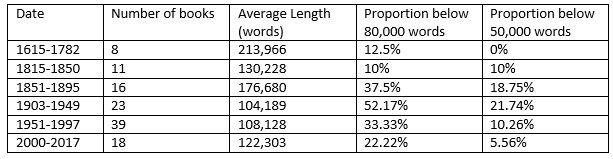
I took a look at how the trend changed over time, using the Guardian 100 best books listand, for the twenty-first century, the winners of the Man Booker Prize. The trend indicates that the heyday of shorter books was in the hundred years between 1851 and 1950.
From Cervantes’ Don Quixote, published in 1615 (and arguably the first novel) to Laclos’ Dangerous Liaisons at the end of the eighteenth century there are eight books, with an average length of 213,966 words. Only one book is less than 80,000.
In the first half of the nineteenth century, there are 11 books, averaging 130,228 words, with two below 80,000. In the second half of the nineteenth century (16 books) the average rises a little to 176,680 words. But, at the same time there are more books (six) below 80,000 words of which half are below 50,000 words. This may reflect growing literacy among the “lower” classes and tastes for stories like Robert Louis Stevenson’s The Strange Case of Dr Jekyll and Mr Hyde.
Come the first half of the twentieth century, and the average of the 23 books falls to 104,189 words. Books below 80,000 words make up over half the list, and books shorter than 50,000 words are over a fifth. Oh that I were alive and writing then! The average length for the 39 books in the second half of the twentieth century doesn’t change much, but the proportion under 80,000 words falls to a third and under 50,000 to a tenth. The airport blockbuster had arrived.
In the twenty-first century, this trend seems to have continued. The average length of the 18 Man Booker winners shows a 13% increase compared with the previous half century, and the proportions below 80,000 and below 50,000 words have continued to drop.
This seems to be at odds with some claims that readers’ attention span has fallen and that there is a trend for shorter books. There is some indication of a rebirth of interest in short stories and other short-form styles, particularly in digital format. Agent Clare Alexander says that the marketing challenge may be that of selling middle-sized works.
However, few publishers are seeking novellas. A quick search unearthed:
So the idea of a growing market for short forms may be an urban myth rather than a reality. Agent Kristen Nelson in 2006 noted a trend for authors submitting shorter books, rather than a trend for publishers wanting them. In fact, other surveys have also noted a trend to increasing length. A study of 2,500 titles on the New York Times bestseller and notable book lists found that between 1999 and 2014, average length increased by a quarter, from 320 pages to 400.
Only in non-fiction is there evidence of a trend towards brevity. A study of 272 non-fiction bestsellers on the New York Times list between 2011 and 2017 found a downward trend in average length, from 467 pages to 273 pages.
Do you suffer the curse of brevity? What do you do about it? Do you enjoy short novels? Where do you find them?