A character arc is a fancy was of describing the changes a character goes through from the beginning to the end of a story. There is a hidden assumption in the idea of character arc that stops us seeing the possibility of other stories.
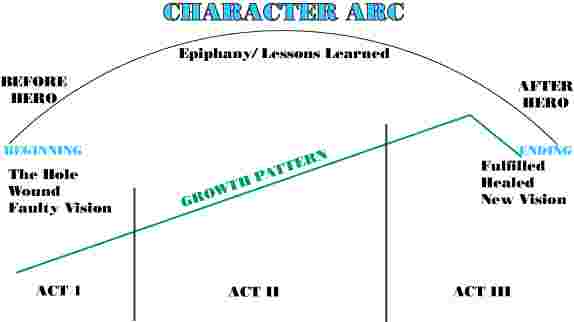
Consider the classic three act story. An individual is confronted by a problem (an external challenge or an internal flaw). They encounter trials and tribulations in which they are tested. They emerge better than before. Or, of course if the story is a tragedy, they succumb to the problem and emerge worse than before.
What does this remind you of? All those self-help and personal growth programmes perhaps? There is a view of the person and of development contained within these formulae.
- We are individuals
- We choose our own fate and can change
These principles of character arc seem so obvious we hardly even notice them as assumptions. But they come from a particular kind of society and, to other cultural traditions, they are far from obvious. How about these propositions:
- People become people through other people. This is the core principle of the Ubuntu cultures of Southern Africa. In other words, humanity is a quality we owe each other. Or, in the European tradition, John Donne’s famous “no man is an island”.
- The number of people on the planet who can choose their own fate is extremely limited. The starting conditions of wealth, gender, race, status and caste circumscribe our choices. For many people, change is unthinkable. Those who do escape their circumstances are not representative of their peers.
These differences are not only narrative, but moral. The first principles are individualistic, the second communitarian. What would character arcs be like if we used this second set of principles?
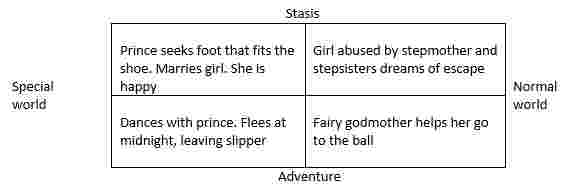
Let’s take an example of well-known tale. Here it is using the first formula. Follow the grid clockwise from top right to top left for the character arc.
Using the second formula, the story might look like this.
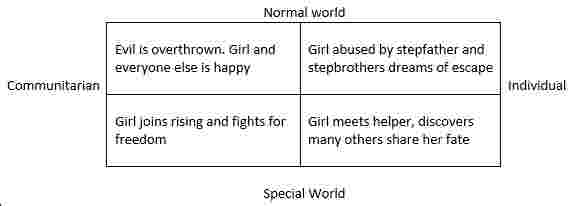
The Cinderella story has morphed into something more like The Handmaid’s Tale.
Other cultures’ story-telling traditions can be very different. While the modern Western tradition requires dualities between subject (the character who acts) and object (the world which is acted upon), protagonist and antagonist (who represent good and evil), this is not true of all cultures. Many use ambiguous Trickster figures who are neither good nor evil. The European tradition used to have Trickster figures but this has now been lost.
Similarly, some traditions don’t require the protagonist to undergo change. In some Japanese literature the character remains unchanged and the reader’s interest is maintained by growing understanding of the character. Similarly, in many Japanese stories the character’s goal is irrelevant: the plot is driven by causality. Though Japanese literature recognises the Three Act structure, they also have a Four Act structure (introduction, development, twist, reconciliation) and Western readers may find it hard to recognise anything they consider as an ending.
Another way of representing the classic, individualistic, character arc of the Western tradition is:
- Goal: what does the character want to achieve?
- The Lie: misconception that prevents them reaching their true potential
- The Truth: character rejects the lie and embraces the truth, leading to self-improvement
What if the conventional character arc is the lie? It describes a fantasy world in which most of us do not live.
In a complex modern economy, we are materially dependent on each other but socially indifferent. The goods and services on which we depend are furnished by strangers about whom we know and care nothing. This one fact contains the possibility for a huge variety of drama.









 Neil MacDonald Author