33. If you can’t name it, you can’t see it

We were sitting on a porch in the middle of Mozambique, sharing a bottle of whiskey.

“The trouble with you Anglo-Saxons,” my Portuguese friend, Joao, said, “is that you only know one way of being.”

Portuguese has two verbs to be – ser, to be permanently, and estar, to be temporarily. Joao argued that understanding this difference affects how you are in the world. The ability to name something carries with it the power to recognise it, to feel it, to explore it. Words don’t just communicate meaning, they create meaning.

I was reminded of this conversation this week, when by chance I read three different articles about words. Tiffany Watt Smith writes in New Scientist about the way words may rewire our brains. The BBC website covers the achievements of the Historical Thesaurus of Scots. And I am in the middle of reading Helen Macdonald’s magnificent H is for Hawk, which is filled with the ancient and arcane vocabulary of falconry.

Tiffany Watt Smith, writing in New Scientist, argues that if we don’t have a word for a thing or an emotion, we may not recognise it. She speculates that the Machiguenga people of Peru, who have no word for “worry”, may not feel the emotion. Equally, she says, English speakers lack a word for awumbuk. This word from the Baining people of Papua New Guinea, describes the empty feeling after visitors depart. They believe departing visitors shed a heaviness into the air in order to be able to travel lightly. This heaviness lingers for three days and creates an inertia that prevents the hosts’ ability to tend to their home and crops. The Baining deal with this by filling a bowl with water to absorb the miasma overnight. Early next morning they throw the water into the trees, and normal life resumes.

Watt Smith suggests that language and culture influence what we see and feel by allowing us to link our sensations to a network of other associations, making it easier to seek out experiences which are consistent with this, and to filter out those which aren’t.

An old favourite example of my own is the Portuguese word saudade. This had no precise equivalent in English, and describes the pleasure of feeling sad. So well recognised is this emotion in Portugal that it has spawned a whole culture of music, fado, which you listen to in fado cafes so as to experience saudade. I wrote this description in an attempt to capture the emotion.

The evening air held onto the warmth of the day, but the light had a dying mellowness, full of shadows. It had a softness that contrasted with the harsh angularities of noon. I sipped gently. The wine’s tart greenness contrasted with the dark wood of the tavern, polished by an antique cargo of a hundred thousand nights of convivial transgression. The guitarist took his seat and tuned his strings, while the fadista, her eyes fixed on some spot beyond our prosaic gaze, composed herself. As the plaintive call of the fado rose, shrill and bright, other patrons drifted in from the sun-warmed cobbled lanes of the Bairro Alto, like leaves collected by an autumn breeze.

Strangers, we sat, communing together through the mournful power of the music. The air was suddenly crisper, the wine more piquant, my heart fuller as she sang of the doomed love between a Count and a street girl. I thought of home. When she finished, there was a moment’s pause, and then an outburst of applause. Most of us clapped, but the man at the table next to me coughed, the traditional form of appreciation in the Coimbra school of fado. The Portuguese have a word, saudade. It means the pleasure of feeling sad. I savoured, for the first time, the pleasure of feeling sad.

Music and dance may be the languages in which we communicate concepts and emotions for which we have no words. It’s also worth remembering that the ancient Greeks distinguished between six different kinds of love, where in English we have only the one inadequate word. Precisely distinguishing varieties of things is important when you live on the edge of survival. It turns out from the Historical Thesaurus of Scots that Scots has 421 different words for snow. In a country where weather can be swift and treacherous, being able to communicate precisely about conditions had survival value. Even today, when British trains in winter are halted by “the wrong kind of snow”, this precision may be important.

Some of the 421 words for snow
Pre-snow conditions (Gramshoch)
To begin to snow (frog)
To snow or sleet lightly (scowder, skiff, sneesl)
To snow heavily (onding)
A swirl of snow (feefle)
Snowflake (flicht)
Large snowflake (flukra, skelf)
Slush/ sleet (snaw-bree, slibber, grue)
A sprinkling of snow (skirvin, glaister)
A slight fall of snow (skirlin, flaffin)
A heavy fall of snow (hog-reek, ondingin)
Snow driven by wind/ movement of snow (spindrift, hurl)
Slippery snow (shurl)
A cover of snow (goor, straik)

Words are talismans – they have the power to summon. At the whim of the writer, they may summon demons or angels. Nothing illustrates this more powerfully than Helen Macdonald’s searing memoir, H is for Hawk, in which she describes with stark honesty how she coped with the grief of her father’s death by training the most dangerous of raptors, a Goshawk. Her hawk, Mabel, is “thirty ounces of death in a feathered jacket”. Her use of language is superb, rendering her grief, the “manning” of Mabel, and the minute details of nature with a unique mixture of poetry and science. Her prose offers the rare pleasure of words that make me go to the dictionary. And then there is the arcane language of falconry. There is the equipment of jesses and creances. When Mabel beats her wings and attempts to escape the perch, this is bating. When she enters the state of murderous desire to hunt, she is in yarak. I have already appropriated these words for my own.

Words give us more than one way of being. That is the writer’s craft.

32. Could a machine write my books?

spark

The obvious, though sci-fi, answer is yes. Unless you believe in some immaterial human essence, human brains write books. Human brains are built of linked neurons in massively complex arrays. When we can emulate this complexity, whether the emulation is built of car tyres, tin cans or software routines, the same thing will happen. Conscious minds will emerge with thoughts, feelings and creativity. They will be able to tell stories and write books. Though some scientists think artificial intelligences may need bodies as well to be fully aware.

That doesn’t really help in answering the question now though. Most experts believe we’re at least 35 years away from being able to build artificial intelligences of this complexity. It’s great fodder for sci-fi writers. It exercises those tasked with considering in advance what rights such beings should have, and also how we should protect ourselves against the a Terminator threat.

So right now, when many jobs are about to be handed over to robots, including some quite skilled jobs, is my job as a writer safe? It’s not such a bizarre question as it might sound, at first hearing. Already, millions of share trading decisions are made by software algorithms, rather than City spivs. Machines are much better than humans at highly skilled tasks involving pattern recognition. Radiographers scanning X-rays for signs of cancer will soon be replaced by software which never gets tired and never has a fight with its partner. Even in the creative field, machines are producing music and images. So why not in writing as well? And if so, would it be any better than the “prolefeed” that George Orwell imagines in Nineteen Eighty Four?

There are any number of formulae offered to us aspiring writers to help us write better and more compelling novels. If you fed these formulae into a computer, could it produce a story?

Many of the plot tools are based more or less on Campbell’s “Monomyth”. Campbell believed that all stories ever told are in essence one archetypal story, and outlined the elements of it in his book Hero With a Thousand Faces. George Lukas followed this archetype faithfully in creating the movie Star Wars. The Novel Factory for example outlines six key elements of plot:

  • Goal – your character must have something they either desire or desire to avoid
  • Conflict – someone or something stops the protagonist achieving their goal
  • Disaster – something happens that not only takes the protagonist further than ever from their goal, but preferably adds on extra layers of peril
  • Reaction – following the disaster, the protagonist has an emotional and or physical response
  • Dilemma – the hero should have two choices, neither of them good, so the reader can empathise with the hopelessness of their plight
  • Decision – the protagonist chooses from the options available – which gives them a new goal… rinse and repeat

There are many other similar formulae, such as the Agile method and the Snowflake method. The Agile method offers a course which claims to get a writer to first draft in six months and says dozens of novels have been written using it.

To see what would happen, I developed a formula based on an amalgam of several methods. I used it to create the story board for my current novel The Golden Illusion, which divides the plot into eight stages:

  • Set-up (two stages)
  • Discovery and growth (two stages)
  • Decline and despair (two stages)
  • Climax and dénouement (two stages)

There are also any number of formulae for creating compelling characters. Just go, for example, to the Writers’ Knowledge Base and type into search field something like “compelling characters”.

And then of course there are the algorithms for text and grammar correction such as Pro Writing Aid, which I wrote about in recent posts.

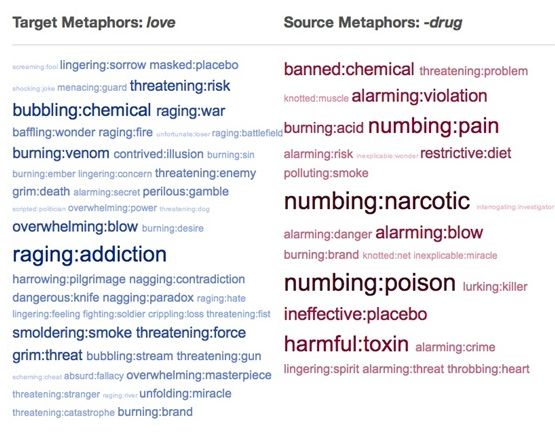
So could a computer programme be written to spew out best-sellers? There are lots of artificial intelligence scientists working on this, but the reassuring answer for all us wordsmiths seems to be “not yet”, as an article by Tom Meltzer shows. Machines don’t yet have any capacity for imagining. They have no means of understanding what a piece of text means. And they have trouble generating the many figurative ways in which people express themselves. Much of what they produce is either bland, or very short.

Metaphor magent

From the Metaphor Magnet

Consider this story, written by the software routine Scheherazade:

John got into his car with his disguise, gun and note in his knapsack and headed towards the Old Second in the next town over, repeating his rehearsed demands silently over and over in his head.

John watched while a little old lady left the bank and walked to her car and then slipped on his gloves, slipped his gun into his coat pocket, grabbed his mask and strode determinedly to the lobby door and pulled it open.

John looked at his reflection in the glass of the door, gave himself a little smirk and covered his face. John took another deep breath as he wondered if this was really a good idea, and entered the bank.

John looked around the bank, making sure his timing was right.

John spotted a young blond teller, Sally, behind the counter.

John stood behind the lady and toddler and politely waited his turn, noticing the nameplate on the counter … “Sally”.

When it was his turn, John, wearing his Obama mask, approached the counter. Sally saw Obama standing in front of her and she felt her whole body tense up as her worst nightmare seemed to be coming true.

Once Sally began to run, John pulled out the gun and directed it at the bank guard.

John wore a stern stare as he pointed the gun at Sally.

Sally screamed hysterically which alerted other people in the bank.

Pretty mechanical, though adding a grammar editor might have made it harder to distinguish from an extremely poor human effort.

But consider these two very short stories:

When the bank robbers that break into calm vaults hide behind livid masks.

And

Ink and soul cooperate with paper

One is by a human, from a blog I follow, In Noir Velvet and one is from a software project called Metaphor Magnet. Not so easy to tell, and I’m not going to let on.

Undoubtedly software will get better in leaps and bounds at generating stories. But there may be a more profound critique of the formulae.

The formula doesn’t work very well if you follow it religiously. I found in my own experiment with a formula in The Golden Illusion, that the plot rapidly spilled over the boundaries of the boxes. Characters began to do things I hadn’t expected or planned. I also found that there were creative problems I had to solve, about plot, sequence, causality and voice for which the formula provided no help. I moved the “call to action” (which was plotted to come to in Chapter 3) right up to beginning of Chapter 1, so there was a “hook” into the action.

Following formulae will produce similar stories. Campbell argued there was only one story – a universal narrative archetype. Critics of Campbell’s Monomyth argue that the similarity in the stories he analysed don’t express an archetype. Rather they reflect the fact that all the stories were created in similar conditions – namely by story tellers to please their rich and powerful aristocratic patrons. Women writers have pointed out similarly that Campbell’s stories were all told by men and don’t include the stories mothers tell their children.

It may not be that hard to invent a story, but it’s considerably harder to write a good story.

31. What price artistic integrity?

This week I’ve had my first brush with the writer’s moral dilemma. Namely, to stand on principle and refuse to change our work, or to accommodate editor’s requirements in the interests of publication.

Those of you who have been following this journey know that my strategy as a writer is to accumulate artistic credentials by publishing stories in literary magazines. As I explore the caves and grottoes of the literary labyrinth, slaying dragons and accumulating treasure, the plan is that these magic credentials will deflect the cold thrust of rejection from literary agents and publishers.

I resubmitted a story to an editor who had enjoyed it but felt that though it had a beginning and a middle, it lacked an end. Fair comment. I wrote an ending. He got back the next day to say the ending still did not provide the resolution he wanted.

Now comes the dilemma. I had crafted the ending, with some thought, to leave the reader unsure about which of two supplied explanations was the truth, and had stopped the tale just short of clear indication of what came next. That’s me. I like ambiguity. The world is full of things we don’t fully understand, and I have no problem with that. But I understand why it might be a problem for others. So, should I take the ending one step further on to resolve the ambiguity, making it, in my opinion at least, a weaker story? Or should I stand on my artistic dignity and dicker?

It took me only five minutes to decide. Artistic dignity is for those who already have a reputation. I changed the story. After all, I still have the earlier version. Did I sell my soul, or am I one step closer to being able to afford integrity?

30. How sticky is glue? Footnote on editing software

Following on from my last post about the perils of slavishly following the dictates of a machine editor, I had this salutary lessons. I was editing a story in which a character quotes Shakespeare’s speech from As You Like It:

“All the world’s a stage, And all the men and women merely players; They have their exits and their entrances, And one man in his time plays many parts, His acts being seven ages.”

My editing software says the Bard of Avon made some schoolboy errors here. The whole thing has a “glue index” of 51.4%. Glue words are the 200 or so most common words in English, which slow the reader down. Worse still, the first sentence has 71.4% of “glue” words – all, the, world. ‘s, a, and, men.

Ha! Much ado about nothing.

29. Machina ex Deus

deus_ex_machina_2

Are machines stupid? Yes, of course. And here’s proof.

I love my editing software. I use Pro Writing Aid to ferret out all those repetitive words, sneaky adverbs, and missing commas. It speeds up my editing and never tires. BUT …….

It’s a machine – the programme has no clue what the words mean. The first line of the chapter from A Golden Illusion that I’m working on at the moment is

“The night was long and adventurous, the morning easy and languorous.”

I was rather pleased with this, and the way it got me out of having to write another sex scene.

Pro Writing Aid wasn’t so impressed, and picked this out as a “sticky sentence”, containing 63.6% of “glue” words. The target figure for such words is below 40%. The software explains glue words as follows:

“Glue words are the 200 or so most common words in English (excluding the personal pronouns). Glue words are generally used to link nouns, verbs, adverbs and adjectives. You can think of the glue words as the empty space in your writing. The more of them there are the more empty space you readers have to pass through to get to the actual meaning.”

Unthinkingly I obeyed since I was in the midst of correcting lots of mistakes. The revised sentence was

“The hours before dawn were prolonged and adventurous, the morning easy and languorous”,

which successfully banished the stickiness by paraphrasing the glue words “night” and “long”. Success! Except that it’s a terrible sentence and doesn’t convey the meaning I wanted. On re-reading, I reverted to my original.

Another thing the software searches for is sentence length. The target for the average number of words per sentence is between 11 and 18, and the maximum length for any sentence is set at below 30 words. Again, this is a reasonable rule, but when followed mechanically, it led to unreadable sentences.

For example, the programme drove me to amalgamate the following sentences into one.

“‘No, not exactly, but it’s a trivial private matter. As I understand it, something to do with a stain on the Parris family reputation.’”

The resulting 24 word sentence was grammatical and within the maximum word limit, but it was harder to read.

Another set of algorithms confirmed the reading difficulty of the sentence. Hemingway App (http://www.hemingwayapp.com/) checks the readability of text, though it will only analyse around 5000 words at a time. The long sentence required a reading age of 14-15 years, while the original corresponded to a reading age of 11.

So, the moral of the tale is don’t allow the god of creativity to become a slave to the machine. I’m a big fan of the machine editor, but make sure your human eye reads everything over afterwards. Correct the text to what you intended to say, even if that breaks a rule or two.

28. To publish or not to publish?

Who knew there were so many tactical decisions in a writer’s life? As earlier posts attest, I keep having to make decisions. The gentle escapism into the creative craft is only the first step on a long journey. My dilemma may strike a chord with you. The decision I have to make now is whether to continue the serialised publication of A Prize of Sovereigns. Sixteen chapters have already appeared, and I’m committed to publication of the first 24. Do I agree to the next 12 (which would mean around three quarters of the book has been published online)?

prizesovereigns_squclean_01I made up a list of pros and cons. I consulted friends. The pros are:

  • Since I’ve decided to switch to pitching my mystery novel The Golden Illusion, it will continue to provide exposure for A Prize of Sovereigns and a readership for my work.
  • Some publishers like to see demonstration that a book has enjoyed online success
  • Along with the serialisation, the book gets an edit

The cons are:

  • The readership this site attracts is not large. The first 12 chapters attracted 555 unique page views, and about 20 regular readers
  • Some publishers will not touch a book which has already appeared online
  • The edit is a micro copy-edit, not a strategic macro-edit.

Decisions, decisions!

27. Editing – am I a craftsman?

Do you love the craft of editing or do you have it? I’ve just had a first class carpenter working on building me new shelving units for my office at the moment. I asked him which bit of the design, manufacture and assembly of the units he enjoyed. He said that his pleasure came from a satisfied customer, but that the bits he most enjoyed were the highly technical intricate work I would never notice, except by their absence if he got them wrong. He’s a craftsman of the old school. That made me wonder whether I’m a literary craftsman.

I’m taking a break from micro-editing. By this I mean copy-editing – going through the text and checking the word use. For me, this is the most tedious part of being a writer. I struggle to find it creative. I have removed 39 instances of the words ‘was’ or ‘were’ and 24 instances of ‘know/knew’ from Chapter 13 of The Golden Illusion. I’m entitled to a rest.

When we write, which part of the process do we enjoy? The big-picture act of writing is a buzz for every author. You have an idea in your mind, and behold it comes to life as your story.

Different authors feel differently about what happens next. After you’ve written your first draft, you then have to revise it, and revise it again. You have to edit, cut, rewrite, hone, and polish. The first draft is one you write only for yourself. Usually, nobody else ever sees it. Subsequent drafts are for the reader. You have to revise with an audience in mind. Some hate the editing process, some love it. Some like bits of it but not others.

I enjoy macro-editing. This is where you’re working on the big picture – does your story work? Are your characters right? The main macro-editing issues are here (https://neilmacdonaldauthor.wordpress.com/2015/08/23/macro-editing-points-character-and-story).

On the other hand, I find micro-editing a pain. This is where you’re working on the nuts and bolts of the writing. This is the heart of wordcraft. The main micro-editing issues are here (https://neilmacdonaldauthor.wordpress.com/2015/08/23/micro-editing-points-writing/)

Both macro-editing and micro-editing are essential if you want your story to sing, and to be the best it can possibly be. To use the analogy of sculpture, it’s not enough to find the form hidden in the rock, you also have to shape it and smooth it and polish it.

I don’t get a buzz from the highly technical stuff, though I can force myself to do the micro-editing because I know it’s essential. I enjoy the texture and savour of finding exactly the right word, just as much as any other member of the wordcraft folk. But done repetitively over the whole 65,000 words of the current draft, it’s just a chore. I guess I’m not a craftsman at heart. Damn! There goes another delusion!

Micro-editing points: Writing

The reader
Who is the reader? Who do you want to read the book? Is it intended for adults or children? Will it appeal more to women than to men? Is there too much description and not enough action for your intended reader? Or too little?

Location
How have you used location? Readers today generally don’t want a lot of description, but every scene takes place somewhere. The location may make a difference to how the scene proceeds. A rocking boat may make movement uncertain. A noisy cafe may impede conversation.

Dialogue
Is all the punctuation correct, with quote marks, commas, full stops in the right places? Is there a new paragraph for each new speaker? Is it clear who is speaking? Endless repeats of ‘he said’ and ‘she said’ get tiresome, and you can miss them out for two or three paragraphs if you only have two speakers.

However, don’t make the mistake of using lots of synonyms for ‘said’ to create variety. Variety is essential in descriptive words but they make the reader stop and stumble if you use them for speech tags. Provided there aren’t too many speech tags, the mind skims over ‘he said’ easily.

As an alternative to the ‘he said, she said’ speech tags, you can use beats, small bits of action to label who is speaking. For example, ‘Tom scratched his head. “What should we do about it?”’
Inserting bits of action into long chunks of dialogue is essential. People rarely just sit and talk without interacting with their environment in some way. One of my bad habits is writing pages of dialogue without action that punctuates it.

Wordcraft
This is where micro-editing becomes really micro. You need to go through your text word-by-word. This is what I’m doing at the moment with The Golden Illusion. Obviously you want to check for spelling mistakes. But there’s a host of other things you need to check for too.

  • Favourite words: We all have favourite words or constructions we tend to overuse. Seek them out and destroy them. For example, I tend to writing ‘I’m not going to do that’ when it would be much simpler to say ‘I won’t do that.’
  • Overused words: Some words are routinely overused. All of us tend to overuse words such as can/could, seem, think/believe, feel/feeling/felt, was/were, know/knew, hear/heard, look, see/saw, watch/notice/observe, it, that, just and maybe. Slash them down. You can’t eliminate every one, but make sure you don’t overuse them.
  • Words that aren’t working for their keep: Also on the hit list, words that aren’t doing any work. For example, ‘It seemed to him that she was interested.’ The phrase ‘It seemed to him that’ is just padding. Eliminate words that aren’t pulling their weight.
  • Adjectives and adverbs: Look out for overuse of adjectives and adverbs. It’s often a sign of weak writing. Why say ‘She looked at him angrily’ when you can use a stronger verb and say ‘She glared at him’?
  • Sentence length: Don’t make it hard for your reader. Hunt down sentences that are too long, and break them up. As a rule of thumb, keep sentences below 30 words. Same thing with paragraphs – break them if they’re running to more than 5 sentences.
  • Pronouns: Overuse of pronouns at the beginning of sentence is another common fault. I’m often guilty of in first draft of having up to 40% of my sentences start with pronouns – “I opened the door and stared at her”. “She looked at me”. It makes for boring writing. Varying the sentence structure makes the writing flow – “Once inside the door, I stared at her.” As a general rule, keep those initial pronouns to 30% or less of sentences.
  • There are many other technical elements, such as avoiding the passive voice – it’s weaker to say ‘Tom was invited by Sue’ than to use the active voice ‘Sue invited Tom.’

Going through all these checks is time-consuming, but it’s worth it to improve the readability and power of your writing. I automate detection of problems by using editing software. This saves some time, but it still takes me the best part of a day to copy edit a chapter.

Macro-editing points: Character and Story

Soul
What is the book’s soul? What was the kernel of truth you wanted to communicate when you first had the idea? When you look at comments you’ve got from readers, do they advance or impede this soul? This may help you decide which comments to work on, and which to ignore.

Character

  • Are your main characters the right ones for telling your story? Usually you’ve got this right, but not always.
  • Is the motivation clear? What do your main characters want? Without motivation, the story won’t move forward. Is the behaviour of the main characters and the interaction between them consistent?
  • Are your main characters interesting? They don’t have to be likeable, but there must be something about them that resonates with the reader and makes him or her want to find out what happens to them.
  • Are your main characters’ voices distinct and consistent? Check that you haven’t introduced your own voice by mistake.
  • What role do the minor characters play? Do they have a purpose in the story? What would happen to the story if you cut them out? If the answer is ‘nothing’ then consider removing the characters who serve no purpose. Be ruthless. Kill your darlings.

Story
Does the story structure work?

Beginning and ending

  • Have you written a page-turner opening that makes the reader want to continue?
  • Does the opening set up the problem and does the ending resolve it? If not, do you need to remove or relocate the opening and the ending? One reader pointed out that she though the real beginning of The Golden Illusion comes in Chapter 3, and I have a horrible feeling she may be right.
  • What’s the inciting incident? Does it happen because of something the main character does, or is it external?
  • Is there a climax? Does it come at the appropriate place, just before the ending? Is there a denouement which ties up the loose ends and resolves the plot? I have a recurring tendency to stop too soon and not write a proper denouement.

Middle

  • Is there an arc of rising action, including setbacks?
  • Do scenes end on cliffhangers to keep the reader motivated?
  • Is there a logical connection between each scene and the next in this middle part? Can you say for every scene ‘this happens because ….’?
  • Does each scene move the story forward? If not, you know it, kill your darlings.
  • Do you need to raise the stakes? Have you pushed your main character as far as he or she will go? In the early drafts of The Golden Illusion, I hadn’t given my hero nearly enough of a hard time.

26. Pithy pitches that woo for you

woo

Words motivate. We all want to get better at writing motivating prose. I want to tell you about the EMV, my latest toy that helps with writing motivating words. EMV stands for Emotional Marketing Value. The toy is the Advanced Marketing Institute’s Headline Analyzer (http://www.aminstitute.com/cgi-bin/headline.cgi). It has nothing to do with creative writing, but rather it analyses advertising copy. We may think we don’t write marketing copy, but the elevator pitch and the blurb of your book is advertising copy. It aims to secure a sale. This is also true of the first sentence of your book. If you don’t hook the reader’s attention, they may stop reading.

The EMV Analyzer scores your headline or your elevator pitch according to the number of words with emotional resonance, in relation to the total number of words. It also tells you whether the appeal is primarily intellectual, empathetic, or spiritual. The explanation says the English language has around 20% EMV words. A professional copywriter will have 30-40% of these words in their headline, while a gifted copywriter will achieve 50-75%. The blurb claims “While many marketers ‘guess’ how people will react to various words and offers, we have determined a test which will give you an actual rating that you can use to judge how well received your copy will be to others.”

For fun, I ran the elevator pitch for The Golden Illusion through the Analyzer. I had to run it in two bits because the maximum word length is 20.

The pitch reads:

“A mystery story with a difference, in which a conjurer turns detective. Believing he is on the trail of an ancient illusion, he is, in fact, uncovering a conspiracy that hides a crime 150 years old.”

The EMV score was 22.22%. Probably not enough to capture the attention of that busy publisher in the elevator. The EMV words were all intellectually appealing

So then I rewrote it, trying out different words, finally reaching a score of 60.87% with this version:

“An unusual mystery story. An illusionist turned sleuth, believing he hunts an ancient illusion, reveals a conspiracy hiding an atrocity spanning the centuries.”

The EMV words were a mixture of intellectual and spiritual appeal. I’m not sure I’m going to trust my fate to an algorithm and I may tweak it further, but I like the change.

There is some academic fruit-loopery that accompanies the tool, if you’re that way inclined. It is said to derive from the work of US language scholar Dr Hakim Chisti. He “found that there are these basic underlying harmonics, a tonality that flows through language, which are in many ways more profound and powerful than the dictionary meaning itself.” Or if you prefer, you can ignore that, and just use the tool.

By the way, I also tried out the Analyzer on various headlines for this post.
“Getting maximum punch from your pitch” had a score of 0%.
“Making pitches work for you” scored 20% and was spiritual
“Pithy pitches that woo for you” got 50% and was spiritual