15. Winchester – a worship of writers

Who knew that the collective noun for a group of writers was a worship? I just looked it up. I might have hoped the noun to be “an eloquence of writers”, but that is reserved for lawyers, and lions have already bagged “a pride”.

So there we were on Saturday, a worship of writers at the Winchester Writers’ Festival. Under an overcast sky, the campus of Winchester University was thronged with writers, eager, hopeful, or stoic, each according to their own experience and temperament. Interestingly, there was a preponderance of women, including one striking blonde Amazon with rippling biceps. I’ll come back to an interesting gender issue later on. Old friends met up with cries of “who are you with now”, making me acutely aware I hadn’t yet been signed by anybody. Perhaps my two one-to-one meetings with an agent and a publisher would rectify that.

We streamed from building to building and from room to room, assessing each other with cautious insouciance, wary of encountering a “shrivel of critics”. Three of us from my writing group had a chance encounter, before the event even started, with one of the “shrivel”. She was a volunteer with the event, who, uninvited, joined our table in the coffee room and demanded to hear our elevator pitches and quizzed us about whether we were truly writing from our own experience. She showed no interest at all in what we’d actually written, in her desire to impress us with her own wisdom. “It’s just my opinion”, she wailed as we extricated ourselves. ‘”I’m just an amateur.” Indeed. Her ruthless and undeviating advocacy of the rules of writing spoke eloquently to this point.

Undaunted, my first stop was a dash to the noticeboard in the main conference centre, to see if either of my two entries to the short story competition had been short-listed. They hadn’t, though in act of nominative determinism, I was ticked to note that one D S Writer had made it through.

During the day I went to four workshops. I’ll just give you one take-away point from each of them. An agent said that she took on only two or three new clients a year. A publisher said that, though they won’t admit it, agents and publishers are looking for a reason to instantly bin the submissions they receive, because they can’t possibly read all of them. A novelist said that to find your own “voice”, you have to unlearn the rules of written English you learned at school (I don’t agree with this one). A maker of historical docudramas said that you can get away with imposing a story structure on the known facts, by exploring the drama of well-chosen characters.

I also had one-to-one meetings with an agent and publisher. The good news for me was that they both liked my writing. The publisher really liked it. And that was validating. From my slough of despond about A Prize of Sovereigns at the beginning of the year, I really believe in my book again. But neither of them offered to sign me, though both made really useful suggestions about other agents I should approach. The really interesting thing, though, was the gender issue I referred to at the beginning.

The agent was a man, the second male agent I’ve talked to about the book. And both of them said the same thing. They said it was neither history, because it’s not a true historical record, nor fantasy because there are no fantasy elements. I pitch the book as historical fantasy, because, though It draws on a lot of historical research, I’ve made what George R R Martin calls a “historical mash-up”. I’ve shortened time scales, and, in some cases, put events into a different order or into different places. Many of the major characters are real as well, though I’ve picked and mixed elements of different historical figures to create my characters. History for me, is a rich toolbox of fascinating events, great stories and strong characters. But I do this in the service of fiction, and use what I find in the box to drive the story. Because of this, I’ve set the book in a fictional location, though readers of history quickly recognize it as England and France during the Hundred Years War. I’m not so much interested in writing about the Hundred Years War as I am in exploring why rulers make the decisions they do, and what effect those decisions have on those they rule. So both guys have said this choice is a commercial problem and have urged me to make it straighter history or straighter fantasy.

The publisher was a woman, and had no such problem. For her, it would sell across both the historical fiction and the fantasy genres. Three female agents and a female literary consultant have also been of the same opinion.

Now, you can’t draw any meaningful conclusions about gender differences from a sample of two men and five women, but it’s intriguing nonetheless. My wife says it’s because men can’t multi-task.

Take a look at the book by clicking the link to it on this page (the first seven chapters are published now) and tell me what you think?

14. Rejection

The publisher who liked the first chapters of A Prize of Sovereigns and asked to see the whole book has turned it down. It’s another rejection, but at least it made it to the second stage. My thoughts are focussed now on the Winchester Writers’ Festival this weekend, where I have meetings with an agent and a publisher.

13. Scenes, Sequels, and MRUs

In the last post I looked at some techniques for plotting out a novel. In this post, I’ll look at one technique for improving the writing of the scenes that make up the plot. I’ve been looking through Randy Ingermanson’s advice on writing the perfect scene. I mentioned his Snowflake method in the last post.

You can find his advice on writing the perfect scene here: http://www.advancedfictionwriting.com/articles/writing-the-perfect-scene/

I’m not going to go through the whole technique. You can look it up if you’re interested in the detail. Basically he talks about the large-scale structure of scenes and their small-scale structure. This is tried and tested stuff, he says. All scenes are either SCENES or SEQUELS. A SCENE is structured, he says, into Goal, Conflict and Disaster.  A SEQUEL is structured into Reaction, Dilemma, and Decision.  Sequels follow scenes and give rise to new scenes.

He writes “You may think these patterns are too simple. You may think this is reducing writing to Paint-by-Numbers. Well, no. This is reducing fiction to the two patterns that have been proven by thousands of novelists to actually work. There are plenty of other patterns people use. They typically work less well.”

I thought it would be interesting to try out his technique on my novel A Prize of Sovereigns. I analysed Chapter 1, and it seemed to fit his idea of a SCENE.

He then goes on to say it’s not enough to create a structure of SCENES and SEQUELS. You have to actually write them, which is where the small-scale structure comes in. The small-scale structure, he says, is a chain of MRUs. MRUs are units (the U) of objective Motivations (the M), followed by subjective Reactions (the R). A scene is just a string of MRUs. He gives the following as an example of a motivation, objective and external: “The tiger dropped out of the tree and sprang toward Jack”; and this as an example of a reaction, internal and subjective: “A bolt of raw adrenaline shot through Jack’s veins. He jerked his rifle to his shoulder, sighted on the tiger’s heart, and squeezed the trigger. ‘Die, you bastard!'”. Anything which isn’t a Motivation or a Reaction should be ruthlessly purged, he argues.

So I analysed my chapter into MRUs. You can see the beginning of it below. I’ve colour coded the motivations in blue, the reactions in red, and other stuff in purple. After the analysis, I rewrote the chapter according to his stipulations.

Original

MRU 1
What a fragile thing a man’s head was. So easily stove in with a hammer. Or lopped from the neck with a swing of a broadsword.

Byrom’s thoughts were oddly detached as he watched. He yielded only the hint of a shiver as Nye Stokys’ severed head bounced on the wooden planking of the bridge.

BACKSTORY
Byrom, of the House of Simmister, had claimed his share of heads in battle. He liked war,
MRU 2
but as he watched the rebel’s headless body crumple and then slowly fall, he knew this was different. This was the first time he had taken a head under a flag of parley. From here, there was no going back. There was no honour in this. But the meaning of that word depended on who you were. The honour of Kings lay in safeguarding the realm.

Revised version
MRU 1
Nye Stokys’ severed head bounced on the wooden planking of the bridge.

Byrom’s thoughts were oddly detached as he watched, yielding only the hint of a shiver What a fragile thing a man’s head was. So easily stove in with a hammer. Or lopped from the neck with a swing of a broadsword.

BACKSTORY

Byrom, of the House of Simmister, had claimed his share of heads in battle. He liked war,

MRU 2
But this was the first time he had taken a head under a flag of parley. From here, there was no going back.

As he watched the rebel’s headless body crumple and then slowly fall, he knew this was different. There was no honour in this. But the meaning of that word depended on who you were. The honour of Kings lay in safeguarding the realm.

The results were interesting. Mostly the Chapter fell out into MRUs and backstory. The MRUs were often inverted, with the reaction coming before the motivation, which was something I hadn’t noticed before. Also, a no-no in Ingermanson’s method, some paragraphs mixed motivations and reactions,as you can see. So in the rewrite, I put motivations before reactions, and separated them into distinct paragraphs. It’s the reaction that puts you into the character’s head, so it’s important to give it prominence. I also checked that the reactions followed a logical sequence – from feeling, to reflex response, to rational action and speech. I eliminated everything that wasn’t an MRU.

Did it make the chapter better? It makes sense, but I’m still not sure. I certainly wasn’t happy about losing the backstory or other elements, such as the description of the main character. I don’t see how you can do away with dropping in backstory. As for the strict sequence of motivation followed by reaction, I don’t know whether readers will find it harder to identify with an MRU if the reaction comes before the motivation. Do we always need to see the zombie before we hear the scream, or is the scream primal enough sometimes?

I’d be really interested to hear from anyone else who’s tried the technique.

12. Tools

A poor workman may always blame his tools, but a good workman always makes sure he has the right tools for the job. I mentioned in the third post, Plotting out a Story, the character tool I use. Perhaps you might be interested in knowing a little more about tools.

Perhaps of course, you won’t. For some writers, the idea of tools is anathema. If you follow a format, they might say with some justification, the writing will become mechanical – it will impede creativity. Such writers enjoy the roller-coaster ride, hanging on for dear life as their characters and their subconscious lead them through a winding plot.

The counter-argument would be that if you’re not sure where your story is going, or who your characters are, you can spend months writing a 100,000 word first draft that doesn’t hang together, and lacks continuity. It’s worth remembering that, since millions of whatever currency they work in are at stake, screenwriters and film directors never trust their work to whims of the Muse, and to the vagaries of their memories.

There’s absolutely no reason why you should use any tools at all, but, if you don’t, be prepared for some pretty savage editing after your first draft.

So let me talk about tools. I said in an earlier post that, for me, the elements of good story-telling are the plot, the characters, and the quality of the writing. I’ve already written about the tool I use to keep track of my character, so let me talk about plot. Perhaps in a later post I’ll talk about tools that can help good writing.

There are lots of theories about what makes a good plot structure. A story should have a beginning, a middle, and an end. After a set-up, tension should rise to a climax and then be resolved. This is the basis for the Three Act Structure, much used in screen-writing. The first act sets the scene, introduces the protagonist, and contains the inciting incident, which drives the rest of the plot. The inciting incident poses a problem. The screenwriter, Michael Hauge in his book Writing Screenplays that Sell, says there are five possible goals that flow from the set-up:

  • To escape
  • To stop something from happening
  • To deliver something of value to where it’s needed
  • To retrieve something of value and return it to the right people or place
  • To win something (a contest, love, respect etc.)

The second act, is one of rising tension as the protagonist struggles to solve the problem posed by the inciting incident. In this, he or she is usually added by others, and foiled by an antagonist. Conflict is an essential part of tension. The author, Randy Ingermanson, creator of the Snowflake writing method (http://www.advancedfictionwriting.com/articles/snowflake-method/), is a great believer in combining disaster with the Three Act Structure. He believes in a “three-disasters-plus-an-ending” structure, with the first disaster at the end of Act 1, the second in the middle of Act 2, and the third at the end of Act 2. You can buy his tool as software, but you can just as easily create it yourself on a spreadsheet.

The third act, the ending, provides the resolution to the problem.

This, of course, is only one way of thinking about plot. Joseph Campbell, in his book, The Hero with a Thousand Faces, said that all stories were variants of one “mono-myth”. George Lucas followed Campbell’s recipe in the making of Star Wars, and there is another writing method that is built on this basis – the Agile Method (http://agilewriters.com). I used my own variant of the Agile formula for the book I’m working on now, The Golden Illusion. Just to see what would happen, I plotted the story arc into four phases:

  • Set-up
  • Discovery and growth
  • Decline and despair
  • Climax and dénouement

It worked pretty well for keeping track of the story, though it escaped the boxes in every direction. You’ll notice this structure only gives me one major disaster, where the Snowflake method advocates three. The protagonist was thwarted in his drive to the goal, and lost his girlfriend and best friend into the bargain. But there were, of course, other minor setbacks as well as triumphs on the way there.

Other people disagree vehemently with Campbell’s mono-myth idea. Critics have argued, for example, that he was oblivious to the stories women tell. As I mentioned above, Michael Hauge believes there are five basic stories. Christopher Booker, influenced by Jung’s psychology, believed there were seven basic stories. Vladimir Propp analysed Russian fairy tales, and claimed to have identified 31 different plots, while Georges Polti advocated for 36 fundamental dramatic situations. You pays your money and you takes your choice.

However you design your plot. It helps to plan (or at least record as you write) the essential elements. You need something that will keep track of your timeline, so you don’t get jumps in sequence, or time of day, or sequence. You need something to keep track of where the action is going – particularly if you have several threads interwoven in your story. This is my master story-board template for The Golden Illusion

storyboard

I took out the details, so there are no spoilers when the book finally, if ever, sees the light of day. But, you can see the grid is divided horizontally into the four elements of the arc, with an associated time-line, and vertically into the main plot, and the three sub-threads (A, B, and C). These sub-threads were: the protagonist’s search for the secret of an ancient Egyptian magic trick, which he believes will be a “Golden Illusion” that will make his fortune; the unfolding story of a group of nineteenth century villagers that seems to be connected to the Golden Illusion; and the protagonist’s problem in emotional commitment. There is also a column for characters, so the main events that happen to each character can be tracked.

For my next book, the sequel to A Prize of Sovereigns, I have modified this template and added two new elements. The first is a summary of the whole book. There are two summaries: a one sentence summary, which is the pre-cursor of the elevator pitch (see post 4: After the writing is over – publishing), and a one-paragraph elaboration of the elevator pitch. Previously I have written these only when the book was finished, but Randy Ingermanson advocates doing this at the beginning in his Snowflake method, so I thought I’d give it a try. At least I now know exactly what the book is about, and am half way to the pitch and synopsis. The second new element is a scene list, again a suggestion from Ingermanson, with a one sentence description of each scene.

I have used a version of scene lists before. In the past, I’ve written one paragraph summaries of each chapter, but only after I’d drafted the chapter. This made it easier to keep track of where I had got to if there was a break in writing, as well as vastly simplifying the writing of the synopsis. What is new this time is that I’ll write the scene descriptions before I draft. I’m curious to see how that works out. In theory, it should make writing the first draft much quicker.

11. Some more encouraging numbers

Twelve wasn’t a great number, but I got some more encouraging numbers today. Today I asked for viewing figures on the serialisation of A Prize of Sovereigns. The first four chapters have appeared now, with the fifth due out tomorrow. There have been 262 unique views in the month since the first chapter was published. Which is still not 20 million, but it’s not unrespectable. The publishers seem pleased.

I haven’t said much about A Prize of Sovereigns yet. Which is remiss of me, since a major point of writing a blog is to promote my writing. One of the promotional pieces I wrote for it runs like this.

War is coming to the kingdoms of Ceweth and Lorrador. Byrom, King of Ceweth, is a bad man. But he hopes to be a good king. Aurthur of Lorrador is a thoroughly nice man, but a weak prince. The fate of both realms depends on the decisions they make. Told from multiple viewpoints of princes and peasants, statesmen and storytellers this is a tale of intrigue, betrayal, war, and revolt. As the story develops, it assumes a strange familiarity; in the end, it is our own, and asks the eternal question: what does it mean to be a good person?

I wrote it to explore that question about goodness, and once I had decided to locate it in a medieval setting, I began to add elements. I was in the middle of reading George RR Martin’s Game of Thrones series then. I loved the story, and the way he used what he calls “historical mash-up”. I adopted “historical mash-up” with glee. I created the main aristocratic characters by amalgamating several real people. I created the events of the war between Ceweth and Lorrador out of real events in the Hundred Years War between England and France, but not necessarily in the precise sequence in which they really happened. Unlike Martin though, I was interested in exploring the strategies rulers employ, and how they may have unintended consequences. And, also unlike Martin, I wanted to explore what ordinary people felt. The ordinary people, called smallfolk in Game of Thrones, barely appear. I guess you could say I wrote the Game of Thrones I would have liked to have read. Or you might say, A Prize of Sovereigns is George RR Martin meets Ken Follett.

Actually, that’s not bad. I might use that line with the next agent I talk to.

10. Social media – 19,999,988 to go

I guess the one major thing in a writer’s bag of tricks I haven’t commented on yet is the use of social media. These days, every author needs a blog, a Goodreads account, a Facebook page, and a Twitter account to network with readers and build a following. It’s not that I don’t do these things, or some of them, it’s that I’m not very good at it yet.

Take this blog for example. I started it on May 17, 2015. It’s not a unique idea, but it seemed there ought to be quite a lot of interest in how a tyro writer negotiates his way into publication (or not, of course). So I’ve posted away for two weeks, and waited for the world to come to me. But of course they haven’t. I don’t mean you, you’re reading this. I mean all the others. It has been viewed 90 times, by 30 distinct visitors – 82 of the views were from the UK, and 5 from the US; the other 3 were untraceable. I have 3 followers, 5 likes, and only one view led to a click through to my book.

Early days, I tell myself. I’ve mailed all my friends in my writing groups. Now I need to work my other networks. An author needs, as I said, several online networks. Facebook and Twitter are the big ones. I still don’t have a Facebook account, I’m not sure why. I will one day. Two weeks ago, I didn’t have a blog. I do have a Twitter account, but I never tweet. I’m verbose. I can’t think why I’d want to express myself in 140 characters or less. So that’s why I started to blog instead.

There are some other key social networking sites that authors should know about. And I’m on them. Goodreads (https://www.goodreads.com) is probably the most important. Goodreads is the world’s largest site for readers and book recommendations. I’m not sure how many members it has. It reported 20 million in 2013. So you can potentially connect with over 20 million readers. Of course I don’t.

I have four friends, four people have liked book reviews I’ve posted, and four people have added my book to their lists and two people rated it. That’s not too many out of 20 million. Yesterday I only had three friends. I made the fourth one by joining a couple of Goodreads groups. This is going to be harder than I thought, but I seem to be on the right track. Of course you don’t just join Goodreads (or any other social networking site) and say “hey guys, you need to read my book, it’s awesome.” Nobody appreciates being marketed at like that. You get respect by being a member of the community, posting reviews of books and joining in discussions.

The other site I joined is Wattpad (http://www.wattpad.com). It’s basically a site where writers can connect with readers who want to read free stuff. There are stories of authors having their work ripped off from there, but nothing more than rumours. I posted the first three chapters of A Prize of Sovereigns there, and then provided a link to the site where it’s being serialised. I’ve got 4 followers, 7 people who rated it, and 6 who left comments.

Apart from the Facebook page, I’ve got a presence on the right social networking sites. You should probably get all of those. So, I’ve got three followers for this blog, four followers on Wattpad, and four Goodreads friends – 12 down 19,999.988 to go.

9. Lying to your readers

Should you ever lie to your reader? Yes, of course. All the time. That’s what a plot twist is – you lead your readers’ expectations down one path, and then flip them. The mechanism is somewhat similar to a joke, which also leads the hearer down one path only to flip it. The physiological response to a joke is the explosive outbreath we call laughter.

sex

Especially with short stories laughter is often our response to a good plot twist.

There are some standard devices for doing this. The most obvious is the Red Herring, and the closely-related McGuffin. Detective stories are full of red-herrings, clues that seem to lead to the solution but are in fact illusory or mistaken. The term “McGuffin” I think originated with Alfred Hitchcock. A McGuffin is a plot device, some object, person or goal that the protagonist pursues. The McGuffin is often illusory or recedes into the background in the course of the story.

The book I’m currently working on, The Golden Illusion, has the protagonist, a stage illusionist, chasing the secret of a 4,000-year-old illusion performed by the Egyptian magician, Djedi, for the Pharaoh Kufu. It is a McGuffin. I’m still struggling with making the real ending, as spectacular as Djedi’s decapitation and re-animation trick.

Other common devices where you lie to your readers are the False Protagonist and the Unreliable Narrator.

The False Protagonist works by leading the reader to believe that a character is the protagonist of the story. This character then vanishes, often by being killed. This has huge shock value. George R R Martin used it to great effect in Game of Thrones by killing Ned Stark at the end of the first book of the series.

The Unreliable Narrator isn’t so much about lying to your readers as leading them to doubt the version of events given by your narrator. You might do this from the outset, by having your narrator character make a statement that is plainly false or delusional. Or you might leave this reveal until later in the story. If you leave it until the end, it becomes a plot twist. William Riggan, in his book Pícaros, Madmen, Naīfs, and Clowns: The Unreliable First-person Narrator, suggests there are five types of Unreliable Narrators:

  • The Picaro, or braggart
  • The Madman, who may be experiencing psychological defence mechanisms, or deeper insanity
  • The Clown, who does not take narration seriously, and plays with convention, truth, and the reader’s expectations
  • The Naif, a narrator whose point of view is limited through immaturity or ignorance
  • The Liar, a narrator who deliberately misrepresents himself, often to cover up misdeeds

I’ve never yet had the courage to use the Unreliable Narrator device. But I should. I’m fascinated by the way different people read the same situation so differently. Perhaps it’s my academic training that leads me to be so unadventurous with the truth. I did write a short story in which the protagonist is autistic, but that’s as far as I’ve dared go so far.

8. How do you know what agents and publishers want? Some key websites.

Let’s say you’re writing a vampire novel (please don’t, it’s been done to death). How do you find out whether this is what the market is looking for? Are you spending hours writing a dark mystery novel when what everyone wants right now is spy thrillers? One editor, for example, fourteen hours ago was looking for “original fantasy! No elves, no orcs, no dwarfs, no euro-centric worlds. Give me something new!” and “non-military space opera! Well-developed characters, intriguing plot, original world building”. A day ago, another was looking for “a romantic comedy featuring hockey players! Bonus points for an enemies to lovers conflict”.

How do I know this? The Internet of course. All this information, and loads more, is on a website called MS WishList (http://www.mswishlist.com/). It is one of several such sites. Another is Agent and Editor Wishlist (http://agentandeditorwishlist.tumblr.com/). And then there’s the twitter frenzy of #mswl. Agents and publishers post their interests on these sites. There’s even an online pitching party four times a year on twitter at #pitmad (short for pitch madness) where you can pitch your completed manuscript directly. The next one is on Thursday 4 June from 8 a.m. to 8 p.m. Eastern Standard Time (1:00 p.m. to 1:00 a.m. UK time).

Of course, the agents and publishers who use these sites are generally the smaller ones. But some of the larger companies also periodically indicate what they’re looking for. Agents at Curtis Brown, one of the largest literary agencies, recently published a list of books they loved and what they would like to see more of (http://www.curtisbrowncreative.co.uk/blog/the-last-book-i-loved-recommendations-from-the-curtis-brown-agents/)

And then there’s the industry trade magazine, the Bookseller (http://www.thebookseller.com/) if you want to keep up with what’s hot and what’s not. You’ll find a lot of articles there about how the publishing world has been transformed by the e-publishing and self-publishing technological revolutions, and arguments about whether power in the industry has been transferred from publishers to readers, or to authors.

When I discovered all these websites, in addition to those of agents, publishers and magazines I had researched as being of interest to me, my heart sank. Were there really enough hours in the day to keep up with them all, and leave the odd minute here or there to do some writing? Of course, if you’re diligent you will keep up with them all. However, if you’re indolent like me, you’ll want something more digested. I confess the only thing I read regularly is the weekly (free) newsletter from Authors Publish, which I mentioned in a previous post. They highlight different publishers and magazines you can approach. That’s how I found the publishers to whom I submitted A Prize of Sovereigns. They have a really useful overview of publishers you can approach directly (http://www.authorspublish.com/the-top-20-publishers-for-new-authors/).

You do have to somehow keep tabs on what the market wants. Going to talks at Literary Festivals can be the sluggard’s way of doing this. The Winchester Writers’ Festival is coming up in a month’s time, and I’ll be there. I have one-to-one meetings lined up with an agent and a publisher. I’ll let you know how I get on.

7. Tinkering

With this week’s edit of A Prize of Sovereigns out of the way, I’ve resumed working on my short story route to literary fame. I have sent off 23 stories in the last 12 months with an acceptance ratio of 6.23%, according to my Duotrope (https://duotrope.com) control panel.

I’ve been tinkering with the two stories that almost made the grade. One, you will remember, was rejected for having a beginning, and a middle, but no end. The story, Zhuang Zhu’s Dream, deals with a character who starts to have memories of a life that isn’t his. Zhuang Zhu, by the way, was the Chinese sage who woke from a dream in which he had been a butterfly and wondered whether he had been a man dreaming he was a butterfly or was now a butterfly dreaming he was a man. I had ended the story with the main character waking to a terrifying memory of having killed someone. He considers and rejects the ideas of running away, and of confessing to the police. So he simply goes to work as normal. I had been satisfied with the idea. This, after all, is how most of us have to deal with the frightening and the inexplicable. We keep calm and carry on. But the editor was kind enough to give me this feedback.

“I very much liked the style in which this one was written, which was clear and entertaining, with a nice pace and all the elements in balance, and really my only criticism is that I felt it fizzled out a bit at the end. I’m left none the wiser as to what the significance of these false memories might be. The whole story seemed like a lead-up to a denouement that was never reached”

I understand his point. So I tinkered with the ending. It wasn’t easy. I really didn’t want to give any definitive explanation of where the memories came from. Definitive explanations don’t belong in literary fiction, I decided. Perhaps they were just dreams, incorrectly identified as memories? Or perhaps they were something more mysterious? Eventually, I decided on the device of presenting both resolutions, and leaving the reader to reach her own decision, depending on her proclivities. The main character is referred to a neurologist, who tells him that this is perfectly normal, and that he happens to lack a particular fold in his brain which makes it more likely he will confuse reality and imagination. The neurologist enrols him in a research study, where he meets another subject who seems to be living the life he has fragmentary memories of. What’s more, this subject describes having memories of a life that may be that of the main character.

I arrived at this ending having considered various alternatives. Might his memories simply be, as the doctor suggests, part of the normal process of confusing imagination and reality? Might his memories be portents of the future, with the ending being that he kills the neurologist?
I felt up-beat enough about the ending I had written that I submitted the story.

The magazine to which I had sent the first version is currently closed to submissions. So, in a fit of hubris, I submitted to a magazine with a 0.22% acceptance rate. I have already had five rejections from this magazine, so you’d think I would have learned. But belief in my story burned bright enough to take the risk again. I’ll let you know when the sixth rejection slithers into my in-box.

The second story I’ve been tinkering with has proved more complicated. This story, Interstices, was described by the editor as a “polarising story” – some of their readers really liked it and others didn’t. He said, “although everyone recognised it had the kernel of something interesting it ultimately could have been delivered better and with fewer clichés.” What? Me? Clichés? I devoted some time yesterday to hunting for clichés. I really only found one, though I did find some other bits of lazy writing. I showed the story over the weekend to a friend in my writing group. He was on the “don’t like it” side of the marmite polarisation, but he was kind enough to suggest that perhaps the story needed a more dramatic crescendo. I’m still tinkering with crescendos and worrying about where other clichés may be lurking.

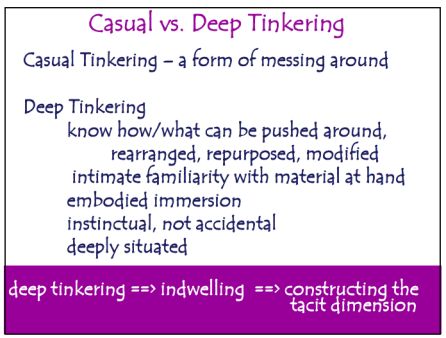
Meanwhile, to reassure myself that tinkering is an appropriately adult form of play, I wondered what others might have said about the process. I came across this interesting slide from John Seely Brown (https://usergeneratededucation.files.wordpress.com/2011/12/2011-12-11_1127.png).

Tinkering

So that’s okay. I’m deep tinkering, not just messing about.

6. Two cultures

Winston Churchill said that the UK and the US were two cultures divided by a common language. As a Brit working with an American editor on the serialisation of A Prize of Sovereigns, I’m experiencing that first hand. Yesterday I received the edit of Chapter 8, and we ended up having a dialogue about the phrase “heavy horse”. My editor had made this plural, changing it to “heavy horses”.

In Medieval times, armoured knights on horseback were the shock combat weapons of war. A charge by hundreds of them could smash through an enemy’s lines. Collectively, they were known as “heavy horse”. The singular was used in the same as we might use “armour” today to collectively describe a brigade of tanks. “Heavy horses”, on the other hand, would mean a group of plough horses, not the fearsome threat of a mass mounted charge.

Of course, phalanxes of armoured knights on their terrible horses never thundered over the prairies of the United States. Not unreasonably, my editor said “heavy horse” meant nothing to her, and suggested we change it to “cavalry”. The problem is the word cavalry only began to come into use in the mid-sixteenth century, and A Prize of Sovereigns is set in the fifteenth century. Cavalry, for me, has the resonance of men armed with sabres, not broadswords.

In fact, to be fair to my editor, this isn’t just an issue of Brit and Yankee usage of the language. It’s also about vocabulary past and present. The same issue came up in Chapter 2, where Reuven, one of the main characters, wonders whether the leader of a peasant revolt has “treated” with the King. Reuven does not know at that point that the King has, rather ignobly, had the peasant leader shortened by a head while they met under a flag of truce. The verb “to treat” originally meant to negotiate. My editor persuaded me that nobody knew this anymore and to change it to “treatied”, which isn’t really a word at all, but hey ho! Reuven is only a peasant, and doesn’t speak proper.

It’s a new and pleasant problem for me, trying to decide when to stick to my guns, and when to yield. The writer is the custodian of the story’s interests, and the editor that of the reader’s interests. Once you publish, of course, the story belongs to the reader. On the “heavy horse” issue, we compromised on “detachment of heavy horse”.

The meaning of words, and how they change over time and place, is fascinating, and part of an author’s stock-in-trade to convey not only meaning but atmosphere. Even the word “word” carries new resonances today. It comes from old English, in which it means both an utterance and a truth. The second of those meanings, as in “my word is my bond”, has migrated into US street lingo.

“I got a new car.”
“Word?” [i.e. Really?]
“Word.” [i.e. I’m telling the truth]

However carefully you select your words and pin them to the page, they live lives of their own and will escape eventually. Nevertheless, we must try, as William Carlos Williams reminds us in Paterson:

“It is dangerous to leave written that which is badly written. A chance word, upon paper, may destroy the world. Watch carefully and erase, while the power is still yours, I say to myself, for all that is put down, once it escapes, may rot its way into a thousand minds, the corn become a black smut, and all libraries, of necessity, be burned to the ground as a consequence.”